
Archer’s ZEE AI Foundation Model Achieves Frontier Breakthrough for Aviation Safety: Demonstrating Real-Time 'Prediction' of Airport Surface Trajectories
Archer (NYSE: ACHR) announced that its aviation foundation model, ZEE, has achieved a technical breakthrough: accurately predicting real-time aircraft trajectories on airport surfaces minutes into the future.
Sentiment and the balance of points
Rhea-AI Sentiment reads the wording of the document, how positive or negative its language is on a 1 to 5 scale. The balance of points shown with the takes weighs what the document actually discloses, so the two can disagree, for example when a trial that missed its main goal is described in upbeat language.




- In July, Archer announced ZEE, what it believes to be the world’s leading aviation-specific foundational model, to deliver a unified aviation intelligence platform built on ADS-B, ATC communication, maps, aircraft state, terrain and weather data.
- Today, Archer announced ZEE achieved a technical breakthrough demonstrating the capability to accurately predict real-time aircraft trajectories on the airport surface minutes into the future, giving the humans in the loop the most critical asset in aviation safety: time to react.
- Archer has already begun testing this technology at Hawthorne Airport and previewed it with commercial partners and regulators. Archer will now work to establish pilot programs to further validate ZEE’s capabilities.
- Read more about the technical details underpinning ZEE’s breakthrough on Archer’s technical blog (LINK).
SILICON VALLEY, Calif.--(BUSINESS WIRE)-- Archer Aviation Inc. (NYSE: ACHR) today announced its aviation foundation model, ZEE, achieved a technical breakthrough demonstrating the capability to accurately predict real-time aircraft trajectories on the airport surface minutes into the future, a frontier breakthrough in its mission to lead the industry in building physical AI for aerospace and defense. Archer shared the technical details underpinning this achievement in a technical blog, also released today.
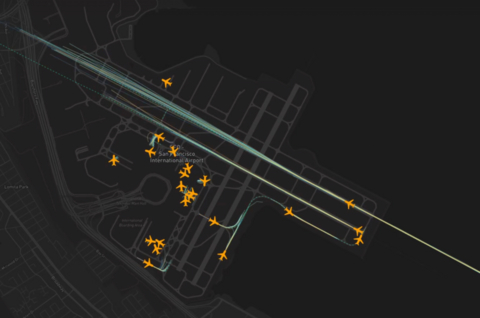
Image depicts airport surface trajectories prediction by Archer’s ZEE
Controllers and flight crews face the growing cognitive burden of coordinating over 44,000 daily flights across the National Airspace System. While most modernization efforts focus on airspace congestion, runway-related incidents account for
Archer's goal with ZEE is to move beyond passive data aggregation, establishing it as an active, highly accurate predictive layer for air traffic management around the world, creating a proactive, safer, more scalable foundation for the next era of aviation.
“ZEE provides a highly accurate ‘window into the future,’ transforming raw observations from a myriad of inputs into predictive context, helping to identify path anomalies and cross-route conflicts before they develop into safety risks. We believe ZEE can give the humans in the loop the most critical asset in aviation: time to react,” said Mario Srouji, VP of AI Products at Archer.
Prediction models struggle with the fluid, branching choices an aircraft can make on the ground. To solve this, ZEE was purpose-built by Archer’s leading AI team using a state-of-the-art generative framework called “conditional flow matching” to model the full distribution of possible futures rather than a single rigid path. This capability is paired with a vision transformer trained on high-resolution satellite imagery, enabling ZEE to "see" native map features like runways, taxiways, and aprons, grounding its spatial calculations and predictions in real-world physical data.
Archer has already begun testing this technology at Hawthorne Airport, which Archer acquired control of late last year. Early results measured against real-world tracking data have been strong, and larger-scale testing is now underway.
To safely transition this technology into the aviation ecosystem, Archer will work with government agencies to build the rigorous empirical foundation needed to further demonstrate ZEE’s effectiveness as a predictive safety net supporting human controllers and pilots across the globe.
About Archer
Archer builds the aircraft and core technologies that will define the next era of flight for aerospace and defense.
Source: Archer
Text: ArcherIR
Forward-Looking Statements and Disclaimers
This press release contains forward-looking statements regarding Archer’s future business plans, expectations, and opportunities. These statements include those regarding design, target specifications and use cases of its technologies; timing of Archer’s development and commercialization of its technologies; development of its planned lines of business and opportunities; and anticipated benefits of collaborations with third parties. Forward-looking statements are only predictions and may differ materially from actual results due to a variety of factors. The risks and uncertainties that could cause actual results to differ from the results predicted are more fully detailed in Archer’s filings made with the Securities and Exchange Commission from time to time, available at investors.archer.com and at www.sec.gov. Any forward-looking statements contained herein are based on assumptions that Archer believes to be reasonable as of the date of this press release. Archer undertakes no obligation to update these statements as a result of new information or future events.
View source version on businesswire.com: https://www.businesswire.com/news/home/20260805523533/en/
Archer Media Contacts: Archer@TheBrandAmp.com
Source: Archer Aviation