
Actuate Therapeutics Presents Topline Elraglusib Phase 2 Data at ASCO 2025 Annual Meeting: Trial Meets Primary Endpoint of Median Overall Survival and Doubles 1-Year Survival in First-Line Treatment of Metastatic Pancreatic Cancer
Actuate Therapeutics (NASDAQ: ACTU) announced positive Phase 2 trial results for elraglusib in treating metastatic pancreatic cancer, presented at ASCO 2025.
Rhea-AI Summary
Positive
- Significant improvement in median overall survival (10.1 vs 7.2 months, p=0.01)
- 37% reduction in risk of death (HR=0.63)
- Doubled 1-year survival rate (44.1% vs 22.3%)
- Higher overall response rate (29.0% vs 21.8%)
- Favorable safety profile with mostly Grade 1-2 adverse events
- Biomarker data confirms immune-modulating mechanism of action
Negative
- Most common adverse events include transient visual impairments in about two-thirds of patients
- Grade 3 or higher neutropenia was observed in treatment group
Details
News Market Reaction – ACTU
In the trading session that priced this news, ACTU declined 11.01%, reflecting a significant negative market reaction.
Data tracked by StockTitan Argus on the day of publication.
AI-generated analysis. How Rhea-AI works. Not financial advice.




- Phase 2 (Actuate-1801 Part 3B) trial meets primary endpoint and demonstrates a clinically meaningful increase in median overall survival (10.1 months vs 7.2 months; log-rank p=0.01) in previously untreated patients with metastatic pancreatic ductal adenocarcinoma (mPDAC) receiving elraglusib/GnP
- Risk of death was reduced by
37% (HR=0.63) in patients treated with elraglusib/GnP - Data featured as an oral presentation at the ASCO Annual Meeting
- Company plans to engage with FDA in the second half of 2025 to align on a path towards product registration
- Company to host KOL event today at 6:30 pm CDT to discuss 1801 Part 3B results
CHICAGO and FORT WORTH, Texas, May 31, 2025 (GLOBE NEWSWIRE) -- Actuate Therapeutics, Inc. (NASDAQ: ACTU) (“Actuate” or the “Company”), a clinical-stage biopharmaceutical company focused on developing therapies for the treatment of high-impact, difficult-to-treat cancers through the inhibition of glycogen synthase kinase-3 beta (GSK-3β), today presented topline results from the Phase 2 (Actuate-1801 Part 3B) trial of elraglusib in combination with gemcitabine/nab-paclitaxel (GnP) in previously untreated patients with metastatic pancreatic ductal adenocarcinoma (mPDAC) at the American Society of Clinical Oncology (ASCO) Annual Meeting.
Abstract Title: Preliminary results from the randomized phase 2 study (1801 Part 3B) of elraglusib in combination with gemcitabine/nab-paclitaxel (GnP) versus GnP alone in patients with previously untreated metastatic pancreatic ductal adenocarcinoma (mPDAC).
Abstract Number: 4006
Session Title: Gastrointestinal Cancer—Gastroesophageal, Pancreatic, and Hepatobiliary
Presenter: Devalingam Mahalingam, MD, PhD
Oral Presentation Date and Time: Saturday, May 31, 2025, 4:48 PM CDT
The trial met its primary endpoint of improved median overall survival. Median overall survival (mOS) increased by almost three months (10.1 months vs 7.2 months, HR=0.63, log-rank p=0.01) with a
Dr. Deva Mahalingam, MD, PhD, Northwestern University Feinberg School of Medicine, and lead principal investigator of the 1801 Part 3B trial commented, “Pancreatic cancer continues to represent one of the highest unmet medical needs with no major treatment advances in recent years, bar some molecular targets in small subsets of patients. New mechanisms of action are urgently needed. The addition of elraglusib to the existing chemotherapy backbone of gemcitabine and nab-paclitaxel is promising and may represent a meaningful therapeutic advance for patients with pancreatic cancer.”
Daniel Schmitt, President & Chief Executive Officer of Actuate added, “We significantly improved mOS, cut the risk of death by
Efficacy
- Figure 1 below depicts the Kaplan-Meier estimate for mOS (10.1 months vs 7.2 months, HR=0.63, log-rank p=0.01) with a
37% reduction in the risk of death, displaying a clear clinical survival benefit for patients treated in the elraglusib/GnP combination arm vs GnP alone arm.
Figure 1: Actuate-1801 Part 3B: Kaplan-Meier Estimate for mOS as of March 27, 2025 (Topline data cut-off).
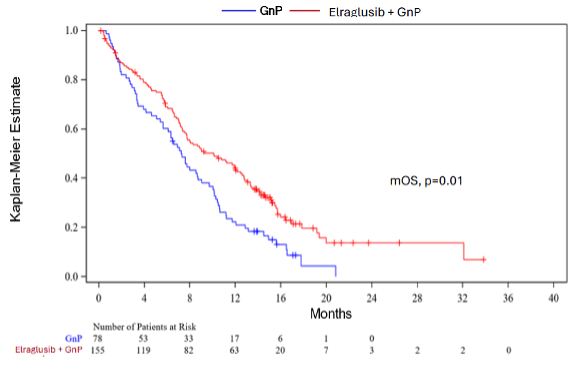
- In addition to the improved mOS and one-year survival rate, a continued survival benefit was also observed at eighteen and twenty-four months (survival rates of
19.7% vs4.4% and13.8% vs0% in the elraglusib/GnP combination arm vs the GnP arm, respectively). - The elraglusib/GnP combination treatment also resulted in numerically improved overall response rates (
29.0% in the elraglusib/GnP combination arm vs21.8% in the GnP arm) and improvements in median progression-free survival and median duration of response of 5.6 months vs 5.1 months, and 5.5 months vs 4.0 months in the elraglusib/GnP combination arms vs GnP arms, respectively.
Safety and Biomarker Findings
- The trial also met its primary safety endpoint. Treatment-emergent adverse events (TEAEs) and Serious Adverse Events (SAEs) in the elraglusib/GnP combination arm were similar to those observed in the GnP arm, indicating a favorable risk-benefit profile for the elraglusib/GnP combination.
- Treatment-related adverse events (TRAEs) were mostly Grade 1-2, with the most frequent TRAEs observed (in about two-thirds of patients) being transient visual impairments that were reversible and non-progressive
- While Grade 3 or higher neutropenia was observed, similar rates of febrile neutropenia and sepsis were observed in both treatment arms.
- Pre-dose cytokine analysis that suggested lower baseline levels of key immune modulators, including CCL3, IL-1α, IL-18, TGF-β, and TRAIL R3, were correlated with improved 1-year survival.
- Increased CD8-positive and granzyme B-positive T cells, increased NK cells, and decreased myeloid-derived suppressor cells were observed in tumor biopsies only from elraglusib-treated patients. This exploratory result confirms elraglusib proposed immune modulating mechanism of action in patients with mPDAC.
KOL Event
Actuate will host a KOL event for the investment community today, May 31, 2025, at 6:30 PM CDT to review the data. The webinar will feature a fireside discussion moderated by Daniel Schmitt, President & Chief Executive Officer of Actuate, and will include four distinguished KOLs: Tanios Bekaii-Saab, MD, FACP, Mayo Clinic College of Medicine and Science; Devalingam Mahalingam, MD, Northwestern University Feinberg School of Medicine; Rachna Shroff, MD, MS, FASCO, University of Arizona Cancer Center; and Colin Weekes, MD, PhD, Massachusetts General Hospital.
Event Details:
| Date and Time: | Saturday, May 31, 2025, at 6:30 pm CDT |
| Format: | In-person and via live webcast |
| Registration: | Click here |
A replay of the event will be available on the Investor Relations section of the Actuate website.
About Actuate-1801 Part 3B Study
The Actuate-1801 Part 3B study (NCT03678883) is a randomized, controlled Phase 2 trial of elraglusib with GnP versus GnP alone in first-line mPDAC. The trial enrolled 286 mPDAC patients with no prior systemic treatment for metastatic disease, who were randomized 2:1 to the elraglusib treatment arm (elraglusib + GnP) or the control arm (GnP alone). Elraglusib is administered at a dose of 9.3 mg/kg by IV infusion on Day 1 of each week of a 28-day cycle. The primary endpoint for this study is median overall survival, with OS summarized throughout the study by estimates of 1-year survival. Secondary endpoints are DCR, ORR, PFS, and AE.
Inhibition of GSK-3β may inhibit tumor growth and improve survival through several complimentary mechanisms that include enhancement of chemotherapy activity, activation of innate anti-tumor immunity, and regulation of gene expression, leading to alterations in tumor metabolism and Epithelial-to-Mesenchymal Transition (EMT).
About Actuate Therapeutics, Inc.
Actuate is a clinical-stage biopharmaceutical company focused on developing therapies for the treatment of high-impact, difficult-to-treat cancers. Actuate’s lead investigational drug, elraglusib (a novel GSK-3β inhibitor), targets molecular pathways in cancer that are involved in promoting tumor growth and resistance to conventional cancer drugs such as chemotherapy through the inhibition of nuclear factor kappa-light-chain-enhancer of activated B cells (NF-kB) and DNA Damage Response (DDR). Elraglusib may also mediate anti-tumor immunity through the regulation of multiple immune checkpoints and immune cell function. For additional information, please visit the Company’s website at http://www.actuatetherapeutics.com.
Forward-Looking Statements
This press release contains forward-looking statements about us, including our and other parties’ clinical trials and development plans, and our industry. The words “anticipate,” “believe,” “continue,” “could,” “estimate,” “expect,” “intend,” “may,” “might,” “ongoing,” “plan,” “potential,” “predict,” “project,” “should,” “target,” “will,” “would,” or the negative of these terms or other comparable terminology are intended to identify forward-looking statements, although not all forward-looking statements contain these identifying words. All statements, other than statements related to present facts or current conditions or of historical facts, contained in this press release are forward-looking statements. Accordingly, these statements involve estimates, assumptions, substantial risks and uncertainties which could cause actual results to differ materially from those expressed in them, including but not limited to that preliminary and unpublished data may be subject to change and further interpretation following the availability of more data or following a more comprehensive review of the data and should not be relied upon as a final analysis; the risk that clinical trial data are subject to differing interpretations and assessments by regulatory authorities and within the medical community; clinical and preclinical drug development involves a lengthy and expensive process with uncertain timelines and outcomes, results of prior preclinical studies and early clinical trials are not necessarily predictive of future results, and elraglusib may not achieve positive clinical results or favorable preclinical results, and we may not be able to make regulatory submissions or receive regulatory approval on a timely basis, if at all; that we may not successfully enroll additional patients or establish or advance plans for further development, including through conversations with the FDA or EMA and the standards such bodies may impose for such development; that elraglusib could be associated with side effects, adverse events or other properties or safety risks, which could delay or preclude regulatory approval, cause us to suspend or discontinue clinical trials or result in other negative consequences; our reliance on third parties to conduct our non-clinical studies and our clinical trials; our reliance on third-party licensors and ability to preserve and protect our intellectual property rights; that we face significant competition from other biotechnology and pharmaceutical companies; our ability to fund development activities, including because our financial condition raises substantial doubt as to our ability to continue as a going concern and we require additional capital to finance our operations beyond the second quarter of fiscal year 2025, and a failure to obtain this necessary capital in the near term on acceptable terms, or at all, could force us to delay, limit, reduce or terminate our development programs, commercialization efforts or other operations. In addition, any forward-looking statements are qualified in their entirety by reference to the factors discussed under the heading “Item 1A. Risk Factors” in our Annual Report on Form 10-K for the year ended December 31, 2024, filed with the SEC on March 13, 2025, our Quarterly Report on Form 10-Q for the quarter ended March 31, 2025, filed with the SEC on May 15, 2025, and other filings with the SEC. Because the risk factors referred to above could cause actual results or outcomes to differ materially from those expressed in any forward-looking statements made by us or on our behalf, you should not place undue reliance on any forward-looking statements. Further, any forward-looking statement speaks only as of the date on which it is made. New factors emerge from time to time, and it is not possible for us to predict which factors will arise. In addition, we cannot assess the impact of each factor on our business or the extent to which any factor, or combination of factors, may cause actual results to differ materially from those contained in any forward-looking statements. Unless legally required, we do not undertake any obligation to release publicly any revisions to such forward-looking statements to reflect events or circumstances after the date of this press release or to reflect the occurrence of unanticipated events.
Investor Contact
Mike Moyer
Managing Director
LifeSci Advisors, LLC
mmoyer@lifesciadvisors.com
A photo accompanying this announcement is available at https://www.globenewswire.com/NewsRoom/AttachmentNg/ec493cba-bb28-4bc9-adae-263985865ae6

FAQ
AI-generated questions and answers. How Rhea-AI works. Not financial advice.