
Aduro Clean Technologies to Present Hydrochemolytic™ Technology for Polyolefin Recycling at Chemical Recycling Europe Annual Conference 2026
Aduro links recent Hydrochemolytic™ pilot results and FOAK plant engineering work to a conference presentation on scaling polyolefin chemical recycling in Europe.
Sentiment and the balance of points
Rhea-AI Sentiment reads the wording of the document, how positive or negative its language is on a 1 to 5 scale. The balance of points shown with the takes weighs what the document actually discloses, so the two can disagree, for example when a trial that missed its main goal is described in upbeat language.
Rhea-AI Summary
Aduro Clean Technologies (ADUR) will present its Hydrochemolytic™ Technology for polyolefin recycling at the Chemical Recycling Europe Annual Conference 2026 in Brussels on September 30, 2026.
Chief Revenue Officer Eric Appelman will outline the evolution of Hydrochemolytic™ Technology (HCT) from pilot-scale validation through the Next Generation Process Pilot Plant toward the planned First-of-a-Kind Plant at Chemelot. HCT is being developed to convert difficult-to-recycle polyolefins into circular hydrocarbon products, supported by seven issued patents and four pending applications. Aduro recently reported about 86% liquid hydrocarbon recovery in steady-state polypropylene runs and selected Saipem S.p.A. for Early Works engineering and procurement to support the FOAK plant design.
Positive
- HCT pilot performance: ~86% liquid hydrocarbon recovery from waste-derived polypropylene in steady-state operation (June 2026)
- Intellectual property: seven issued patents and four pending applications support Hydrochemolytic™ Technology
- Scale-up progress: Saipem S.p.A. engaged for Early Works engineering and procurement for the planned FOAK plant at Chemelot
- Downstream validation: HCT-derived liquid from mixed waste plastics showed stable steam-cracking operation with olefin yields comparable to conventional feedstocks
Negative
- None.
Details
News Market Reaction – ADUR
On Sep 8, the day this news came out, ADUR closed 1.03% below the previous close.
Data tracked by StockTitan Argus for the Sep 8 session.
Key Terms
polyolefins technical
mass-balance accounting regulatory
steam-cracking technical
hydrotreatment technical
AI-generated analysis. How Rhea-AI works. Not financial advice.




Chief Revenue Officer Eric Appelman to present in Brussels on September 30, 2026, discussing the advancement of Aduro’s Hydrochemolytic™ Technology from pilot operations to the planned industrial scale deployment, as Europe prepares for its 2030 circularity targets
LONDON, Ontario, Sept. 08, 2026 (GLOBE NEWSWIRE) -- Aduro Clean Technologies Inc. (“Aduro” or the “Company”) (Nasdaq: ADUR) (TSX: ACT) (FSE: 9D5), a clean technology company using the power of chemistry to transform lower-value feedstocks, like waste plastics, heavy bitumen, and renewable oils, into resources for the 21st century, today announced that Eric Appelman, Chief Revenue Officer, will present at the Chemical Recycling Europe (“CRE”) Annual Conference 2026, taking place September 29–30, 2026 in Brussels, Belgium.
Appelman will participate in Session III – CRE Members: Progress & FIDs, presenting “Hydrochemolytic™ Technology, an attractive path to polyolefin recycling.” The presentation will discuss Aduro’s perspective and approach to the chemical recycling of polyolefins and the evolution of Hydrochemolytic™ Technology (“HCT”) from pilot-scale validation toward industrial deployment. HCT is being developed to convert difficult-to-recycle polyolefins into circular hydrocarbon products, with demonstrated tolerance for contaminants and product characteristics aligned with downstream petrochemical requirements. The technology is supported by a portfolio of seven issued patents and four pending applications. Appelman will also discuss process performance and the progression from the Next Generation Process (“NGP”) Pilot Plant to the planned First-of-a-Kind (“FOAK”) Plant at Chemelot.
The conference comes as Europe continues to move from setting circularity targets to defining the practical frameworks required to achieve them. The Packaging and Packaging Waste Regulation (“PPWR”) establishes recycled-content requirements for plastic packaging beginning in 2030, while recently adopted European Commission rules under the Single-Use Plastics Directive establish mass-balance accounting for chemically recycled content in single-use PET beverage bottles. Together with certification, product-quality requirements and market demand, these frameworks are becoming increasingly relevant to investment decisions around new recycling capacity and the integration of circular feedstocks into established petrochemical value chains.
Aduro’s participation in the conference comes as the Company continues to advance HCT for waste-plastic chemical recycling from pilot-scale operation toward industrial deployment through its NGP Pilot Plant and FOAK Program at Chemelot Industrial Park in Sittard-Geleen, the Netherlands. In June 2026, the Company reported liquid hydrocarbon recovery of approximately
The scale-up pathway also builds on downstream validation completed in 2025, when an HCT-derived liquid produced from mixed waste plastics was processed in pilot-scale steam-cracking trials in Europe as produced, without dilution or hydrotreatment. The trials demonstrated stable furnace operation and olefin yields comparable to conventional liquid feedstocks, supporting the potential integration of HCT-derived liquids into existing petrochemical infrastructure.
“The challenge facing our industry is no longer simply demonstrating that plastic can be chemically recycled,” said Eric Appelman, Chief Revenue Officer at Aduro. “The next phase is understanding the global plastics value chain, its constraints, and regulatory requirements, while demonstrating how HCT can be configured to integrate into existing petrochemical infrastructure at industrial scale. At CRE, I look forward to sharing Aduro’s approach to polyolefin recycling, what we are learning through the NGP Pilot Plant, and how that work is informing our progression toward the planned FOAK Plant at Chemelot.”
Aduro joined Chemical Recycling Europe in March 2026, expanding participation in European industry discussions related to chemical recycling, including regulatory frameworks, certification systems, mass-balance accounting, and policy development. These areas are directly relevant to the planned FOAK Facility at Chemelot and the potential deployment of HCT-derived circular feedstocks within European plastics value chains.
The CRE Annual Conference 2026 opens with a networking dinner on September 29, 2026, followed by the main conference programme on September 30, 2026, in Brussels. Sessions will address the regulatory framework for chemical recycling, demand for circular materials, progress by CRE members and the upgrading challenge in plastics recycling. Industry participants and other interested stakeholders are invited to attend and join the discussion on Europe’s path toward its 2030 circularity targets. Registration and further programme information are available through Chemical Recycling Europe at https://www.chemicalrecyclingeurope.eu.
About Aduro Clean Technologies
Aduro Clean Technologies is a developer of patented water-based technologies to chemically recycle waste plastics; convert heavy crude and bitumen into lighter, more valuable oil; and transform renewable oils into higher-value fuels or renewable chemicals. The Company’s Hydrochemolytic™ technology relies on water as a critical agent in a chemistry platform that operates at relatively low temperatures and cost, a game-changing approach that converts low-value feedstocks into resources for the 21st century. For more information, visit https://www.adurocleantech.com
For further information, please contact:
Abe Dyck
Head of Corporate Development / Investor Relations
ir@adurocleantech.com
+1 226 784 8889
Forward-Looking Statements
This news release contains “forward-looking information” within the meaning of applicable Canadian securities laws and “forward-looking statements” within the meaning of applicable U.S. securities laws, including the U.S. Private Securities Litigation Reform Act of 1995.
Forward-looking information in this news release includes, but is not limited to, statements regarding Eric Appelman’s anticipated participation in the Chemical Recycling Europe Annual Conference 2026 and the topics expected to be addressed in his presentation; the continued advancement of Hydrochemolytic™ Technology from pilot operations toward industrial deployment; the use of NGP Pilot Plant operating data to inform the Company’s FOAK Program at Chemelot; the potential integration of HCT-derived products into existing petrochemical value chains; and the potential relevance of European regulatory, certification, recycled-content, and mass-balance frameworks to the development and deployment of circular plastics solutions.
Forward-looking information is based on management’s current expectations, estimates, projections, and assumptions, and is subject to known and unknown risks, uncertainties, and other factors that may cause actual results, performance, or achievements to differ materially from those expressed or implied. These risks include, but are not limited to, changes to conference programming; technology development and scale-up risks; delays in advancing the FOAK Program; changes in regulatory, certification, or market frameworks; market acceptance of HCT-derived products; availability of capital; and other risks described in the Company’s public disclosure filings available on SEDAR+ at www.sedarplus.ca and with the U.S. Securities and Exchange Commission at www.sec.gov.
Readers are cautioned not to place undue reliance on forward-looking information, which speaks only as of the date of this news release. Except as required by applicable law, Aduro undertakes no obligation to update or revise any forward-looking information.
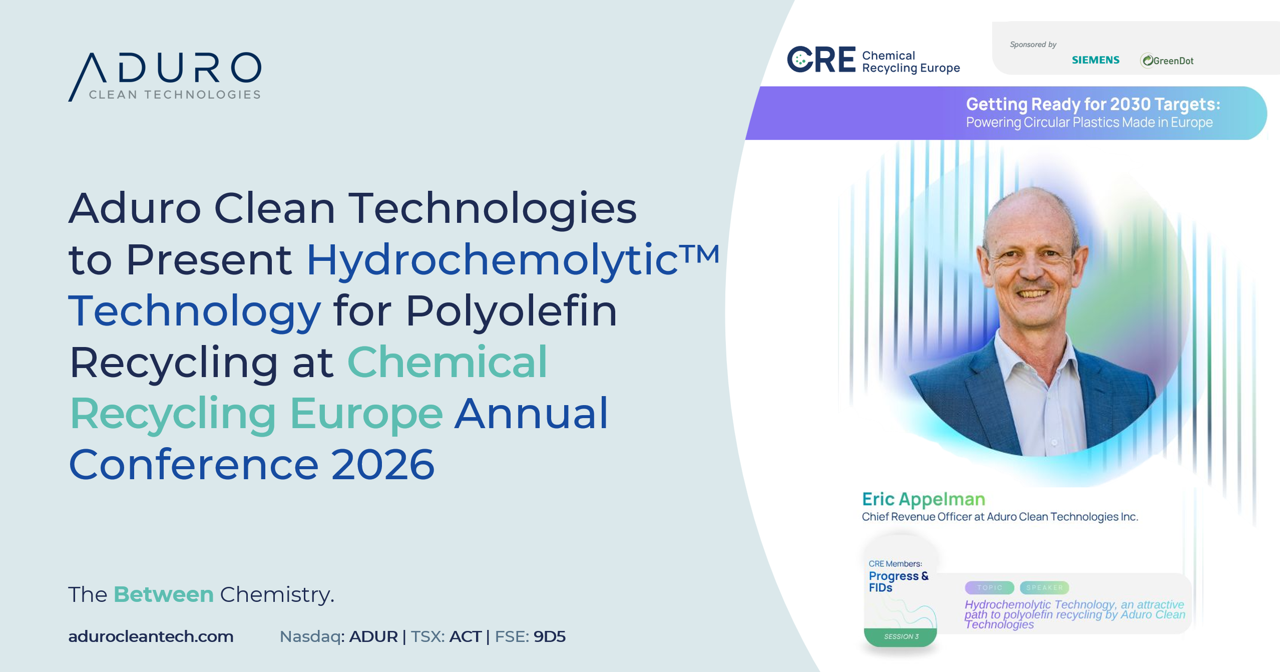
A photo accompanying this announcement is available at:
https://www.globenewswire.com/NewsRoom/AttachmentNg/bca4e58c-9d45-453a-9b83-e3fe4e05c329

FAQ
AI-generated questions and answers. How Rhea-AI works. Not financial advice.
When and where will Aduro present at the Chemical Recycling Europe Annual Conference 2026?
Eric Appelman, Chief Revenue Officer at Aduro, is scheduled to present during Session III – CRE Members: Progress & FIDs on September 30, 2026, at the Chemical Recycling Europe Annual Conference in Brussels, Belgium. The conference runs September 29–30, 2026, with a networking dinner on September 29 followed by the main programme on September 30.
What aspects of Hydrochemolytic™ Technology will be highlighted in Aduro’s conference presentation?
The presentation, titled “Hydrochemolytic™ Technology, an attractive path to polyolefin recycling,” will cover Aduro’s perspective on chemical recycling of polyolefins, HCT’s evolution from pilot-scale validation toward industrial deployment, process performance at the NGP Pilot Plant, and how this experience informs the design and planning of the First-of-a-Kind plant at Chemelot.
How is Hydrochemolytic™ Technology intended to fit into existing petrochemical infrastructure?
HCT is being developed to convert difficult-to-recycle polyolefins into circular hydrocarbon products with tolerance for contaminants and product characteristics aligned with downstream petrochemical requirements. Pilot-scale steam-cracking trials in Europe processed an HCT-derived liquid from mixed waste plastics as produced, without dilution or hydrotreatment, demonstrating stable furnace operation and olefin yields comparable to conventional liquid feedstocks.
What European regulatory developments are relevant to Aduro’s HCT and planned FOAK facility?
The Packaging and Packaging Waste Regulation sets recycled-content requirements for plastic packaging starting in 2030, and rules under the Single-Use Plastics Directive establish mass-balance accounting for chemically recycled content in single-use PET beverage bottles. Together with certification, product-quality requirements and demand for circular materials, these frameworks are described as increasingly relevant to investments in new recycling capacity and deployment of HCT-derived circular feedstocks.
How can interested stakeholders learn more or participate in the Chemical Recycling Europe Annual Conference 2026?
Industry participants and other stakeholders are invited to attend the CRE Annual Conference 2026 in Brussels. Registration details and the programme are available through Chemical Recycling Europe at https://www.chemicalrecyclingeurope.eu.