
Abitibi Metals Intersects 3.72% CuEq over 9.2 m Within a Broader 1.25% CuEq over 60.2 m at the B26 Deposit
New B26 drill results show broad and locally very high-grade CuEq intercepts, extending mineralization and supporting a future resource update.
Rhea-AI Summary
Abitibi Metals (AMQFF) reported high-grade copper-equivalent intercepts from ongoing drilling at the B26 polymetallic deposit in Québec, highlighting both near-surface and deep Western Down-Plunge (“WDP”) mineralization.
Hole 1274-25-366-W1 returned 1.25% CuEq over 60.2 m, including 2.45% CuEq over 18.8 m and a higher-grade core of 3.72% CuEq over 9.2 m, among the strongest intercepts of the 2026 program. In the WDP zone, hole 1274-26-378W2 intersected 1.45% CuEq over 14.1 m, including 2.21% CuEq over 5.9 m, while 1274-26-378W1A cut 0.66% CuEq over 40 m including 1.65% CuEq over 7.6 m. Wedge holes 1274-26-387-W1 and -W2 delivered high-grade silver-zinc and narrow copper-gold veins, including up to 9.54% CuEq over 0.5 m. These results extend mineralization eastward and down-plunge and will feed into a future B26 resource update.
Positive
- Hole 1274-25-366-W1: 1.25% CuEq over 60.2 m, including 3.72% CuEq over 9.2 m
- WDP hole 1274-26-378W2: 1.45% CuEq over 14.1 m, including 2.21% CuEq over 5.9 m
- WDP hole 1274-26-378W1A: 0.66% CuEq over 40.0 m, including 1.65% CuEq over 7.6 m
- High-grade veins in 1274-26-387-W2: up to 9.54% CuEq over 0.5 m and 4.32% CuEq over 1.8 m
- Deep continuity: hole 1274-24-342-W1 confirms mineralization to ~1,417 m depth
- Geological model strengthened: drilling increases confidence and supports additional WDP resource growth potential
Negative
- None.
AI-generated analysis. How Rhea-AI works. Not financial advice.




Toronto, Ontario--(Newsfile Corp. - September 17, 2026) - Abitibi Metals Corp. (CSE: AMQ) (OTCQB: AMQFF) (FSE: FW0) ("Abitibi" or the "Company") is pleased to report new wide copper-gold intercepts from ongoing drilling at the B26 Polymetallic Deposit ("B26" or the "Deposit") in Québec. Results continue to support strong grade continuity as the Company advances its resource-development program.
Highlights:
- High-Grade Copper-Gold Zone:
- Hole 1274-25-366-W1 returned
1.25% CuEq (1.08% Cu, 0.14 g/t Au, 5.04 g/t Ag, and0.03% Zn) over 60.2 m, including2.45% CuEq (2.24% Cu, 0.18 g/t Au, 6.88 g/t Ag, and0.02% Zn) over 18.8 m and3.72% CuEq (3.42% Cu, 0.26 g/t Au, 9.86 g/t Ag, and0.02% Zn) over 9.2 m. - Represents a wide, high-grade copper-gold intercept and ranks among the strongest results of the 2026 drill program at B26.
- Hole 1274-25-366-W1 returned
- Western Down-Plunge Zone continues to grow:
- Hole 1274-26-378W2 intersected
1.45% CuEq (1.36% Cu, 0.08 g/t Au, 2.58 g/t Ag, and0.02% Zn) over 14.1 m starting at 985.3 m depth, including a higher-grade interval of2.21% CuEq (2.09% Cu, 0.10 g/t Au, 3.57 g/t Ag, and0.02% Zn) over 5.9 m. - Hole 1274-26-378W1A intersected
0.66% CuEq (0.53% Cu, 0.11 g/t Au, 1.95 g/t Ag, and0.05% Zn) over 40 m starting at 966 m depth, including a higher-grade interval of1.65% CuEq (1.32% Cu, 0.34 g/t Au, 2.71 g/t Ag and0.02% Zn) over 7.6 m. - Hole 1274-26-387-W1 intersected
1.05% CuEq (0.0% Cu, 0.0 g/t Au, 69.9 g/t Ag, and1.7% Zn) over 11.1 m within a broader silver-zinc-rich0.62% CuEq (0.00% Cu, 0.01 g/t Au, 41.11 g/t Ag, and1.03% Zn) over 20.6 m and also intersected a separate0.68% CuEq (0.23% Cu, 0.50 g/t Au, 0.56 g/t Ag, and0.01% Zn) over 5.5 m gold-copper interval. - Hole 1274-26-387-W2 returned narrow high-grade copper-gold veins, including
9.54% CuEq over 0.5 m (2.33% Cu, 8.08 g/t Au, 2.90 g/t Ag, and0.01% Zn) and4.32% CuEq (2.84% Cu, 1.63 g/t Au, 3.4 g/t Ag, and0.0% Zn) over 1.8 m. - Drilling into the eastern extension of the Western Down-Plunge Zone "WDP" demonstrates further continuity of the high-grade plunge which could result in an increase in overall tonnage in future MRE's.
- Hole 1274-26-378W2 intersected
Jonathon Deluce, CEO of Abitibi Metals, commented: "B26 continues to demonstrate the qualities of a growing, high-grade deposit. Hole 366-W1 delivered one of the strongest intercepts drilled at the B26 Deposit to date, intersecting high-grade and broad mineralization grading
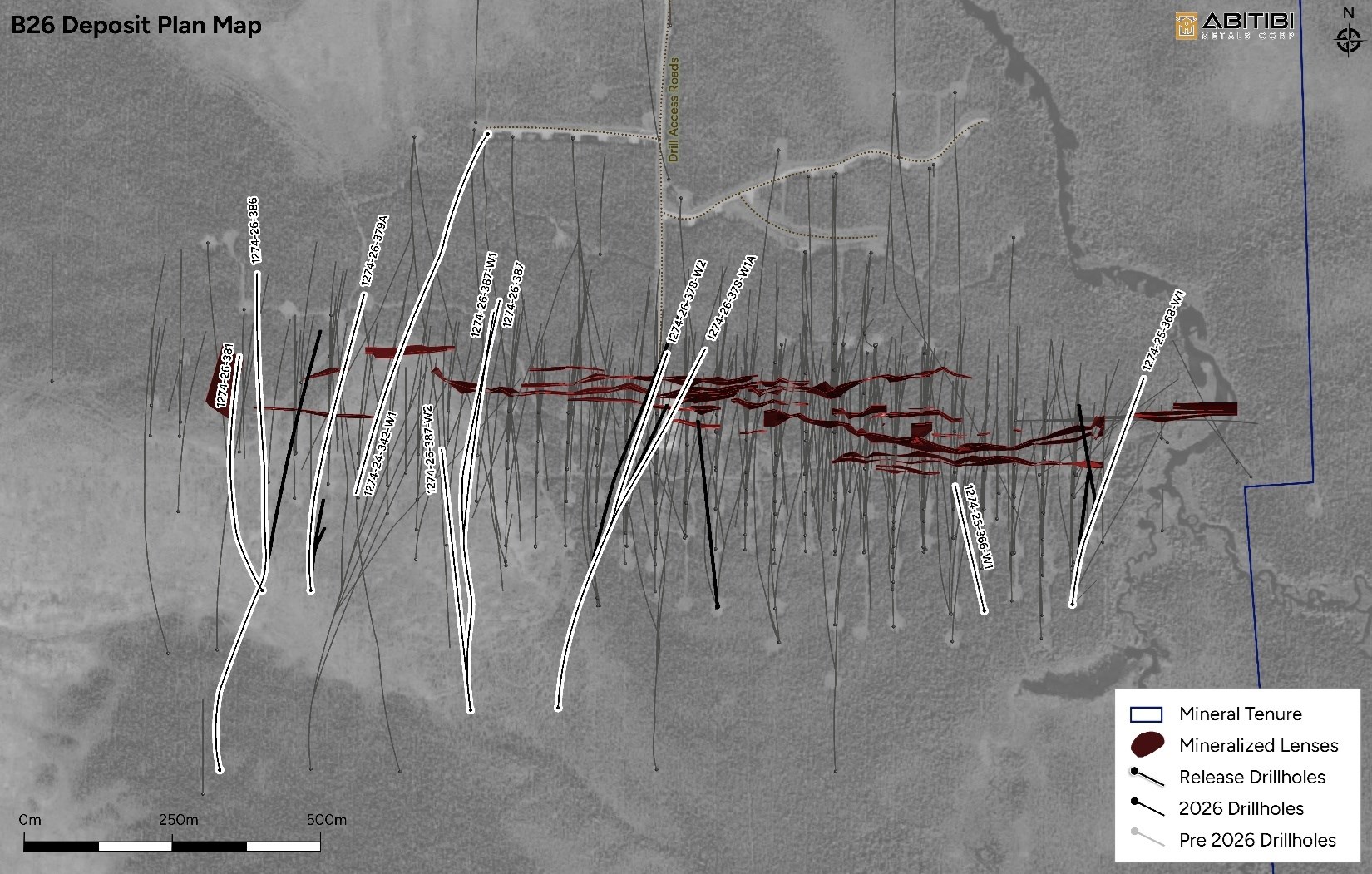
Figure 1: B26 drill traces in plan view
To view an enhanced version of this graphic, please visit:
https://images.newsfilecorp.com/files/11775/314710_29a764802438a956_001full.jpg
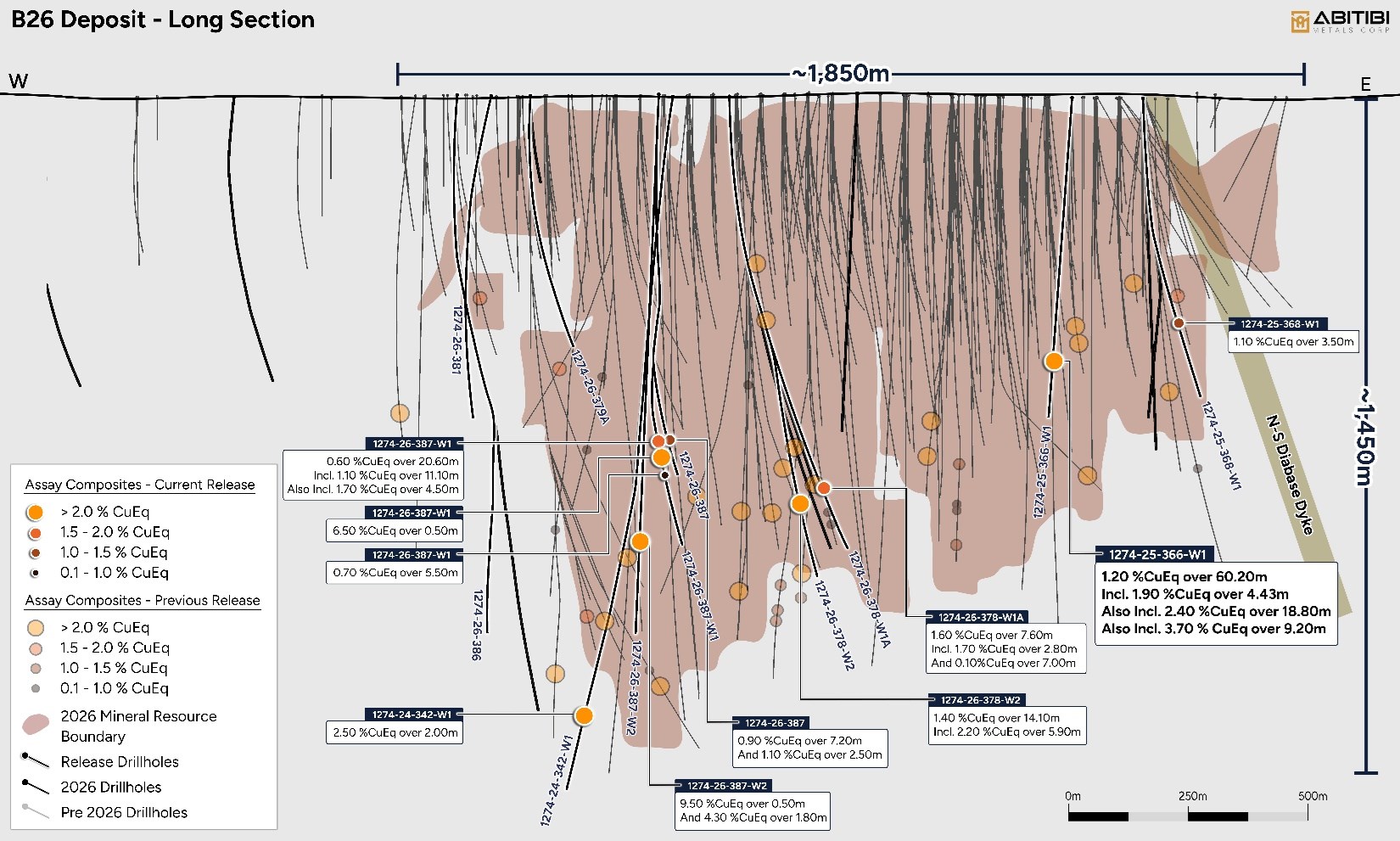
Figure 2: B26 Long section with results
To view an enhanced version of this graphic, please visit:
https://images.newsfilecorp.com/files/11775/314710_29a764802438a956_002full.jpg
Discussion of Results:
Near-Surface Expansion (0 - 400m) and Mid Level Expansion Drilling (400m - 800m):
Holes 1274-26-379A and 1274-26-381 targeted a lower-grade, under-drilled expansional target west of the deposit. Hole 1274-26-379A intersected
Hole 1274-25-366-W1 returned one of the strongest intercepts in the 2026 program to date. It targeted a zone on the eastern side of the deposit and delivered materially higher-grade results than anticipated, intersecting
Western Down Plunge (WDP) Extension and Step-Out Drilling (>800m):
Western Extension - Hole 1274-26-386 tested the upper western extension of the WDP and intersected the characteristic B26-style alteration signature together with narrow copper mineralization (7.0 m of
Eastern and Deep Step-Out Drilling - Holes 1274-25-368-W1 and 1274-24-342-W1
Two step-out holes tested the margins of the deposit. Hole 1274-25-368-W1, drilled in the eastern part of the deposit, intersected mineralization that extends the known system eastward, and hole 1274-24-342-W1 confirmed the down-dip continuity of the mineralized system at approximately 1,417 m depth. Full assay details for both holes are provided in Table 1.
Overall, these results continue to strengthen the geological model of the B26 Deposit by increasing resource confidence within the WDP while supporting additional resource growth potential along this priority expansion corridor.
Western Down Plunge (WDP) Extension and Definition
Drill holes 1274-26-378W2 and 1274-26-378W1A successfully intersected and expanded the WDP with more follow up drilling now being planned for additional extensions to this zone.
Drill hole 1274-26-378W1A is the continuation and extension of 1274-26-378W1, that was terminated due to technical reasons .It successfully extended the mineralized footprint of the WDP as planned,
Hole 1274-26-378W2 targeted an area of approximately 130 m by 320 m and intersected high-grade narrow mineralization in the targeted areas adding continuity to the mineralized footprint.
Hole 1274-26-387 targeted an under-drilled area of about 210 m by 215 m at the upper limit of the WDP. The hole intersected economically significant mineralization that helps link higher-grade areas in the resource. Additional follow-up holes are being planned.
Western Down-Plunge Wedge Drilling
Wedge holes 1274-26-387-W1 and 1274-26-387-W2 were drilled from parent hole 1274-26-387 to further explore the down-plunge extension of the WDP. Hole 1274-26-387-W1 intersected high-grade Ag/Zn mineralization of 41.1 g/t Ag and
Hole 1274-26-387-W2 intersected a narrow, high-grade copper-gold zone including
Table 1: Significant Intercepts from recent drilling
| Drill hole ID | From (m) | To (m) | Core Length (m) | Est true width (m) | CuEq % 2026 | Cu (%) | Au (g/t) | Ag (g/t) | Zn (%) | CuEq % Spot |
| 1274-24-342-W1 | 1404.5 | 1406.5 | 2.0 | 1.2 | 2.5 | 2.5 | 0.1 | 2.7 | 0.0 | 2.6 |
| 1274-25-366-W1 | 548.8 | 609.0 | 60.2 | 52.1 | 1.2 | 1.1 | 0.1 | 5.0 | 0.0 | 1.3 |
| Including | 548.8 | 574.0 | 25.2 | 21.8 | 0.9 | 0.7 | 0.2 | 5.8 | 0.1 | 1.0 |
| Including | 562.0 | 566.4 | 4.4 | 3.8 | 1.9 | 1.6 | 0.3 | 9.0 | 0.1 | 2.0 |
| Including | 580.4 | 599.2 | 18.8 | 16.3 | 2.4 | 2.2 | 0.2 | 6.9 | 0.0 | 2.5 |
| Including | 590.0 | 599.2 | 9.2 | 8.0 | 3.7 | 3.4 | 0.3 | 9.9 | 0.0 | 3.9 |
| 1274-25-368-W1 | 549.0 | 552.5 | 3.5 | 2.7 | 1.1 | 0.6 | 0.5 | 5.5 | 0.1 | 1.2 |
| 1274-26-378-W1A | 966.0 | 1006.0 | 40.0 | 30.6 | 0.7 | 0.5 | 0.1 | 1.9 | 0.0 | 0.7 |
| Including | 970.2 | 977.8 | 7.6 | 5.8 | 1.6 | 1.3 | 0.3 | 2.7 | 0.0 | 1.7 |
| Including | 975.0 | 977.8 | 2.8 | 2.1 | 1.7 | 1.2 | 0.5 | 3.0 | 0.0 | 1.8 |
| Including | 982.0 | 989.0 | 7.0 | 5.4 | 1.0 | 0.8 | 0.1 | 2.5 | 0.2 | 1.0 |
| 1274-26-378-W2 | 985.3 | 999.4 | 14.1 | 10.0 | 1.4 | 1.4 | 0.1 | 2.6 | 0.0 | 1.5 |
| Including | 989.4 | 995.3 | 5.9 | 4.2 | 2.2 | 2.1 | 0.1 | 3.6 | 0.0 | 2.3 |
| 1274-26-379A | 641.7 | 645.0 | 3.3 | 3.0 | 0.5 | 0.2 | 0.3 | 0.7 | 0.0 | 0.6 |
| 1274-26-381 | 633.5 | 635.5 | 2.0 | 1.5 | 1.1 | 0.0 | 0.0 | 7.7 | 3.0 | 0.9 |
| 1274-26-386 | 1234.0 | 1241.0 | 7.0 | 6.1 | 0.3 | 0.3 | 0.0 | 2.7 | 0.0 | 0.3 |
| 1274-26-387 | 921.2 | 928.3 | 7.2 | 6.7 | 0.9 | 0.2 | 0.7 | 0.6 | 0.0 | 1.0 |
| And | 932.4 | 934.9 | 2.5 | 2.3 | 1.1 | 0.9 | 0.2 | 1.4 | 0.0 | 1.2 |
| 1274-26-387-W1 | 859.9 | 880.5 | 20.6 | 17.8 | 0.6 | 0.0 | 0.0 | 41.1 | 1.0 | 0.9 |
| Including | 863.5 | 874.6 | 11.1 | 9.6 | 1.1 | 0.0 | 0.0 | 69.9 | 1.7 | 1.5 |
| Including | 863.5 | 868.0 | 4.5 | 3.9 | 1.7 | 0.0 | 0.0 | 111.7 | 3.0 | 2.4 |
| And | 913.2 | 913.7 | 0.5 | 0.4 | 6.5 | 0.1 | 0.1 | 19.4 | 19.2 | 5.4 |
| And | 962.0 | 967.5 | 5.5 | 4.8 | 0.7 | 0.2 | 0.5 | 0.6 | 0.0 | 0.8 |
| 1274-26-387-W2 | 990.6 | 991.1 | 0.5 | 0.3 | 9.5 | 2.3 | 8.1 | 2.9 | 0.0 | 11.3 |
| And | 998.4 | 1000.2 | 1.8 | 1.2 | 4.3 | 2.8 | 1.6 | 3.4 | 0.0 | 4.7 |
Note 1: The intercepts above are not necessarily representative of the true width of mineralization. The local interpretation indicates that the mineralized lens' true width generally corresponds to
Note 2: Copper equivalent values calculated using metal prices of
Note 3: Intervals are generally composited starting with a
Note 4: Spot copper equivalent values calculated using metal prices of
Table 2: Phase 3 Drill Hole Information
| Hole ID | UTM East | UTM North | Elevation | Azimuth | Dip | Start (m) | End (m) |
| 1274-24-342-W1 | 652368 | 5513881 | 272 | 215 | -75 | 0 | 1609 |
| 1274-25-366-W1 | 653200 | 5513081 | 269 | 347 | -72 | 348 | 721 |
| 1274-25-368-W1 | 653348 | 5513092 | 268 | 7 | -73 | 0 | 750 |
| 1274-26-378-W1A | 652486 | 5512919 | 272 | 2 | -66 | 378 | 1153 |
| 1274-26-378-W2 | 652486 | 5512919 | 272 | 2 | -66 | 600 | 1183 |
| 1274-26-379A | 652071 | 5513116 | 273 | 355 | -59 | 0 | 735 |
| 1274-26-381 | 651989 | 5513116 | 273 | 330 | -66 | 0 | 786 |
| 1274-26-386 | 651918 | 5512813 | 277 | 350 | -73 | 0 | 1435 |
| 1274-26-387 | 652339 | 5512915 | 276 | 354 | -69 | 0 | 1084 |
| 1274-26-387-W1 | 652339 | 5512915 | 276 | 354 | -69 | 624 | 1192 |
| 1274-26-387-W2 | 652339 | 5512915 | 276 | 354 | -69 | 480 | 1207 |
Note 1: Numbers have been rounded to the nearest whole number in the table above.
QAQC
The core logging and QAQC protocol program was run and supervised by the Company technical team. The drill core was split in half and sent to AGAT Laboratories Ltd. All sample preparation takes place in Val-d'Or, all fire assay takes place in Thunder Bay and all 4-Acid digestion and multi-element analysis takes place in Calgary. Prepared samples are fused using accepted fire assay techniques, cupelled and parted in nitric acid and hydrochloric acid. Sample splits of 30 g are routinely used, though 50 g may also be used (AGAT Code 202 551). 0.2g of prepared samples are digested with a series of acids (HClO4, HF, HCL and HNO3) at a temperature of ~200oC until incipient dryness. It is then heated with HNO3 and HCl, then diluted to 12 mL with de-ionized water. While very aggressive, the solubility of some elements can be dependent on the mineral species present and a s such, data reported from the 4-Acid digestion should be considered as representing only the leachable portion of a particular analyte. Some elements show poor recovery due to volatilization (B, As, Hg). PerkinElmer 7300DV/8300DV ICP-OES and Agilent 5900 ICP-OES instruments are used in the analysis. Inter-Element Correction (IEC) techniques are used to correct for any spectral interferences. Blanks, sample replicates, duplicates, and internal reference materials (both aqueous and geochemical standards) are routinely used as part of AGAT Laboratories quality assurance program. AAS instruments are used in the analysis.
Qualified Person
Information contained in this press release was reviewed and approved by Louis Gariépy, P.Eng. (OIQ #107538), VP Exploration of Abitibi Metals, who is a qualified person as defined under National Instrument 43-101, and responsible for the technical information provided in this news release.
About Abitibi Metals Corp:
Abitibi Metals Corp. is dedicated to acquiring and exploring mineral properties within Quebec, with a particular emphasis on high-quality base and precious metal assets that offer significant potential for growth and expansion.
The company's flagship B26 Polymetallic project hosts a substantial and growing resource base1:
- Indicated: 12.96Mt at
2.08% CuEq (1.19% Cu,1.16% Zn, 0.44 g/t Au and 30.8 g/t Ag)1 - Inferred: 12.34Mt at
2.20% CuEq (1.60% Cu,0.16% Zn, 0.68 g/t Au and 8.1 g/t Ag) 1
The B26 Project is strategically located just 7 km southeast of the formerly producing Selbaie Mine, providing access to key infrastructure for potential future mine development.
ON BEHALF OF THE BOARD
Jonathon Deluce, Chief Executive Officer
For more information, please call +1 226-271-5170, email info@abitibimetals.com, or visit https://www.abitibimetals.com.
The Company also maintains an active presence on various social media platforms to keep stakeholders and the general public informed and encourages shareholders and interested parties to follow and engage with the Company through the following channels to stay updated with the latest news, industry insights, and corporate announcements:
Twitter: https://twitter.com/AbitibiMetals
LinkedIn: https://www.linkedin.com/company/abitibi-metals-corp-amq-c/
Neither the Canadian Securities Exchange nor its Regulation Services Provider accepts responsibility for the adequacy or accuracy of this release.
Note 1: Technical Report NI 43-101 Resource Estimation Update Project B26, Quebec, For Abitibi Metals Corp., By SGS Canada Inc., Yann Camus, ing., Olivier Vadnais-Leblanc, géo., SGS Canada - Geostat., Effective Date: November 1, 2024, Date of Report: February 26, 2025
Forward-looking statement:
This news release contains certain statements, which may constitute "forward-looking information" within the meaning of applicable securities laws. Forward-looking information involves statements that are not based on historical information but rather relate to future operations, strategies, financial results or other developments on the B26 Project or otherwise. Forward-looking information is necessarily based upon estimates and assumptions, which are inherently subject to significant business, economic and competitive uncertainties and contingencies, many of which are beyond the Company's control and many of which, regarding future business decisions, are subject to change. These uncertainties and contingencies can affect actual results and could cause actual results to differ materially from those expressed in any forward-looking statements made by or on the Company's behalf. Although Abitibi has attempted to identify important factors that could cause actual actions, events or results to differ materially from those described in forward-looking information, there may be other factors that cause actions, events or results to differ from those anticipated, estimated or intended. All factors should be considered carefully, and readers should not place undue reliance on Abitibi's forward-looking information. Generally, forward-looking information can be identified by the use of forward-looking terminology such as "expects," "estimates," "anticipates," or variations of such words and phrases (including negative and grammatical variations) or statements that certain actions, events or results "may," "could," "might" or "occur. Mineral exploration and development are highly speculative and are characterized by a number of significant inherent risks, which may result in the inability of the Company to successfully develop current or proposed projects for commercial, technical, political, regulatory or financial reasons, or if successfully developed, may not remain economically viable for their mine life owing to any of the foregoing reasons, among others. There is no assurance that the Company will be successful in achieving commercial mineral production and the likelihood of success must be considered in light of the stage of operations.

To view the source version of this press release, please visit https://www.newsfilecorp.com/release/314710
FAQ
AI-generated questions and answers. How Rhea-AI works. Not financial advice.
How was copper equivalent (CuEq) calculated for the B26 drill results?
Copper equivalent values use metal prices of $4.50/lb Cu, $1.50/lb Zn, $28.00/oz Ag, and $3,000/oz Au. Recovery factors applied are 98.3% for copper, 90.0% for gold, 96.1% for zinc, and 72.1% for silver based on SGS metallurgical test CACGS-P2017-047. Intervals are generally composited using a 0.1% CuEq cut-off and 0.6% CuEq cut-off for “including” intervals, allowing up to three consecutive samples below cut-off grade.
What spot price assumptions were used for the reported spot CuEq values?
Spot copper equivalent values are based on metal prices of $5.60/lb Cu, $1.50/lb Zn, $75.00/oz Ag, and $4,650/oz Au, with the same recovery factors as the main CuEq calculation from SGS metallurgical test CACGS-P2017-047.
Are the reported core lengths representative of the true width of mineralization at B26?
The intercepts are not necessarily representative of true width. The local interpretation indicates that true width of the mineralized lenses generally corresponds to 60% to 94% of the core length reported.
What drilling and expansion work is being done in the Western Down-Plunge (WDP) zone?
Recent work includes extension and definition drilling with holes 1274-26-378W1A, 1274-26-378W2, and 1274-26-387, plus wedge holes 1274-26-387-W1 and -W2. These holes expanded the WDP footprint, confirmed high-grade Ag/Zn and Cu-Au zones, and targeted under-drilled areas up to roughly 210 m by 320 m, with additional follow-up drilling now being planned.
How is Abitibi Metals ensuring QA/QC on the B26 assay results?
Drill core is logged by the company’s technical team, split, and sent to AGAT Laboratories. Sample preparation is done in Val-d'Or, fire assays in Thunder Bay, and 4-acid digestion and multi-element analysis in Calgary. The program uses blanks, replicates, duplicates, and internal reference materials, with ICP-OES and AAS instruments and inter-element correction techniques as part of AGAT’s quality assurance procedures.
Who is the qualified person responsible for the technical information in this release?
The technical information was reviewed and approved by Louis Gariépy, P.Eng. (OIQ #107538), VP Exploration of Abitibi Metals, who is a qualified person under National Instrument 43-101.
How does the company plan to use these new drill results at B26?
The company stated that these results, together with findings from the ongoing program, will be incorporated into a future resource update for the B26 deposit, with the aim of enhancing and derisking it as a foundation for long-term value creation.