
Appia Intersects REE-Bearing Monazite in Three of Six Drill Holes and Completes 2026 Alces Lake Summer Drill Program
Appia Rare Earths & Uranium (OTCQB: APAAF) completed its 2026 summer diamond drill program at the 100%-owned Alces Lake REE property in Saskatchewan, drilling six holes totalling 1,440.87 metres across Targets 1, 5 and 7.
Rhea-AI Summary
Appia Rare Earths & Uranium (OTCQB: APAAF) completed its 2026 summer diamond drill program at the 100%-owned Alces Lake REE property in Saskatchewan, drilling six holes totalling 1,440.87 metres across Targets 1, 5 and 7.
Visual REE-bearing monazite was identified in three of six holes: 26-ALF-001 (216–220 m), 26-RSC-002 (71–78 m and 84–90 m) and 26-RSC-004 (202–214 m), all showing anomalous radioactivity. Appia collected 274 core samples for REE geochemical analysis at the Saskatchewan Research Council, with results pending QA/QC and interpretation. Three planned holes remain undrilled, and the company has outlined ten additional drill targets along regional structural corridors, supporting a pipeline for future exploration on the 38,522-hectare Alces Lake project.
Positive
- 3 of 6 drill holes intersected visually identified REE-bearing monazite
- 1,440.87 metres drilled in 2026 summer program across three target areas
- 274 drill-core samples submitted to SRC for REE geochemical analysis
- 10 additional drill targets identified within the regional corridor and fold
- 38,522-hectare Alces Lake project is 100% owned by Appia
- Historical regional fold structure returned up to 49.17 wt.% TREO over 3.7 m
Negative
- Only 3 of 6 completed 2026 drill holes intersected monazite-bearing intervals
- Assay results for 274 samples are pending, leaving REE grades unquantified
- 3 of 9 originally planned 2026 drill holes remain undrilled along the corridor
Details
News Market Reaction – APAAF
On Aug 6, the day this news came out, APAAF closed 4.60% below the previous close.
Data tracked by StockTitan Argus for the Aug 6 session.
AI-generated analysis. How Rhea-AI works. Not financial advice.




Toronto, Ontario--(Newsfile Corp. - August 6, 2026) - Appia Rare Earths & Uranium Corp. (CSE: API) (OTCQB: APAAF) (FSE: A0I0) (MUN: A0I0) (BER: A0I0) (the "Company" or "Appia") is pleased to announce the completion of its 2026 summer diamond drill program at the Company's
The focused summer program comprised six diamond drill holes totalling 1,440.87 meters across Targets 1, 5 and 7. The program was originally designed to test whether the dense rock package associated with pegmatite-hosted REE-bearing monazite could be identified at depth across the property. This target package was first outlined by anomalous medium- to high-gravity responses identified through the 2024 airborne gravity gradiometer ("AGG") survey and subsequently refined through the 2025 ground gravity survey. Drilling confirmed several dense rock packages at depth that correlated with the geophysical model, and three of the six drill holes intersected pegmatite-hosted (and associated amphibolite-hosted) REE-bearing monazite.
A total of 274 drill-core samples were collected and submitted to the Saskatchewan Research Council ("SRC") for REE geochemical analysis. Results will be released publicly following receipt, QA/QC review, and interpretation.
2026 Program Highlights
- Pegmatite-hosted (and associated amphibolite-hosted) REE-bearing monazite was visually identified in three of the six drill holes completed.
- Drill hole 26-ALF-001 intersected monazite from approximately 216 to 220 metres.
- Drill hole 26-RSC-002 intersected two monazite-bearing intervals from approximately 71 to 78 metres and 84 to 90 metres.
- Drill hole 26-RSC-004 intersected monazite from approximately 202 to 214 metres.
- All visually identified monazite-bearing intervals displayed anomalous radioactivity during core logging, consistent with the naturally radioactive character of the REE-bearing monazite previously documented at Alces Lake.
The newly identified monazite-bearing intervals provide further geological support for Appia's exploration model along the large kilometre-scale regional fold structure, which connects with a >20-kilometre-long regional shear zone / structural corridor along its eastern limb. Both major structures have demonstrated consistent, trackable and repeatable associations with REE mineralization, with the regional fold structure returning a high grade intersection of 16.059 wt.% TREO over 15.55 meters, including 49.17 wt% TREO over 3.7 meters (see Sept. 3, 2019 press release), giving Appia a clearly defined framework for future drill targeting.
Tom Drivas, CEO and Director of Appia, commented:
"Drilling confirmed several dense rock bodies at depth that correlated with the gravity anomalies identified by our 2024 airborne survey and refined through our 2025 ground survey. Intersecting pegmatite-hosted REE-bearing monazite in three of six holes is an encouraging result that supports the exploration approach used to identify targets within these large-scale structures. With three planned holes and ten additional targets remaining for follow-up, Appia has a clear path to test for additional mineralized volume once we return to Alces Lake in the future. We are eager to continue evaluating the potential scale of the REE minerals system."
Future Exploration Outlook
Three of the nine diamond drill holes originally planned and spotted for the 2026 program remain undrilled along the regional structural corridor. Appia intends to complete these holes upon returning to Alces Lake during their future drill programs.
The Company has also identified ten additional drill targets within the central portion of the regional corridor and regional fold for potential drilling. Continued identification of monazite mineralization along these major structures reinforces their potential to host additional REE-mineralized volume and provides Appia with a substantial pipeline of follow-up targets.
Table 1 - Final 2026 Diamond Drill Hole Summary
| Target Zone | UTM | DDH | Easting | Northing | Dip | Azimuth | Depth |
| 1 | 12N | 26-ALF-001 | 666273 | 6618090 | -45 | 340 | 434.55 |
| 1 | 12N | 26-ALF-002 | 666230 | 6618501 | -45 | 340 | 291 |
| 5 | 12N | 26-RSC-001 | 670618 | 6612815 | -45 | 90 | 234.56 |
| 5 | 12N | 26-RSC-002 | 670618 | 6612815 | -45 | 270 | 84.76 |
| 7 | 12N | 26-RSC-003 | 670970 | 6611766 | -60 | 270 | 273 |
| 7 | 12N | 26-RSC-004 | 670970 | 6611766 | -45 | 90 | 123 |
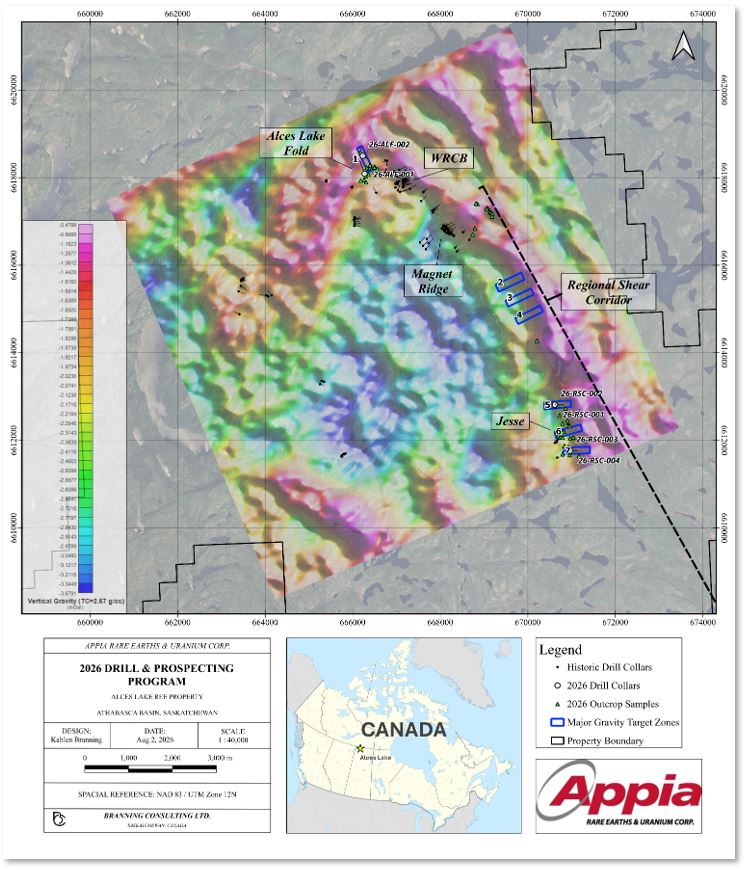
Figure 1 - Drill Target and Outcrop Sample Locations 2026 - Alces Lake, Saskatchewan
To view an enhanced version of this graphic, please visit:
https://images.newsfilecorp.com/files/5416/308401_appia.jpg
About the Alces Lake Project
The Alces Lake project encompasses some of the highest-grade total and critical* REE and gallium mineralization in the world, hosted within several surface and near-surface monazite occurrences that remain open at depth and along strike.
* Critical rare earth elements/oxides (CREO) are defined here as those that are in short-supply and high-demand for use in permanent magnets that enable modern electronic applications such as electric vehicles and wind turbines. The "magnet alloy" CREO are neodymium (Nd), praseodymium (Pr), dysprosium (Dy) and terbium (Tb).
The Alces Lake project is located in northern Saskatchewan, the same provincial jurisdiction that the Saskatchewan Research Council (SRC) is developing a "first-of-its-kind" rare earth processing facility in Canada. The Alces Lake project area is ~ 38,522 hectares (~95,191acres) in size and is
The technical content in this news release was reviewed and approved by Dr. Irvine R. Annesley, P.Geo., Senior Exploration Advisor of Appia and a Qualified Person as defined by National Instrument 43-101.
About Appia Rare Earths & Uranium Corp.
Appia is a publicly traded Canadian company in the rare earth element and uranium sectors. The Company holds a
The Company is also focusing on delineating high-grade critical rare earth elements and gallium on the Alces Lake property and exploring for high-grade uranium in the prolific Athabasca Basin on its Otherside, Loranger, North Wollaston, and Eastside properties. The Company holds the surface rights to exploration for 94,982.39 hectares (234,706.59 acres) in Saskatchewan. The Company also has a
Appia has 194.9 million common shares outstanding, 206.6 million shares fully diluted.
Cautionary note regarding forward-looking statements: This News Release contains forward-looking statements which are typically preceded by, followed by or including the words "believes", "expects", "anticipates", "estimates", "intends", "plans" or similar expressions. Forward-looking statements are not a guarantee of future performance as they involve risks, uncertainties and assumptions. We do not intend and do not assume any obligation to update these forward-looking statements and shareholders are cautioned not to put undue reliance on such statements.
Neither the Canadian Securities Exchange nor its Market Regulator (as that term is defined in the policies of the CSE) accepts responsibility for the adequacy or accuracy of this release.
For more information, visit www.appiareu.com
As part of our ongoing effort to keep investors, interested parties and stakeholders updated, we have several communication portals. If you have any questions online (X, Facebook, LinkedIn) please feel free to send direct messages.
Contact:
Tom Drivas
CEO and Director
(416) 876-3957
tdrivas@appiareu.com
To view the source version of this press release, please visit https://www.newsfilecorp.com/release/308401
FAQ
AI-generated questions and answers. How Rhea-AI works. Not financial advice.