
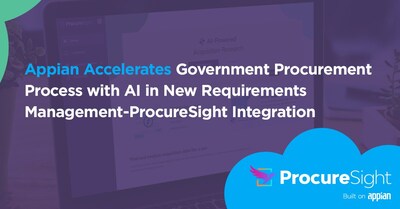
Appian Accelerates Government Procurement with AI in New Requirements Management-ProcureSight Integration
Appian announced the integration of ProcureSight with its Requirements Management solution, enhancing government procurement processes through AI capabilities.
Rhea-AI Summary
Appian announced the integration of ProcureSight with its Requirements Management solution, enhancing government procurement processes through AI capabilities. The integration streamlines requirements building by incorporating semantic search and generative AI to analyze award, solicitation, protest, and vendor data. This solution addresses the challenge of researching past procurements as required by the Federal Acquisition Regulation (FAR), automating the process of gathering and analyzing procurement information from multiple sources. Key benefits include streamlined research, AI-powered insights, faster document creation, and automatic display of best-in-class contracts based on PSC or NAICS codes.
Positive
- Integration enables faster and more accurate requirements building for government procurement
- Automates time-consuming research process across multiple government websites
- Reduces procurement action lead time while maintaining accuracy
- Potential for significant cost savings through increased competition
Negative
- None.
Details
News Market Reaction – APPN
In the trading session that priced this news, APPN gained 2.80%, reflecting a moderate positive market reaction.
Data tracked by StockTitan Argus on the day of publication.
AI-generated analysis. How Rhea-AI works. Not financial advice.




Latest integration incorporates award, solicitation, protest and vendor data to enable faster, more accurate requirements building with generative AI for acquisition professionals
Requirements building is a crucial phase of the procurement process. Having clearly defined requirements results in a less risky contract opportunity, increasing competition and lowering vendor pricing. However, capturing all of the details of the opportunity must be done in a precise and deliberate fashion.
As outlined in the Federal Acquisition Regulation (FAR), procurement professionals are required to research past procurements to learn about and compare contract vehicles, vendors, costs, and other details associated with the acquisition of similar goods and services. This is a difficult and time-consuming process involving government websites that often lack relevant results and require users to manually combine pertinent information.
The Requirements Management-ProcureSight integration is designed to solve this challenge, allowing the research functionality in ProcureSight to feed directly into agency- and procurement-specific requirements creation in the Appian Requirements Management solution. By leveraging generative AI and semantic search, procurement teams are able to create requirements documents faster and more accurately. Key benefits include:
- Streamlined past procurement research. Using semantic search, ProcureSight brings highly-relevant search results to the forefront and displays all results—solicitation, award, vendor, and protest data—from multiple websites in one place, saving hours of manually reading through hundreds of pages of information.
- AI insights. ProcureSight automatically surfaces key insights from historical documents and offers an AI chatbot that pinpoints the information you're looking for without needing to read through hundreds of pages.
- Faster building and customization of requirements packages. Requirements Management uses generative AI to draft new documents based on the results found and saved in ProcureSight while allowing users to adjust the approach and length of each section, as needed.
- Accuracy with best-in-class contract vehicles. Requirements Management automatically displays best-in-class contracts based on PSC or NAICS codes.
"I wish I had known about ProcureSight sooner—it would have saved me a lot of time. I used to go to SAM to find similar procurements and use similar language," said an analyst at a federal agency. "So far, out of all the other AI tools I'm exploring, this one is one of the best."
"Requirements building is an essential, yet laborious and time-consuming, part of the procurement process," said Ben Allen, Public Sector Solutions Vice President, Appian. "This integration brings the power of ProcureSight directly into the Appian Requirements Management solution, allowing procurement professionals to seamlessly create, track, build, and manage requirements packages all in one place. By layering in AI and semantic search, we're drastically reducing procurement action lead time without compromising accuracy, enabling more competition and the potential of significant cost savings for our government customers."
To learn more about this integration and new capabilities, schedule a demo to see how ProcureSight integrates with Appian Requirements Management.
About Appian
Appian is a software company that orchestrates business processes. The Appian Platform empowers leaders to design, automate, and optimize important processes from start to finish. With our industry-leading platform and commitment to customer success, Appian is trusted by top organizations to drive transformational process change. For more information, visit appian.com. [Nasdaq: APPN]
Follow Appian: LinkedIn, X (Twitter)
 View original content to download multimedia:https://www.prnewswire.com/news-releases/appian-accelerates-government-procurement-with-ai-in-new-requirements-management-procuresight-integration-302291512.html
SOURCE Appian
FAQ
AI-generated questions and answers. How Rhea-AI works. Not financial advice.