
New Survey from Harvard Business Review Analytic Services Finds AI Adoption Remains High, Yet Value May Lag Without Modernization and Workflow Integration
Appian (NYSE:APPN) sponsored a Harvard Business Review Analytic Services survey (April 29, 2026) showing widespread AI adoption but limited top-line impact.
Rhea-AI Summary
Appian (NYSE:APPN) sponsored a Harvard Business Review Analytic Services survey (April 29, 2026) showing widespread AI adoption but limited top-line impact. Key findings: 59% have AI in production, 64% report productivity gains, while only 30% see new revenue streams and 16% report high measurable value. The report highlights integration, legacy systems, data quality, and guardrails as primary barriers to scaling AI across workflows.
Positive
- 59% of organizations report AI in production
- 64% see productivity improvements from AI
- Embedding AI in processes: 71% report substantial or moderate value
- 76% report strong returns from modernizing legacy systems
Negative
- Only 30% report AI enabling new revenue streams
- Only 16% report a high degree of measurable AI value
- 69% say legacy systems limit AI scaling
- Fewer than 48% have defined rules-based guardrails for AI agents
Details
News Market Reaction – APPN
In the Apr 29 session, APPN declined 0.32%, reflecting a mild negative market reaction.
Data tracked by StockTitan Argus on the day of publication.
AI-generated analysis. How Rhea-AI works. Not financial advice.




A critical AI success gap is emerging for organizations, with
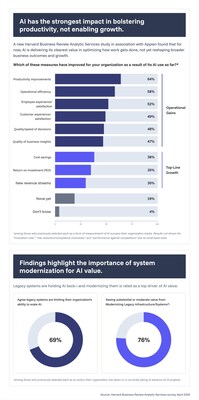
Notably, AI has the strongest impact in bolstering productivity, not enabling growth. Respondents indicated that of the AI performance measures their organization tracks, most see impact in productivity improvements (
"Enterprises are at an inflection point. Instead of using AI to drive productivity, organizations must evolve to focus on business growth. That's where Appian comes in," said Matt Calkins, CEO of Appian. "The true potential of AI can only be realized when it moves from a standalone tool to an embedded worker that drives revenue. To get there, leaders must prioritize the foundational orchestration and rules-based guardrails required to safely apply AI to high-impact work."
AI still sits outside the flow of work
In most organizations, AI is being used alongside work, not built into how work gets done, limiting its ability to drive higher-level business outcomes. Only
Most see some returns on AI, but not yet at scale
Most respondents are seeing some returns from AI investments, but only
AI delivers value when embedded in workflows
As organizations advance their AI strategies, value is closely tied to how effectively AI is integrated into workflows and applied to operational work. Seventy-one percent of organizations embedding AI into processes realized substantial or moderate value from those efforts, according to respondents. In parallel, approximately three-quarters report strong returns from modernizing legacy infrastructure/systems (
Legacy systems continue to limit AI's impact
Nearly seven in ten respondents,
AI agent adoption lags in core operations
The research also highlights differences in how AI agents are being applied across the enterprise. Organizations are more actively deploying AI agents in areas such as software development (
Most organizations lack the guardrails needed to scale AI agents safely
Ninety-two percent of respondents agree that AI agents need rules-based guardrails to operate safely and effectively, yet fewer than half (
Process design is emerging as the key to unlocking AI value
Realizing the full value of AI and achieving sustainable ROI requires rethinking how work is structured and governed. According to respondents, organizations are increasingly focused on better defining rules/guardrails that AI must follow (
"Organizations are adopting AI, but many haven't integrated it into the core processes that drive business outcomes," said Alex Clemente, managing director of Harvard Business Review Analytic Services. "Those that successfully embed AI into workflows will be better positioned to realize meaningful value."
About the Research
In March 2026, Harvard Business Review Analytic Services, sponsored by Appian, surveyed 385 business decision makers from organizations that are exploring, piloting, or actively using artificial intelligence (AI).
About Appian
Appian provides process automation technology. We automate complex processes in large enterprises and governments. Our platform is known for its unique reliability and scale. We've been automating processes for 25 years and understand enterprise operations like no one else. For more information, visit appian.com. [Nasdaq: APPN]
![Appian is The Process Company. We deliver a software platform that helps organizations run better processes that reduce costs, improve customer experiences, and gain a strategic edge. Committed to client success, we serve many of the world’s largest companies across various industries. For more information, visit appian.com. [Nasdaq: APPN] (PRNewsfoto/Appian)](https://mma.prnewswire.com/media/1488235/Appian_Caption_2700px_Logo.jpg "Appian is The Process Company. We deliver a software platform that helps organizations run better processes that reduce costs, improve customer experiences, and gain a strategic edge. Committed to client success, we serve many of the world’s largest companies across various industries. For more information, visit appian.com. [Nasdaq: APPN] (PRNewsfoto/Appian)")
 View original content to download multimedia:https://www.prnewswire.com/news-releases/new-survey-from-harvard-business-review-analytic-services-finds-ai-adoption-remains-high-yet-value-may-lag-without-modernization-and-workflow-integration-302756836.html
SOURCE Appian
FAQ
AI-generated questions and answers. How Rhea-AI works. Not financial advice.
How prevalent is AI in production among companies surveyed in the Appian-sponsored HBR study (APPN)?
Direct answer: 59% of organizations reported having AI in production.
Context: According to Appian, most firms use AI for efficiency and productivity rather than for driving new revenue streams or large-scale measurable value.
What barriers did the Harvard Business Review survey identify for scaling AI across enterprises (APPN)?
Direct answer: Legacy systems, poor data quality, lack of integration, and AI skills gaps are top barriers.
Context: According to Appian, 69% cite legacy systems, 34% cite siloed/low-quality data, and 30% cite lack of AI talent as key constraints.
What percentage of organizations reported AI creating new revenue streams in the Appian-sponsored survey (APPN)?
Direct answer: Only 30% of respondents reported an impact on new revenue streams.
Context: According to Appian, organizations more often report productivity or operational efficiency gains than top-line growth from current AI deployments.
How common are rules-based guardrails for AI agents according to the HBR study sponsored by Appian (APPN)?
Direct answer: Fewer than 48% of organizations agree they have defined rules-based guardrails for AI agents.
Context: According to Appian, 92% say guardrails are needed, yet under half report having them, raising governance concerns as agentic AI use grows.
Does embedding AI in workflows affect reported value in the Appian-sponsored HBR survey (APPN)?
Direct answer: Yes—71% embedding AI into processes reported substantial or moderate value.
Context: According to Appian, organizations that modernize infrastructure, integrate data, and orchestrate workflows report stronger returns and higher measurable value.