
STOCK TITAN

Aptiv and Vecna Robotics to Develop Next Generation Autonomous Mobile Robots

Rhea-AI Impact
(Moderate)
Rhea-AI Sentiment
(Positive)
Tags

Key Terms

autonomous mobile robot technical
An autonomous mobile robot is a self-guided machine that navigates and performs tasks without direct human control, using onboard sensors and software like a self-driving car for indoor spaces such as warehouses, factories or hospitals. Investors care because these robots can cut labor costs, speed operations and enable scalable growth, but they also require upfront investment and carry risks around technology reliability, integration and changing regulations.
machine learning technical
Machine learning is a set of computer programs that learn patterns from large amounts of data and improve their predictions or decisions over time, like a recipe that gets better each time it’s adjusted based on taste tests. For investors it matters because these systems can speed up analysis, spot trends or risks humans might miss, automate routine work, and potentially create competitive advantages or cost savings that affect a company’s performance.
real-time operating system technical
A real-time operating system is specialized software that manages a device’s hardware and applications so tasks run at predictable, guaranteed times instead of whenever resources happen to be free. For investors it matters because predictable timing is often critical for safety, regulatory approval and customer trust in products like medical devices, cars and industrial controllers—think of it as the conductor or traffic controller that keeps time-sensitive equipment from failing under pressure.
virtualization platform technical
A virtualization platform is software that lets one physical computer run many separate virtual machines or services, like renting individual rooms in a single building so multiple tenants can operate independently. For investors, it matters because it drives cost savings, faster deployment, and better use of hardware, which can lower operating expenses and enable scalable growth for companies relying on cloud services or data centers, affecting profitability and competitive position.
autonomy technical
Autonomy is the ability of a system, device, or organization to operate and make decisions without direct human control, like a self-driving car navigating on its own or a business unit running independently from a parent company. Investors care because greater autonomy can lower ongoing labor costs, create new revenue opportunities, change safety and legal risk, and alter competitive positioning — much like replacing a hired driver with a smart machine or giving a team the freedom to move faster.
orchestration technical
Orchestration is the coordinated management of multiple tasks, systems or teams so they work together smoothly, like a conductor ensuring each instrument plays at the right time. For investors, orchestration matters because it improves efficiency, speeds up delivery, reduces errors and operational costs, and makes scaling or changing business processes less risky—factors that can directly affect a company’s profitability and reliability.
ultrashort-range radar technical
A ultrashort-range radar is a compact sensing device that sends radio pulses and measures reflections to detect and track objects only a few centimeters to a few meters away, used for tasks like touchless controls, parking aid, gesture recognition, and close-proximity safety. Investors care because it is a small but critical sensor component whose adoption, cost, and supply affect product features, competitive differentiation, unit margins, and after-market service opportunities across industries like automotive, consumer electronics, and industrial automation.
surround-view camera technical
A surround-view camera is a system of multiple exterior cameras that stitch together a continuous overhead-style image of a vehicle’s immediate surroundings, like a virtual bird’s-eye view. For investors, it signals higher safety, convenience and advanced-driver features that can increase a vehicle’s price, appeal and regulatory compliance costs; it also points to revenue opportunities for suppliers of cameras, sensors and software that enable these systems.

Collaboration to Deliver Safer, Smarter, and Cost-Effective Automation for Warehouses and Factories
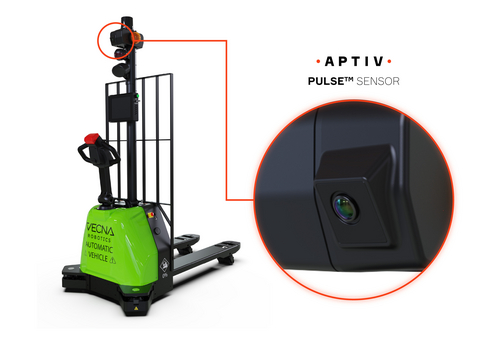
SCHAFFHAUSEN, Switzerland & WALTHAM, Mass.--(BUSINESS WIRE)-- Aptiv PLC (NYSE: APTV), a global industrial technology leader, and Vecna Robotics, a pioneer in AI-driven autonomous material handling solutions, today announced a strategic collaboration to co-develop next-generation Autonomous Mobile Robot (AMR) solutions designed to deliver cost-efficient automation.

Aptiv’s advanced perception portfolio and machine learning technologies will be integrated into Vecna Robotics’ platform.

Aptiv’s advanced perception portfolio and machine learning technologies will be integrated into Vecna Robotics’ platform.

This partnership combines Aptiv’s industry-leading portfolio, with Vecna Robotics’ advanced autonomy and orchestration platform to provide safer, more efficient, and scalable material handling systems.

“Automation is transforming the way goods move through warehouses and factories, with devices that sense, think and act in real time,” said Javed Khan, Executive Vice President, Intelligent Systems, Aptiv. “Our collaboration with Vecna Robotics combines Aptiv’s advanced perception, compute, and software solutions with Vecna’s proven expertise in autonomous material handling. Together, we’re making automation safer, smarter, and more affordable—helping customers meet the demands of modern logistics.”

As part of this collaboration, Aptiv’s advanced perception portfolio and machine learning technologies will be integrated into Vecna Robotics’ platform, delivering reliable, cost-efficient automation at scale across industrial environments. The joint solution combines several key capabilities:

Perception and Sensing Hardware – Award-winning PULSE™ Sensor – a compact, surround-view camera paired with an ultrashort-range radar, enabling reliable and accurate 360-degree sensing.

ML Based Real-Time Perception and Path Planning – Aptiv Radar ML and Behavior ML deliver advanced machine learning technologies for real-time perception and dynamic path planning in complex environments.

Autonomy and Workflow Orchestration – The Vecna Robotics platform, equipped with advanced perception and fail-safe navigation systems, prioritizes workplace safety by detecting and avoiding obstacles in real time—even in mixed-traffic environments. Beyond autonomy, Vecna’s unique CaseFlow™ integration enables seamless orchestration of workflows across humans, forklifts, and other automation systems, ensuring optimized throughput without disrupting existing operations.

Aptiv’s Embedded Software and Compute – Built on Aptiv's scalable, efficient and high-performance compute platform—including the VxWorks real-time operating system (RTOS) and Wind River® Helix™ Virtualization Platform—this solution delivers best-in-class performance, advanced virtualization, ultra-low latency, and exceptional flexibility to support a wide range of system designs.

Vecna Robotics delivers flexible, intelligent automation through advanced AMRs that adapt to dynamic warehouse and factory environments. Powered by AI-driven autonomy and the Pivotal™ orchestration platform, Vecna’s solutions coordinate people, robots, and workflows to optimize material flow in real time—without requiring costly or rigid infrastructure. Its platform accelerates deployment, scales easily across operations, and consistently delivers measurable improvements in throughput, safety, and operational efficiency.

“Partnering with Aptiv enables us to deliver even more robust and cost-optimized robotic products,” said Karl Iagnemma, CEO, Vecna Robotics. “This collaboration strengthens our ability to help customers reduce operational costs, improve throughput, and achieve faster, more scalable automation ROI. By combining our AI-driven autonomy and orchestration with Aptiv’s advanced perception and compute technologies, we’re enabling more efficient workflows, safer operations, and meaningful cost savings for customers seeking to modernize without major infrastructure investment.”

Together, Aptiv and Vecna Robotics are redefining what’s possible in autonomous material handling—combining advanced perception, compute, and orchestration to deliver automation that is safer, smarter, and built to scale. This partnership equips customers with a more powerful, cost-effective foundation for the future of industrial operations.

Aptiv will showcase Vecna Robotics’ CPJ Co-Bot Pallet Jack in its pavilion at CES 2026.

About Aptiv

Aptiv is a global industrial technology company focused on enabling a more automated, electrified, and digitalized future. Visit aptiv.com.

About Vecna Robotics

Vecna Robotics’ flexible material handling AMRs and PivotalTM software platform boost throughput, reduce labor strain, and deliver fast ROI without fixed infrastructure. Visit https://www.vecnarobotics.com/.

Ariel Gavilan

Vice President of Global Communications, Aptiv

ariel.gavilan@aptiv.com

248-251-3447

Alex Miller

vecnarobotics@marketbridge.com

832-564-9966

Source: Aptiv PLC

Aptiv Plc

NYSE:APTV

APTV Rankings

APTV Latest News

APTV Latest SEC Filings

APTV Stock Data

16.77B
215.03M
0.49%
102.56%
2.13%
Auto Parts
Motor Vehicle Parts & Accessories
Link
Switzerland
SCHAFFHAUSEN
