
Apex Expands Trinity Zone with Step-out Hole Returning 197.5 m Interval of 2.12% REO at the Rift Rare Earth Project in SE Nebraska
New high-grade rare earth intercepts at Rift substantially enlarge the Trinity Zone and support Apex’s plan for a first resource estimate in Q1 2027.
Sentiment and the balance of points
Rhea-AI Sentiment reads the wording of the document, how positive or negative its language is on a 1 to 5 scale. The balance of points shown with the takes weighs what the document actually discloses, so the two can disagree, for example when a trial that missed its main goal is described in upbeat language.
Rhea-AI Summary
Apex Critical Metals (APXCF) reported new 2026 drill results that materially expand the Trinity Zone rare earth footprint at the Rift Project in Nebraska.
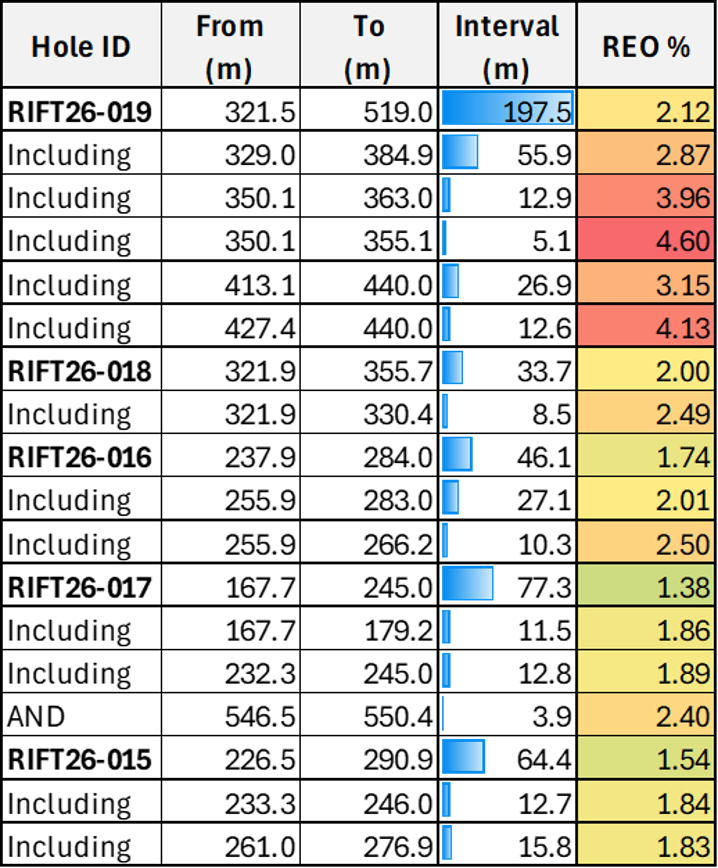
Step-out hole RIFT26-019 returned 197.5 m at 2.12% REO, including a high‑grade core of 26.9 m at 3.15% REO, and extends mineralization about 120 m further down dip to the west from RIFT26-005A. Southern fence holes RIFT26-016, -017 and -018 delivered intervals of 1.74% REO over 46.1 m, 1.38% REO over 77.3 m (with higher‑grade sub‑intervals), and 2.00% REO over 33.7 m, adding roughly 100 m of N‑S strike.
The Trinity Zone is now defined over about 500 m N‑S strike and 300 m of western down‑dip extent within a 700 m corridor, remains open in all directions, and continues to show broad high‑grade REO intervals. Apex has completed 34 holes (~22,000 m) in 2026, with assays pending for 15 holes, and targets an inaugural mineral resource estimate in Q1 2027.
Positive
- RIFT26-019 intersected 197.5 m at 2.12% REO, including 26.9 m at 3.15% REO.
- Trinity Zone footprint expanded to about 500 m N‑S strike and 300 m down-dip, still open in all directions.
- Southern fence holes added ~100 m of strike with intervals up to 2.00% REO over 33.7 m.
- 2026 program totals 34 drillholes (~22,000 m), providing a growing dataset for modelling.
- Company aims to deliver an inaugural mineral resource estimate for Rift in Q1 2027.
Negative
- True widths of all reported intercepts remain unknown pending further work.
- Assays are still pending for 15 of 34 2026 drillholes, leaving the full extent and continuity unconfirmed.
News Explained
The added hole broadens the assay record, but its 64.4-metre interval does not establish 64.4 metres of true mineralized thickness.
Apex adds a reported assay from RIFT26-015 to the Trinity Zone record—
The reported intervals are downhole core lengths described as apparent widths; true widths remain undetermined until further confirmation and interpretation.
Details
News Market Reaction – APXCF
On Sep 8, the day this news came out, APXCF closed 1.77% above the previous close.
Data tracked by StockTitan Argus for the Sep 8 session.
AI-generated analysis. How Rhea-AI works. Not financial advice.




Highlights:
RIFT26-019 returns
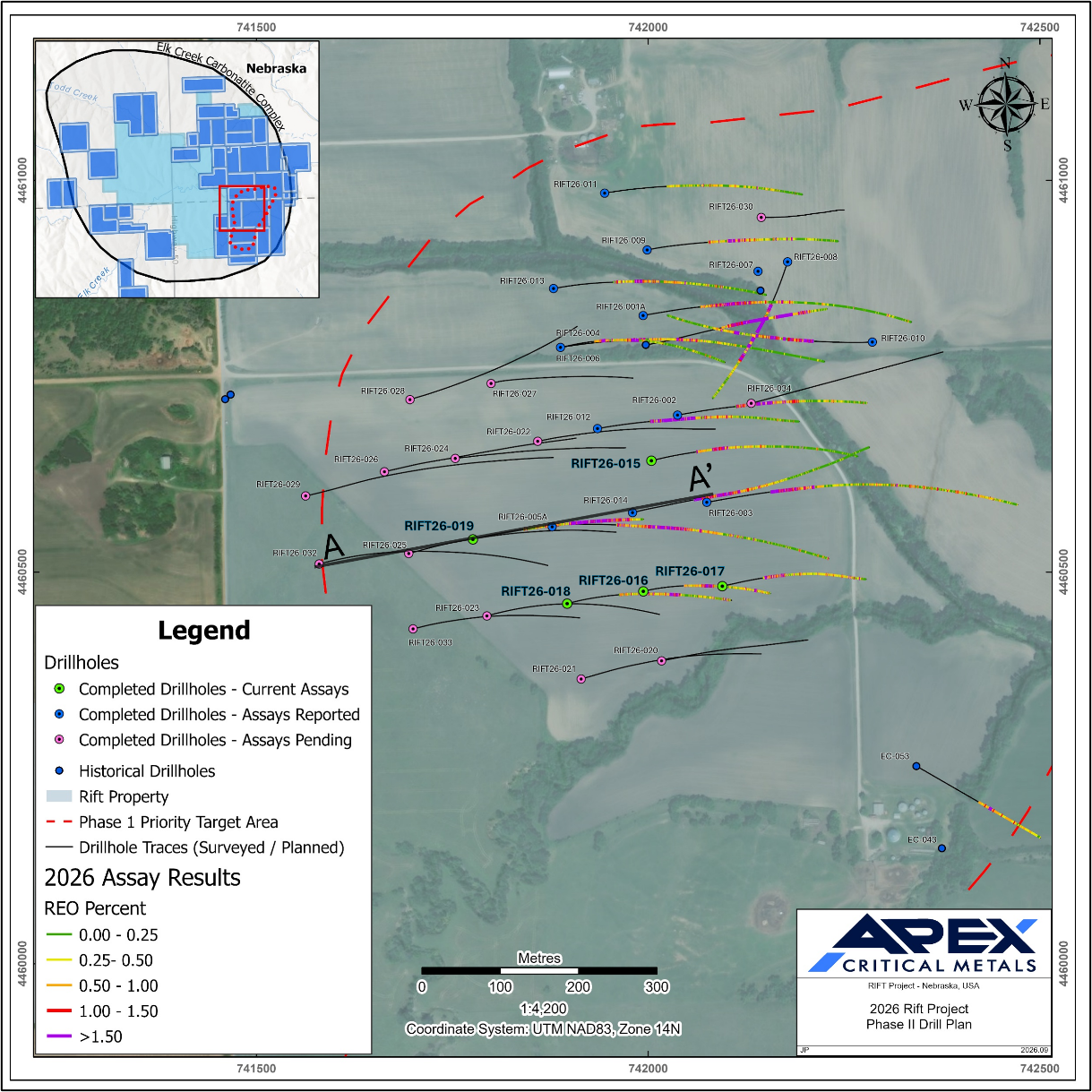
2.12% REO (1) over 197.5 m, including:4.60% REO over 5.1 m, or3.15% REO over 12.9 m, or2.87% REO over 55.9 mRIFT26-019 extends Trinity Zone mineralization ~120 m further down dip to the west (now defined over 300 m) with assays still pending for additional western step-out drillholes (see Figures 1-2).
RIFT26-016, RIFT26-017 & RIFT26-018 comprise the southernmost drill fence and demonstrate a further 100 m of mineralized N-S strike length returning
1.74% REO over 46.1 m,1.38% REO over 77.3 m, and2.00% REO over 33.7 m, respectively (see Figure 1).Additional western step-out drillholes (see Figure 1) continue to intersect hematite alteration and rock characteristics similar to western mineralized holes reported to date.
The Trinity Zone is now defined over an approximate 500 m N-S strike length and 300 m down-dip (west) with strongly mineralized intervals ranging from 80 to 197 m, which continue to demonstrate strong continuity of high-grade REO mineralization.
The Trinity Zone remains open in all directions.
Sean Charland, CEO of Apex Critical Metals, commented: "The results from western step-out drillhole RIFT26-019 confirms the western plunge of the upper Trinity Zone and demonstrates continuity of the high-grade REO mineralization with one of the strongest grade x width intervals to-date. Assays remain pending for several additional holes further to the west, and the visual observations and favourable geology suggest there's a significant opportunity to expand the mineralized footprint with each western step-out. We have made a tremendous amount of progress over the past 12 months and remain on track for an inaugural mineral resource estimate in Q1 2027."
VANCOUVER, BC / ACCESS Newswire / September 8, 2026 / Apex Critical Metals Corp. ("Apex" or the "Company") (CSE:APXC)(OTCQX:APXCF)(FWB:KL9)(Euronext Access Paris:MLAPX), a mineral exploration company focused on advancing its strategic
Key Observations and Takeaways
Current analytical results targeting the down dip extension of The Trinity Zone (RIFT26-019) confirm the extension of the high-grade west plunging mineralized body an additional 120 m west of previously reported RIFT26-005A, which highlighted 80.0 m at
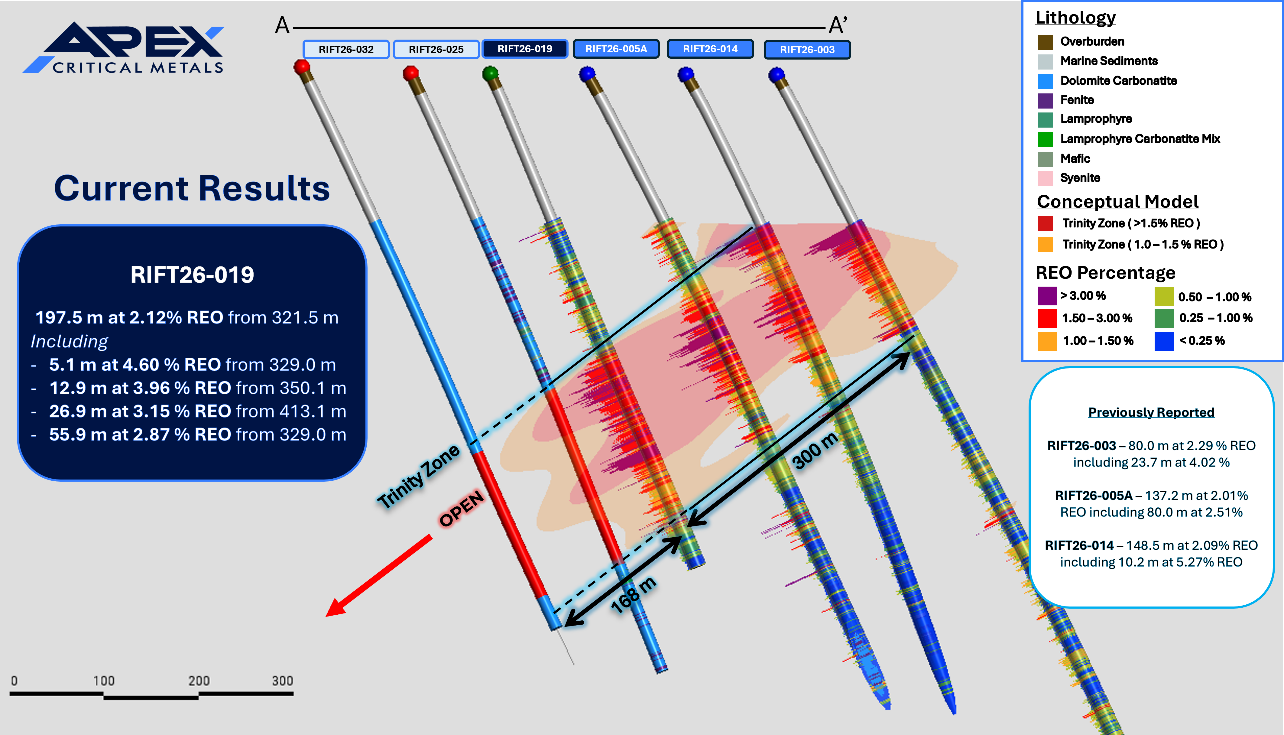
As shown above in Figure 2, two (2) additional western step-out drillholes have been completed along the same drillhole fence, with assays pending. Initial visual results show broad intervals with hematite alteration consistent with mineralization of reported results, suggesting a further potential down-dip extension of Trinity Zone.
Drillholes RIFT26-016, RIFT26-017, & RIFT26-018 form a three-hole drill fence targeting the area 100m south of the positive results observed in the fence connecting holes RIFT26-019 and RIFT26-003 (Figure 1). Analytical results along the southern most drill fence with assays reported highlight 27.1 m of
RIFT26-015 encountered a different carbonatite breccia host rock in this area, which is interpreted to crosscut the primary altered hematite observed throughout most of the Trinity Zone. RIFT26-015 still returned 64.4 m of
To date, nineteen (19) of the thirty-four (34) completed drillholes have analytical results released. Results contained herein, continue to highlight significant intervals of >
Table 1: Drillhole Location and Attributes
Hole ID | Depth (m) | Azimuth(b) (°) | Dip(b) (°) | Easting (a) | Northing (a) | Elevation |
RIFT26-015 | 789 | 75 | -65 | 742004 | 4460642 | 331.38 |
RIFT26-016 | 543 | 75 | -70 | 741993 | 4460475 | 331.77 |
RIFT26-017 | 573 | 75 | -70 | 742094 | 4460482 | 332.46 |
RIFT26-018 | 512 | 75 | -65 | 741896 | 4460460 | 332.92 |
RIFT26-019 | 564 | 75 | -65 | 741776 | 4460542 | 332.65 |
(a)Coordinates are presented in NAD83 UTMZ14 (b) Azimuth and Dip are planned and may vary downhole | ||||||
Table 2: RIFT26-015, RIFT26-016, RIFT26-017, RIFT26-018 and RIFT26-019 Assay Highlights
(a) All reported intervals are downhole core lengths, and do not represent true widths, which remain unknown until further confirmation assay results are received and interpreted. NdPr(2) distributions for the Trinity Zone mineralization remain within typical global carbonatite ranges of 10
(b) For more detailed drill results information, including REO calculations and conversions, please visit https://apexcriticalmetals.com/projects/rift-rare-earth-project/#reo_disclosure
Program Status and Next Steps
The Company has completed additional drillholes designed to further test the extent of mineralization along strike and at depth with assay results pending. Ongoing refinement of the 3D geological model, including integration of assay results as received, will support improved understanding of the mineralized system and help prioritize future drill targeting. The 2026 drill program remains ongoing, with a total of thirty-four (34) drillholes completed to date for approximately 22,000 m, with assays currently pending for fifteen (15) drillholes. Drilling is expected to continue through September and October with a single drill rig.
Quality Assurance / Quality Control
All drilling was completed using one truck and one track mounted diamond drill rigs with HQ-size core and all drill core samples have been or will be shipped to Activation Laboratories Ltd. (Actlabs) preparation facility in Ancaster, Ontario, for standard sample preparation (code RX1) which includes drying, crush (< 7 kg) up to
A Quality Assurance/Quality Control protocol was incorporated into the program and included the insertion of certified reference material and silica blanks at a rate of approximately
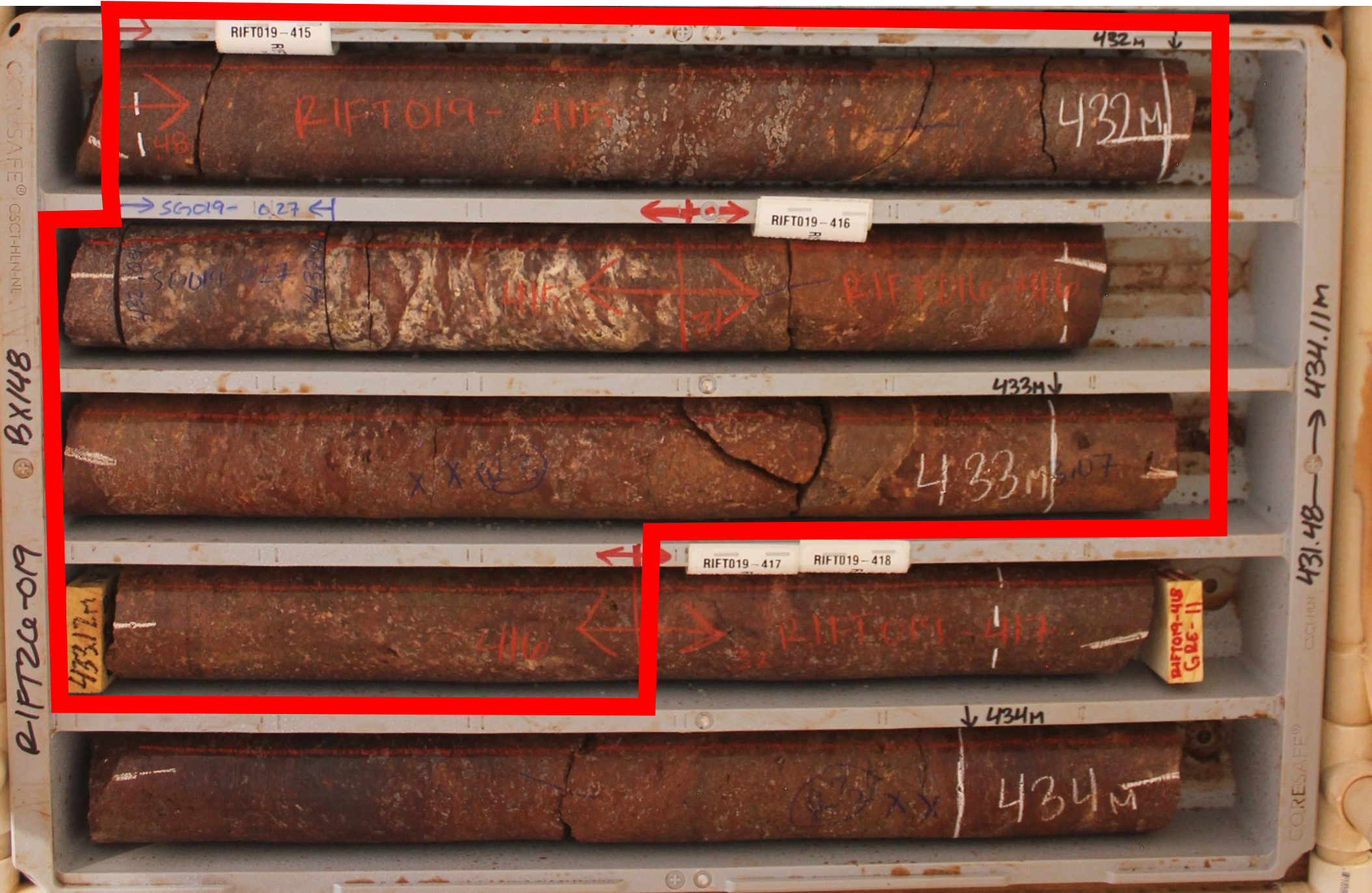
Management cautions that the interception of carbonatite and associated hematite alteration is not necessarily indicative of mineralization. Assay results are required to confirm the presence, grade, and significance of any mineralization.All intercepts reported in this news release represent core length (apparent width). True widths have not yet been determined.
(1) REO (Rare Earth Oxide) is defined as the sum of Ce2O3, La2O3, Pr2O3, Nd2O3, Eu2O3, Sm2O3, Gd2O3, Tb2O3, Dy2O3, Ho2O3, Er2O3, Tm2O3, Yb2O3, Lu2O3, and Y2O3.
(2) NdPr distribution calculated as (Nd2O3 + Pr2O3) / REO x 100
For more detailed drill results information, including REO calculations and conversions, please visit https://apexcriticalmetals.com/projects/rift-rare-earth-project/#reo_disclosure
Qualified Person
The technical content of this news release has been reviewed and approved by Nathan Schmidt, P.Geo., a Qualified Person under NI 43-101 on standards of disclosure for mineral projects. Mr. Schmidt is a Geologist with Dahrouge Geological Consulting Ltd., the consulting firm engaged by Apex Critical Metals Corp. to conduct and oversee all of the Company's exploration work, including the 2026 drill program.
Mr. Schmidt has verified all scientific and technical data disclosed in this news release including the sampling and QA/QC results, and certified analytical data underlying the technical information disclosed. Mr. Schmidt noted no errors or omissions during the data verification process. The Company and Mr. Schmidt do not recognize any factors of sampling or recovery that could materially affect the accuracy or reliability of the assay data disclosed in this news release.
Rare earth oxide ("REO") values reported in this news release are calculated as the sum of individual rare earth oxide components and are not directly measured assay results. The individual rare earth oxide values underlying each reported REO grade are available at Individual Rare Earth Oxide Disclosure.
About Apex Critical Metals Corp. (CSE:APXC)(OTCQX:APXCF)(FWB:KL9)(Euronext Access Paris:MLAPX)
Apex Critical Metals Corp. is a Canadian exploration company focused on advancing rare earth element (REE) and niobium projects that support the growing demand for critical and strategic metals across the United States and Canada. The Company's flagship Rift Project, located within the highly prospective Elk Creek Carbonatite Complex in Nebraska, U.S.A., hosts extensive rare earth rights surrounding one of North America's most advanced niobium deposits. Two historical drillholes located within the 700 m corridor of interest returned broad intervals of >
In Canada, Apex continues to advance its
With a growing portfolio of critical mineral projects in both Canada and the United States, Apex Critical Metals is strategically positioned to help strengthen domestic supply chains for the minerals essential to advanced technologies, clean energy, and national security. Apex is publicly listed in Canada on the Canadian Securities Exchange (CSE) under the symbol APXC and quoted on the OTCQX market in the United States under the symbol APXCF, in Germany on the Borse Frankfurt under the symbol KL9 and/or WKN: A40CCQ, and in France on Euronext Access Paris under the symbol MLAPX.
Find out more at www.apexcriticalmetals.com and watch our videos at https://apexcriticalmetals.com/apex-critical-metals-corporate-video/ and make sure to stay in touch by signing up for free news alerts at https://apexcriticalmetals.com/news/news-alerts/, or by following us on X (formerly Twitter), Facebook or LinkedIn.
On Behalf of the Board of Directors
APEX CRITICAL METALS CORP.,
Sean Charland
Chief Executive Officer
Tel: 604.681.1568
Email: info@apexcriticalmetals.com
Neither the Canadian Securities Exchange nor its Regulation Services Provider (as that term is defined in the policies of the CSE) accepts responsibility for the adequacy or accuracy of this release.
CAUTIONARY STATEMENT REGARDING FORWARD-LOOKING INFORMATION:
This news release may contain "forward-looking information" or "forward-looking statements" under applicable Canadian and United States securities legislation (collectively, "forward-looking statements"). Forward-looking statements consist of statements that are not purely historical, including any statements regarding beliefs, plans, expectations or intentions regarding the future. Forward-looking statements in this news release include (without limitation) statements regarding the Company's drill program and any subsequent drill programs and statements regarding the Company's prospective assets (more particularly described above), and statements regarding future assay results and the potential for future exploration and drilling to confirm the source of magnetic anomalies, to test the extent of mineralization along strike and at depth, and ongoing refinement of the 3D geological modelling and understanding of the mineralized system. Forward-looking statements are subject to various known and unknown risks and uncertainties that may cause actual results, performance or developments to differ materially from those contained in the statements. Risks that could change or prevent these events, activities or developments from coming to fruition include: the Company's properties are at an early stage of development and no current mineral resources or reserves have been identified by the Company thereof, that we may not be able to fully finance any additional exploration on the Company's properties; that even if we are able to raise capital, costs for exploration activities may increase such that we may not have sufficient funds to pay for such exploration or processing activities; the timing and content of any future work programs; geological interpretations based on drilling that may change with more detailed information; potential process methods and mineral recoveries assumptions based on limited test work and by comparison to what are considered analogous deposits that, with further test work, may not be comparable; testing of our process may not prove successful or samples derived from our properties may not yield positive results, and even if such tests are successful or initial sample results are positive, the economic and other outcomes may not be as expected; the anticipated market demand for REE and other minerals may not be as expected; the availability of labour and equipment to undertake future exploration work and testing activities; geopolitical risks which may result in market and economic instability. There can be no assurance that such statements will prove to be accurate, as actual results and future events could differ materially from those anticipated in such statements. Accordingly, readers should not place undue reliance on forward-looking statements. The forward-looking statements herein are made as of the date hereof, and the Company disclaims any intention or obligation to update or revise any forward-looking statements, whether as a result of new information, future events or otherwise, except as required by law.
SOURCE: Apex Critical Metals Corp.
View the original press release on ACCESS Newswire
FAQ
AI-generated questions and answers. How Rhea-AI works. Not financial advice.
What does the new hole RIFT26-019 show about the Trinity Zone at Rift?
Hole RIFT26-019, a western step-out, intersected 197.5 m at 2.12% REO, including a high‑grade core of 26.9 m at 3.15% REO. It extends the high‑grade, west‑plunging Trinity Zone about 120 m down dip to the west of previously reported hole RIFT26-005A and confirms the association between hematite alteration and REO mineralization in this area.
How have the southern fence drillholes affected the known size of the Trinity Zone?
Drillholes RIFT26-016, RIFT26-017 and RIFT26-018 form the southernmost reported fence and extend the mineralized footprint roughly 100 m south. They returned notable intervals including 46.1 m at 1.74% REO (with 27.1 m at 2.01% REO) in RIFT26-016, two intervals of 11.5 m at 1.86% REO and 12.8 m at 1.89% REO in RIFT26-017, and 33.7 m at 2.00% REO in RIFT26-018.
How many drillholes and metres have been completed at the Rift Project in 2026, and how many assays are pending?
The 2026 drill program at Rift has completed 34 drillholes totaling approximately 22,000 m. Analytical results have been released for 19 of these holes, and assays are currently pending for the remaining 15 drillholes.
What is the current understanding of the Trinity Zone’s dimensions and continuity?
Trinity Zone intercepts now trace an approximate 500 m north‑south strike length and 300 m of western down‑dip extension within a broader 700 m target corridor. Reported holes show strongly mineralized intervals ranging from about 80 m to 197 m, and the company states that the zone remains open in all directions.
What quality assurance and quality control procedures are used for the Rift drill samples?
Drill core is HQ-size, saw‑cut with half‑core sent to Activation Laboratories (Actlabs) in Ancaster, Ontario, for preparation and REE analyses. The program includes insertion of certified reference materials and silica blanks at roughly 5% each, and pulp‑split and reject‑split duplicates at about 5% and 2.5%, respectively. A Qualified Person has reviewed and verified the sampling, QA/QC results, and analytical data and reported no material issues.
How are the reported REO grades calculated in this release?
REO (rare earth oxide) values are calculated as the sum of individual rare earth oxide components, including oxides of cerium, lanthanum, praseodymium, neodymium, and other listed rare earths. These REO grades are therefore derived values, not directly measured single‑assay results. The company states that NdPr distributions in Trinity Zone mineralization are typically within the 10–20% range of total REO.
What caution does Apex give regarding visual indicators like hematite alteration?
Management cautions that the interception of carbonatite and associated hematite alteration alone is not necessarily indicative of mineralization. Assay results are required to confirm the presence, grade, and significance of any mineralization, and all intercepts reported currently represent core lengths rather than true widths.