
Aquestive Therapeutics Announces Positive Topline Human Factors and Pharmacokinetic Study Results for Anaphylm™ (dibutepinephrine) Sublingual Film
Rhea-AI Summary
Aquestive Therapeutics (NASDAQ: AQST) reported positive topline results from a human factors validation study and a pharmacokinetic (PK) study of Anaphylm sublingual film, supporting a planned NDA resubmission in the third quarter of 2026 for Type 1 allergic reactions, including anaphylaxis.
The revised packaging cut median pouch-opening time from 17 to 3 seconds, reduced users with opening difficulty from 26/166 to 1/105, and lowered incorrect film placement from 20/166 to 2/105, with no chewing or film removal observed. In the PK study, self-administered Anaphylm achieved a geometric mean Cmax of 391.7 pg/mL and median Tmax of 12 minutes, similar to clinician-administered dosing and higher, faster exposure than manual intramuscular epinephrine. Incorrect top-of-tongue placement still produced Cmax above 100 pg/mL, a 35-minute Tmax, and clinically meaningful pharmacodynamic effects comparable to or exceeding injectable epinephrine, with no serious adverse events or discontinuations reported.
Positive
- HF improvements: median pouch-opening time reduced from 17s to 3s; opening difficulties from 26/166 to 1/105; incorrect placement from 20/166 to 2/105
- PK self vs clinician: self-administered Cmax 391.7 pg/mL and clinician-administered 357.6 pg/mL, both with 12-minute median Tmax
- Faster vs IM injection: manual IM Cmax 334.5 pg/mL with 45-minute median Tmax, slower than Anaphylm sublingual administration
- Misplaced dosing still effective: top-of-tongue Cmax above 100 pg/mL, 35-minute median Tmax, and clinically meaningful PD response comparable to or greater than injectable epinephrine
- Favorable safety/tolerability: no serious adverse events and no discontinuations in the PK study; no premature film removal reported
- Regulatory progress: NDA resubmission for Anaphylm planned for Q3 2026 and regulatory submissions advancing in Canada, the UK, and the EU
Negative
- Prior FDA Complete Response Letter: in January 2026 the FDA cited human factors issues such as difficulty opening pouches and incorrect film administration in an earlier study
- Reduced exposure with incorrect placement: intentionally misplaced top-of-tongue dosing showed significantly lower Cmax and longer Tmax compared with correct sublingual administration in prior studies
News Explained
Aquestive says its new studies address deficiencies identified in the FDA’s
Details
Market move: AQST +8.88% in the Aug 10 session. Anaphylm clinical data
On Aug 10, the day this news came out, AQST closed 8.88% above the previous close. Argus tracked a peak move of +12.0% during that session. Our momentum scanner recorded 37 alerts for this stock that day. Relative volume reached 3.7x the daily average during tracking.
Data tracked by StockTitan Argus for the Aug 10 session.
Key Figures
- Planned NDA resubmission
- Q3 2026
- Anaphylm NDA
- Pouch opening time
- 17 seconds to 3 seconds
- Revised human factors study versus previous study
- Incorrect placement reduction
- Over 80%
- Revised instructions for use versus previous validation study
- Pouch-opening difficulty
- 26 of 166 to 1 of 105 participants
- Previous human factors study versus latest study
- Incorrect administration
- 20 of 166 to 2 of 105 participants
- Previous human factors study versus latest study
- Geometric mean Cmax
- 391.7, 357.6, and 334.5 pg/mL
- Self-administered, clinician-administered, and manual IM administration
- Median Tmax
- 12, 12, and 45 minutes
- Self-administered, clinician-administered, and manual IM administration
- Top-of-tongue Cmax and Tmax
- Above 100 pg/mL and 35 minutes
- Purposely misplaced administration arm
Historical Context
-
Announced second-quarter results date and investor conference call schedule.
-
Announced participation in the Leerink Partners Therapeutics Forum and investor meetings.
-
Reported higher revenue, reduced net loss, and reaffirmed Anaphylm resubmission plans.
-
Completed a new Oaktree facility with staged funding and milestone-based tranches.
-
Announced first-quarter results date and investor conference call schedule.
24h Move is the share-price change in the day after each event; other market factors may also have contributed.
Key Terms
pharmacokinetic medical
pharmacodynamic medical
complete response letter regulatory
cmax medical
tmax medical
new drug application regulatory
AI-generated analysis. How Rhea-AI works. Not financial advice.




- Human factors and clinical study results support planned resubmission of Anaphylm™ NDA in the third quarter of 2026
- Self-administration pharmacokinetic (PK) results were comparable to clinician-administered PK results
- Revised packaging design reduced median time to open pouch from 17 seconds in the previous human factors study to 3 seconds
- Revised instructions for use reduced incorrect film placement from previous human factors validation study by over
80% - Top-of-tongue PK arm showed clinically meaningful pharmacodynamic (PD) results
WARREN, N.J., Aug. 10, 2026 (GLOBE NEWSWIRE) -- Aquestive Therapeutics, Inc. (NASDAQ: AQST) (“Aquestive” or the “Company”), a pharmaceutical company advancing medicines to bring meaningful improvement to patients’ lives through innovative science and delivery technologies, today announced results from its human factors (HF) validation study and pharmacokinetic (PK) study for Anaphylm™ (dibutepinephrine) sublingual film, conducted in support of the Company’s planned resubmission of its New Drug Application (NDA) to the U.S. Food and Drug Administration (FDA) for the treatment of Type 1 allergic reactions, including anaphylaxis.
“Our Anaphylm program has reached an important milestone,” said Daniel Barber, President and Chief Executive Officer of Aquestive. “The topline results from our human factors and pharmacokinetic studies reinforce our confidence in the revised packaging design and instructions for use as we prepare for our planned NDA resubmission. If approved, we believe Anaphylm has the potential to be the first and only non-invasive, orally delivered epinephrine product for patients at risk of life-threatening allergic reactions. We are grateful to the patients, participants, caregivers, and investigators who participated in these studies, as we plan to resubmit our NDA less than eight months from receipt of a Complete Response Letter from the FDA.”
“For patients who are at risk of having a severe allergic reaction, having a package for your epinephrine that’s easy to open in an emergency can make all the difference,” said Matthew Greenhawt, M.D., MBA, MSc, Chief Medical Officer of Aquestive. “In our topline analysis, patients and caregivers were better able to use the revised packaging, and our pharmacokinetic data met the endpoints we set out to achieve. Together, we believe this evidence supports our planned resubmission of the Anaphylm NDA and reflects our ongoing commitment to the allergy community.”
"Even if used incorrectly, such as placing on top of the tongue instead of under the tongue, the pharmacodynamic response is what you would want in an epinephrine product during an allergic reaction," said Jay Lieberman, MD, Professor of Pediatrics at the University of Tennessee Health Center, Department of Pediatrics and Interim Chief, Section of Allergy and Immunology, who also serves as a member of Aquestive’s Scientific Advisory Board. “I am excited to see continued innovation in this critical treatment area. Increasing options for patients is vital to improving outcomes in the real world.”
The new HF study evaluated a revised packaging design, incorporating modifications to the pouch opening, instructions for use, and pouch and carton labeling intended to address previously identified issues. Specifically, the Company received a Complete Response Letter (CRL) from the FDA in January 2026 which indicated that, in a previous human factors study, participants had difficulty opening the pouch, tore the film during pouch opening, incorrectly placed the film during administration, chewed the film, and/or removed the film after administration. The new HF study shows significant improvement across each deficiency identified by the FDA. The median time to open a pouch decreased from 17 seconds in the previous study to 3 seconds. The number of participants who had difficulty opening the pouch decreased from 26 (out of 166) to 1 (out of 105). The number of participants who incorrectly administered the film in the mouth decreased from 20 (out of 166) to 2 (out of 105). In the latest HF study, no participants were observed chewing the film or removing the film.
In addition, using the revised packaging and revised instructions for use, the Company conducted a single PK study in healthy volunteers comparing self-administration to clinician-administered as well as manual intramuscular (IM) administration. No administration errors were observed in the self-administration arm of the PK study. Table 1 provides the topline results from the PK study.
Table 1: Clinical PK Study in Healthy Subjects Comparing Anaphylm Self-Administration to Clinician-Administered and Epinephrine IM Administration (Study AQ109109)*
| Description | Anaphylm Self-Administered | Anaphylm Clinician-Administered | Manual IM Clinician-Administered |
| Geometric Mean Cmax** (pg/mL) | 391.7 | 357.6 | 334.5 |
| Median Tmax*** (minutes) | 12 | 12 | 45 |
*All values in Table 1 are from study AQ109109
**Cmax – Maximum concentration of drug found in the blood plasma
***Tmax – Time to maximum concentration of drug found in the blood plasma
The FDA also requested that Aquestive include a PK arm studying purposely misplaced administration of Anaphylm on top of the tongue or on the roof of the mouth, intended to demonstrate the impact of incorrect placement on PK and PD measures and tolerability. As expected, compared with prior clinical studies where the film was administered as per the instructions, the geometric mean Cmax is significantly lower and the Tmax significantly longer than with correct placement of our sublingual film. However, top-of-tongue placement resulted in a geometric mean Cmax above 100 pg/mL (baseline unadjusted), a median Tmax of 35 minutes, and clinically meaningful PD results that were comparable to or of greater magnitude than those observed with injectable epinephrine. Chart 1 below provides a comparison of systolic blood pressure (SBP).
Chart 1*: A PD Comparison of Systolic Blood Pressure to Epinephrine Manual IM and Epinephrine Autoinjectors when Anaphylm Is Placed Incorrectly**
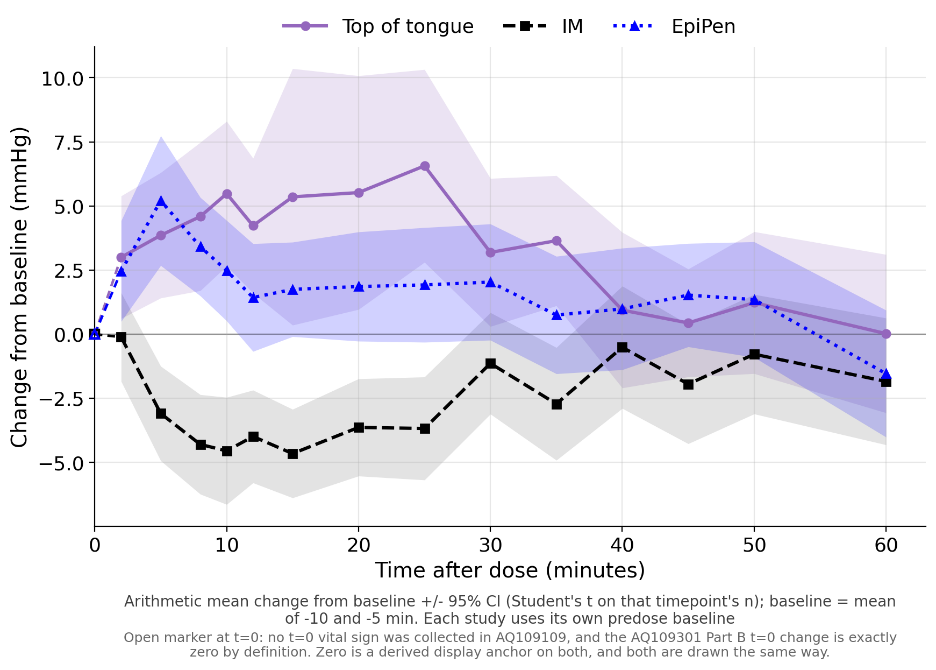
*Mean changes with
**Cross-study comparison of PD results for study AQ109109 for Anaphylm and the Manual Intra-Muscular Injection and EpiPen® results from AQ109301
From a tolerability perspective, there were no participants in the HF study and no subjects in the PK study who prematurely removed the film. In the PK study there were no serious adverse events, no serious events, and no events that led to study drug discontinuation.
Aquestive plans to include the HF and clinical PK study data as part of its Anaphylm NDA resubmission, which the Company is on track to complete in the third quarter of 2026. In parallel, the Company continues to advance regulatory submissions for Anaphylm in Canada, the UK, and the European Union.
A presentation containing additional information about the HF study data and the topline clinical study data is available on the Events and Presentations page within the Investor page of the Aquestive website.
About Anaphylm™ (dibutepinephrine) Sublingual Film
Anaphylm™ (dibutepinephrine) sublingual film is a polymer matrix-based epinephrine prodrug investigational drug product. Anaphylm is similar in size to a postage stamp, weighs less than an ounce, and begins to dissolve on contact. No water or swallowing is required for administration. The primary packaging for Anaphylm is thinner and smaller than an average credit card, can be carried in a pocket, and is designed to withstand weather excursions such as exposure to rain and/or sunlight. The Anaphylm trade name for AQST-109 has been conditionally approved by the FDA. Final approval of the Anaphylm proprietary name is conditioned on FDA approval of the product candidate.
About Aquestive Therapeutics, Inc.
Aquestive is a pharmaceutical company advancing medicines to bring meaningful improvement to patients' lives through innovative science and delivery technologies. The worldwide leader in delivering trusted, quality medications on oral film, Aquestive operates as both a developer of its own proprietary products and a Contract Development and Manufacturing Organization (CDMO) for licensees, with its headquarters in New Jersey and U.S.-based manufacturing facilities in Indiana. The Company is the exclusive manufacturer of four commercialized products marketed by its licensees across six continents using proprietary, best-in-class technologies like PharmFilm®. Aquestive's AdrenaVerse™ platform contains a library of more than 20 epinephrine prodrugs enabling the pursuit of various potential allergy and dermatological indications. The Company is advancing Anaphylm™ (dibutepinephrine) sublingual film for the treatment of severe allergic reactions, including anaphylaxis, and AQST-108 (epinephrine prodrug) topical gel for various potential dermatological conditions. For more information, visit Aquestive.com and follow us on LinkedIn.
Forward Looking Statements
This press release contains certain forward-looking statements within the meaning of the Private Securities Litigation Reform Act of 1995. Words such as “believe,” “anticipate,” “plan,” “expect,” “estimate,” “intend,” “may,” “will,” or the negative of those terms, and similar expressions, are intended to identify forward-looking statements. These forward-looking statements include, but are not limited to, statements regarding the results of the Company’s Human Factors (HF) validation study and pharmacokinetic (PK) study for Anaphylm™ (dibutepinephrine) sublingual film; the significance, interpretation and sufficiency of those study results; the Company’s belief that such results support its efforts to address concerns raised by the U.S. Food and Drug Administration (FDA) in the Complete Response Letter dated January 30, 2026; the planned resubmission of the Anaphylm New Drug Application (NDA) during the third quarter of 2026; the timing and outcome of FDA review of the NDA resubmission; potential international regulatory submissions for Anaphylm; and the potential benefits and commercial opportunity of Anaphylm, if approved.
These forward-looking statements are based on the Company’s current expectations and beliefs and are subject to a number of risks and uncertainties that could cause actual results to differ materially from those described in the forward-looking statements. Such risks and uncertainties include, but are not limited to, risks that preliminary, topline, interim or summary HF, PK or pharmacodynamic (PD) results may differ from final analyses or may be interpreted differently by regulatory authorities; risks associated with the FDA’s review of the Company’s study data and NDA resubmission; the possibility that the FDA may disagree with the Company’s interpretation of study results, findings or conclusions; the possibility that the FDA may request additional information, analyses, human factors studies, clinical studies or other data; delays in the regulatory approval process; the risk that the Company may be unable to successfully address all matters identified by the FDA in the Complete Response Letter; the risk that FDA review timelines may differ from the Company’s expectations; risks associated with obtaining regulatory approvals outside the United States; and other risks and uncertainties affecting the Company, including those described in the “Risk Factors” section and in other sections included in the Company’s Annual Report on Form 10-K, Quarterly Reports on Form 10-Q and Current Reports on Form 8-K filed with the U.S. Securities and Exchange Commission.
Given those uncertainties, you should not place undue reliance on these forward-looking statements, which speak only as of the date made. All subsequent forward-looking statements attributable to the Company or any person acting on its behalf are expressly qualified in their entirety by this cautionary statement. The Company assumes no obligation to update forward-looking statements after the date of this press release whether as a result of new information, future events or otherwise, except as may be required by applicable law.
PharmFilm® and the Aquestive logo are registered trademarks of Aquestive Therapeutics, Inc. All other registered trademarks referenced herein are the property of their respective owners.
Investor Contact:
Brian Korb
astr partners
brian.korb@astrpartners.com

FAQ
AI-generated questions and answers. How Rhea-AI works. Not financial advice.