
Astrotech Corporation Submits Proposal to NASA's Commercial Lunar Payload Services 2 Program
Astrotech (Nasdaq: ASTC) submitted a proposal to NASA’s Commercial Lunar Payload Services 2 (CLPS2) program.
Rhea-AI Summary
Astrotech (Nasdaq: ASTC) submitted a proposal to NASA’s Commercial Lunar Payload Services 2 (CLPS2) program. The Phase 1 proposal seeks about $20 million in non-dilutive funding for lunar mining and materials-processing technology demonstrations.
The initiative supports Astrotech’s long-term lunar industrial strategy, leveraging its prior Shuttle-era spaceflight heritage.
Positive
- CLPS2 Phase 1 proposal seeks about $20 million non-dilutive NASA funding
- Targets entry into emerging commercial lunar infrastructure and industrial market
- Leverages prior Space Shuttle, Mir and ISS spaceflight operations heritage
Negative
- Proposal submission is not a NASA selection, award or funding commitment
- Astrotech withholds confidential technical details, limiting investor visibility into proposal scope
Details
News Market Reaction – ASTC
In the Jun 30 session, ASTC declined 10.47%, reflecting a significant negative market reaction.
Data tracked by StockTitan Argus on the day of publication.
Key Figures
- Phase 1 CLPS2 proposal
- $20 million
- Non-dilutive NASA funding sought for initial lunar technology demonstrations
- CLPS/CLPS2 budget
- $10 billion
- Reported total budget for all NASA CLPS2 contracts
- Shelf registration capacity
- $200,000,000
- Aggregate initial offering price under S-3 shelf filed June 30, 2026
- ATM program size
- $24,492,819
- At-the-market common stock offering capacity via H.C. Wainwright
- Sales agent commission
- 3.0%
- Commission on aggregate gross proceeds under ATM agreement
- Shares outstanding
- 2,009,050 shares
- Common shares outstanding as of June 26, 2026 (S-3 prospectus)
- Quarterly revenue
- $343,000
- Revenue for quarter ended March 31, 2026
- Quarterly net loss
- $3.8 million
- Net loss for quarter ended March 31, 2026
Historical Context
-
Board authorized exploring sale of 1st Detect to fund lunar initiative.
-
TRACER 1000 received ECAC certification for wand swabbing in aviation security.
-
Board approved strategic lunar resource and infrastructure initiative for future manufacturing.
-
EN-SCAN launched Labrador HH-GC handheld GC for field VOC analysis.
-
Quarterly report showed lower revenue, reduced margins and continued net losses.
24h Move is the share-price change in the day after each event; other market factors may also have contributed.
Key Terms
clps2 technical
non-dilutive financial
shelf registration statement regulatory
at-the-market offering financial
quantum wafer manufacturing technical
AI-generated analysis. How Rhea-AI works. Not financial advice.




Proposal seeks approximately
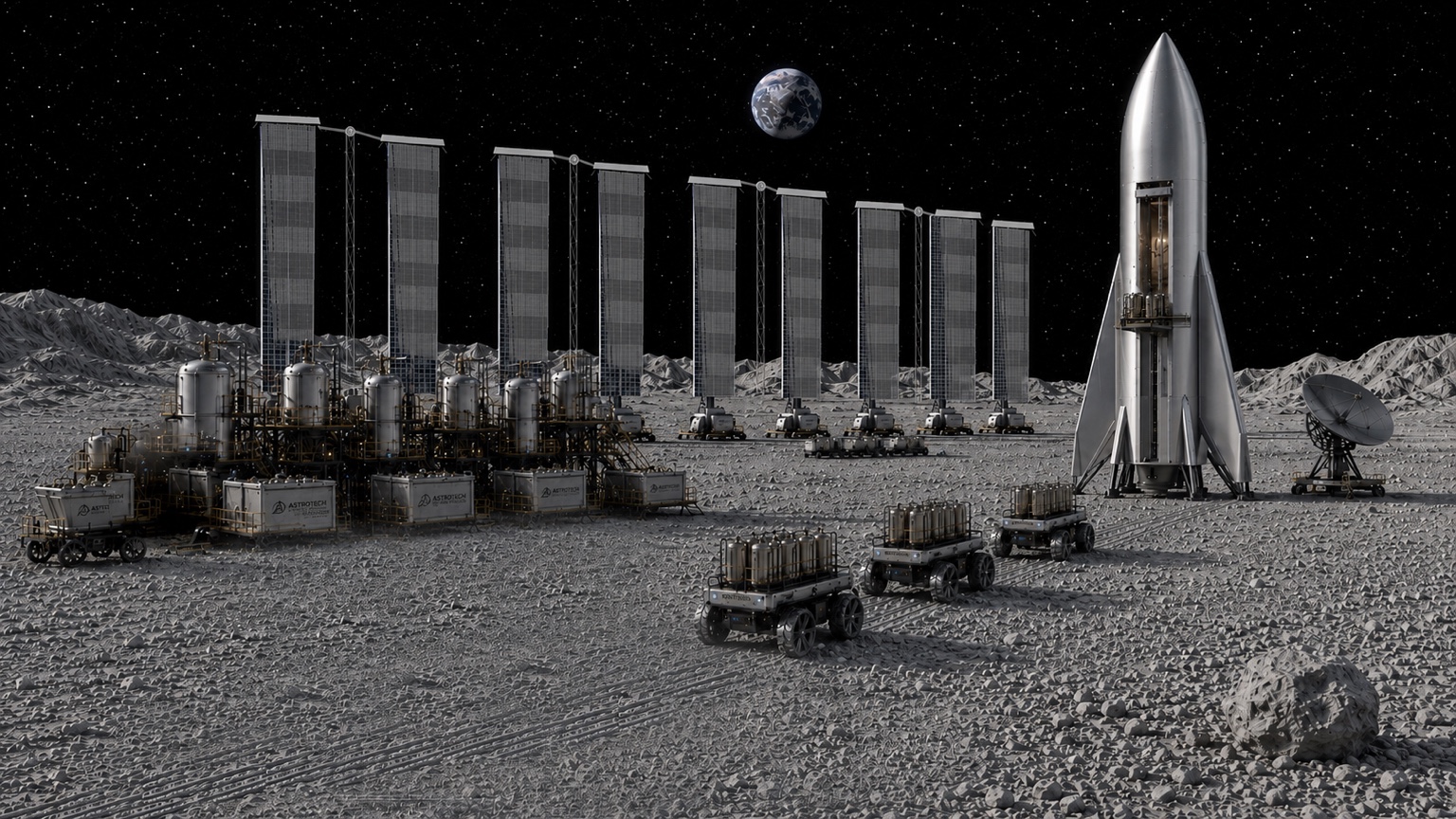
AUSTIN, Texas, June 30, 2026 (GLOBE NEWSWIRE) -- Astrotech Corporation (Nasdaq: ASTC) ("Astrotech" or the "Company"), a science and technology company with prior deep operational spaceflight heritage, today announced that it has submitted a proposal to NASA under the agency's Commercial Lunar Payload Services 2 ("CLPS2") program. Astrotech's Phase 1 proposal seeks approximately
Astrotech's proposal submission for technology demonstrations represents an important step in the Company's strategy to participate in the emerging commercial lunar infrastructure market and support future operations on the Moon.
Astrotech's CLPS2 proposal is part of the Company's broader lunar resources and infrastructure initiative, which is focused on evaluating and developing technologies and partnerships that could support lunar resource extraction, materials processing, autonomous industrial operations, oxygen production, silicon-28 ("Si-28") production, platinum group metals recovery, quantum wafer manufacturing, AI-enabled process control, a lunar commercial communications hub, solar-electric power generation, potential future nuclear power generation, and other advanced manufacturing applications that may benefit from the Moon's unique operating environment, including ultra-high vacuum conditions.
"Submitting this CLPS2 proposal formally introduces Astrotech's vision for a lunar industrial economy and marks the return to the Company's prior spaceflight heritage," said Thomas B. Pickens III, Chairman, Chief Executive Officer and Chief Technology Officer of Astrotech Corporation. "Astrotech previously identified what it believes to be significant long-term commercial value on the Moon, but the transportation infrastructure required to pursue that vision did not yet exist at the scale, cadence or cost structure needed to support a serious lunar industrial strategy. Today, with the growth of commercial launch and lander capabilities, NASA's Artemis campaign, and the CLPS and CLPS2 programs, we believe the foundation is being established for a new era of lunar industrial development.
"Our Phase 1 proposal seeks approximately
Astrotech's long-term lunar strategy contemplates a recurring-mission architecture designed to support the identification, extraction, transfer, processing and potential commercialization of lunar resources. The Company intends to pursue technologies and partnerships supporting autonomous excavation, lunar surface mobility, regolith handling, sealed material transfer, process control, thermal processing, advanced materials development for quantum computing and AI applications, and potential deployment of lunar processing, smelting or refining systems on the Moon.
Astrotech's lunar initiative is structured as a return to its prior spaceflight legacy spanning the Space Shuttle, Mir, International Space Station, commercial cargo and satellite-processing eras. This heritage includes the Company’s prior operations working with SPACEHAB, pressurized modules that supported Shuttle-era research, cargo and logistics missions. SPACEHAB hardware flew aboard Space Shuttle missions carrying experiments and supplies to low Earth orbit, Mir and the International Space Station.
"Operating beyond Earth demands discipline, reliability and experience," Pickens added. A successful lunar industrial venture will not be built on a single mission; it will require recurring missions, proven hardware and disciplined execution over time. Through our prior space operations heritage and Shuttle-era flight experience, Pickens has had experience with complex space missions repeatedly. We believe that experience is central to our strategy for lunar mining, materials processing, power generation and advanced manufacturing opportunities, including quantum computing and AI applications. "
Astrotech is not disclosing confidential details of its CLPS2 proposal, including proprietary technical architecture. Submission of the proposal does not constitute a NASA selection, award, contract, authorization, endorsement or commitment. Any selection, task order or funding, if made, would be made by NASA in accordance with applicable procurement rules.
About Astrotech Corporation
Astrotech Corporation (Nasdaq: ASTC) is a science and technology company headquartered in Austin, Texas. The Company creates, operates and scales innovative businesses through its subsidiaries and technology platforms, including space-related technology, advanced instrumentation, mass spectrometry, gas chromatography, process-control and environmental analysis technologies. Astrotech is evaluating opportunities to identify, develop and commercialize advanced technologies with potential applications in space, defense, industrial, environmental, quantum computing, AI, advanced semiconductor materials, lunar infrastructure and related markets.
Forward-Looking Statements
This press release contains forward-looking statements within the meaning of the Private Securities Litigation Reform Act of 1995. Forward-looking statements include, but are not limited to, statements regarding Astrotech's CLPS2 proposal; potential selection, award, task order issuance, Phase 1 funding from NASA, NASA funding for the estimated total proposed program requirement, NASA procurement ceilings, or performance under any NASA procurement; the Company's strategic lunar resources and infrastructure initiative; potential lunar mining, resource extraction, materials processing, smelting, refining, solar-electric power generation, future nuclear power generation, power sales, utility-style power services, commercial communications infrastructure, autonomous systems, Si-28, lunar-use oxygen, platinum group metals, quantum computing, AI, advanced semiconductor materials, future lunar base support, lunar transportation, recurring lunar missions, lunar surface operations, customer demand, partnerships, NASA funding, commercialization, and future lunar industrial activity; and the Company's ability to develop, validate, obtain NASA funding for, launch, operate, or commercialize any space-related technology or infrastructure.
Forward-looking statements may be identified by words such as "aims," "anticipates," "believes," "could," "expects," "intends," "may," "plans," "potential," "proposes," "seeks," "should," "targets," "will," "would," and similar expressions. These statements are based on current expectations, estimates, forecasts and assumptions and are subject to significant risks and uncertainties, many of which are beyond the Company's control.
Risks and uncertainties include, among others, the possibility that NASA does not select Astrotech for any CLPS2 award, task order or Phase 1 funding; the possibility that Astrotech does not receive approximately
No assurance can be given that Astrotech will receive a NASA award, task order, Phase 1 funding from NASA, or additional NASA funding from CLPS2 for the proposed program, or any portion of any NASA procurement ceiling; successfully develop lunar mining or processing systems; deploy lunar processing, smelting or refining systems; build lunar solar-electric or nuclear power infrastructure; provide utility-style lunar power services; support a future lunar base; develop or commercialize Si-28, quantum-computing, AI or advanced semiconductor applications; sell power, materials or services to third parties; or achieve any of the objectives described in this release. Forward-looking statements speak only as of the date of this release. Astrotech undertakes no obligation to update or revise any forward-looking statements except as required by law.
Contacts
| Company Contact: Scott Bartley Interim Chief Financial Officer Astrotech Corporation (512) 485-9530 | Investor Relations Contact: Matt Kreps Managing Director, Darrow Associates (214) 597-8200 mkreps@darrowir.com |

FAQ
AI-generated questions and answers. How Rhea-AI works. Not financial advice.