
Azincourt Energy Completes Harrier Prospecting Program and Commences Drilling at Snegamook Uranium Deposit
Two newly identified uranium showings bring Harrier's total to 16, while soil and assay results remain pending.
Sentiment and the balance of points
Rhea-AI Sentiment reads the wording of the document, how positive or negative its language is on a 1 to 5 scale. The balance of points shown with the takes weighs what the document actually discloses, so the two can disagree, for example when a trial that missed its main goal is described in upbeat language.
Rhea-AI Summary
Azincourt Energy (AZURF) has completed prospecting at its Harrier Project in Labrador and begun diamond drilling at the Snegamook uranium deposit. Drilling commenced in late September; following a later-than-expected start, the program is now expected to cover approximately 2,000 metres in 6 to 7 holes.
The work will test selected historical mineralized intervals and the extent of known mineralization. A possible first mineral resource estimate depends on historical-data verification, the 2026 results and sufficient data meeting Canadian NI 43-101 reporting requirements. Snegamook has no current or historical mineral resource.
Summer prospecting identified two new uranium showings, bringing Harrier's total to 16. Soil surveys collected 128 samples at Brook and 60 at Boiteau Central. Soil and assay results remain pending, with fieldwork intended to refine targets for potential drilling in 2027 and 2028.
Positive
- Minor point. Forward-looking: it has not happened yet and may not happen.Snegamook drilling is underway, with approximately 2,000 metres in 6 to 7 holes now expected.
- Minor pointSummer prospecting identified two new uranium showings, bringing Harrier's total to 16.
- Minor point. Forward-looking: it has not happened yet and may not happen.Snegamook work includes twinning selected historical holes and additional drilling to test mineralization extent.
- Minor pointBrook fieldwork identified parallel fractures with elevated radioactivity north and west of the known showing.
- Minor pointBrook's soil survey collected 128 samples to refine targets for potential 2027 drilling.
3 minor points
- Minor pointBoiteau Central's soil survey collected 60 samples to identify targets for potential 2027 or 2028 drilling.
- Minor point. Forward-looking: it has not happened yet and may not happen.Azincourt anticipates additional drilling at Anomaly 7 in 2027 following structural analysis.
- Minor pointSummer 2025 check samples returned 2.71% U3O8 over 10 cm at SN-08-06 and 0.35% over 10 cm at SN-08-18.
Negative
- Minor pointA later-than-expected start changed the expected scope of the 2026 Snegamook drilling program.
- Minor point. Forward-looking: it has not happened yet and may not happen.A possible first resource estimate depends on historical-data verification, 2026 results and sufficient compliant data.
- Minor pointHistorical exploration results remain not independently verified by Azincourt.
- Minor pointShort, selective check samples are not representative of historical interval grades, widths or the deposit generally.
- Minor pointSummer survey soil and assay results remain pending.
- Minor point. Forward-looking: it has not happened yet and may not happen.Anomaly 7 historical drill records require further review to assess whether holes adequately tested interpreted targets.
AI-generated analysis. How Rhea-AI works. Not financial advice.




Vancouver, British Columbia--(Newsfile Corp. - October 2, 2026) - AZINCOURT ENERGY CORP. (TSXV: AAZ) (OTCQB: AZURF) (FSE: A0U0) ("Azincourt" or the "Company"), is pleased to provide an update on the 2026 work program at the Harrier Project in the Central Mineral Belt in Labrador, Canada. The Company has completed prospecting and soil sampling across priority targets at the Harrier Project, and diamond drilling is now underway at the Snegamook uranium deposit.
About the Harrier Project
Azincourt's Harrier Project covers approximately 13,000 hectares across six licence groups in the Central Mineral Belt. The Harrier Project includes the Snegamook uranium deposit and straddles uranium-bearing structural corridors adjacent to and on trend with ATHA Energy Corp.'s Moran Lake C and Anna Lake deposits and Paladin Energy Ltd.'s Michelin deposit. Information concerning these nearby deposits is provided below for regional context only and is not necessarily indicative of mineralization at the Harrier Project.
More than a dozen uranium mineralization zones have been identified across the Harrier Project, with historical surface rock samples returning grades of up to
2026 Diamond Drilling Program
The diamond drilling program commenced in late September and due to a later than expected start is now expected to consist of approximately 2,000 metres in 6 to 7 drill holes at the Snegamook uranium deposit. The program is designed to provide additional geological and confirmatory information that may support the Company's evaluation of a potential future mineral resource estimate, subject to verification of the historical data, the results of the 2026 program and the availability of sufficient data meeting applicable NI 43-101 requirements.
"With prospecting completed and drilling now underway at Snegamook, we are moving into the next phase of exploration at Harrier," said Mark Tommasi, CEO of Azincourt Energy. "Our immediate focus is to test selected historical mineralized intervals at Snegamook, while using the summer fieldwork to prioritize targets across the broader project. This work will help guide future drilling and assess the potential for a maiden mineral resource estimate at Snegamook."
Snegamook Uranium Deposit
The priority for the 2026 exploration program is diamond drilling at the Snegamook uranium deposit. Historical drilling completed in 2007 and 2008 identified uranium mineralization approximately 1.3 kilometres southeast of the Two-Time uranium deposit. Seventeen historical drill holes intersected a 20- to 50-metre-wide section of uranium-bearing, brecciated and altered monzodiorite characterized by moderate to strong chlorite, hematite, and carbonate alteration, which is interpreted to represent a geological setting similar to the Two-Time uranium deposit. (Figures 3 and 4).
The Two-Time uranium deposit is hosted by brecciated, and fractured monzodiorite to diorite gneiss of the Kanairiktok Intrusive Suite. Uranium mineralization is breccia-hosted and occurs within an extensive zone of hematite, chlorite and carbonate alteration. A resource was prepared on behalf of Silver Spruce Resources and Universal Uranium in June 2008 and reported an indicated and inferred resource of 6.1 million pounds U₃O₈. (Ross, 2008). Although prepared in accordance with NI 43-101 this report was never finalized or filed and cannot be relied upon as being a compliant resource report.
As part of Azincourt's ongoing review of historical exploration data and available core, check sampling was completed during the summer 2025 prospecting program. A 10 cm check sample collected from drill hole SN-08-06 returned a grade of
There is no current or historical mineral resource for the Snegamook uranium deposit. Work to be conducted as part of the 2026 drill program will include:
- Rehabilitating and examining historical drill core from the Snegamook uranium deposit at the Kanairiktok core storage facility;
- Engaging an independent Qualified Person to examine available core and consult on additional drilling in connection with potential future mineral resource work;
- Twinning selected historical drill holes to confirm mineralization; and
- Completing additional drilling to test the extent of known mineralization.
Diamond drilling, historical core review, and the collection of additional confirmatory data are priorities for Azincourt as it evaluates the preparation of a possible maiden NI 43-101 compliant mineral resource estimate for the Snegamook uranium deposit.
All activities for the work program are being conducted from the Florence Lake Exploration Camp approximately 170 km north of Goose Bay, Labrador, under the supervision of C. Trevor Perkins, Azincourt's Vice President of Exploration. Camp and helicopter services have been contracted through Titjaluk Logistics Ltd. of Roddickton, Newfoundland, with drilling services contracted through Quesnel Brothers Diamond Drilling Ltd. of Denare Beach, Saskatchewan.
2026 Summer Prospecting Program
The summer prospecting program was conducted during the last two weeks of August and consisted of helicopter-supported surveys over key previously identified uranium occurrences and prospecting of previously identified radiometric anomalies. A crew consisting of one pilot, two geologists, including Trevor Perkins, Azincourt's Vice President of Exploration, and six prospectors conducted the field program. The purpose of this program was to expand the target inventory on the project and prepare the higher priority targets for an anticipated 2027 diamond drilling program.
Three historical and previously identified uranium showings were visited where additional structural, soil and radiometric data was collected to get a better understanding of the characteristics and geological settings of these uranium occurrences. More detailed information related to these surveys will be provided once soil sample results have been received.
Extensive prospecting of untested airborne radiometric anomalies across the remaining claims was conducted, and two new uranium showings have been identified in the southern Boiteau Lake area and northwest of the Brook showing bringing the total number of uranium showings on the property to 16. More information related to these showings will be provided once assay sample results have been received.
Brook Showing
The Brook Showing consists of a north-trending, steeply dipping mineralized vein/fracture in a granitic gneiss. A sample collected in 2025 returned
Additional investigation during this program has identified parallel north-trending fractures with elevated radioactivity several metres to the north and west of the known showing. A square soil survey grid was placed over the showing area and 128 samples were collected. The soil survey was designed to help trace the identified mineralized fractures beneath soil and vegetation cover and refine targets for a potential 2027 drill program.
Boiteau Lake Group
The Boiteau Lake Group is the northernmost block of the Harrier Project and straddles the Kanariktok Bay Shear Zone (KSZ, Figure 1). The licences are underlain by a sequence of sandstone, conglomerate, and massive volcanic flows. The Boiteau Lake Group is located in a different structural setting than the rest of the Harrier Project.
Airborne magnetics, Landsat imagery, air photo interpretation and ground investigation identified a 12 km long, northeast-trending structural corridor located in the heart of the Boiteau claims. Significant uranium mineralization was found in 2008 in nine separate bedrock showings grouped in three key areas (Main, Central, North) over a strike length of nearly 4.5 km. Historical boulder samples returned grades including
The Boiteau Central showing consists of a sequence of steeply dipping splayed fractures containing pitchblende (News Release dated October 1, 2025) in slatey grey metasediments in the footwall of a significant southwest trending fault and trending perpendicular to that fault. Outcrop samples from 2024 in these fractures returned grades of up to
A rectangular soil survey grid was placed over the showing area and 60 samples were collected. The soil survey was designed to help trace the identified mineralized fractures beneath cover and identify parallel target trends for potential drilling in 2027 or 2028.
Anomaly 7
The Anomaly 7 Prospect was first discovered in the 1970s. Mineralized occurrences have been mapped over 3.5 km of strike. In 2024 an outcrop sample returned values of
Mineralization appears as pitchblende and secondary uranophane hosted in north-northwest trending steeply dipping veins where these veins intersect a series of parallel east-northeast trending hematite-altered breccias. Old drill pads were found along the edge of the anomaly. Further review of the historical drill records is needed to assess whether these holes adequately tested the optimal target on the interpreted mineralized structures. (News Release dated October 1, 2025).
A more detailed structural analysis of the main mineralized outcrop and along trend to the east was conducted to better understand the setting of the mineralization. It is believed that historical drilling on this anomaly may not have targeted the optimal mineralization trend and it is anticipated that additional drilling will be conducted on this target in 2027.
"This program has improved our understanding of the structural controls at these priority targets," commented Trevor Perkins, Vice President of Exploration. "Integrating the structural mapping, radiometric surveys and soil sampling data will help us refine and prioritize these targets for future drilling. Additional showings across Harrier also warrant further exploration."
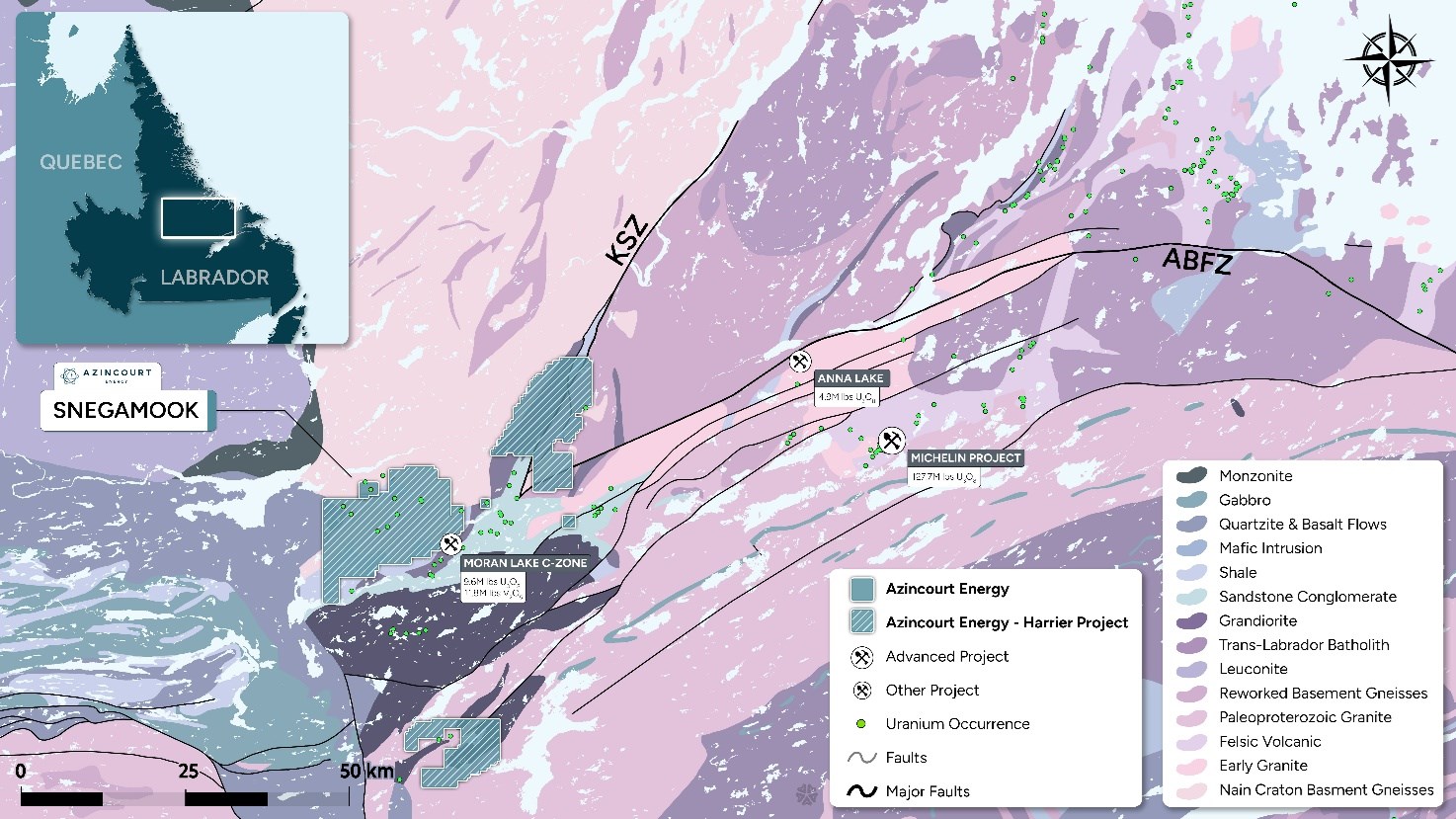
Figure 1: Azincourt land position overlain on the geology of the Central Mineral Belt, Labrador, Canada. Known uranium deposits and reported mineral resources are also shown.**
To view an enhanced version of this graphic, please visit:
https://images.newsfilecorp.com/files/6137/317113_90e7c2e664c938e4_002full.jpg
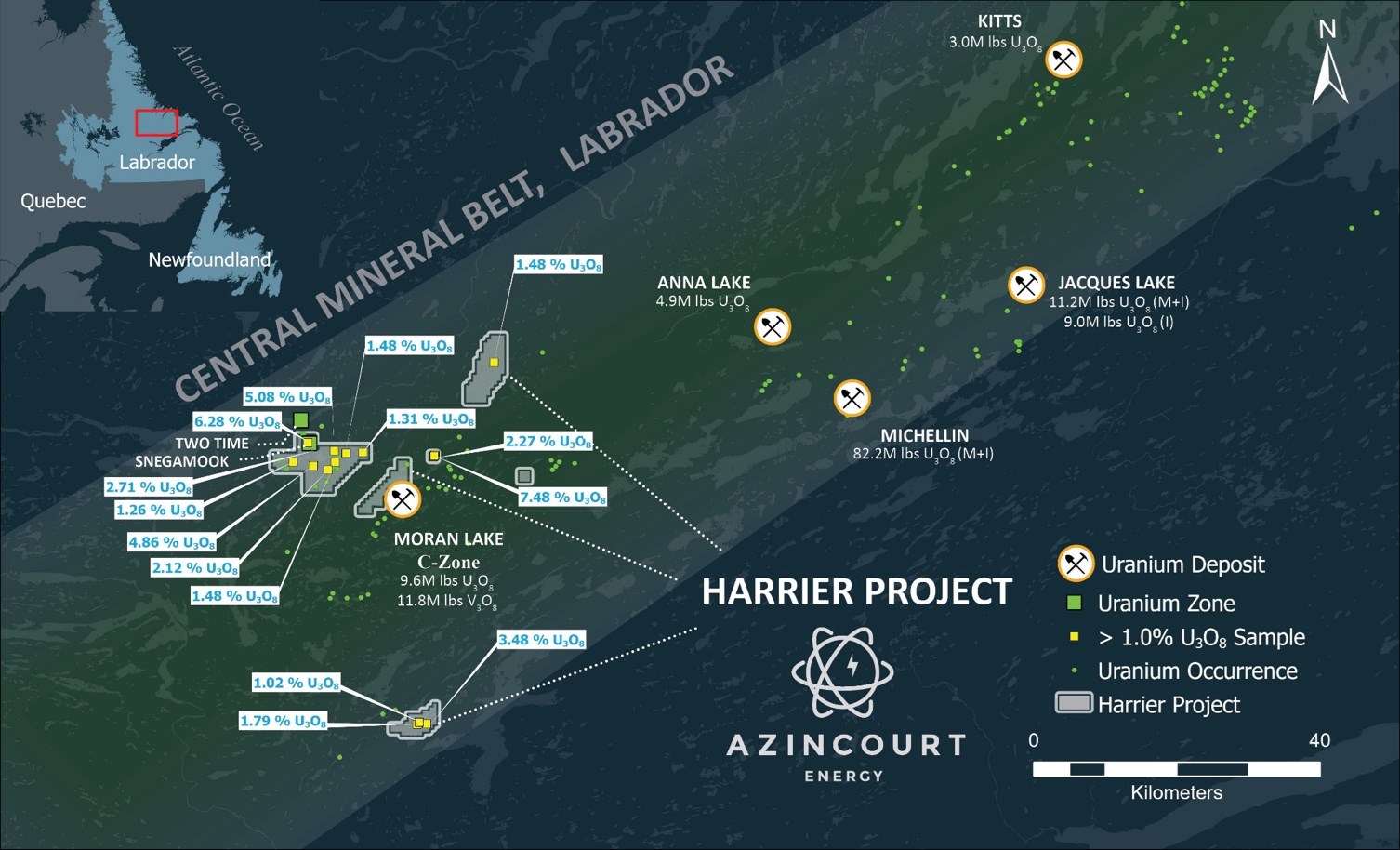
Figure 2: Azincourt's Harrier Project with uranium showings and grades highlighted. Known uranium deposits and reported mineral resources are also shown.**
To view an enhanced version of this graphic, please visit:
https://images.newsfilecorp.com/files/6137/317113_90e7c2e664c938e4_003full.jpg
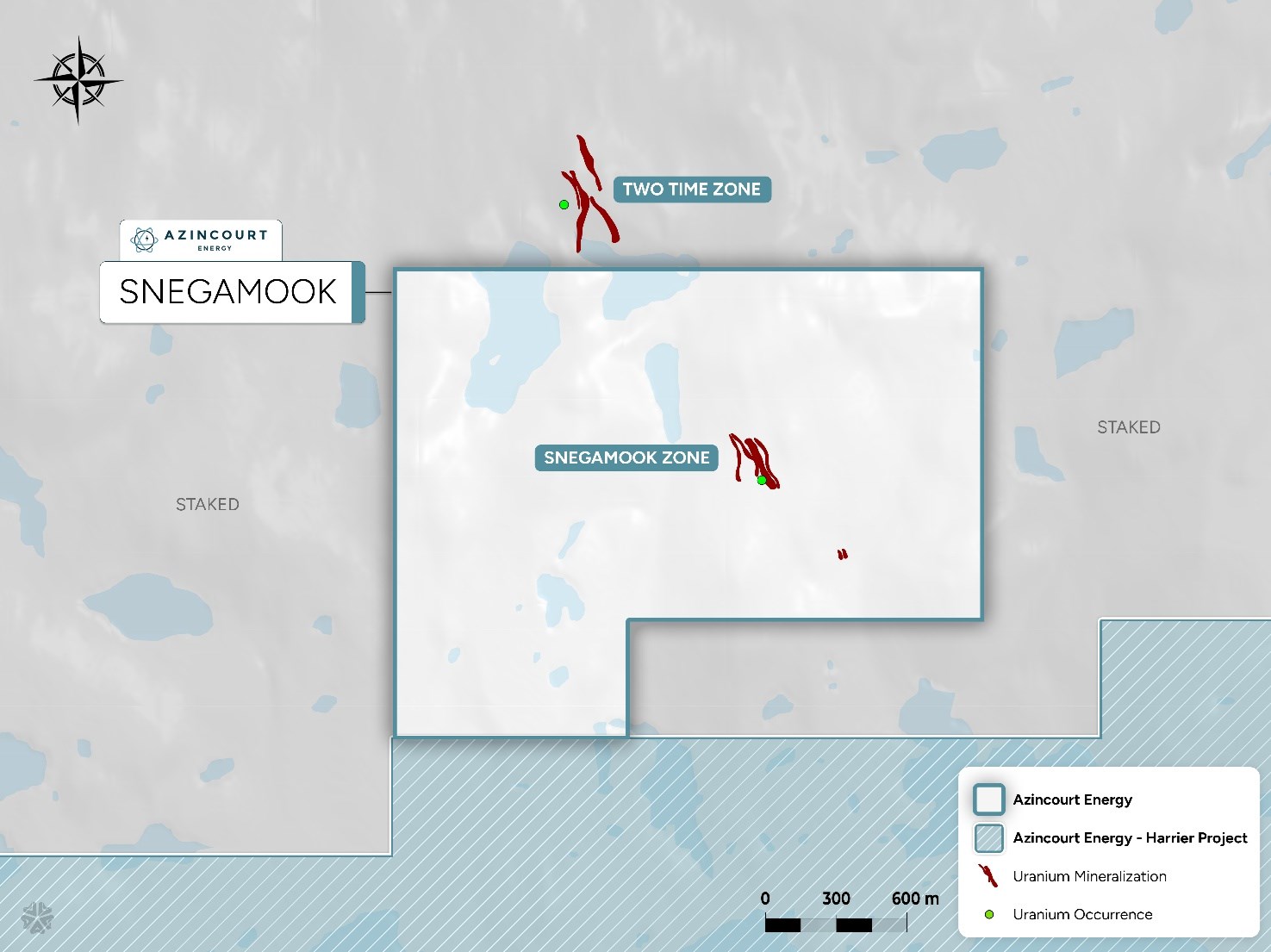
Figure 3: Snegamook and Two Time Zone mineralization map
To view an enhanced version of this graphic, please visit:
https://images.newsfilecorp.com/files/6137/317113_90e7c2e664c938e4_004full.jpg
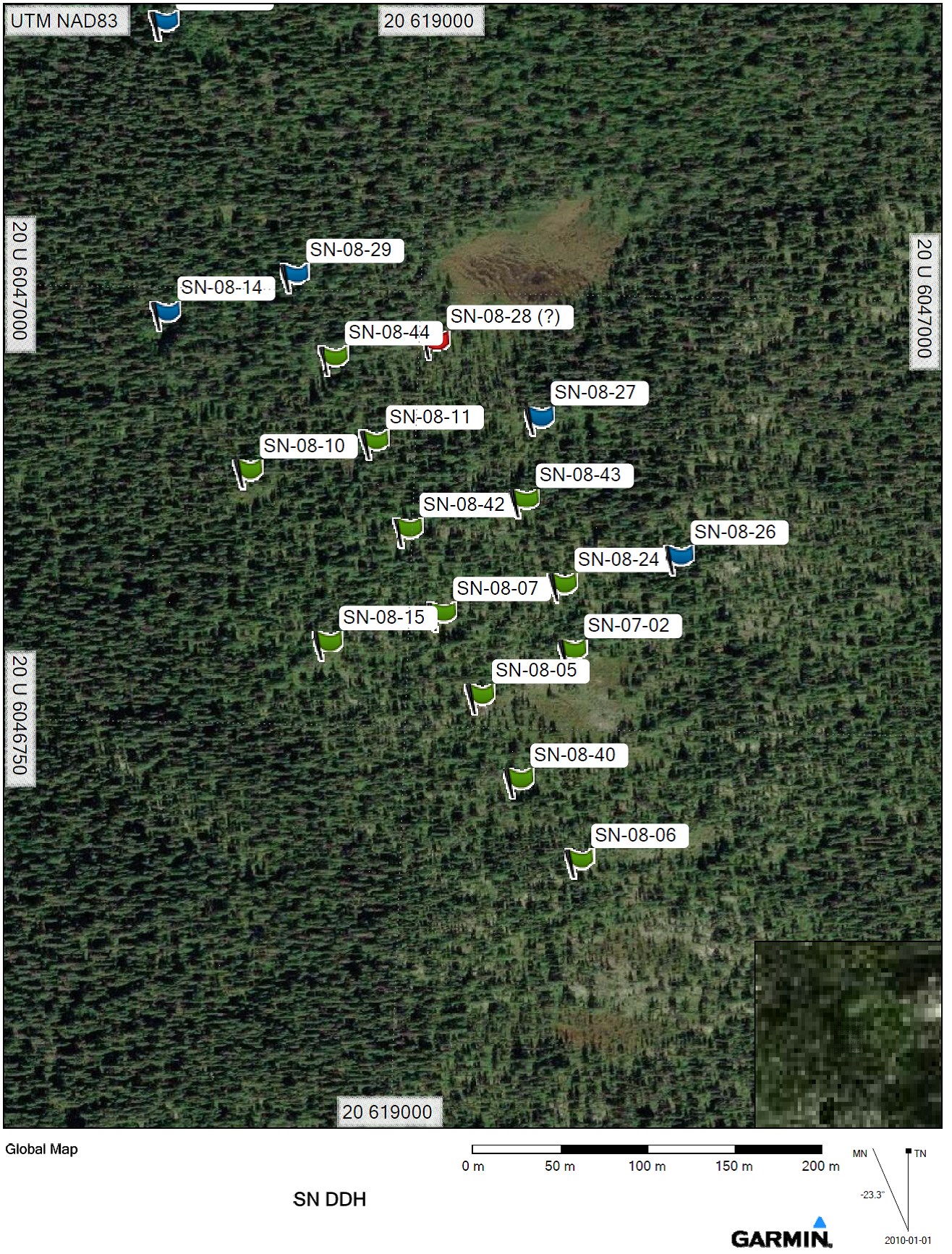
Figure 4: Snegamook Deposit Historical Drilling Map.
To view an enhanced version of this graphic, please visit:
https://images.newsfilecorp.com/files/6137/317113_90e7c2e664c938e4_005full.jpg
About the Central Mineral Belt
Labrador's Central Mineral Belt ("CMB") hosts numerous uranium and base-metal deposits and showings and has experienced renewed exploration activity as interest in secure uranium supply has increased. To date there has been no uranium production in the CMB.
The CMB includes Paladin Energy's Michelin Uranium Project, consisting of 6 deposits including Michelin and Jacques Lake, reported to contain a total mineral resource of 127.7 million pounds U₃O₈ (Paladin Annual Report 2026), the historical Moran Lake C deposits, reported to contain an indicated and inferred resource of 9.3 million pounds U₃O₈ and 25.3 million pounds V₂O₅, (Morgan and Giroux, 2008), and the historical Anna Lake deposit, reported to contain an inferred resource of 4.9 million pounds U₃O₈ (Fraser and Giroux, 2009). These third-party figures are provided for regional context only, have not been independently verified by Azincourt and are not necessarily indicative of mineralization at the Harrier Project.
The Company believes the CMB remains prospective for additional uranium discoveries, while recognizing that further exploration is required to evaluate targets on the Harrier Project.
Qualified Person
The technical information in this news release has been prepared in accordance with the Canadian regulatory requirements set out in National Instrument 43-101 and reviewed and approved on behalf of the Company by C. Trevor Perkins, P.Geo., Vice President, Exploration of Azincourt Energy, and a Qualified Person as defined by National Instrument 43-101.
About Azincourt Energy Corp.
Azincourt is a Canadian-based resource company specializing in the strategic acquisition, exploration, and development of alternative energy/fuel projects, including uranium, lithium, and other critical clean energy elements. The Company is currently active at its East Preston uranium project located in the Athabasca Basin, Saskatchewan, and its Snegamook and Harrier uranium projects, located in the Central Mineral Belt of Labrador.
*The historical sample results, interpretation and drill intersections described herein have not been verified and are extracted from news releases issued by Silver Spruce Resources Inc on April 24, 2008, and August 12, 2008, as well as annual Management Discussion and Analysis documents filed on www.sedarplus.ca, and Koba Resources Limited on April 11, 2024, and August 20, 2024, which can be found at www.kobaresources.com/investors/asx-announcements/. The historical unpublished resource estimate for the Snegamook Deposit was extracted from an incomplete report and data obtained by the Company from Silver Spruce Resources in 2025. The Company has not completed sufficient work to confirm and validate any of the historical data contained in this news release. The Company considers the historical work a reliable indication of the potential of the Harrier Project and the information may be of assistance to readers.
**The information on the Michelin, Moran Lake C, and Anna Deposits has been extracted from the websites and investor presentations of Paladin Energy Limited (www.paladinenergy.com) and Atha Energy Corp (www.athaenergy.com) and the relevant reports as listed here:
Paladin Annual Report 2026, available at www.paladinenergy.com reports on page 36 that the total JORC compliant Mineral Resources and Ore Reserves for the Michelin Project consist of a measured reserve of 17.8 million tonnes at
"Morgan, J.A., and Giroux, G.H. 2008. Form 43-101 technical report on the Central Mineral Belt (CMB) uranium project, Labrador, Canada, Prepared for Crosshair Exploration & Mining Corp., July 31, 2008", reports the Moran Lake Upper C-Zone has an indicated mineral resource of 6.92 million tonnes at
"Fraser, R.D., and Giroux, G.H., 2009. Form 43-101 Technical Report on the Anna Lake Uranium Project, Central Mineral Belt, Labrador, Canada, prepared for Bayswater Uranium Corporation, September 30, 2009", reports the Anna Lake Deposit contains an inferred resource of 5.91 million tonnes at
"Ross, D.A., 2008. Technical report on the CMBNW Property, Labrador, Canada, Prepared for Silver Spruce Resources and Universal Uranium Ltd., June 12, 2008", reports the Two Time Deposit contains an indicated resource of 1.82 million tonnes at
ON BEHALF OF THE BOARD OF AZINCOURT ENERGY CORP.
"Mark Tommasi"
Mark Tommasi, CEO
For further information please contact:
Mark Tommasi, CEO
Tel: (236)-229-2030
fair@azincourtenergy.myir.ai

Azincourt Energy Corp.
Suite 1012-1030 West Georgia St.
Vancouver, BC V6E2Y3
www.azincourtenergy.com
Cautionary Statement Regarding Forward-Looking Statements
This news release may contain certain "Forward-Looking Statements" within the meaning of the United States Private Securities Litigation Reform Act of 1995 and applicable Canadian securities laws. When or if used in this news release, the words "anticipate", "believe", "estimate", "expect", "target", "plan", "forecast", "may", "schedule" and similar words or expressions identify forward-looking statements or information. Such statements represent the Company's current views with respect to future events and are necessarily based upon a number of assumptions and estimates that, while considered reasonable by the Company, are inherently subject to significant business, economic, competitive, political, and social risks, contingencies and uncertainties. Many factors, both known and unknown, could cause results, performance, or achievements to be materially different from the results, performance or achievements that are or may be expressed or implied by such forward-looking statements. The Company does not intend, and does not assume any obligation, to update these forward-looking statements or information to reflect changes in assumptions or changes in circumstances or any other events affecting such statements and information other than as required by applicable laws, rules, and regulations.
Neither the TSX Venture Exchange nor its Regulation Services Provider (as that term is defined in the policies of the TSX Venture Exchange) accepts responsibility for the adequacy or accuracy of this release.
To view the source version of this press release, please visit https://www.newsfilecorp.com/release/317113
FAQ
AI-generated questions and answers. How Rhea-AI works. Not financial advice.
What is the scope of Azincourt Energy's 2026 Snegamook drilling program?
The program is now expected to consist of approximately 2,000 metres in 6 to 7 drill holes. Drilling began in late September after a later-than-expected start. Planned work includes twinning selected historical holes to confirm mineralization and additional drilling to test the extent of known mineralization.
What did Azincourt Energy discover during Harrier's summer prospecting program?
Prospecting identified two new uranium showings, one in the southern Boiteau Lake area and another northwest of the Brook showing, bringing the property's total to 16. Further information about these showings will follow receipt of assay sample results.
Why are Azincourt Energy's Snegamook check samples not representative of the deposit?
The check samples were short and selective, so they should not be treated as representative of historical interval grades or widths, or of the deposit generally. Each sample measured 10 cm: SN-08-06 returned 2.71% U3O8, while SN-08-18, from a showing southeast of Snegamook, returned 0.35% U3O8.