
Hadron Energy Appoints Previous TerraPower COO Eric Williams as Executive Vice President of Engineering
Hadron Energy (Nasdaq: HDRN) appointed Eric Williams as Executive Vice President of Engineering, effective August 31, 2026.




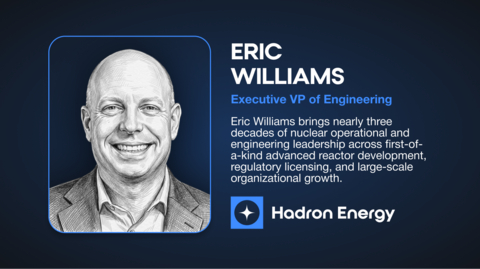
Previous TerraPower COO and Advanced Reactor Pioneer Joins Hadron to Lead its Engineering Organization as it Accelerates its Execution Toward Halo MMR Commercialization
The appointment represents a critical inflection point for Hadron as a newly public company (Nasdaq listing, May 2026), which continues to invest heavily in building a world-class innovative Engineering organization, now to be led by an industry-recognized expert. With zero debt on its balance sheet, recent NRC licensing milestones (Quality Assurance Program Description acceptance, Principal Design Criteria whitepaper submittal), and a growing portfolio of strategic partnerships (GSE Systems for simulator supply, ConverDyn for uranium fuel supply and conversion), Hadron is now positioned to accelerate the engineering execution, organizational scaling, and regulatory discipline required to bring a first-of-a-kind commercial microreactor to market at an accelerated timeline schedule. Eric's appointment signals Hadron's commitment to institutional-grade engineering leadership and the operational rigor expected of a public company executing on advanced nuclear technology, while joining the world renowned experts on Hadron’s leadership team.
A Track Record in First-of-a-Kind Advanced Reactor Leadership
Eric joins Hadron from TerraPower, where he spent the last 12 years of his career rising to the EVP and COO rank, overseeing all operational functions including Engineering, Nuclear Fuel, Regulatory Affairs, Supply Chain, Quality, and Operations across TerraPower's portfolio of advanced reactor projects. Under his operational leadership, TerraPower achieved a historic milestone: NRC approval of the Natrium Construction Permit, the first Construction Permit issued for a commercial advanced SMR design in
As Senior Vice President and Design Authority for the Natrium Demonstration Project, Eric served as Head of Engineering for the 345 MWe advanced SMR, with direct responsibility for all engineering and testing across the design, configuration management, technical decision-making, and project governance. During his tenure, he submitted the first NRC Construction Permit Application for a commercial advanced reactor, established the company's Design Control program and Design Authority functions, and developed the integrated decision-making process that guided engineering execution.
Prior to his operational roles, Eric scaled TerraPower's engineering organization from 60 to 180 engineers over a period of 4 years, established company-wide engineering standards and training, and reformed engineering procedures to implement NQA-1 quality assurance standards. His earlier career spans B&W mPower (small modular reactor safety analysis and design), Framatome (nuclear safety, severe accident analysis, and materials engineering for the operating reactor fleet), and roles in aerospace and space operations. Eric holds an M.B.A. from the University of Lynchburg and a B.S. in Mechanical Engineering from the University of
Strategic Leadership Role: Engineering Excellence for Commercialization
As EVP of Engineering, Eric will oversee Hadron's complete engineering organization including Hardware, Software, Systems, Product, Manufacturing, Test & Validation, Quality, Program Management, and Operations. As a member of the Executive Leadership Team, he will drive engineering strategy and product execution from concept through commercialization, establish engineering standards and technology roadmaps, optimize design for manufacturability and cost, lead organizational scaling, and manage the tight schedule toward commercialization of the Halo MMR.
“I have spent my career proving that advanced nuclear technology can be engineered, licensed, and deployed in
— Eric Williams, Executive Vice President of Engineering, Hadron Energy
“On behalf of the Hadron Board of Directors and Leadership team, I am delighted to welcome Eric on board. Eric brings exactly what a public company needs to execute on advanced nuclear: operational discipline, first-of-a-kind experience, NRC expertise, and the proven ability to build and scale engineering organizations in support of our aggressive GTM program. He sat in the room when TerraPower received the first Construction Permit for an advanced reactor. He has written NRC applications, managed billion-dollar projects, and built engineering cultures from scratch as part of a meaningful SMR industry pioneer. That experience is invaluable as we move into commercialization. With Eric leading engineering, our investors and customers can trust that our technical roadmap and delivery schedule are led by someone with highly relevant expertise.”
— Sam Gibson, Founder and Chief Executive Officer, Hadron Energy
About Hadron Energy, Inc.
Hadron Energy, Inc. (Nasdaq: HDRN) is an advanced nuclear technology company focused on developing the Halo Micro-Modular Reactor (MMR), a 10 megawatt-electric factory-manufactured, transportable light-water reactor. Engineered to deliver continuous, emission-free baseload power and heat with a multi-year refueling cycle, Hadron aims to meet growing demand for clean, scalable, and rapidly deployable energy. As an integrated designer, manufacturer, and owner-operator, Hadron Energy is dedicated to powering data centers, industrial and heavy-manufacturing facilities, remote communities, and grid stabilization. For more information, visit www.hadronenergy.com.
Forward-Looking Statements
This press release contains forward-looking statements within the meaning of U.S. federal securities laws, including, but not limited to, statements regarding the role of Eric Williams as the Company’s Executive Vice President of Engineering, regulatory approvals of the Halo MMR, and the engineering, development, licensing, and commercialization of the Halo MMR. Any statements contained herein that are not statements of historical fact may be deemed to be forward-looking statements. The words “anticipate,” “believe,” “continue,” “could,” “estimate,” “expect,” “intends,” “may,” “might,” “plan,” “possible,” “potential,” “predict,” “project,” “should,” “would” and similar expressions may identify forward-looking statements, but the absence of these words does not mean that a statement is not forward-looking. These forward-looking statements are based on certain assumptions and analyses made by the management of Hadron Energy in light of their experience and perception of historical trends, current conditions, and expected future developments, as well as other factors they believe are appropriate in the circumstances, and involve a number of risks and uncertainties, some of which are beyond Hadron Energy’s control, that may cause actual results or performance to be materially different from those expressed or implied by these forward-looking statements. Should one or more of these risks or uncertainties materialize, or should any of the assumptions being made prove incorrect, actual results may vary in material respects from those projected in these forward-looking statements. Hadron Energy undertakes no obligation to update or revise any forward-looking statements, whether as a result of new information, future events or otherwise, except as may be required under applicable securities laws.
View source version on businesswire.com: https://www.businesswire.com/news/home/20260810344929/en/
Investor and Media Contact
Hadron Energy Investor Center: https://www.hadronenergy.com/investor-relations
Samuel Gibson, Chief Executive Officer
sgibson@hadronenergy.com
Rory Rumore, CoreIR
rory@coreir.com
Source: Hadron Energy, Inc.