
Banyan Gold Intersects 1.05 g/t Gold over 52.8 metres and Bonanza-Grade Gold at Powerline Deposit, AurMac, Yukon, Canada
Rhea-AI Summary
Banyan Gold (BYAGF) reported new 2026 drill results from the western Powerline Deposit at the AurMac project in Yukon, including 1.05 g/t gold over 52.8 m in hole AX-26-892B and a bonanza-grade interval of 149.14 g/t gold over 0.4 m in AX-26-891, within 0.56 g/t over 169.2 m.
Additional highlighted intercepts include 1.18 g/t over 8.3 m within 0.51 g/t over 50.5 m (AX-26-873), 1.15 g/t over 13.9 m within 0.44 g/t over 51.5 m (AX-26-876), 1.37 g/t over 11.8 m including up to 9.78 g/t over 1.0 m (AX-26-878), and 1.01 g/t over 17.2 m within 0.73 g/t over 26.6 m (AX-26-895). The company said these results improve grade and continuity along the margins of Powerline’s near-surface higher-grade cores and support its resource conversion and expansion strategy.
Positive
- AX-26-892B: 1.05 g/t Au over 52.8 m within 0.87 g/t over 69.7 m
- AX-26-891: 149.14 g/t Au over 0.4 m within 0.56 g/t over 169.2 m
- AX-26-873: 1.18 g/t Au over 8.3 m within 0.51 g/t over 50.5 m
- AX-26-876: 1.15 g/t Au over 13.9 m within 0.44 g/t over 51.5 m, incl. 16.50 g/t over 0.3 m
- AX-26-878: 1.37 g/t Au over 11.8 m, incl. up to 9.78 g/t over 1.0 m
- AX-26-895: 1.01 g/t Au over 17.2 m within 0.73 g/t over 26.6 m, incl. 10.30 g/t over 0.5 m
Negative
- None.
News Explained
The main holder-facing change is 970,000 options that may increase common shares if exercised; the 149.14 g/t interval is only 0.4 metres.
On
The option grant creates a possible future increase in the common-share count, but the release describes exercisable options rather than an immediate issue of shares.
Although the headline calls
AI-generated analysis. How Rhea-AI works. Not financial advice.




VANCOUVER, BC / ACCESS Newswire / September 17, 2026 / Banyan Gold Corp. (the "Company" or "Banyan") (TSXV:BYN)(OTCQB:BYAGF) is pleased to report new results from western portions of the Powerline Deposit ("Powerline"), AurMac Project ("AurMac"), Yukon, Canada. Drillhole AX-26-892B intersected 1.05 g/t gold ("Au") over 52.8 metres ("m") and drillhole AX-26-891 intersected 149.14 g/t Au over 0.4 m, within a wider interval of 0.56 g/t Au over 169.2 m. The results demonstrate the potential to improve grade and continuity in known mineralized domains on the margins of Powerline's near-surface higher-grade cores. The drilling forms part of Banyan's ongoing 2026 drill program focused on resource conversion, expansion and delineation of higher-grade mineralized domains within and adjacent to the current Mineral Resource.
Highlights from Powerline:
AX-26-873 - 1.18 g/t Au over 8.3 m, within 0.51 g/t Au over 50.5 m
AX-26-876 - 1.15 g/t Au over 13.9 m within 0.44 g/t Au over 51.5 m, including 16.5 g/t Au over 0.3 m
AX-26-878 - 1.37 g/t Au over 11.8m, including high-grade of 7.37 g/t Au over 0.5m and 9.78 g/t Au over 1.0 m
AX-26-891 - 149.14 g/t Au over 0.4m and 0.63 g/t Au over 19.9 m, all within 0.56 g/t Au over 169.2m
For context, the 0.56 g/t Au over 169.2 m composite in AX-26-891 is materially influenced by the 149.14 g/t Au over 0.4 m interval. Excluding that interval, the remaining 168.8 m averages approximately 0.21 g/t Au with the lower mineralized zone of 0.63 g/t Au over 19.9m. High-densities of extensional quartz veins are present throughout the full interval.
AX-26-892B - 1.05 g/t Au over 52.8 m, within 0.87 g/t Au over 69.7 m
AX-26-895 - 1.01 g/t Au over 17.2 m within 0.73 g/t Au over 26.6 m; includes high-grade of 6.72 g/t Au over 0.6 m and 10.30 g/t Au over 0.5 m
"These results demonstrate the opportunity to improve the grade, extent and continuity of mineralized domains along the current margins of Powerline's near-surface higher-grade cores," stated Tara Christie, President and CEO. "Hole AX-26-892B returned 1.05 g/t Au over 52.8 m, while AX-26-891 intersected several higher-grade intervals, including 149.14 g/t Au over 0.4 m. Together, the results support our strategy of targeting areas that could improve the grade profile and confidence of the AurMac resource. Our 2026 and planned 2027 drilling will continue to test the extent and expansion potential of higher-grade domains."
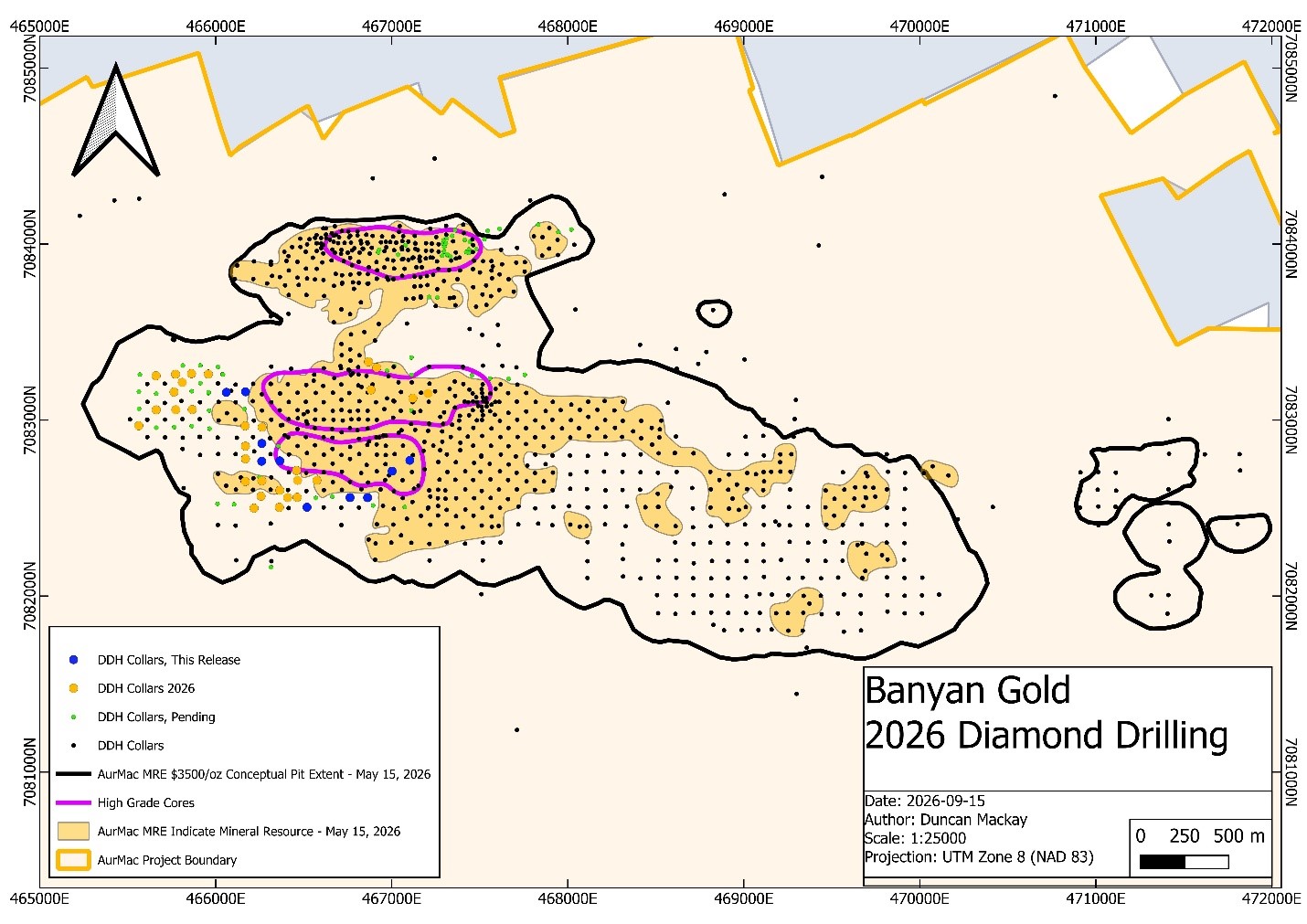
Figure 1: Plan map of AurMac, Yukon, Canada. Drillholes reported in this release highlighted in blue. Pending results are shown in green. Previously released 2026 drilling is shown in orange and all other diamond drilling in black. The reported holes extend higher-grade mineralized domains along the margins of Powerline's near-surface high-grade cores. Detailed drill hole maps and sections are included below with Powerline South (Figure 2), Powerline Southwest (Figure 3) and Powerline West (Figure 4).
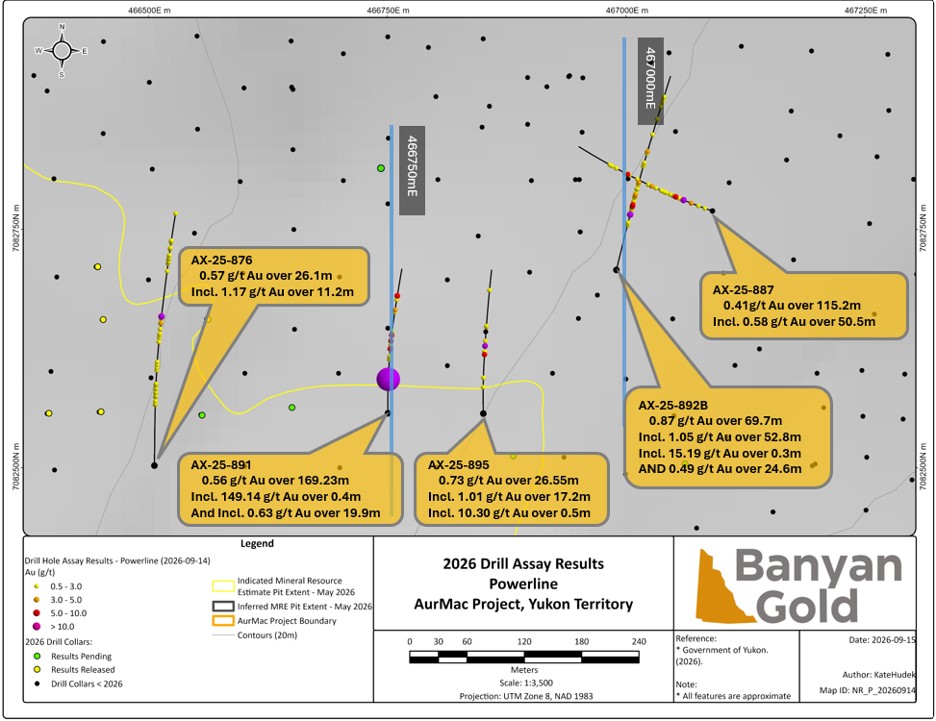
Figure 2: Plan map of Powerline South. Cross sections denoted by blue lines.
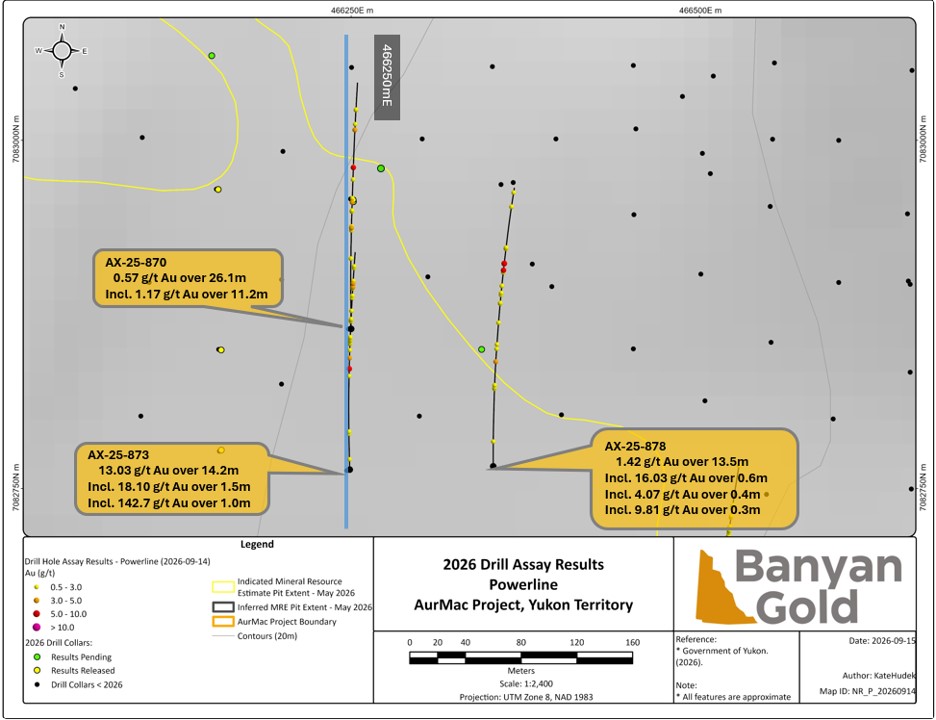
Figure 3: Plan map of Powerline Southwest. Cross sections denoted by blue lines.
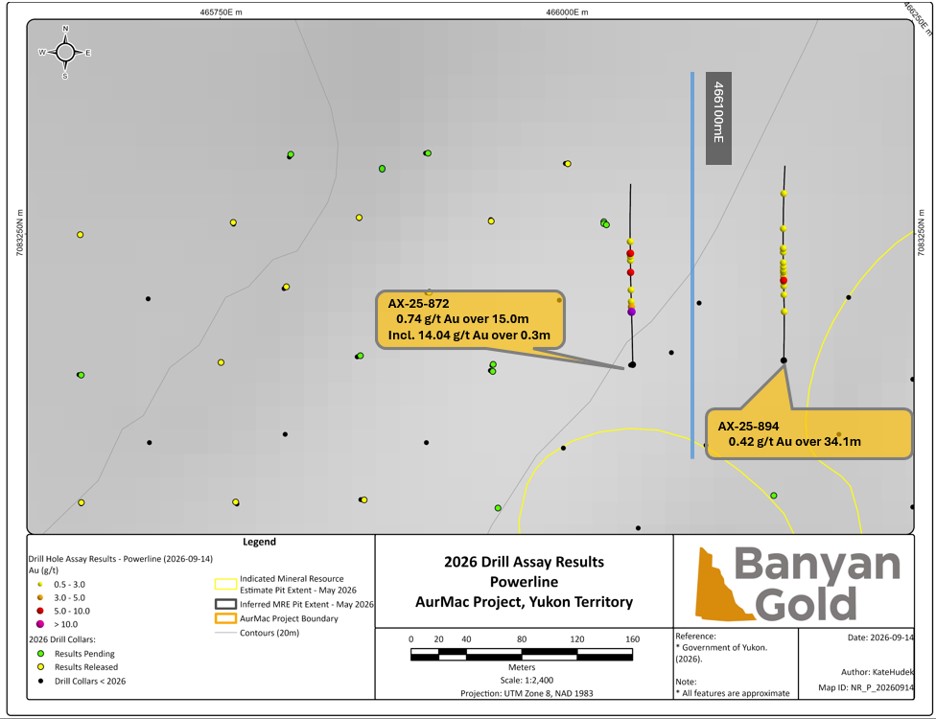
Figure 4: Plan map of Powerline West. Cross sections denoted by blue lines.
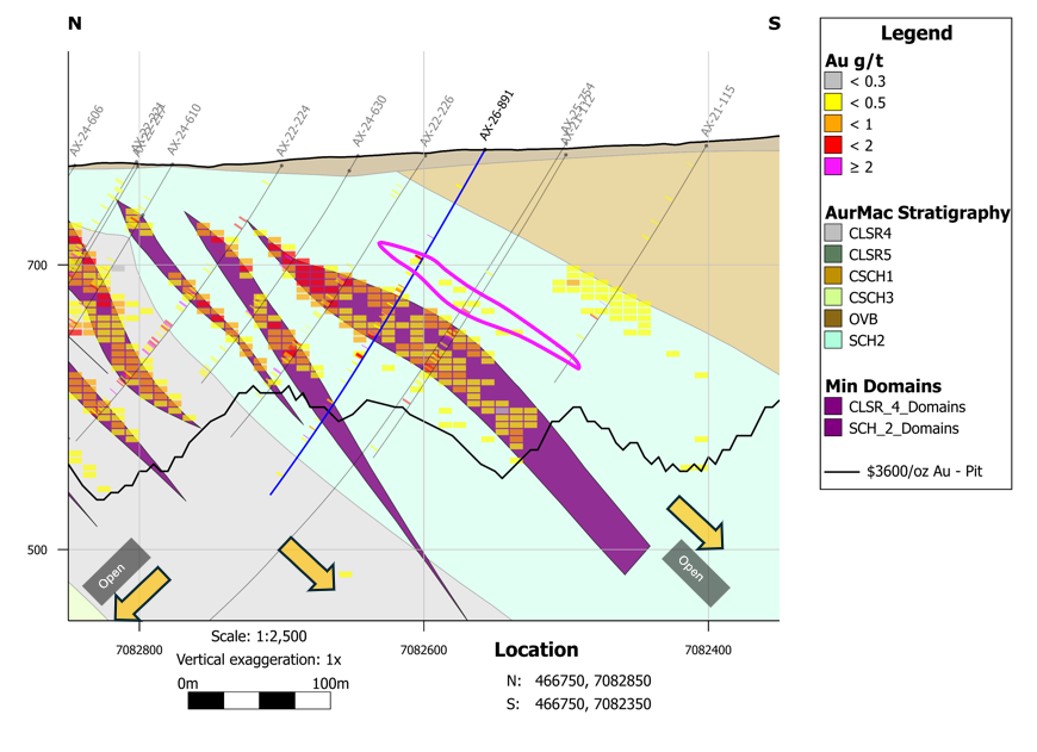
Figure 5: Cross-section 466750mE through Powerline South at AurMac. Mineralized domains are overlaid on the lithological model. Mineralization remains open down-dip at depth, with the high-grade interval in AX-26-891 (Figure 5) highlighting the potential to extend mineralized domains and upgrade domains on the margins of high-grade cores. The MRE block model is constrained by mineralized and lithological domains. Mineral Resource blocks are 10 m x 10 m x 5 m. Only blocks above the 0.30 g/t Au cut-off and within the US
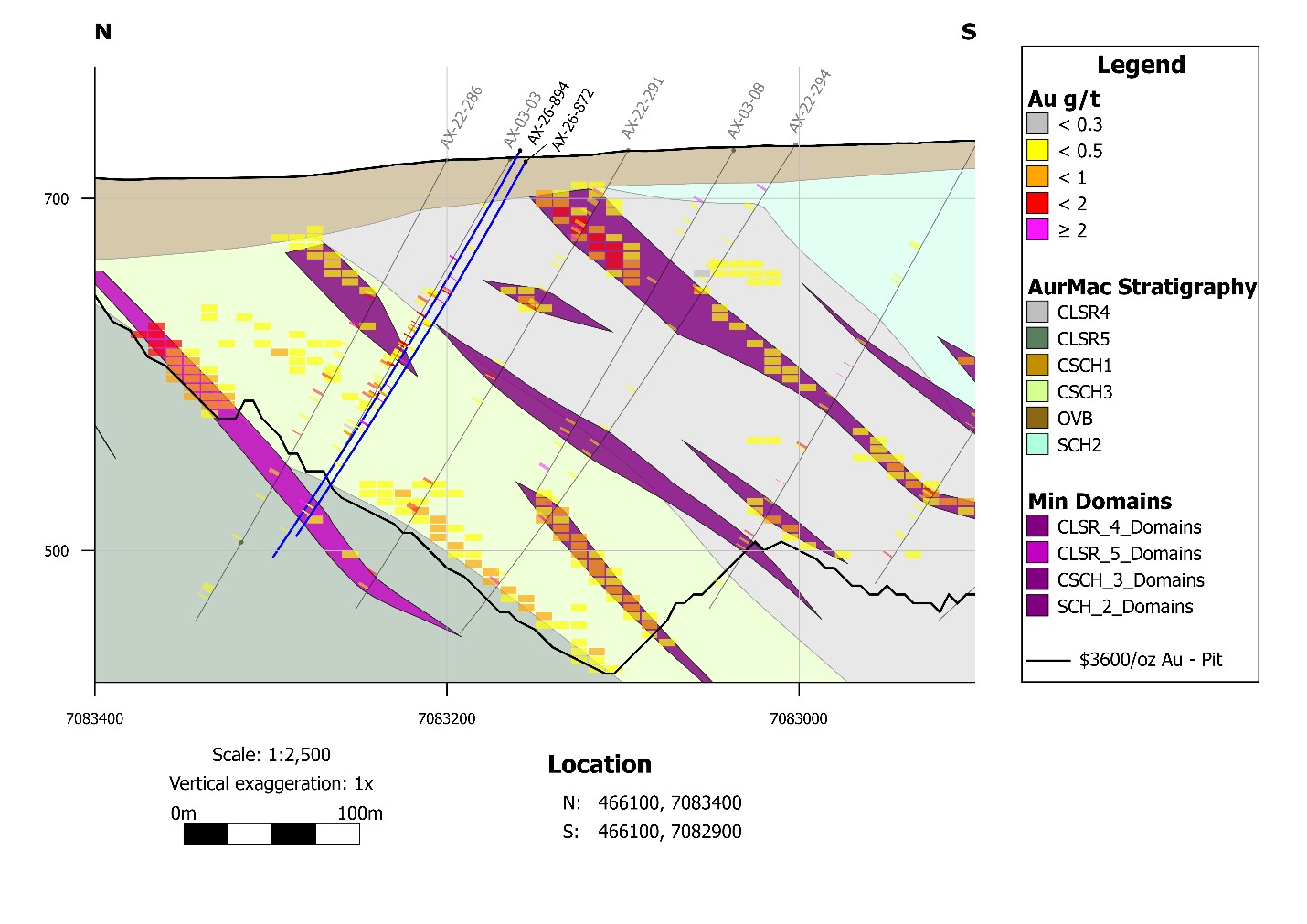
Figure 6: Cross-section 466100mE through Powerline West at AurMac. Mineralized domains are overlaid on the lithological model. Mineralization remains open down-dip at depth and highlights the potential to extend mineralized domains and upgrade domains on the margins of high-grade cores. The MRE block model is constrained by mineralized and lithological domains. Mineral Resource blocks are 10m x 10m x 5m. Only blocks above the 0.30 g/t Au cut-off and within the US
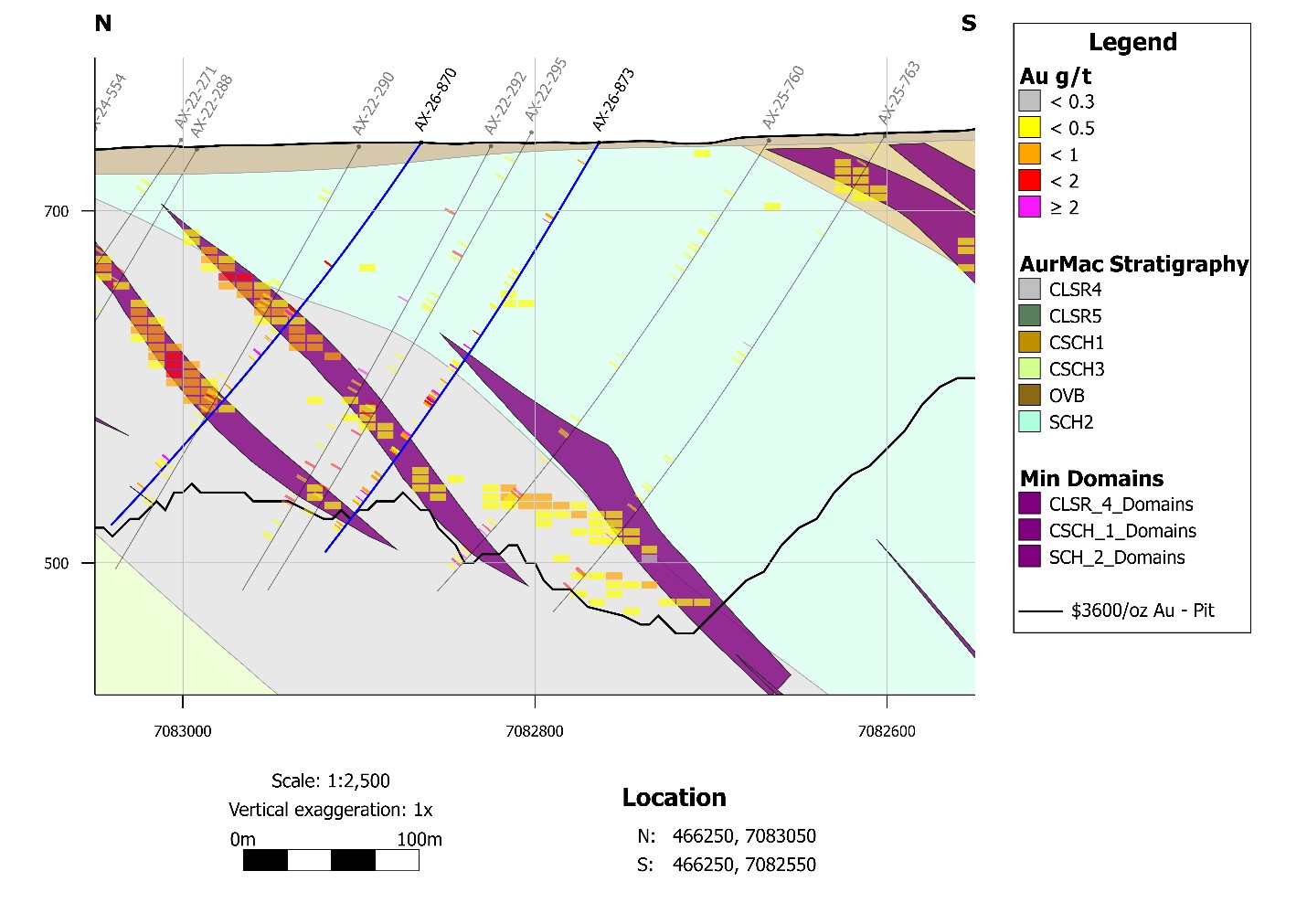
Figure 7: Cross-section 466250mE through Powerline Southwest at AurMac. Mineralized domains are overlaid on the lithological model. Mineralization remains open down-dip at depth, highlighting the potential to extend mineralized domains and upgrade domains on the margins of high-grade cores. The MRE block model is constrained by mineralized and lithological domains. Mineral Resource blocks are 10m x 10m x 5m. Only blocks above the 0.30 g/t Au cut-off and within the US
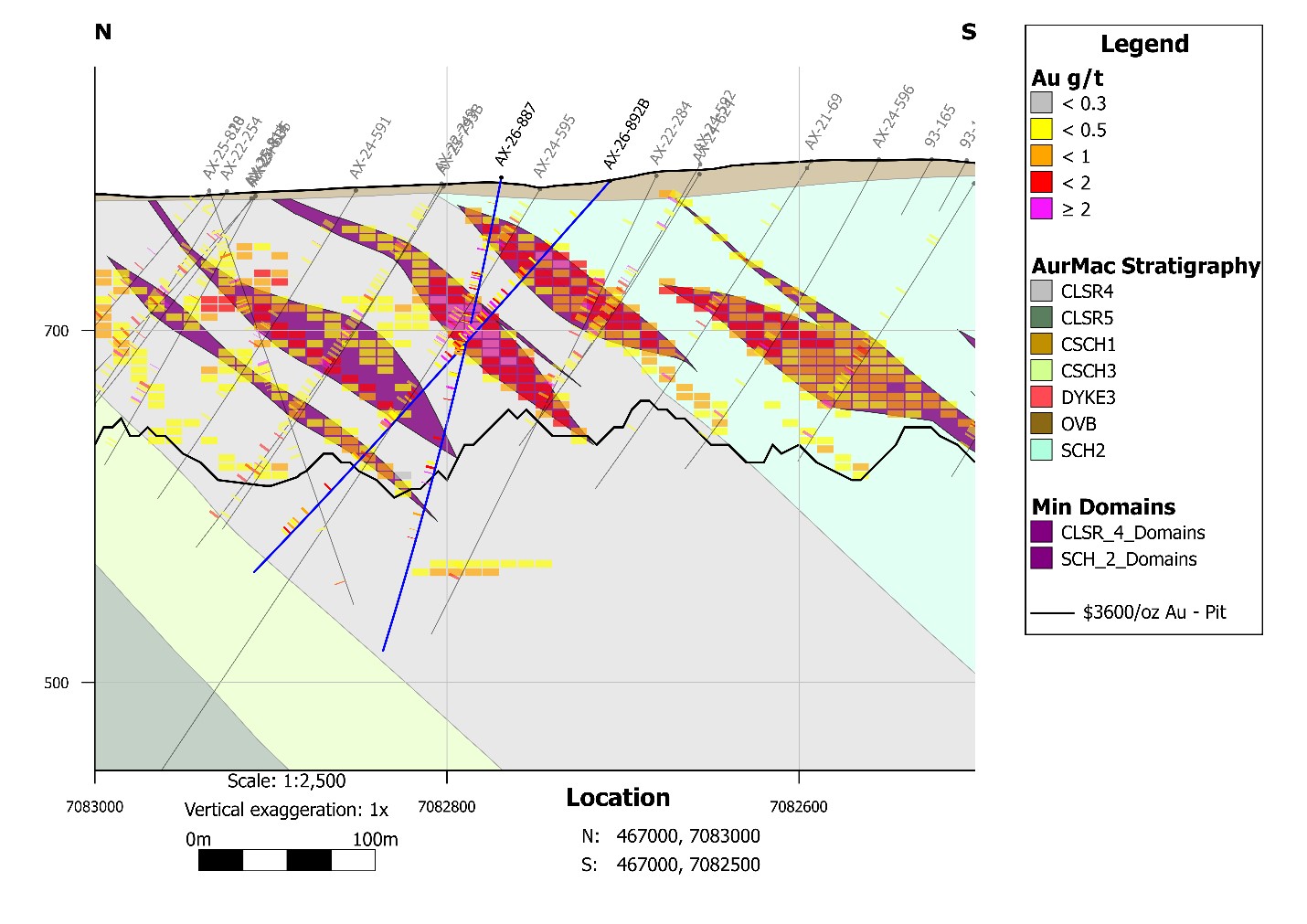
Figure 8: Cross-section 467000mE through Powerline South at AurMac. Mineralized domains are overlaid on the lithological model. Mineralization remains open down-dip at depth, highlighting the potential to extend mineralized domains and upgrade domains on the margins of high-grade cores within Powerline. The MRE block model is constrained by mineralized and lithological domains. Mineral Resource blocks are 10m x 10m x 5m. Only blocks above the 0.30 g/t Au cut-off and within the US
Lithological domains at Powerline are dominated by metasedimentary rocks of various compositions, typically mica-chlorite schists with varying calcareous content. Domains shown in this section are: CLSR_4 and 5 - chlorite-sericite schist; CSCH_1 and 3 - calcareous schist; and sch_2 - heterogeneous schist. Altered host rocks with intense silicification and meta-greenstones are preferential host for extensional quartz veining (Figures 9 and 11).
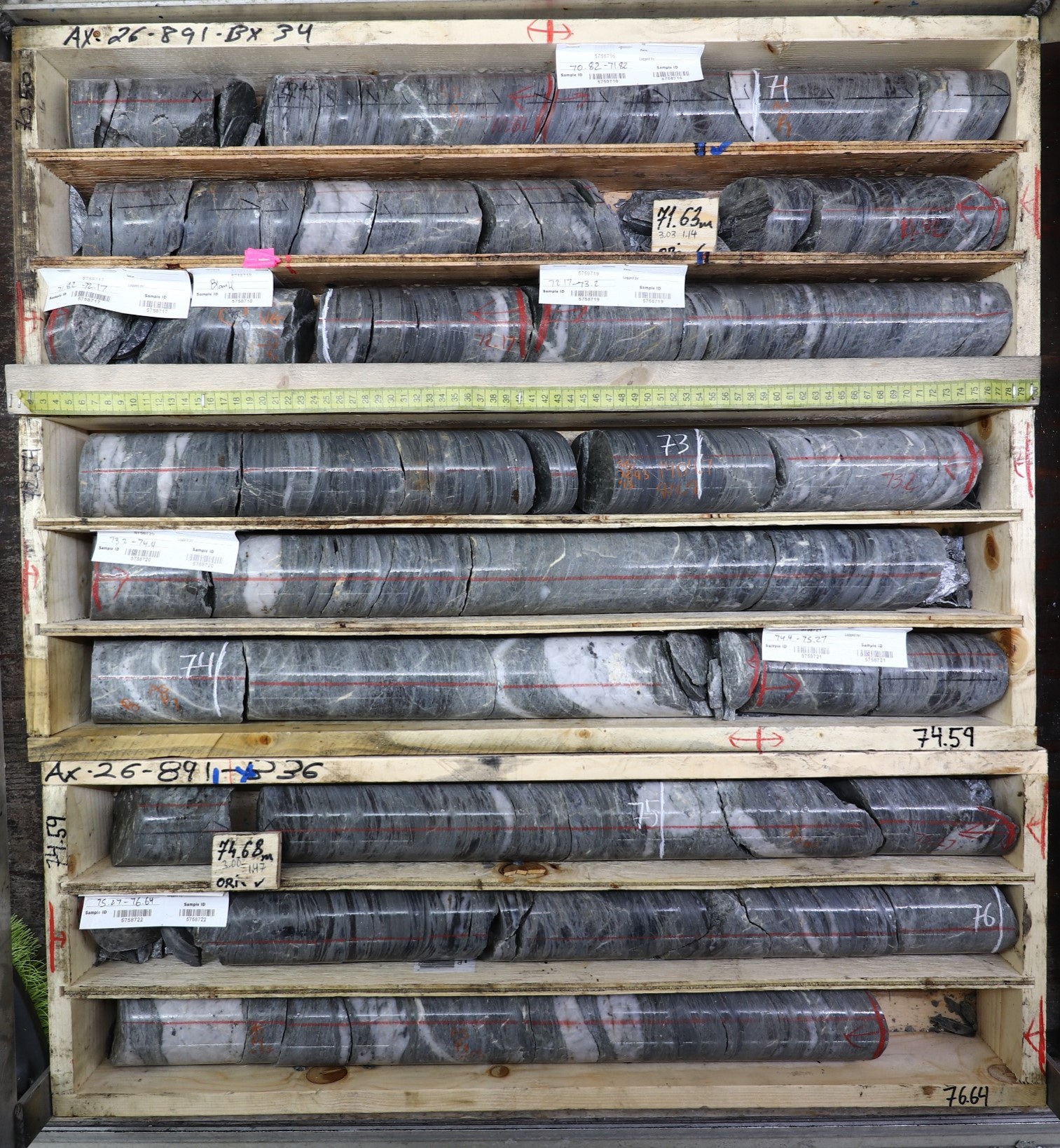
Figure 9: Mineralized extensional quartz veins in metasedimentary rocks in Powerline South from diamond drillhole AX-26-891. The large gold grain at 71.95 m is associated with Bonanza grade assay of 149.14 g/t Au over 0.4 m from an extensional quartz vein with arsenopyrite and sulphosalts, within a wider interval of 0.56 g/t Au over 169.2 m. High-density of extensional quartz veins (>3 veins/m) with bismuth-sulphosalts, arsenopyrite, and pyrite are present throughout the interval from 71.8-241.0m. Several other instances of visible gold were observed at 134.4 m, 150.6 m, 162.2 m and 238.0 m (Figure 10), all associated with individual assays >5.0 g/t Au over 0.3 to 0.5m.
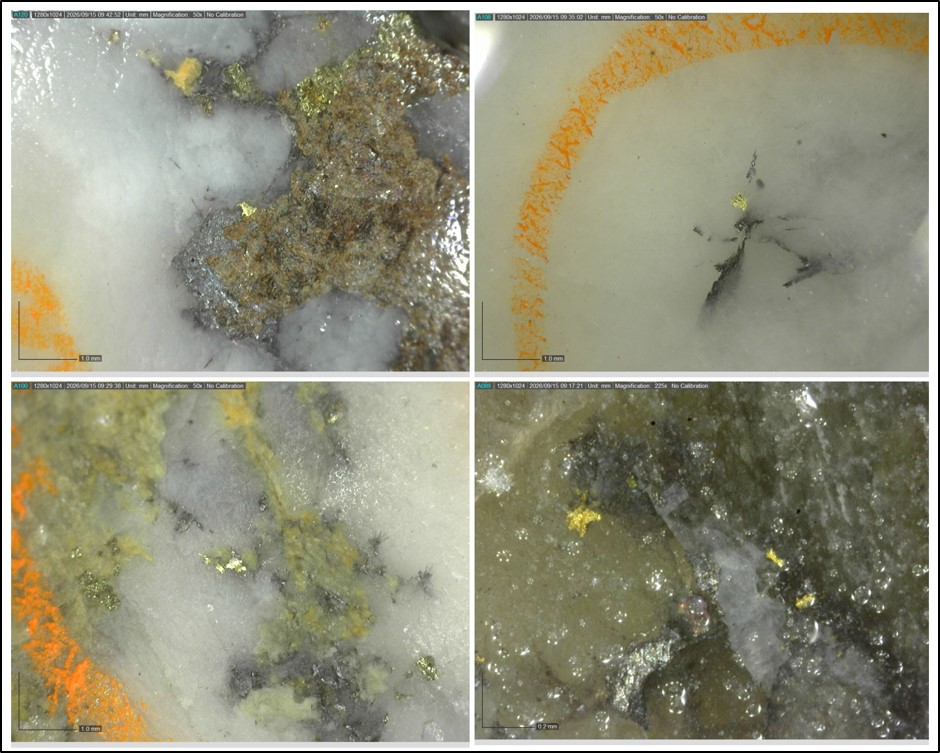
Figure 10: Visible gold occurrences in extensional quartz veins from Powerline: Top left: gold grain intergrown with arsenopyrite and sphalerite - AX-26-891 at 134.4 m. Top right: gold grain intergrown with acicular bismuth sulphosalts - AX-26-891 at 150.6 m. Bottom left; gold grain with spatially associated arsenopyrite aggregates - AX-26-891 at 162.2 m. Bottom right: visible gold grain intergrown and associated with arsenopyrite aggregates - AX-26-891 at 238.1 m.
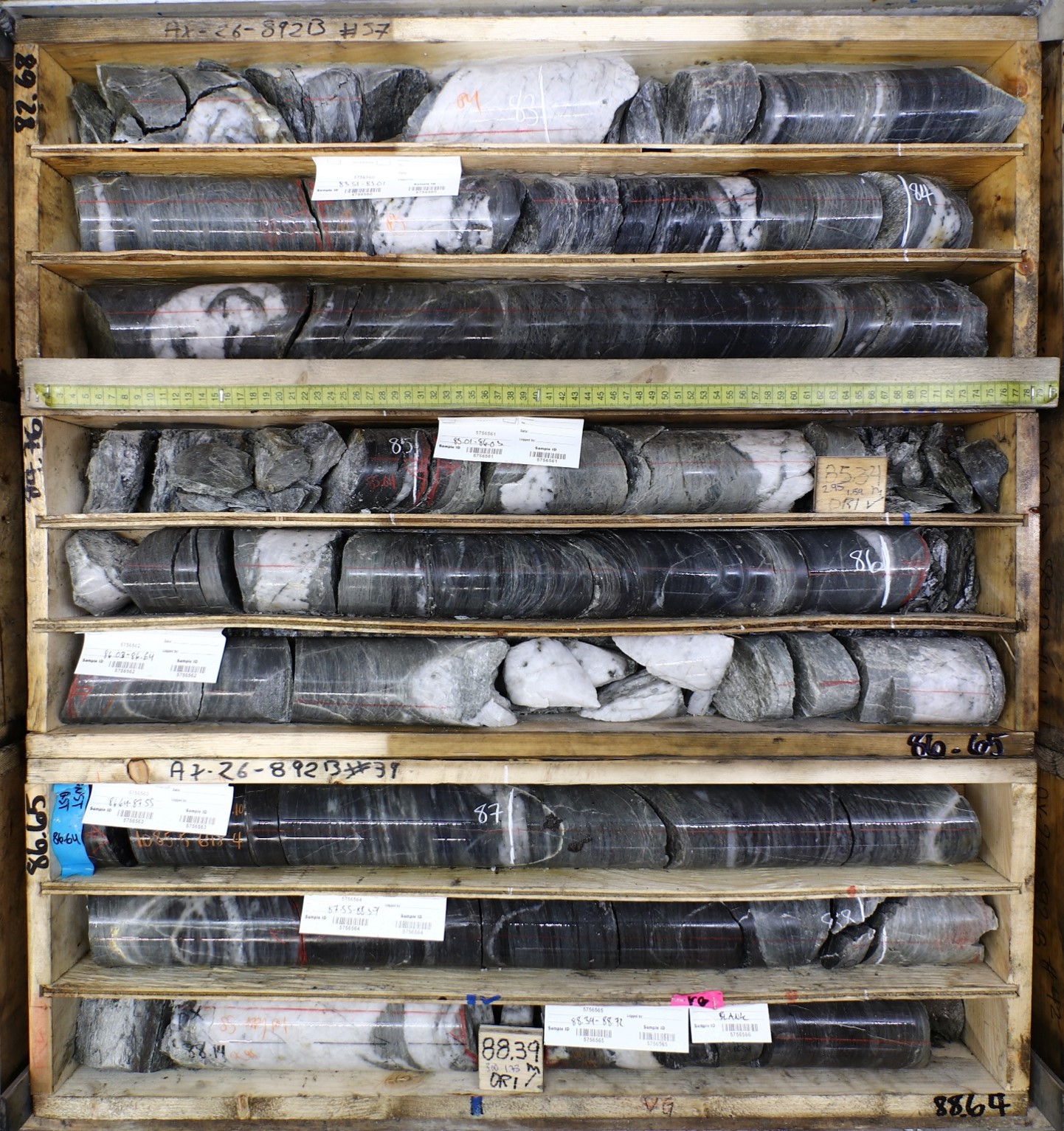
Figure 11: Mineralized extensional quartz veins in metasedimentary rocks in Powerline South from diamond drillhole AX-26-892B. High-density of large extensional quartz veins (>3 veins/m) with bismuth-sulphosalts, arsenopyrite, and pyrite are present throughout the interval from 87.6-140.4m, with multiple instances of visible gold (Figure 12).
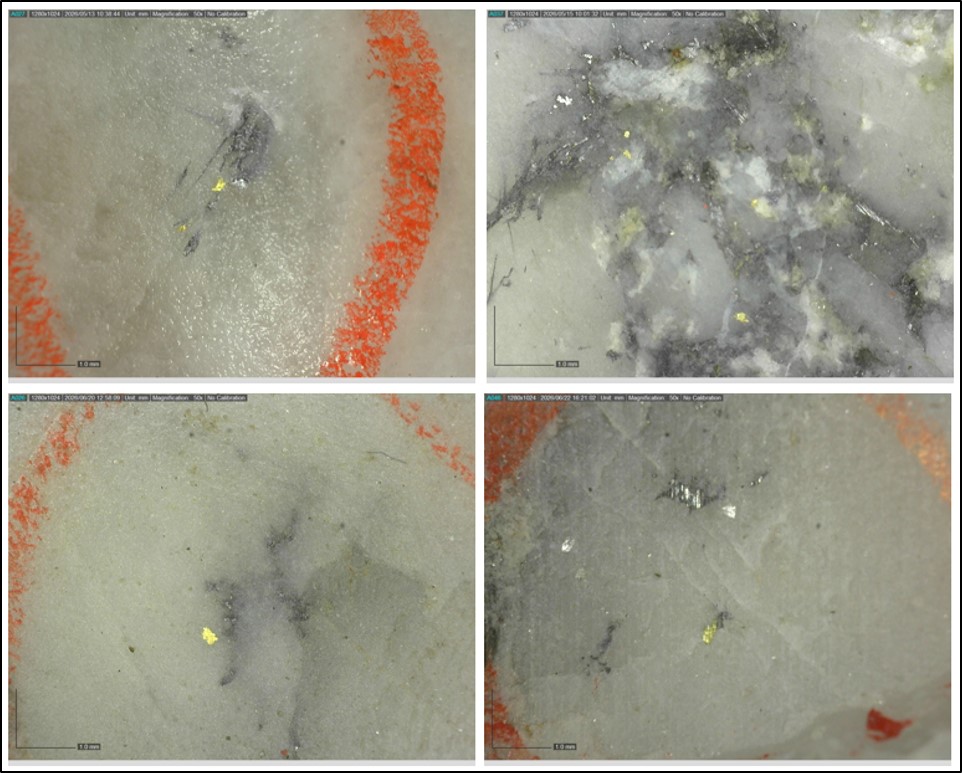
Figure 12: Visible gold occurrences in extensional quartz veins from Powerline: Top left: gold grains intergrown with bismuth sulphosalts - AX-26-873 at 53.5m. Top right: gold grains intergrown with acicular arsenopyrite and bismuth sulphosalt masses - AX-26-873 at 138.4 m. Bottom left: gold grain in extensional quartz vein with spatially associated arsenopyrite - AX-26-892B at 88.4m. Bottom right: visible gold grain intergrown and associated with arsenopyrite grain - AX-26-892B at 101.8 m.
Table 1: Intervals from Powerline
| HOLE NUMBER | depth from | depth to | Au Interval (m) | Au Grade (g/t) |
AX-26-870 | 86.3 | 87.4 | 1.1 | 1.70 |
and | 119.0 | 124.9 | 5.9 | 1.34 |
including | 119.0 | 120.2 | 1.2 | 1.01 |
and including | 121.9 | 123.4 | 1.5 | 3.41 |
and | 140.8 | 156.3 | 15.5 | 0.41 |
including | 150.7 | 152.0 | 1.3 | 3.03 |
and | 176.6 | 191.2 | 14.6 | 0.31 |
including | 189.9 | 190.3 | 0.4 | 6.98 |
and | 230.2 | 252.8 | 22.6 | 0.35 |
including | 230.2 | 231.4 | 1.2 | 4.26 |
AX-26-872 | 78.0 | 109.2 | 31.2 | 0.42 |
including | 78.0 | 93.0 | 15.0 | 0.74 |
including | 78.0 | 78.3 | 0.3 | 14.04 |
and including | 84.6 | 85.3 | 0.7 | 4.00 |
and | 132.7 | 135.6 | 2.9 | 1.44 |
including | 132.7 | 133.3 | 0.6 | 6.17 |
and | 149.2 | 179.0 | 29.8 | 0.41 |
including | 149.2 | 159.1 | 9.9 | 0.74 |
including | 158.6 | 159.1 | 0.5 | 9.26 |
and including | 174.1 | 175.3 | 1.2 | 2.49 |
AX-26-873 | 49.6 | 53.8 | 4.2 | 0.50 |
and | 128.4 | 178.9 | 50.5 | 0.51 |
including | 137.7 | 138.6 | 0.9 | 8.82 |
and including | 151.4 | 152.4 | 1.0 | 3.78 |
and including | 169.2 | 177.5 | 8.3 | 1.18 |
and | 197.4 | 269.4 | 72.0 | 0.31 |
including | 197.4 | 198.8 | 1.4 | 2.25 |
and including | 239.4 | 244.5 | 5.1 | 1.03 |
and including | 268.2 | 269.4 | 1.2 | 1.05 |
AX-26-876 | 129.4 | 179.1 | 49.7 | 0.55 |
including | 133.1 | 137.5 | 4.4 | 1.12 |
and including | 150.7 | 153.5 | 2.8 | 1.51 |
and including | 167.1 | 168.5 | 1.4 | 1.21 |
and including | 177.8 | 178.2 | 0.4 | 2.46 |
and | 205.3 | 223.3 | 18.0 | 0.38 |
and | 262.0 | 313.5 | 51.5 | 0.44 |
including | 262.0 | 263.0 | 1.0 | 1.15 |
and including | 297.0 | 310.9 | 13.9 | 1.15 |
including | 297.0 | 298.5 | 1.5 | 3.72 |
and including | 310.6 | 310.9 | 0.3 | 16.50 |
and | 393.7 | 447.8 | 54.1 | 0.41 |
including | 410.8 | 421.7 | 10.9 | 0.50 |
and including | 433.2 | 433.7 | 0.5 | 1.10 |
and including | 445.8 | 447.8 | 2.0 | 1.36 |
AX-26-878 | 104.4 | 110.3 | 5.9 | 0.63 |
including | 104.4 | 105.4 | 1.0 | 1.16 |
and including | 109.1 | 110.3 | 1.2 | 1.37 |
and | 126.4 | 163.1 | 36.7 | 0.30 |
including | 139.5 | 141.0 | 1.5 | 3.69 |
and | 189.0 | 236.7 | 47.7 | 0.24 |
including | 226.8 | 227.9 | 1.1 | 1.33 |
and including | 235.6 | 236.7 | 1.1 | 2.04 |
and | 252.4 | 264.2 | 11.8 | 1.37 |
including | 255.2 | 255.7 | 0.5 | 7.37 |
and including | 263.2 | 264.2 | 1.0 | 9.78 |
and | 281.1 | 283.9 | 2.8 | 2.52 |
and | 332.4 | 333.6 | 1.2 | 2.68 |
AX-26-887 | 31.3 | 146.5 | 115.2 | 0.41 |
including | 31.3 | 31.9 | 0.6 | 1.12 |
and including | 47.3 | 48.2 | 0.9 | 4.82 |
and including | 63.0 | 113.5 | 50.5 | 0.58 |
including | 64.9 | 65.4 | 0.5 | 14.24 |
and including | 82.6 | 83.1 | 0.5 | 7.57 |
and including | 86.8 | 87.2 | 0.4 | 3.09 |
and including | 137.8 | 139.2 | 1.4 | 3.32 |
and including | 145.9 | 146.5 | 0.6 | 1.32 |
and | 170.9 | 172.4 | 1.5 | 1.23 |
and | 190.0 | 201.3 | 11.3 | 0.68 |
including | 194.0 | 194.6 | 0.6 | 7.01 |
and | 221.0 | 237.1 | 16.1 | 0.14 |
including | 236.8 | 237.1 | 0.3 | 1.71 |
AX-26-891 | 71.8 | 241.0 | 169.2 | 0.56 |
including | 71.8 | 72.2 | 0.4 | 149.14 |
and including | 88.0 | 89.5 | 1.5 | 1.77 |
and including | 112.1 | 171.5 | 59.4 | 0.42 |
including | 150.6 | 170.5 | 19.9 | 0.63 |
including | 119.7 | 120.1 | 0.4 | 1.32 |
and including | 134.4 | 134.8 | 0.4 | 6.49 |
and including | 150.6 | 151.1 | 0.5 | 6.57 |
and including | 162.2 | 162.5 | 0.3 | 7.72 |
and | 207.2 | 212.0 | 4.8 | 0.45 |
including | 211.6 | 212.0 | 0.4 | 3.02 |
and | 230.3 | 238.4 | 8.1 | 0.57 |
including | 238.0 | 238.4 | 0.4 | 9.81 |
AX-26-892B | 70.7 | 140.4 | 69.7 | 0.87 |
including | 72.6 | 74.0 | 1.4 | 1.25 |
and including | 87.6 | 140.4 | 52.8 | 1.05 |
including | 88.4 | 88.7 | 0.3 | 15.19 |
and including | 101.5 | 105.0 | 3.5 | 2.75 |
and including | 117.3 | 121.2 | 3.9 | 2.82 |
and including | 139.2 | 140.4 | 1.2 | 4.50 |
and | 165.1 | 189.7 | 24.6 | 0.49 |
including | 165.1 | 169.2 | 4.1 | 0.99 |
and including | 188.5 | 189.7 | 1.2 | 3.52 |
and | 239.7 | 240.8 | 1.1 | 1.30 |
and | 258.9 | 275.4 | 16.5 | 0.33 |
including | 274.4 | 275.4 | 1.0 | 1.06 |
AX-26-894 | 71.2 | 72.1 | 0.9 | 2.95 |
and | 95.4 | 162.0 | 66.6 | 0.29 |
including | 108.3 | 142.4 | 34.1 | 0.42 |
including | 116.5 | 116.8 | 0.3 | 7.13 |
and including | 160.7 | 161.0 | 0.3 | 2.09 |
and | 234.2 | 235.7 | 1.5 | 2.66 |
AX-26-895 | 39.3 | 56.2 | 16.9 | 0.14 |
and | 121.0 | 147.6 | 26.6 | 0.73 |
including | 121.0 | 138.2 | 17.2 | 1.01 |
including | 121.0 | 121.6 | 0.6 | 6.72 |
and including | 137.7 | 138.2 | 0.5 | 10.30 |
and | 173.6 | 175.8 | 2.2 | 0.65 |
Note: Calculated true widths are approximate and vary by drillhole; see Table 2
Table 2: Collars for diamond drillholes in this release
Hole ID | Easting (m) | Northing (m) | Elevation (m) | Length (m) | Azimuth | Dip | Calc. Width (pct) |
AX-26-870 | 466250 | 7082865 | 739 | 280.4 | 360 | -56 | 90 |
AX-26-872 | 466048 | 7083155 | 721 | 249.9 | 0 | -62 | 95 |
AX-26-873 | 466249 | 7082764 | 739 | 280.4 | 0 | -60 | 95 |
AX-26-876 | 466506 | 7082502 | 762 | 493.8 | 349 | -52 | 90 |
AX-26-878 | 466352 | 7082766 | 754 | 355.1 | 0 | -59 | 95 |
AX-26-887 | 467091 | 7082769 | 787 | 310.9 | 290 | -60 | 95 |
AX-26-891 | 466751 | 7082557 | 781 | 286.5 | 359 | -60 | 95 |
AX-26-892B | 466990 | 7082707 | 785 | 306.3 | 14 | -49 | 90 |
AX-26-894 | 466157 | 7083158 | 727 | 270.7 | 0 | -61 | 95 |
AX-26-895 | 466851 | 7082557 | 787 | 274.3 | 360 | -61 | 95 |
Analytical Method and Quality Assurance/Quality Control Measures
The reported work was completed using industry standard procedures and a quality assurance/quality control ("QA/QC") program consisting of the insertion of certified reference materials, field duplicates and coarse blanks into the sample stream and utilizing certified independent analytical laboratories for all assays.
Certified independent laboratories completed all analyses. The Qualified Persons reviewed the available QA/QC data and identified no material issues.
Standards, core duplicates and coarse blanks represented approximately
Banyan personnel systematically logged and photographed all diamond drill core. HTW- and NTW-diameter core was split at Banyan's core-processing facilities. One half was returned to the core box and the other was sealed in a poly bag with one part of a three-part sample tag. Banyan personnel or a dedicated expediter delivered samples to the Bureau Veritas ("BV") preparation laboratory in Whitehorse or to AGAT Laboratories' Geochemical Mining Division in Calgary ("AGAT"). Samples prepared by BV were shipped to its analytical laboratory in Vancouver, British Columbia. AGAT samples were prepared, pulverized and analyzed in Calgary, Alberta, or Thunder Bay, Ontario.
BV analyzed samples using four-acid digestion and either its MA-200 ICP-ES 45-element package or MA-250 ICP-ES/MS 59-element package, together with FA-450 50 g fire assay with an AAS finish for gold. Samples returning more than 10 g/t Au were reanalyzed by FA-550 fire assay with a gravimetric finish. High-grade samples containing documented visible gold were also analyzed by FS-652 metallic-screen fire assay. Silver overlimits were analyzed using MA-370, FA-550 or FA-501, as applicable. Bureau Veritas is accredited to ISO/IEC 17025:2017 under SCC File No. 15895.
AGAT analyzed samples using four-acid digestion and its 201-071 ICP-OES/ICP-MS 48-element package, together with 201-551 50 g fire assay with an AAS finish for gold. Samples returning more than 10 g/t Au were reanalyzed by 202-551 fire assay with a gravimetric finish. High-grade samples containing documented visible gold were also analyzed by 202-131 metallic-screen fire assay. Samples returning more than 100 g/t Ag were analyzed using 201-470. AGAT is accredited to ISO/IEC 17025:2017 under SCC File Nos. 151266 and 151083.
Qualified Persons
Duncan Mackay, M.Sc., P.Geo., is a "Qualified Person" as defined under National Instrument 43-101, Standards of Disclosure for Mineral Projects ("NI 43-101"), and has reviewed and approved the content of this news release in respect of all disclosure other than the MRE. Mr. Mackay is Vice President Exploration for Banyan and has verified the data disclosed in this news release, including the sampling, analytical and test data underlying the information.
Grant of Incentive Stock Options
The Company has granted 970,000 incentive stock options (the "Options") effective today (the "Grant Date") to certain employees and consultants of the Company pursuant to the Company's incentive plan approved by shareholders of the Company on October 20, 2025 (the "Plan").
The Options are exercisable for a period of five years at an exercise price of
Upcoming Events
- GCFF Conference, Vancouver, September 19, 2026
- Precious Metals Summit, Beaver Creek, September 22-25, 2026
- Corporate Presentation: September 23 at 1:30 PM MDT
- Denver Gold Forum, Colorado Springs, September 27-30, 2026
- The MoneyShow, Orlando, October 5-7, 2026
About Banyan
Banyan's primary asset, the AurMac Project is located in the Traditional Territory of the First Nation of Na-Cho Nyäk Dun in Canada's Yukon Territory. The AurMac Project comprises two main deposits, the Airstrip and Powerline Deposits. Mineralization is characteristic of a Reduced Intrusion Related Gold system, hosted in auriferous cross-cutting sheeted quartz veins and replacement style mineralization hosted in skarn horizons. The current Mineral Resource Estimate ("MRE") for the AurMac Project has an effective date of May 15, 2026 and comprises an Indicated Mineral Resource of 3.639 million ounces of gold ("Au") (167.3 M tonnes at 0.68 g/t) and an Inferred Mineral Resource of 4.985 Moz of Au (267.2 M tonnes at 0.58 g/t) (See MRE Table 3 below; as defined in the 2014 CIM Definition Standards for Mineral Resources and Mineral Reserves incorporated by reference into NI 43‑101). The 303 square kilometres ("sq km") AurMac Project lies 40 kilometres from Mayo, Yukon. The AurMac Project is transected by the main Yukon highway and benefits from a 69 kV 3-phase powerline, existing power substation and cell phone coverage.
MRE Table 3: Pit-constrained Indicated and Inferred Mineral Resources - AurMac Project
Cut-off Grade | Tonnes | Gold Grade | Contained Gold | |
(Au g/t) | (M Tonnes) | (g/t) | (M Oz) | |
Indicated MRE | ||||
Airstrip | 0.30 | 37.7 | 0.69 | 0.840 |
Powerline | 0.30 | 129.5 | 0.67 | 2.799 |
Combined | 0.30 | 167.3 | 0.68 | 3.639 |
Inferred MRE | ||||
Airstrip | 0.30 | 15.1 | 0.84 | 0.405 |
Powerline | 0.30 | 252.1 | 0.57 | 4.580 |
Combined | 0.30 | 267.2 | 0.58 | 4.985 |
Notes to MRE Table:
- The effective date for the MRE is May 15, 2026, the technical report is available for review on SEDAR+ at www.sedarplus.ca.
- The Mineral Resource Estimate was prepared by Marc Jutras, P.Eng., M.A.Sc., Principal, Ginto Consulting Inc., who is an independent Qualified Person as defined by NI 43-101.
- Mineral Resources which are not Mineral Reserves do not have demonstrated economic viability. The estimate of Mineral Resources may be materially affected by environmental, permitting, legal, title, taxation, sociopolitical, marketing, changes in global gold markets or other relevant issues.
- The 2014 CIM Definition Standards were followed for classification of Mineral Resources. The quantity and grade of reported Inferred Mineral Resources in this estimation are uncertain in nature and there has been insufficient exploration to define these Inferred Mineral Resources as an Indicated Mineral Resource. It is reasonably expected that the majority of Inferred Mineral Resources could be upgraded to Indicated Mineral Resources with continued exploration.
- Mineral Resources are reported at a cut-off grade of 0.30 g/t gold for all deposits, using a US$/CAN$ exchange rate of 0.73 and constrained within an open pit shell optimized with the Lerchs-Grossman algorithm to constrain the Mineral Resources with the following estimated parameters: gold price of US
$3,500 /ounce, US$2.75 /t mining cost, US$11.50 /t processing cost, US$2.00 /t G+A,90% gold recoveries, and 45° pit slopes. - The number of tonnes was rounded to the nearest hundred thousand and ounces rounded to the nearest thousand. Any discrepancies in the totals are due to rounding effects.
In addition to the AurMac Project, the Company holds the Hyland Gold Project, located 70 km northeast of Watson Lake, Yukon, along the southeast end of the Tintina Gold Belt (the "Hyland Project") in the Traditional Territory of the Kaska Nations, closest to the Liard First Nation and Daylu Dena Council. The Hyland Project represents a sediment hosted, structurally controlled, intrusion-related gold deposit, within a large land package (over 125 sq km), accessible by a network of existing gravel access roads. The Hyland Project MRE comprises an Indicated Mineral Resource of 337 thousand ("K") ounces ("oz") of gold ("Au") and 2.63 million ("M") oz of silver ("Ag") (11.3 M tonnes at 0.93 g/t Au and 7.27 g/t Ag), and an Inferred Mineral Resource of 118 Koz of Au and 0.86 Moz Ag (3.9 M tonnes at 0.95 g/t Au and 6.94 g/t Ag) (as defined in the 2014 CIM Definition Standards for Mineral Resources & Mineral Reserves incorporated by reference into NI 43‑101) effective September 1, 2025 and with a technical report filed on SEDAR+ on October 27, 2025.
Banyan also holds the Nitra Gold Project and Seattle-Goodman Creek Project which are grassroots exploration projects located in the Mayo Mining district, adjacent to the AurMac Gold Project. These properties lie in the northern part of the Selwyn Basin and are underlain by metaclastic rocks of the Late Proterozoic Yusezyu Formation of the Hyland Group, similar to lithologies hosting portions of the AurMac Project. Middle Cretaceous Tombstone Plutonic suite intrusions occur along the properties including the Morrison Creek and Minto Creek stocks. The properties are
Banyan trades on the TSX Venture Exchange under the symbol "BYN" and is quoted on the OTCQB Venture Market under the symbol "BYAGF". For more information, please visit the corporate website at www.banyangold.com or contact the Company.
ON BEHALF OF BANYAN GOLD CORPORATION
(signed) "Tara Christie"
Tara Christie
President & CEO
For more information, please contact:
Tara Christie • 778 928 0556 • tchristie@banyangold.com
Jasmine Sangria • 604 312 5610 • jsangria@banyangold.com
CAUTIONARY STATEMENT: Neither the TSX Venture Exchange, its Regulation Services Provider (as that term is defined in policies of the TSX Venture Exchange) nor OTCQB Venture Market accepts responsibility for the adequacy or accuracy of this release.
No stock exchange, securities commission or other regulatory authority has approved or disapproved the information contained herein.
FORWARD-LOOKING INFORMATION: This release contains forward-looking information, which is not comprised of historical facts and is based upon the Company's current internal expectations, estimates, projections, assumptions and beliefs. Such information can generally be identified by the use of forward-looking wording such as "may", "will", "expect", "estimate", "anticipate", "intend(s)", "believe", "potential" and "continue" or the negative thereof or similar variations. Forward-looking information involves risks, uncertainties and other factors that could cause actual events, results, performance, prospects and opportunities to differ materially from those expressed or implied by such forward-looking information. Forward looking information in this news release includes, but is not limited to, the potential for resource expansion and increased grades; mineral recoveries and anticipated mining costs. Factors that could cause actual results to differ materially from such forward-looking information include uncertainties inherent in resource estimates, continuity and extent of mineralization, capital and operating costs varying significantly from estimates, the preliminary nature of metallurgical test results, delays in obtaining or failures to obtain required governmental, environmental or other project approvals, political risks, uncertainties relating to the availability and costs of financing needed in the future, changes in equity markets, inflation, changes in exchange rates, fluctuations in commodity prices, and the other risks involved in the mineral exploration and development industry, enhanced risks inherent to conducting business in any jurisdiction, and those risks set out in Banyan's public documents filed on SEDAR+. Although Banyan believes that the assumptions and factors used in preparing the forward-looking information in this news release are reasonable, undue reliance should not be placed on such information, which only applies as of the date of this news release, and no assurance can be given that such events will occur in the disclosed time frames or at all. Banyan disclaims any intention or obligation to update or revise any forward-looking information, whether as a result of new information, future events or otherwise, other than as required by law.
SOURCE: Banyan Gold Corp.
View the original press release on ACCESS Newswire
FAQ
AI-generated questions and answers. How Rhea-AI works. Not financial advice.
What is the main objective of Banyan Gold’s 2026 drilling at AurMac?
The 2026 drill program is focused on resource conversion, expansion and delineation of higher-grade mineralized domains within and adjacent to the current Mineral Resource at the Powerline Deposit. The company said the new results support a strategy of targeting areas that could improve the grade profile and confidence of the AurMac resource.
How do the new drill results relate to Powerline’s higher-grade cores?
The reported holes extend and upgrade mineralized domains along the margins of Powerline’s near-surface high-grade cores. Cross-sections show mineralization remaining open down-dip at depth, highlighting potential to further extend mineralized domains and improve continuity near these higher-grade cores.
How significant is the bonanza-grade interval in hole AX-26-891?
Hole AX-26-891 intersected 149.14 g/t Au over 0.4 m within a broader interval of 0.56 g/t Au over 169.2 m. The company explains that this bonanza-grade interval materially influences the composite; excluding it, the remaining 168.8 m averages approximately 0.21 g/t Au, with a lower mineralized zone of 0.63 g/t Au over 19.9 m.
What quality assurance and quality control (QA/QC) measures were used for these assays?
The program used industry-standard QA/QC, including insertion of certified reference materials, field duplicates and coarse blanks representing about 10% of samples. Assays were performed by independent ISO/IEC 17025:2017-accredited labs (Bureau Veritas and AGAT). Qualified Persons reviewed QA/QC data and identified no material issues, and results were within established accuracy and precision thresholds.
Which drilling and sampling methods were applied at Powerline?
Banyan used HTW- and NTW-diameter diamond drilling. Core was systematically logged and photographed, then split at the company’s core facilities, with half retained in the box and half sealed as the assay sample. Samples were delivered to Bureau Veritas in Whitehorse or AGAT in Calgary for preparation and analysis using four-acid digestion, multi-element ICP packages, and 50 g fire assays for gold, with gravimetric and metallic-screen methods for high-grade and visible-gold samples.