
Compass Gold Reports Final Diamond Drilling Assays at Massala Prospect, Intersecting 8.35 M @ 2.82 g/t Au
Compass Gold (OTC: COGDF) reported final assay results from a 42-hole (1,457.3 m) diamond drilling program at the Massala prospect on the Sikasso Property in southern Mali.
Sentiment and the balance of points
Rhea-AI Sentiment reads the wording of the document, how positive or negative its language is on a 1 to 5 scale. The balance of points shown with the takes weighs what the document actually discloses, so the two can disagree, for example when a trial that missed its main goal is described in upbeat language.
Rhea-AI Summary
Compass Gold (OTC: COGDF) reported final assay results from a 42-hole (1,457.3 m) diamond drilling program at the Massala prospect on the Sikasso Property in southern Mali. Drilling tested a 340 m panel along the Tarabala fault within the Massala Small Mine Permit application area and intersected gold in 35 of 42 holes (82%), with mineralization encountered on all 13 drilled sections and remaining open down-dip.
The best intercept remains 18 m at 4.99 g/t Au from 17.3 m, including a 0.8 m interval above 100 g/t Au (capped at 100 g/t for calculations). New results include 8.35 m at 2.82 g/t Au (from 24.5 m, including 3.3 m at 5.07 g/t Au), 8.30 m at 1.45 g/t Au, and 6.58 m at 0.82 g/t Au. These data will feed into planning for initial small-scale production at Massala while the Small Mine Permit, filed in 2025, remains pending amid nationwide processing delays in Mali. Compass Gold and an independent resource geologist are evaluating whether additional drilling and deeper metallurgical testing are required, and the company cautions that its decision to advance toward production is not supported by a feasibility study, implying higher technical and economic risk.
Positive
- 18 m @ 4.99 g/t Au including 0.8 m >100 g/t Au at Massala
- 82% of 42 drill holes intersected gold mineralization along 340 m panel
- New intercept of 8.35 m @ 2.82 g/t Au, including 3.3 m @ 5.07 g/t Au
- Continuous mineralization observed across all 13 drilled sections, remaining open down-dip
- Results to support planning for initial small-mine production at Massala
- Independent resource geologist engaged to assess drilling and next steps
Negative
- Massala Small Mine Permit filed in 2025 remains unprocessed amid Mali-wide delays
- Company advancing toward production without a feasibility study, increasing technical and economic risk
- Fieldwork paused during July–September rainy season at Massala
- Mali fuel and supply shortages and road travel disruptions impacting logistics
AI-generated analysis. How Rhea-AI works. Not financial advice.




Positive Results to be Incorporated into Plan for Initial Production at Massala
Toronto, Ontario--(Newsfile Corp. - August 5, 2026) - Compass Gold Corp. (TSXV: CVB) (Compass or the Company) is pleased to report the positive assay results from the recently completed 42-hole diamond drilling program at the Massala prospect, located on the Company's Sikasso Property in Southern Mali (Figure 1).
Highlights
Drilling tested a 340 m mineralized zone along the approximately 3 km Tarabala fault within the Massala Small Mine Permit application area
Drilling intercepted gold mineralization in all 13 sections drilled, showing the structure is present over the entire strike length and remains open down-dip (at depth)
Widest interval and highest grade of gold mineralization is the previously reported 18 m at *4.99 g/t Au (from 17.3 m), including 3.8 m @ *21.94 g/t Au (from 31.5 m) with 0.8 m @ >100 g/t Au (from 34.5 m) (Figure 2)
Widest mineralization from the new assays is 8.35 m @ 2.82 g/t Au (from 24.5 m), including 3.3 m @ 5.07 g/t Au
These results will be reviewed as part of the planning for initial production at Massala
Compass CEO, Larry Phillips, said, "These assay results show that gold mineralization is present along the entire 340 metres of the tested structure. This zone represents just
Dr. Sandy Archibald, PGeo, Technical Director, added, "We're encouraged to see continuous mineralization across the resource area with gold intersected in 35 of 42 holes. These strong results align with our modelling for this graphite-rich shear zone, and we will use them as we work towards our goal of beginning production at our first small mine at Massala. The successful conclusion of the drilling program could not have been accomplished without the hard work and dedication of the Malian exploration team."
* The overlimit assay value (>100 g/t Au) has been capped at 100 g/t Au to calculate the mineralized intervals. Once received, the updated assay value will be published in a later news release.
Massala Drilling Results
As previously reported, the Company initiated a 42-hole diamond drill program, totalling 1,457.3 m, which was completed on May 22, 2026, at the Massala prospect. The purpose of the drill program was to test the down-dip extension and strike potential of gold mineralization previously identified by near-surface drilling and trenching (See Compass press releases March 28, 2021, September 18, 2022, March 5, 2024, May 21, 2026).
The holes were completed on 13 east-west sections over a zone previously investigated by air core (AC) drilling and trenching to test the grade and continuity of a 340-m panel of the best gold mineralization identified thus far (Figure 1). Initial drilling in 2021 recorded 24 m @ 2.35 g/t Au (SAAC123) (see Compass Press release March 28, 2021), and trenching performed in 2024 recorded 20 m @ 4.13 g/t Au (at a depth of 5 m) in trench MATR001 (see Compass Press release August 19, 2024). Gold mineralization was encountered in
The widest zone of mineralization intercepted was 18.0 m @ *4.99 g/t Au (from 17.3 m, MADD001) on section 400 mN. This result was previously reported (see Compass Press release May 21, 2026) and included an interval over 1 m in excess of 100.00 g/t Au (from 34.5 m, MADD001; reanalysis is pending), which corresponded to visible gold.
.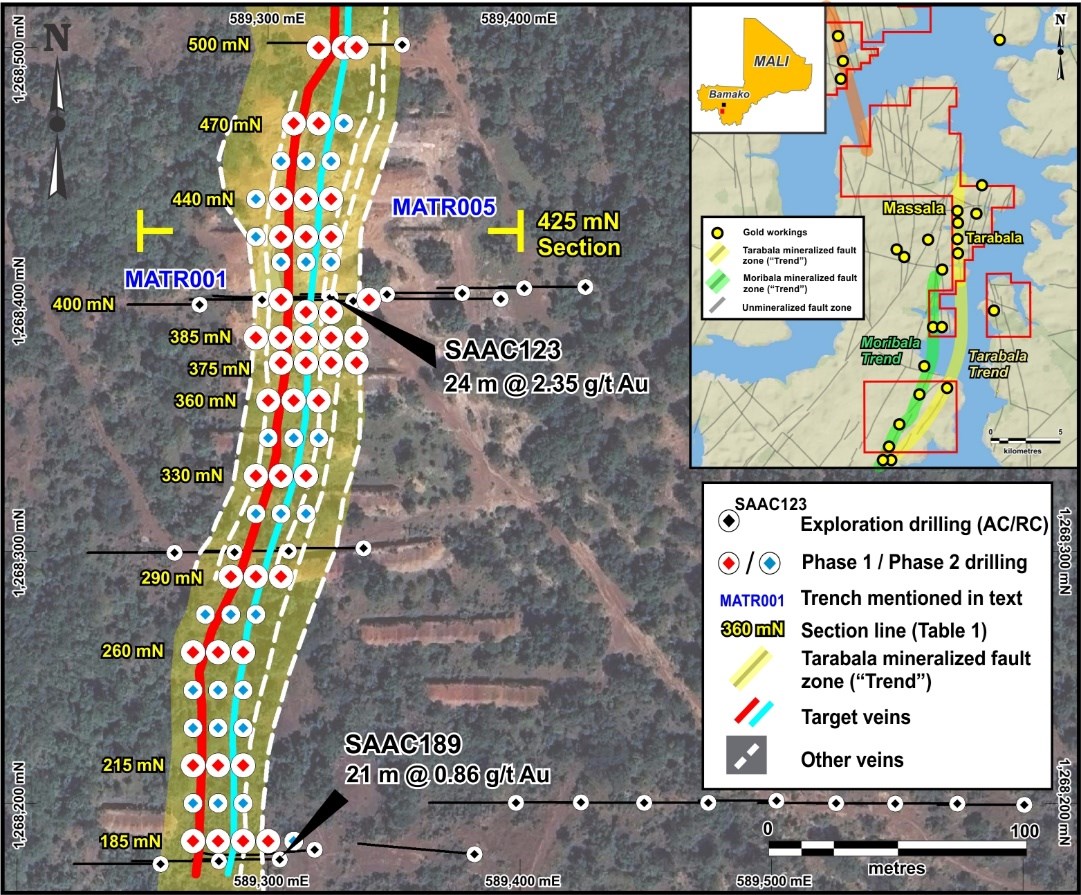
Figure 1: Diamond drill hole locations and significant results at Massala.
To view an enhanced version of this graphic, please visit:
https://images.newsfilecorp.com/files/1861/307982_f3a478c2d4f12a28_001full.jpg
Results from the latest assay data, not previously reported, include the three widest intercepts of 8.35 m @ 2.82 g/t Au (from 36.78 m, MADD013, Section 425 mN; Figure 2), 8.30 @ 1.45 g/t Au (from 1.5 m, MADD021, Section 470 mN), and 6.58 m @ 0.82 g/t Au (from 2.8 m MADD031, Section 185 mN). The highest recorded grades intercepted in this latest drilling are 0.50 m @ 14.20 g/t Au (from 36.40 m, MADD004, Section 385 mN), 1.0 m @ 12.10 g/t Au (from 37. 8 m, MADD026, Section 290 mN), 0.5 m @ 5.10 g/t Au (from 32.5 m, MADD004, Section 385 mN), and 3.3 m @ 5.07 g/t Au (from 24.5 m, MADD013. The full results are presented in Table 1 below.
The widest intervals with the highest-grade intervals occurred over a 95 m strike from section 375 mN to 470 mN. Minor mineralization was noted in the northernmost section (500 mN). Narrower, but well-mineralized intervals with good gold grades were noted in the five sections from 215 mN to 360 mN. The main vein may have followed a more easterly structure in this zone, and drilling missed it. The average width of the main vein in this zone was 2.20 m. Mineralization is wider (6.58 m) in the most southerly section, 185 mN, which suggests the zone could widen to the south.
Table 1. Diamond drilling results from Massala, ordered north (500 mN) to south (185 mN).
| Section (mN) | Hole ID | From (m) | To (m) | 1, 2 Interval (m) | Au (g/t) |
| 500 | MADD017 | 10.7 | 11.8 | 1.10 | 1.82 |
| 470 | MADD020 | 14.5 | 19.35 | 4.85 | 0.34 |
| inc. | 16.5 | 18.96 | 2.46 | 0.50 | |
| MADD021 | 1.5 | 9.8 | 8.30 | 1.45 | |
| 440 | MADD041 | 12.7 | 13.44 | 0.74 | 1.56 |
| 425 | MAAD013 | 14.60 | 15.75 | 1.15 | 1.07 |
| MAAD013 | 24.50 | 32.85 | 8.35 | 2.82 | |
| MADD039 | 1.5 | 4.5 | 3.00 | 0.46 | |
| MADD040 | 17.55 | 20 | 2.45 | 0.70 | |
| 400 | MADD001 | 17.30 | 35.30 | 18.00 | 4.99 |
| inc. | 31.50 | 35.30 | 3.80 | 3,421.94 | |
| MADD002 | 29.40 | 31.00 | 1.60 | 0.37 | |
| MADD002 | 33.30 | 35.70 | 2.40 | 2.26 | |
| MADD007 | 15.60 | 24.61 | 9.01 | 1.92 | |
| inc. | 22.90 | 24.61 | 1.71 | 0.82 | |
| 385 | MADD003 | 25.50 | 26.50 | 1.00 | 1.32 |
| MADD004 | 32.50 | 33.00 | 0.50 | 5.10 | |
| MADD004 | 36.00 | 37.36 | 1.36 | 6.98 | |
| inc. | 36.40 | 36.90 | 0.50 | 14.20 | |
| MADD005 | 22.65 | 23.60 | 0.95 | 3.17 | |
| 375 | MADD008 | 28.45 | 32.10 | 3.65 | 0.27 |
| MADD009 | 16.00 | 20.00 | 4.00 | 0.38 | |
| MADD009 | 24.60 | 25.75 | 1.15 | 0.95 | |
| MADD009 | 32.25 | 34.50 | 2.25 | 0.90 | |
| MADD010 | 21.00 | 28.00 | 7.00 | 0.93 | |
| inc. | 23.20 | 28.00 | 4.8 | 1.20 | |
| 360 | MADD014 | 21.23 | 24.85 | 3.62 | 0.62 |
| 330 | MADD022 | 13.35 | 14.26 | 0.91 | 0.65 |
| MADD022 | 22.5 | 23.3 | 0.80 | 0.64 | |
| MADD022 | 34.3 | 35.55 | 1.25 | 0.28 | |
| 290 | MADD026 | 36.78 | 38.8 | 2.02 | 7.84 |
| inc. | 37.8 | 38.8 | 1.00 | 12.10 | |
| 260 | MADD029 | 18 | 19 | 1.00 | 0.23 |
| 215 | MADD037 | 14.5 | 17.6 | 3.10 | 0.70 |
| 185 | MADD031 | 2.8 | 9.38 | 6.58 | 0.82 |
| MADD031 | 13.65 | 16.2 | 2.55 | 1.29 |
1True thicknesses are interpreted as 70
Next Steps
While the Small Mine Permit at Massala is pending, the Company, working with an independent resource geologist, will determine if additional drilling is required, and if so, to identify the locations of the next drill holes. Also, since previous metallurgical test material was collected at depths of less than 10 m, which might not be representative of deeper mineralization that could be used in a resource estimation, additional metallurgical testing of drilled material is also being considered.
Mali Update
The Company notes that its fieldwork has concluded for the rainy season, which in the Massala region runs from July through September. Fuel and supply shortages continue to present challenges, along with disruptions to travel along main roads into and out of Bamako. While the in-country team continues to be in regular communication with the Malian mining department, there is currently no clear indication of when the government will process the completed permit applications, including the Company's application filed in 2025. The delays and uncertainty are not specific to the Company, but are affecting virtually all companies seeking mining permits of any kind within the country. The mining industry remains central to Mali's economic activity, and we remain confident that the permit applications will be reviewed and processed in time.
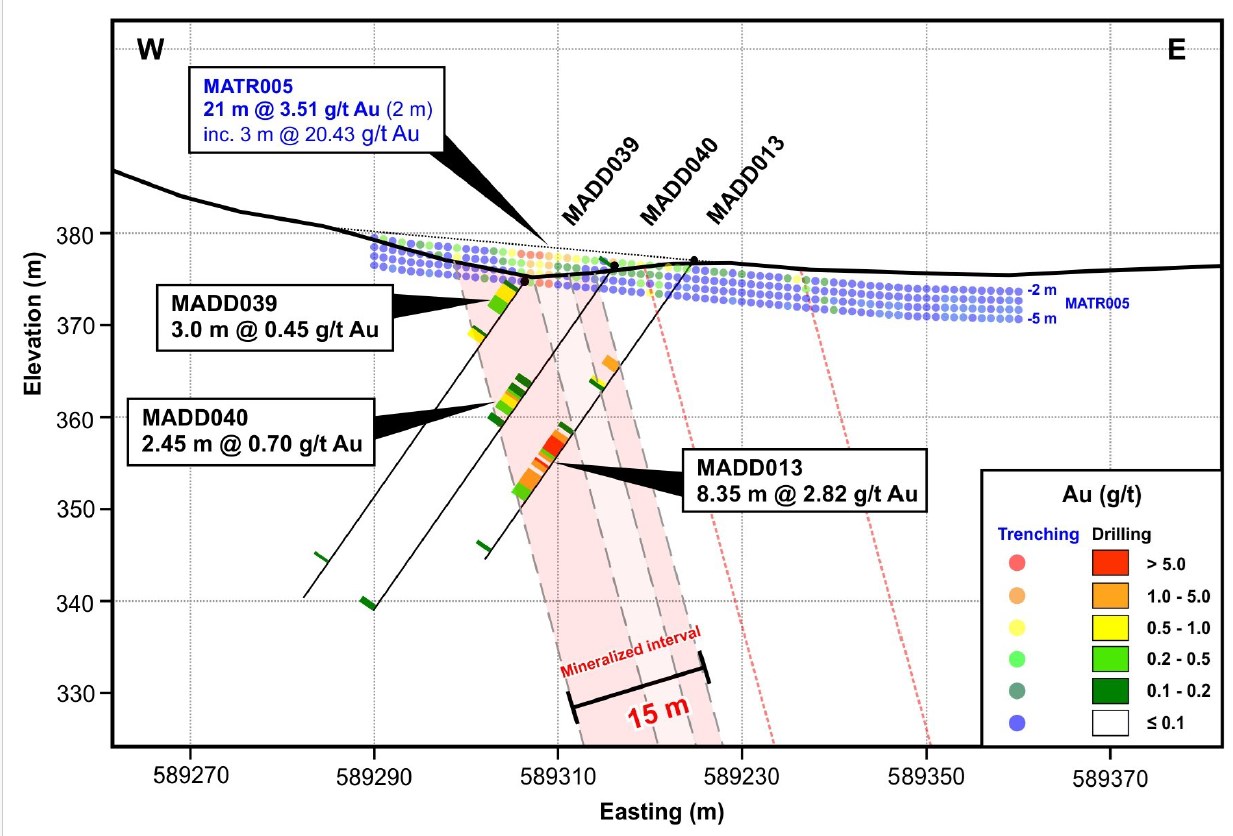
Figure 2: Cross section on the 425 mN section line at Massala. Previous drilling and trenching are illustrated, along with results from the current drilling program (MADD013, 039, 040).
To view an enhanced version of this graphic, please visit:
https://images.newsfilecorp.com/files/1861/307982_f3a478c2d4f12a28_002full.jpg
Technical Details & QAQC
All 42 diamond holes at the Massala prospect were drilled at dips of 55°, and azimuths of 270° (towards the west). Hole lengths varied from 20 to 46.5 m. The holes were designed to test the grade and continuity of near-surface mineralization that is anticipated to form part of a resource estimation on the prospect. Drilling was performed by Technisol (Bamako, Mali). All samples were prepared by Compass staff under the guidance of Dr. Sandy M. Archibald, P.Geo. (Aurum Exploration Services).
All diamond drill core samples were collected following industry best practices, and an appropriate number and type of certified reference materials (standards), blanks and duplicates were inserted to ensure an effective QAQC program was carried out. Bulk density analysis was performed on the core. Initial samples (MADD001, 002, 007) were prepared and analyzed at SGS SARL (Bamako, Mali) by fire assay technique FAE505, and the remainder of the holes were prepared and analyzed at SGS Ltd (Ouagadougou, Burkina Faso). All standard and blank results were reviewed to ensure no failures were detected.
Qualified Person
This news release has been reviewed and approved by EurGeol. Dr. Sandy Archibald, P.Geo., Compass's Technical Director, who is the Qualified Person for the technical information in this news release under National Instrument 43-101 standards.
Forward‐Looking Information
This news release contains "forward‐looking information" within the meaning of applicable securities laws, including statements regarding the Company's planned exploration work and management appointments. Readers are cautioned not to place undue reliance on forward‐looking information. Actual results and developments may differ materially from those contemplated by such information. The statements in this news release are made as of the date hereof. The Company undertakes no obligation to update forward‐looking information except as required by applicable law.
The Company's decision to advance toward production at Massala is not based on a feasibility study of mineral reserves demonstrating economic and technical viability. Accordingly, there is increased uncertainty and higher economic and technical risks of failure associated with this development approach, including risks regarding the yield and continuity of mineralized structures.
About Compass Gold Corp.
Compass Gold, a public company incorporated in Ontario, is a Tier 2 issuer on the TSX-V. Through the 2017 acquisition of MGE and Malian subsidiaries, Compass Gold holds gold exploration permits located in Mali that comprise the Sikasso Property. The exploration permits are located in three sites in southern Mali with a combined land holding of approximately 900 sq. km. The Sikasso Property is located in the same region as several multi-million-ounce gold projects1, including Morila, Syama, Kalana and Komana. The Company's Mali-based technical team, led in the field by Dr. Madani Diallo and under the supervision of Dr. Sandy Archibald, P.Geo., is conducting the current exploration program. They are examining numerous anomalies first noted in Dr. Archibald's August 2017 "NI 43-101 Technical Report on the Sikasso Property, Republic of Mali."
Note: Mineralization on adjacent properties is not necessarily indicative of mineralization on the Company's properties. Any references to exploration results on adjacent properties are provided for information only and do not imply any certainty of achieving similar results on the Company's properties.
For further information, please contact:
| Compass Gold Corporation | Compass Gold Corporation | ||
| Larry Phillips - Pres. & CEO | Greg Taylor - Dir. Investor Relations & Corporate Communications | ||
| lphillips@compassgoldcorp.com | gtaylor@compassgoldcorp.com | ||
| T: +1 416-596-0996 X 302 | T: +1 416-596-0996 X 301 |
Website: www.compassgoldcorp.com
NEITHER THE TSX VENTURE EXCHANGE NOR ITS REGULATION SERVICES PROVIDER (AS THAT TERM IS DEFINED IN THE POLICIES OF THE TSX VENTURE EXCHANGE) ACCEPTS RESPONSIBILITY FOR THE ADEQUACY OR ACCURACY OF THIS RELEASE.

To view the source version of this press release, please visit https://www.newsfilecorp.com/release/307982
FAQ
AI-generated questions and answers. How Rhea-AI works. Not financial advice.