
Copper Fox Confirms Porphyry Discovery at Mineral Mountain with Grades up to 1.48% Copper and 0.313% Molybdenum
Copper Fox Metals (OTCQX: CPFXF) reported significant copper-molybdenum mineralization from diamond drillhole MM-02-2025 at its 100% owned Mineral Mountain porphyry copper project in Arizona.
Rhea-AI Summary
Copper Fox Metals (OTCQX: CPFXF) reported significant copper-molybdenum mineralization from diamond drillhole MM-02-2025 at its 100% owned Mineral Mountain porphyry copper project in Arizona. A 278.97m interval from 1,379m to 1,657.97m returned progressively increasing copper, molybdenum, silver and rhenium values, with grades locally up to 1.48% copper and 0.313% molybdenum.
The 2025 two-hole, 2,558.11m program tested a large surface porphyry footprint and a chargeability anomaly. MM-02-2025 intersected strong phyllic alteration, multiple cross-cutting sulphide vein assemblages and bornite rimming chalcopyrite at depth, interpreted as the outer copper-enriched pyritic portion of a porphyry system whose hotter potassic core may lie deeper.
According to Copper Fox, next steps include additional core sampling and integrating geological, structural, geochemical, geophysical and alteration data using geochemical vectoring techniques (ICP-MS with 4-acid digestion) to refine targeting before follow-up drilling. QA/QC included duplicates, certified reference standards and blanks, with analyses performed by an accredited laboratory.
Positive
- 188.08m interval grading 0.189% Cu and 0.019% Mo from 1,469.89m to 1,657.97m
- 58.00m interval grading 0.144% Cu and 0.014% Mo from 1,379.00m to 1,437.00m
- 8.00m interval grading 0.709% Cu and 0.052% Mo with elevated Ag and Re from 1,541.00m to 1,549.00m
- Porphyry features and grade ranges interpreted as comparable to Laramide porphyry deposits in Arizona
- Positive molybdenum-rhenium correlation, with several samples exceeding 1,000 ppb rhenium
- Robust QA/QC program with 351 core samples, duplicates, 30 CRMs and 34 blanks analyzed by an accredited lab
Negative
- True thickness and widths of mineralized intervals are unknown
- DDH MM-02-2025 interpreted as intersecting only the outer copper-enriched pyritic portion, not the potassic core
- Further core sampling, data integration and follow-up drilling are required before resource definition
Details
News Market Reaction – CPFXF
In the Aug 6 session, CPFXF declined 2.84%, reflecting a moderate negative market reaction.
Data tracked by StockTitan Argus on the day of publication.
AI-generated analysis. How Rhea-AI works. Not financial advice.




Calgary, Alberta--(Newsfile Corp. - August 6, 2026) - Copper Fox Metals Inc. (TSXV: CUU) (OTCQX: CPFXF) (FSE: HPU) ("Copper Fox" or the "Company") and its wholly owned subsidiary, Desert Fox Mineral Mountain Co. ("Desert Fox"), are pleased to report significant copper-molybdenum mineralization within a 278.97 meter (m) interval (1379.00m to 1657.97m) in diamond drillhole (DDH) MM-02-2025 at its
Elmer B. Stewart, President and CEO of Copper Fox, stated, "The concentrations of copper-molybdenum intersected in the lower portion of DDH MM-02-2025 are comparable to and within the range of copper-molybdenum grades seen in other Laramide age porphyry deposits in Arizona. The telescoping of multiple porphyry features (copper-molybdenum mineralization, quartz veining, multiple cross cutting sulphide vein assemblages, alteration patterns, magnetite sulphidization and appearance of bornite rimming chalcopyrite at depth) indicates that DDH MM-02-2025 did not reach the core of this porphyry system. These porphyry features provide strong support for a follow-up drilling program and strengthens our view that higher-grade mineralization could lie below the current drill depth."
Next Steps
The porphyry features identified in DDH MM-02-2025 support the interpretation that the hotter part (the potassic core) of the porphyry system is located at depth. To gain a better understanding of the system prior to planning the next drilling program, additional core sampling followed by a review of all geological, structural, geochemical, geophysical and alteration data incorporating several geochemical vectoring techniques using the geochemical data (ICP-MS with 4-acid digestion) are planned. The objective of the vectoring is to map the trace element; mineral and alteration changes/patterns associated with the transition from high to lower temperatures within a porphyry system. High-temperature metals such as bismuth and molybdenum (Bi-Mo) indicate the core of the system whereas lower-temperature base metals such as antimony and arsenic (Sb-As) occur in the lower temperature margins of the system. Similarly major oxide data (Al, Na, K, Ca) can be used to map areas of lower temperature phyllic/argillic alteration and high-temperature potassium flooding in the Potassic zone.
2025 Drill Program Summary
The maiden two-hole drill program (2558.11m) tested the large surface porphyry footprint and underlying positive chargeability anomaly. DDH MM-01-2025 (860.76m) intersected eight intervals of copper-molybdenum enrichment in the outer portion of the porphyry system (see news release dated April 7, 2026). DDH MM-02-2025 (1697.35m) located approximately 1.2km northeast of DDH MM-01-2025 intersected at depth, multiple porphyry features typically observed in porphyry copper systems including consistent, significantly higher copper-molybdenum concentrations associated with strong to intense phyllic (quartz-sericite-pyrite) altered Pinal Schist and instances of bornite riming chalcopyrite towards the bottom of the hole (Figure-2).
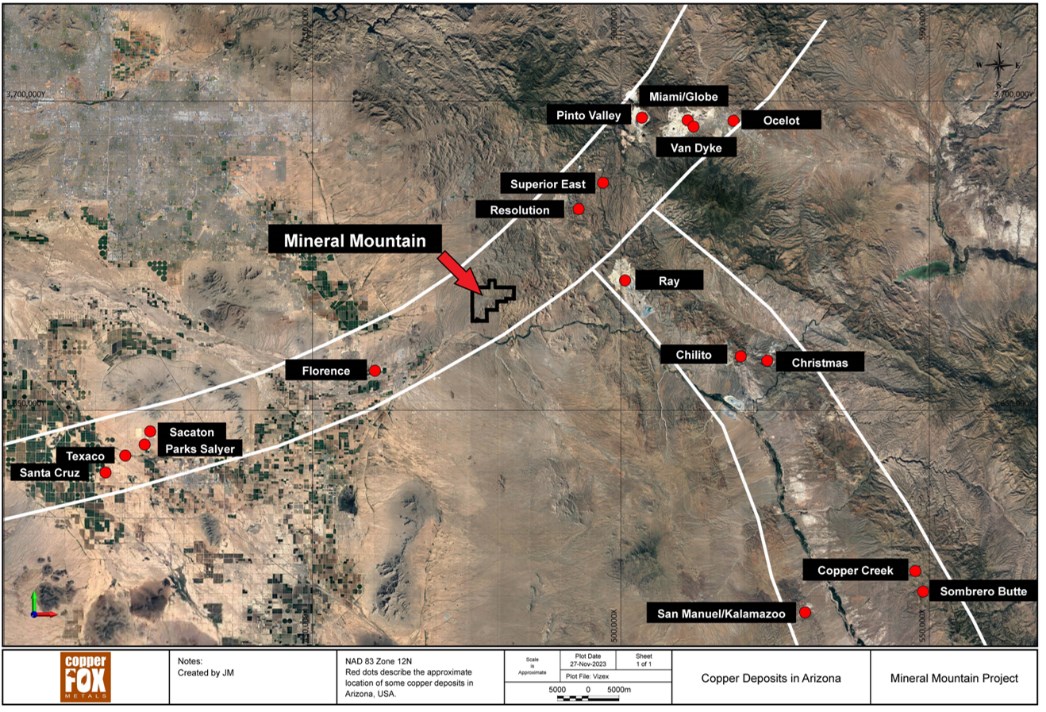
Figure-1: Regional setting of the Mineral Mountain porphyry copper project on NE trending porphyry copper belt, Arizona.
To view an enhanced version of this graphic, please visit:
https://images.newsfilecorp.com/files/2177/308294_f96ad5d2d466d954_001full.jpg
Analytical Results
Sampling in DDH MM-02-2025 commenced at a core depth of 896m based on the alteration phase, increased pyrite content, presence of quartz-base metal veining, fluorescent calcite and scheelite. The sampling program continued to the end of the hole at 1697.35m. Table-1 shows the progressively increasing weighted average copper-molybdenum-silver-rhenium concentrations for the core interval; from 1259.30m to 1657.97m.
Table-1: Weighted average grade of significant mineralized intervals in DDH MM-02-2025.
| DDH ID | From(m) | To (m) | Int. (m) | Cu (ppm) | Cu (%) | Mo (ppm) | Mo (%) | Ag (ppm) | Re (ppb) | Re (ppm) |
| MM-02-2025 | 1259.30 | 1379.00 | 119.70 | 590 | 0.059 | 51.6 | 0.005 | 0.45 | 120 | 0.120 |
| 1379.00 | 1437.00 | 58.00 | 1,441 | 0.144 | 136.5 | 0.014 | 0.62 | 128 | 0.130 | |
| including | 1382.00 | 1385.00 | 3.00 | 2,032 | 0.203 | 101.0 | 0.010 | 0.90 | 49 | 0.049 |
| including | 1415.00 | 1418.00 | 3.00 | 2,547 | 0.255 | 583.0 | 0.058 | 1.30 | 624 | 0.624 |
| including | 1435.80 | 1437.00 | 1.20 | 4,330 | 0.433 | 9.8 | 0.001 | 0.60 | <5 | <5 |
| 1469.89 | 1657.97 | 188.08 | 1,894 | 0.189 | 187.9 | 0.019 | 0.57 | 124 | 0.124 | |
| including | 1499.12 | 1555.00 | 55.88 | 2,641 | 0.264 | 360.0 | 0.036 | 0.80 | 235 | 0.235 |
| including | 1541.00 | 1549.00 | 8.00 | 7,090 | 0.709 | 524.0 | 0.052 | 2.28 | 531 | 0.414 |
Notes: m=meters; Cu=copper; ppm=parts per million; %= percent; Mo=molybdenum; Ag=silver; Re=rhenium; ppb=parts per billion. True thickness/widths of mineralization are unknown.
The analytical results from DDH MM-02-2025 indicate:
a) Comparable copper-molybdenum grade ranges to other Laramide age porphyry copper-molybdenum deposits in Arizona
b) Several episodes of overlapping copper and molybdenum mineralization
c) Multiple cross-cutting copper and molybdenum sulphide vein assemblages
d) A positive molybdenum-rhenium correlation in a significant number of samples with several samples exceeding 1,000 ppb rhenium
Figure-2 shows the interpreted relationship between the chargeability signature and analytical results from the 2025 drilling program.
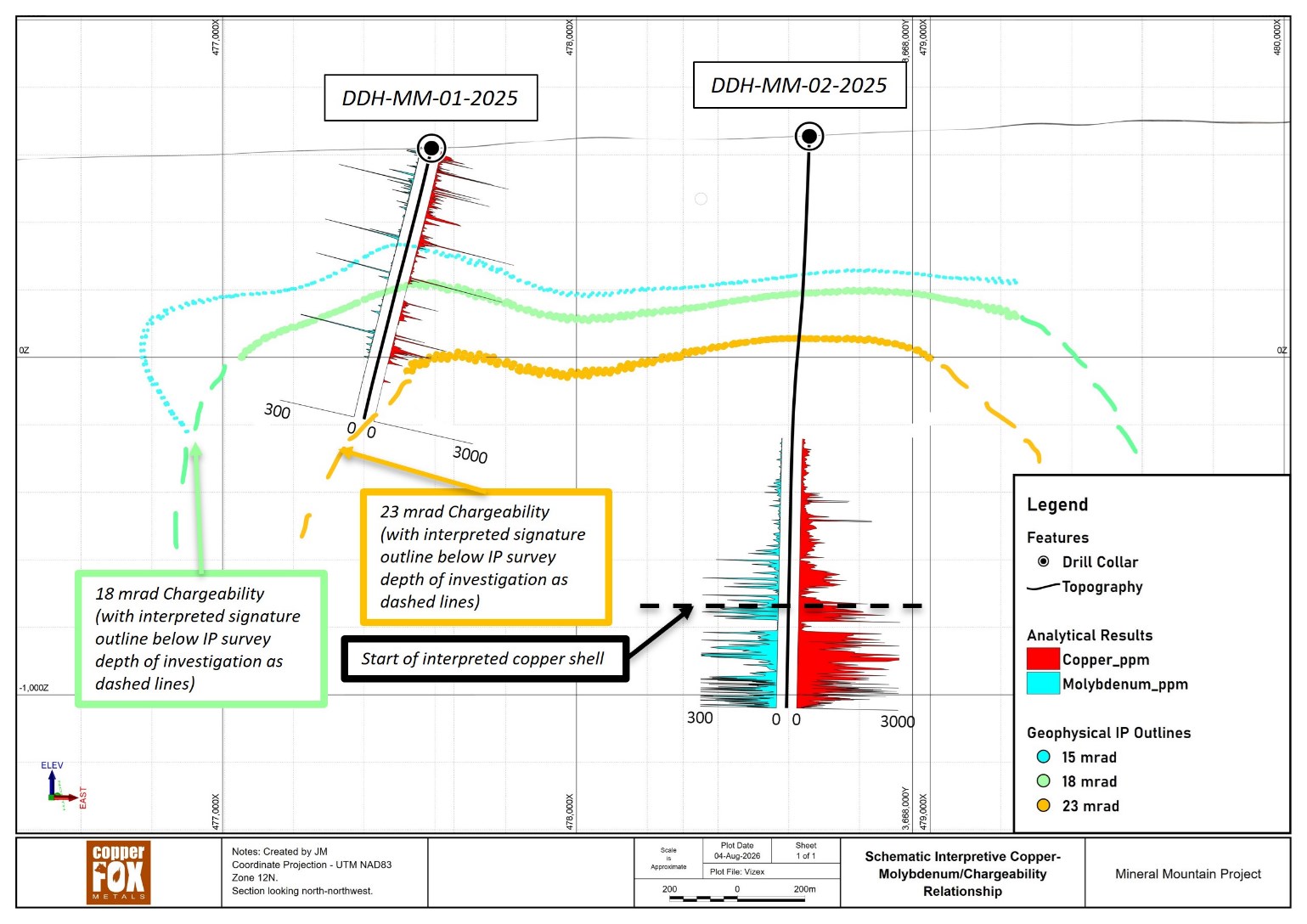
Figure-2: Schematic interpretative section showing copper-molybdenum mineralization/chargeability relationship.
To view an enhanced version of this graphic, please visit:
https://images.newsfilecorp.com/files/2177/308294_f96ad5d2d466d954_002full.jpg
A discussion of the analytical results for the core interval 896m to 1657m in DDH MM-02-2025 is provided below.
Interval 896m to 1259m: This interval is interpreted to represent the distal portion of the porphyry system characterized by generally low, copper (12.9 to 2,133 ppm) and molybdenum (0.1 to 123 ppm). Copper concentrations increase significantly (>500 ppm) toward the end of the interval with higher copper-molybdenum concentrations attributed to mineralized veins. Copper and molybdenum exhibit a negative correlation whereas the molybdenum and rhenium exhibit a positive correlation. The host rock is propylitic altered (chlorite-epidote ± actinolite) Pinal Schist and diabase dikes intruded by thin, un-mineralized, late-stage rhyolite porphyry dike. The alteration transitions down hole to progressively stronger phyllic (quartz-sericite-pyrite or "QSP") alteration toward the bottom of the interval. Veining is generally weak but persistent consisting of quartz-pyrite ± chalcopyrite-molybdenite, with associated K-spar, sphalerite, scheelite/powellite, tourmaline, specularite and epidote/calcite. Classical porphyry style "D" veins occur in the lower portion of this interval. The intervals1217m-1259m and 1333-1346m exhibit higher copper concentration due to increased frequency of quartz-sulphide veining.
Interval 1259m to 1379m: This interval marks the transition from propylitic (chlorite-epidote-actinolite) to dominantly phyllic/QSP altered Pinal Schist and diabase dike. This interval exhibits consistently higher copper (25.9 to 1,406 ppm), molybdenum (2 to 515 ppm) and silver concentrations. The higher copper-molybdenum and silver concentrations are mostly associated with the diabase dike. Veining is mainly quartz-pyrite ± chalcopyrite-molybdenite, with associated gangue minerals consisting of albite, magnetite, epidote, calcite, specularite and scheelite.
Interval 1379 to 1435m: The host rock is Pinal Schist cut by a late-stage weakly mineralized quartz-eye porphyry dike. Alteration consists of early-stage chlorite-epidote overprinted by strong QSP alteration. Veining consists of quartz-chalcopyrite-pyrite ± molybdenite, quartz-pyrite-chalcopyrite-molybdenite and pyrite-chalcopyrite-molybdenite veins with locally stronger chalcopyrite near the schist-porphyry contact. The copper concentrations range from 222 ppm in the quartz-eye porphyry dike to a maximum of 4,330 ppm at the schist/porphyry contact. Molybdenum values range from 9.2 ppm associated with the quartz eye porphyry dike to 583 ppm in pervasively sericitized Pinal Schist. The molybdenum concentrations tend to increase toward the bottom of the interval. Silver exhibits a moderate correlation to copper values.
Interval 1435m to 1469m: This interval is a late-stage, weakly mineralized quartz-eye, quartz monzonite porphyry. This interval exhibits QSP alteration with subordinate intermediate argillic alteration. Veining is sparse, dominated by chalcopyrite-pyrite-chlorite veinlets and minor chalcopyrite veinlets at the lower contact with the schist.
Interval 1469m to 1657m: This interval is interpreted to represent the outer copper enriched pyritic portion of a porphyry system that typically contains copper concentrations in the order of
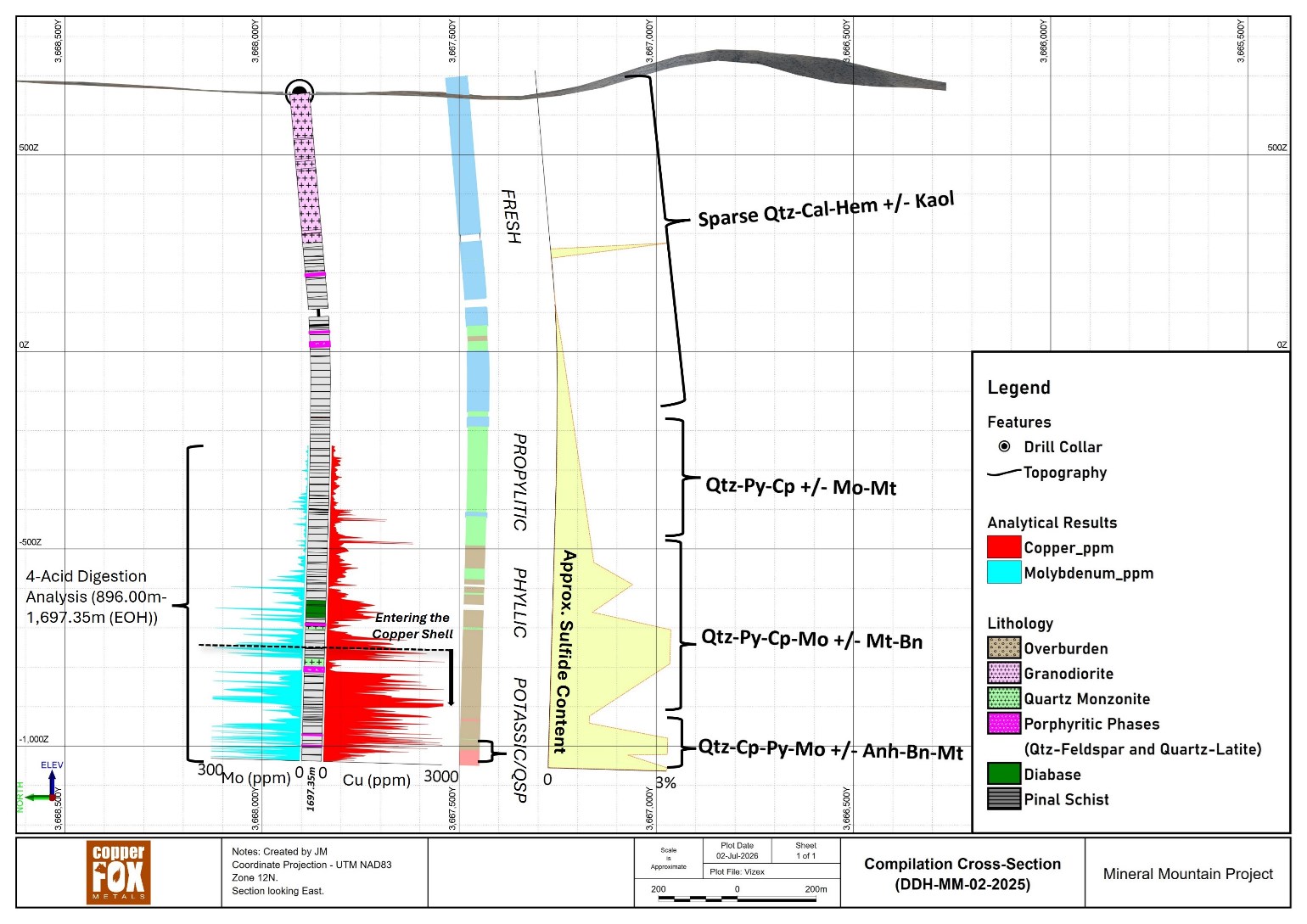
Figure-3: Schematic representation of lithologies, alteration, sulphide content and major vein types encountered in DDH MM-02-2025. Notes: Cu=copper, Mo=molybdenum, ppm=parts per million, m=meters. True thickness/widths of mineralization are unknown. The measurements of the alteration and sulphide boundaries are approximate.
To view an enhanced version of this graphic, please visit:
https://images.newsfilecorp.com/files/2177/308294_f96ad5d2d466d954_003full.jpg
The locations and drill collar co-ordinates for drillholes MM-01-2025 and MM-02-2025 are shown in Table-2 and Figure-4.
Table-2: Mineral Mountain 2025 drillhole information.
| DDH ID | Easting | Northing | Elev (masl) | Dip (deg) | Azi (deg) | Depth (m) |
| MM-01-2025 | 477590 | 3667582 | 619 | -75 | 290 | 860.76 |
| MM-02-2025 | 478660 | 3667905 | 663 | -85 | 180 | 1,697.35 |
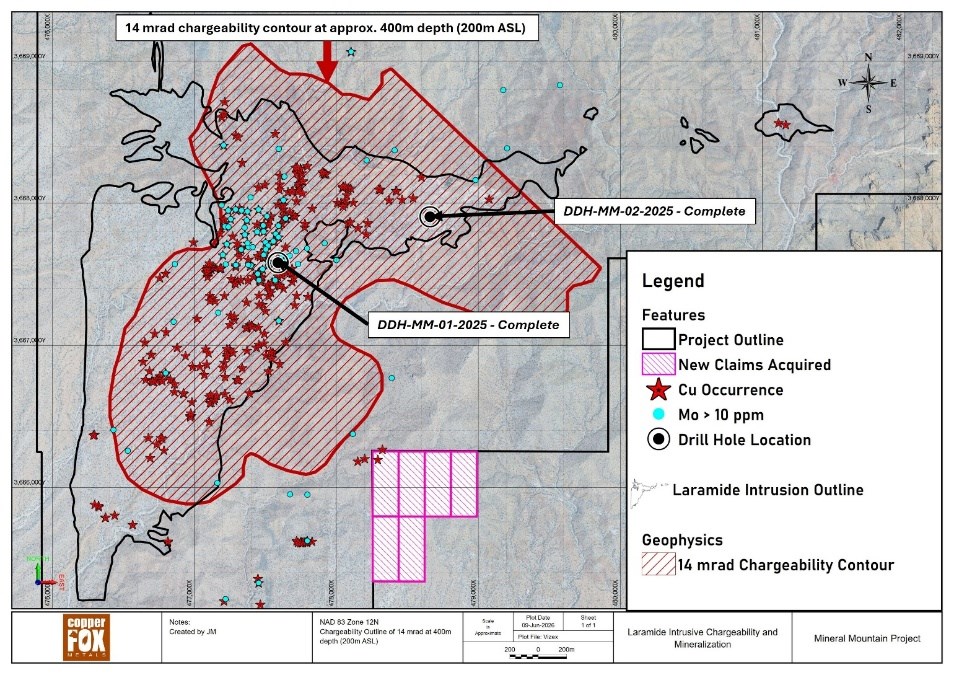
Figure-4: Mineral Mountain project drillhole location map superimposed on copper-molybdenum mineralization and 400m depth slice (below surface) of the 15mrad chargeability anomaly.
To view an enhanced version of this graphic, please visit:
https://images.newsfilecorp.com/files/2177/308294_f96ad5d2d466d954_004full.jpg
Quality Control (QA/QC)
A total of 351 drill core samples from DDH MM-02-2025 were sent for analysis. Copper Fox's Quality Assurance/Quality Control program for DDH MM-02-2025 consisted of 11 split-core duplicates, 30 commercial certified reference material (CRM) standards, and 34 blanks. The matrix material of the CRM's matches the Mineral Mountain geology. All standards are certified for 4-acid digestion.
Skyline Assayers and Laboratories Inc. (Accreditation 2953.01 and Standard ISO/IEC 17025:2017) located in Tucson, Arizona completed the sample preparation and analysis for the Mineral Mountain samples. Samples were prepared using preparation code SP-1 - crush to plus
Qualified Person
Elmer B. Stewart, MSc. P.Geo., President, and CEO of Copper Fox, is the Company's non-independent, nominated Qualified Person pursuant to National Instrument 43-101, Standards for Disclosure for Mineral Projects, and has reviewed and approves the scientific and technical information disclosed in this news release.
About Copper Fox
Copper Fox is a Canadian resource company focused on copper development and exploration in the United States and Canada. Copper Fox and its subsidiaries own
On behalf of the Board of Directors
Elmer B. Stewart
President and Chief Executive Officer
For additional information contact: Lynn Ball at 1-844-464-2820 or investor@copperfoxmetals.com.
Neither the TSX Venture Exchange nor its Regulation Services Provider (as that term is defined in the policies of the TSX Venture Exchange) accepts responsibility for the adequacy or accuracy of this release.
Cautionary Note Regarding Forward-Looking Information
This news release contains forward-looking statements within the meaning of the Section 27A of the Securities Act of 1933 and Section 21E of the Securities Exchange Act of 1934, and forward-looking information within the meaning of the Canadian securities laws (collectively, "forward-looking information"). Forward-looking information is generally identifiable by use of the words "believes," "may," "plans," "will," "anticipates," "intends," "budgets," "could," "estimates," "expects," "forecasts," "projects" and similar expressions, and the negative of such expressions. Forward-looking information in this news release includes statements regarding; DDH MM-02-2025 intersecting a classic porphyry alteration and mineralization sequence indicating vectoring toward a potential higher-grade potassic core; follow-up drill program ; and the potential for higher-grade mineralization lying below the current drill depth.
In connection with the forward-looking information contained in this news release, Copper Fox and its standards have made numerous assumptions regarding, among other things: the geological advice that Copper Fox has received is reliable and is based upon practices and methodologies which are consistent with industry standards; and the reliability of historical reports. While Copper Fox considers these assumptions to be reasonable, these assumptions are inherently subject to significant uncertainties and contingencies.
Additionally, there are known and unknown risk factors which could cause Copper Fox's actual results, performance, or achievements to be materially different from any future results, performance or achievements expressed or implied by the forward-looking information contained herein. Known risk factors include among others: the results of DDH MM-02-2025 may not represent a porphyry copper system; the porphyry style mineralization and alteration may not be indicative of or represent a porphyry copper system; further drilling may not locate additional porphyry style mineralization at depth, the financial markets and the overall economy may deteriorate; the need to obtain additional financing and uncertainty as to effects of threatened tariffs, timely availability of permits and other governmental approvals.
A more complete discussion of the risks and uncertainties facing Copper Fox is disclosed in Copper Fox's continuous disclosure filings with Canadian securities regulatory authorities at www.sedarplus.ca. All forward-looking information herein is qualified in its entirety by this cautionary statement, and Copper Fox disclaims any obligation to revise or update any such forward-looking information or to publicly announce the result of any revisions to any of the forward-looking information contained herein to reflect future results, events, or developments, except as required by law.

To view the source version of this press release, please visit https://www.newsfilecorp.com/release/308294
FAQ
AI-generated questions and answers. How Rhea-AI works. Not financial advice.