
Faraday Copper Intersects Near-Surface Copper Mineralization at Globe, Copper Giant and Marsha Breccias
Faraday Copper (OTCQX:CPPKF, TSX:FDY) reported results from 19 Phase IV drill holes at the Copper Creek project in Arizona, focused on near-surface copper.
Rhea-AI Summary
Faraday Copper (OTCQX:CPPKF, TSX:FDY) reported results from 19 Phase IV drill holes at the Copper Creek project in Arizona, focused on near-surface copper.
Thirteen holes hit mineralization generally within 40 m of surface, including 36.00 m at 0.81% Cu at Copper Giant and 347.42 m at 0.26% Cu at Marsha, supporting potential heap-leachable oxide resource growth.
Positive
- Thirteen of 19 Phase IV holes intercepted near-surface copper mineralization
- Copper Giant hole FCD-26-141 intersected 36.00 m at 0.81% Cu from surface
- Marsha hole FCD-26-152 returned 347.42 m at 0.26% Cu from 46.00 m
- Multiple intercepts show significant acid-soluble copper, indicating heap-leach potential
- Phase IV drilling better defines oxide and secondary sulphide enrichment zones
- 9,084 m drilled in 35 holes to date across multiple Copper Creek areas
Negative
- Copper has been leached from surface to 45 m depth at the Marsha breccia
- Some Globe and Copper Giant holes report only low or trace copper in upper intervals
Details
News Market Reaction – CPPKF
In the May 12 session, CPPKF gained 6.67%, reflecting a notable positive market reaction.
Data tracked by StockTitan Argus on the day of publication.
AI-generated analysis. How Rhea-AI works. Not financial advice.




VANCOUVER, BC / ACCESS Newswire / May 12, 2026 / Faraday Copper Corp. (" Faraday " or the " Company ") (TSX:FDY)(OTCQX:CPPKF) is pleased to announce the results of 19 drill holes from its Phase IV drill program at the Copper Creek Project, located in Arizona ("Copper Creek"). These holes targeted near-surface copper mineralization and addressed infill drilling and geotechnical objectives. Seven holes were drilled in the Globe area, seven holes were drilled in the Marsha area, and five holes were drilled in the Copper Giant area.
Paul Harbidge, President and CEO, commented, "One objective of our Phase IV drill program is expanding and better defining the oxide resource. These drill results demonstrate the presence of additional copper oxide and secondary sulphide material near surface and adjacent to previously defined breccia hosted mineralization. This is particularly exciting as copper oxides provide the opportunity for initial cathode production and allow for the delivery of made-in-America copper."
Highlights
Thirteen drill holes intercepted copper mineralization, typically within 40 metres ("m") from surface, supporting the potential for oxide resource growth at Copper Creek that is amenable to heap leach processing.
At Copper Giant, intersected 36.00 m at
0.81% copper (0.68% acid soluble copper) from surface in drill hole FCD-26-141.At the Marsha area, six drill holes intersected breccia and vein-hosted copper and molybdenum mineralization, including:
28.00 m at
0.58% copper and0.10% molybdenum from 46.00 m in drill hole FCD-26-152. This intercept is at the start of a longer intercept of 347.42 m at0.26% copper from 46.00 m.Identified new breccia mineralization west of the Marsha breccia with drill hole FCD-26-151, intersecting 17.50 m at
0.40% copper near surface, within 76.95 m at0.23% copper from 106.05 m.
At the Globe area, four drill holes intersected mineralization, including:
28.00 m at
0.64% copper (0.36% acid soluble copper) from 20.00 m in drill hole FCD-25-124.
(For true width information see Table 1)
Supergene Copper Mineralization
Supergene copper mineralization forms through weathering of chalcopyrite and pyrite and includes copper oxide minerals such as chrysocolla, malachite and tenorite as well as secondary sulphides, such as chalcocite and covellite.
Supergene copper mineralization at Copper Creek typically occurs within the first 40 m from surface and locally also deeper. The formation of oxide or secondary sulphide minerals depends on the primary mineralogy of the rock and other geological factors. Commonly, oxide minerals occur above secondary copper sulphides which can form an enrichment blanket consisting of high-grade copper mineralization.
Copper oxide and secondary sulphide minerals can be processed through heap-leaching (refer to news release dated February 26, 2024), which offers the potential to produce copper cathode early in the mine life and with low capital expenditure.
A part of the Company's Phase IV drilling is focused on better defining and expanding near-surface oxide and secondary copper sulphide enrichment zones which have not been a focus of historical drilling. The program is carried out with a diamond drill rig capable of drilling shallow-angle holes which minimizes the number of drill pads required for resource definition. While primary copper mineralization is hosted in breccias and porphyry-style veins, it can be leached during weathering and precipitated as supergene mineralization in surrounding rocks or as enrichment blankets in the lower part of the weathering zone. Many of the drillholes presented herein include oxide, primary and secondary sulphide dominant zones and help further define the ore types for future resource updates.
Holes drilled in the Globe area
The Globe area includes a variety of supergene mineralization styles. Oxide mineralization occurs in breccias and in surrounding host rocks within 35 m from surface. Below zones where copper has been leached near surface, a secondary copper sulphide enrichment zone of up to 20 m thickness is present. The primary copper mineralization includes chalcopyrite with pyrite as breccia cement.
Drill hole FCD-25-123 was collared north of the Globe breccia and drilled to the east. It intersected Glory Hole volcanics for the entire length. Mineralization occurs as chrysocolla and black copper oxide minerals as fracture coatings. Below 40 m, trace amounts of pyrite, chalcopyrite and chalcocite are present.
Drill hole FCD-25-124 was collared at the same location as FCD-25-123 and drilled to the southwest. It intersected breccia to 13 m and Glory Hole volcanics to the end of the hole. Mineralization is present as chalcocite, malachite and other copper oxide minerals in veinlets and fracture coatings.
Drill hole FCD-25-125 was collared south of the Globe breccia and drilled to the northeast. The hole intersected Glory Hole volcanics to 11 m followed by hydrothermal breccia to 25 m. The remainder of the hole is in Glory Hole volcanics. Mineralization is present as chrysocolla, malachite and other oxide copper minerals as well as minor chalcocite, mostly on fracture coatings in the volcanic rocks surrounding the breccia.
Drill hole FCD-25-126 was collared at the same location as FCD-25-125 and drilled to the south. It intersected Glory Hole volcanics for its entire length except for a 1 m intercept of breccia at 30 m. Fracture coatings of iron and manganese oxides with low copper content are observed in the top 30 m of the hole.
Drill hole FCD-25-127 was collared approximately 70 m southeast of FCD-25-125 and drilled to the south. It intersected Glory Hole volcanics for its entire length. Mineralization is present as copper bearing manganese oxides, malachite and trace chalcocite in the top 30 m of the hole.
Drill hole FCD-25-132 was collared approximately 320 m south of the Globe breccia and drilled to the northeast, targeting the Holly breccia. It intersected 101 m of Glory Hole volcanics followed by hydrothermal breccia to 136 m. The hole enters volcanics crosscut by narrow porphyry dykes to 172 m. After crossing a fault at that depth, it enters back into breccia to 289 m and ends in volcanics. The breccia intervals are pyrite cemented. Trace chalcopyrite is observed from 158 m to 182 m and from 241 m to 289 m.
Drill hole FCD-25-133 was collared approximately 250 m south of the Globe breccia and drilled to the southwest, targeting the Holly breccia. The hole starts in Glory Hole volcanics and enters porphyry to 56 m, followed by breccia to 66 m. It intersected volcanics to 102 m before entering a zone of alternating breccia and volcanics to 161 m where it goes back into volcanics. Trace chalcopyrite is observed along with pyrite from 142 m to 161 m.
Holes drilled in the Copper Giant area
The supergene mineralization at Copper Giant is dominated by copper oxide minerals which occur within 30 m from surface, whereas secondary copper sulphides are less abundant. No extensive leach zone is developed. These characteristics reflect neutralizing host rock characteristics and the low pyrite content in the primary mineralization which limits copper mobility during weathering.
Drill hole FCD-25-138 was collared west of the Copper Giant breccia and drilled to the south. It tested an occurrence of iron oxides with anomalous copper identified in fractures at surface. The hole stayed in granodiorite for its entire length. Chrysocolla and black copper oxide minerals, together with trace chalcopyrite, pyrite and chalcocite make up the mineralization which is fracture hosted.
Drill hole FCD-25-139 was collared at the same location as FCD-25-139 and drilled to the southwest. It intersected granodiorite except for a monzogranite porphyry from 78 m to 91 m. Malachite and chrysocolla have been observed in veinlets in the top 30 m, whereas trace chalcopyrite together with pyrite are present in the remainder of the hole.
Drill hole FCD-25-140 was collared at the northern margin of the Copper Giant breccia and drilled to the north. The hole started in Glory Hole volcanics and entered granodiorite at 16 m to 30 m before entering a zone of breccia to 36 m. Porphyry is present from 36 m to 45 m, followed by breccia to 52 m. Granodiorite follows thereafter to 86 m where the hole enters breccia again to the end. Mineralization is vein and breccia hosted and consists of trace pyrite and chalcopyrite with local occurrence of minor chalcocite and black copper oxide minerals with isolated 2 m samples exceeding
Drill hole FCD-26-141 was collared at the same location as FCD-25-140 and drilled to the west. It intersected hydrothermal breccia for the first 33 m, followed by 1 m of porphyry, before entering Glory Hole volcanics to 178 m. Two short breccia intervals (less than 3 metre-wide) are present at 152 m and at 165 m. The hole ends in porphyry. Mineralization occurs as chrysocolla, malachite and copper bearing manganese oxides and locally chalcocite within the breccia domain near the start of the hole. Locally abundant chalcopyrite is observed as cement in a small breccia intercept at 165 m.
Drill hole FCD-25-142 was collared at the same location as FCD-25-140 and was drilled to the southeast. The hole drilled 10 m of overburden material and then entered breccia to 68 m, porphyry to 83 m and again breccia to 86 m. The remainder of the hole intercepted porphyry. Mineralization consists of malachite, chrysocolla and copper-bearing manganese oxides replacing sulphides in breccia cement to 40 m. Below that, copper is contained in chalcopyrite in breccia cement and porphyry-style veinlets.
Holes drilled in the Marsha area
The Marsha breccia is exposed on a topographic ridge, where copper has been leached from surface to 45 m depth, while molybdenum and silver are still present. Below the leached domain, copper is enriched in a chalcocite zone that within breccia locally extends to 120 m below surface. Primary mineralization at depth consists of chalcopyrite with pyrite. Copper oxide mineralization occurs at the margins of the breccia approximately 30 m to 40 m below surface.
Drill hole FCD-26-148 was collared at the Marsha breccia and drilled to the south. The hole intercepted hydrothermal breccia to 65 m followed by alternating intervals of porphyry, breccia and granodiorite to 152 m. The remainder of the hole stayed in granodiorite except for an interval of porphyry from 173 m to 194 m. Copper was leached in the top 65 m, while molybdenite is still present. Chalcocite together with relict chalcopyrite are present from 71 m to 133 m.
Drill hole FCD-26-149 was collared at the same location as FCD-26-148 and drilled to the northeast. It intersected breccia to 29 m, followed by granodiorite to the end of the hole. The breccia interval is oxidized, and primary copper sulphides have been leached. Conversely, molybdenite is present with molybdenum content exceeding
Drill hole FCD-26-150 was collared at the same location as FCD-26-148 and drilled to the east. It intersected breccia to 75 m, followed by granodiorite to the end of the hole. The breccia is affected by intense sericitic alteration and oxidized. Mineralization occurs as chrysocolla and malachite in the breccia domain whereas trace chalcopyrite and chalcocite occur in veinlets in the granodiorite.
Drill hole FCD-26-151 was collared at the same location as FCD-26-148 and drilled to the west. It intersected breccia in the first 14 m, before entering granodiorite, followed by porphyry from 104 m to 242 m. Within the porphyry domain breccia was intersected from 142 to 178 m. The hole ends in granodiorite. Breccia domains have modest potassic alteration overprinted by moderate to intense sericite. Mineralization occurs chalcocite-chalcopyrite together with pyrite, disseminated and as breccia cement.
Drill hole FCD-26-152 was collared at the same location as FCD-26-148 and drilled to the south. The hole dominantly intersected breccia to 395 m, followed by granodiorite to 435 m and porphyry to the end of the hole. Breccia domains are affected by sericitic alteration overprinting potassic alteration. The top 47 m consist of a strongly oxidized breccia with trace chrysocolla and molybdenite. Chalcocite is the dominant copper mineral from 47 to 80 m and occurs together with molybdenite and an increasing proportion of chalcopyrite with depth. Breccia cement is the dominant style of mineralization.
Drill hole FCD-26-159 was collared at the same location as FCD-26-148 and drilled to the north. It intersected breccia to 52 m, followed by granodiorite to the end of the hole. The breccia is affected by intense sericitic alteration and is oxidized. Copper mineralization occurs below 33 m primarily as chalcocite, trace chrysocolla and malachite. Molybdenum averages
Drill hole FCD-26-160 was collared at the same location as FCD-26-148 and drilled steeply to the west. It intersected breccia to 110 m, followed by granodiorite and, again, breccia from 145 m to 176 m. The hole terminated in granodiorite. Copper is contained in copper oxide minerals in the uppermost 40 m, with chalcocite being the dominant species from 40 m to 110 m. Below 110 m chalcopyrite increases in relative abundance, but chalcocite is present throughout the breccia domains, as deep as 176 m. Molybdenite is present throughout the hole, including in the top 40 m of the hole.
Next Steps
Drilling continues, focused on near-surface mineralization as well as geotechnical and hydrogeological objectives. The Company has released results from 9,084 m drilled in 35 holes, of which 15 holes are in the American Eagle area, seven in the Globe area, seven in the Marsha area, five in the Copper Giant area and one hole in Keel.
The assay results for additional completed drill holes will be released as they are received, analyzed and confirmed by the Company.
Figure 1: Plan View Showing Surface Geology and Location of the Drill Holes
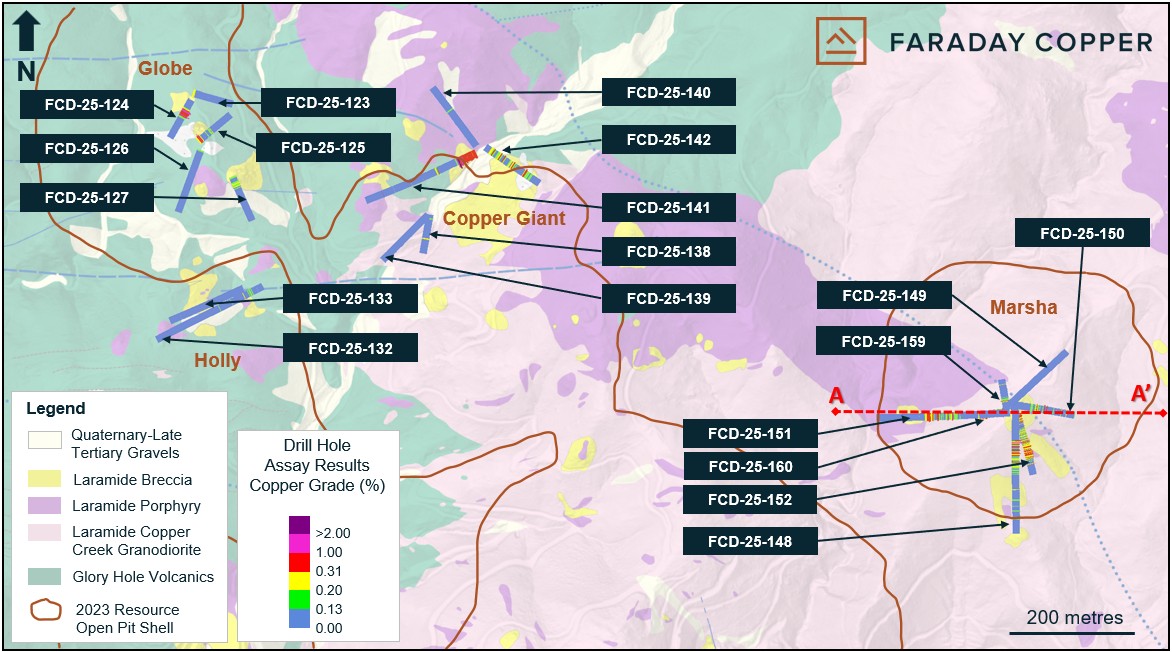
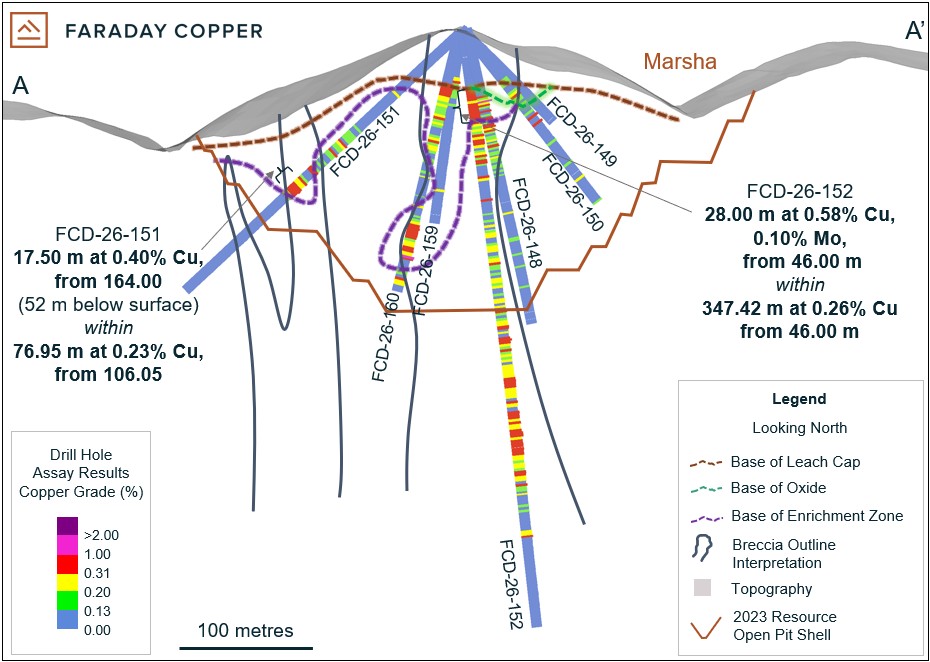
Figure 3: Images of Copper Oxide and Molybdenite Present in Drill Core and Surface Outcrop
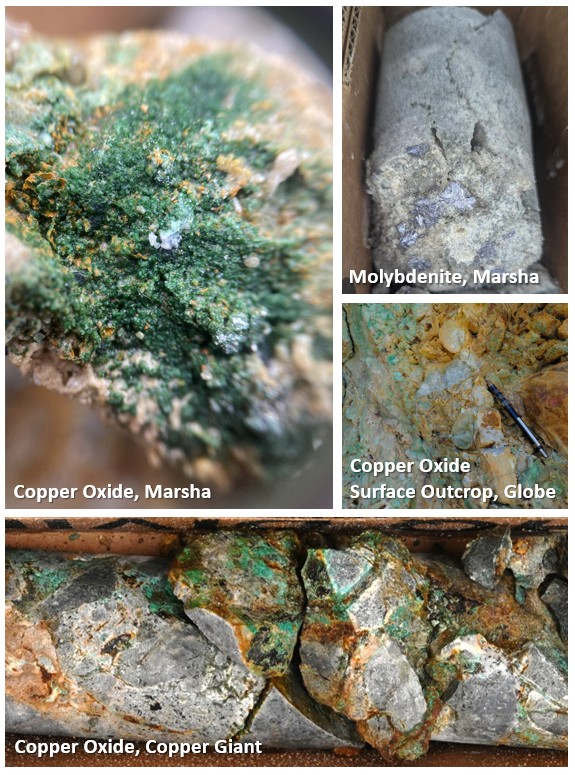
Table 1: Selected Drill Results
Drill Hole ID | From | To | Length | True Width | Total Cu | Acid Soluble Cu (ACu) | ACu / Total Cu | Mineralized Zone | Au | Ag | Mo |
(m) | (m) | (m) | (m) | (%) | (%) | Ratio | (g/t) | (g/t) | (%) | ||
FCD-25-123 | 0.00 | 14.28 | 14.28 | 6 | 0.15 | 0.08 | 0.55 | Oxide | N/A | 0.10 | 0.0002 |
FCD-25-124 | 20.00 | 48.00 | 28.00 | 20 | 0.64 | 0.36 | 0.51 | Chalcocite | N/A | 0.36 | 0.0014 |
FCD-25-125 | 0.00 | 11.18 | 11.18 | 8 | 0.54 | 0.47 | 0.81 | Oxide | N/A | 0.75 | 0.0006 |
and | 24.79 | 39.63 | 14.83 | 11 | 0.13 | 0.07 | 0.52 | Oxide | N/A | 0.57 | 0.0034 |
FCD-25-127 | 0.00 | 30.00 | 30.00 | 21 | 0.15 | 0.05 | 0.32 | Mixed | N/A | 0.54 | 0.0006 |
FCD-25-138 | 4.00 | 12.00 | 8.00 | 8 | 0.11 | 0.04 | 0.37 | Oxide | N/A | 0.11 | 0.0012 |
FCD-26-141 | 0.00 | 36.00 | 36.00 | N/Ap | 0.81 | 0.68 | 0.79 | Oxide | 0.07 | 1.54 | 0.0013 |
FCD-25-142 | 0.00 | 65.00 | 54.85 | N/Ap | 0.16 | 0.06 | 0.36 | Mixed | 0.01 | 0.54 | 0.0005 |
including | 0.00 | 30.00 | 30.00 | N/Ap | 0.16 | 0.11 | 0.66 | Oxide | <0.01 | 0.59 | 0.0031 |
and | 80.00 | 98.00 | 18.00 | N/Ap | 0.22 | 0.01 | 0.04 | Primary | N/A | 0.52 | 0.0042 |
FCD-26-148 | 71.00 | 141.00 | 70.00 | 49 | 0.27 | 0.03 | 0.11 | Mixed | <0.01 | 0.41 | 0.0010 |
including | 71.00 | 106.00 | 35.00 | 25 | 0.35 | 0.05 | 0.20 | Chalcocite | <0.01 | 0.23 | 0.0009 |
FCD-26-150 | 44.00 | 91.00 | 47.00 | 33 | 0.16 | 0.06 | 0.37 | Mixed | N/A | 0.44 | 0.0217 |
Including | 59.00 | 69.00 | 10.00 | 7 | 0.21 | 0.15 | 0.73 | Oxide | N/A | 0.21 | 0.0059 |
FCD-26-151 | 106.05 | 183.00 | 76.95 | 59 | 0.23 | 0.04 | 0.16 | Chalcocite | <0.01 | 0.50 | 0.0009 |
including | 164.00 | 181.50 | 17.50 | 13 | 0.40 | 0.11 | 0.25 | Chalcocite | <0.01 | 0.78 | 0.0013 |
FCD-26-152 | 46.00 | 393.42 | 347.42 | 100 | 0.26 | N/A | N/A | Mixed | <0.01 | 0.56 | 0.0225 |
including | 46.00 | 74.00 | 28.00 | 28 | 0.58 | 0.02 | 0.04 | Chalcocite | <0.01 | 1.19 | 0.1038 |
and including | 295.96 | 330.00 | 34.04 | 10 | 0.46 | N/A | N/A | Primary | N/A | 0.81 | 0.0025 |
FCD-26-159 | 35.00 | 58.00 | 23.00 | 10 | 0.18 | 0.01 | 0.06 | Mixed | N/A | 0.58 | 0.0064 |
including | 35.00 | 47.00 | 12.00 | 11 | 0.22 | 0.02 | 0.08 | Chalcocite | N/A | 0.58 | 0.0064 |
FCD-26-160 | 40.00 | 196.00 | 156.00 | 150 | 0.23 | 0.02 | 0.07 | Mixed | 0.01 | 0.45 | 0.0153 |
including | 40.00 | 52.00 | 12.00 | N/Ap | 0.48 | 0.02 | 0.04 | Chalcocite | 0.01 | 0.74 | 0.0060 |
and including | 148.75 | 176.15 | 27.40 | N/Ap | 0.45 | 0.07 | 0.15 | Chalcocite | 0.01 | 0.62 | 0.0410 |
FCD-25-126 | No significant intercepts | ||||||||||
FCD-25-132 | No significant intercepts | ||||||||||
FCD-25-133 | No significant intercepts | ||||||||||
FCD-25-139 | No significant intercepts | ||||||||||
FCD-25-140 | No significant intercepts | ||||||||||
FCD-25-149 | No significant copper intercepts, 0.11 % Mo 0 m to 30 m in leached cap | ||||||||||
Note: All intercepts are reported as downhole drill widths. Mineralization includes bulk porphyry style and breccia mineralization with a supergene overprint. True widths are approximate due to the irregular shape of mineralized domains. True width for certain drill intercepts cannot be determined. These drill holes are labeled as "Not applicable" ("N/Ap"). "N/A": Not analyzed.
Table 2: Collar Locations from the Drill Holes Reported Herein
Drill Hole ID | Easting | Northing | Elevation | Azimuth | Dip | Target | Depth | Depth |
(m) | (°) | (°) | (ft) | (m) | ||||
FCD-25-123 | 547681 | 3624907 | 1273 | 105 | 25 | Globe oxide | 247.1 | 75.32 |
FCD-25-124 | 547676 | 3624905 | 1272 | 209 | 45 | Globe oxide | 336.0 | 102.41 |
FCD-25-125 | 547696 | 3624832 | 1283 | 050 | 45 | Globe oxide | 317.4 | 96.74 |
FCD-25-126 | 547691 | 3624824 | 1283 | 200 | 25 | Globe oxide | 395.7 | 120.61 |
FCD-25-127 | 547742 | 3624778 | 1281 | 156 | 40 | Globe oxide | 343.2 | 104.61 |
FCD-25-132 | 547628 | 3624516 | 1274 | 063 | 46 | Holly Breccia | 977.0 | 297.79 |
FCD-25-133 | 547762 | 3624606 | 1230 | 245 | 46 | Holly Breccia | 637.3 | 194.25 |
FCD-25-138 | 548057 | 3624724 | 1227 | 190 | 15 | Copper Giant | 216.0 | 65.84 |
FCD-25-139 | 548054 | 3624727 | 1228 | 225 | 10 | Copper Giant | 344.0 | 104.85 |
FCD-25-140 | 548139 | 3624832 | 1236 | 324 | 10 | Copper Giant | 319.0 | 119.18 |
FCD-26-141 | 548134 | 3624824 | 1238 | 247 | 08 | Copper Giant | 640.0 | 195.07 |
FCD-25-142 | 548142 | 3624816 | 1235 | 125 | 25 | Copper Giant | 380.0 | 115.82 |
FCD-26-148 | 548990 | 3624409 | 1346 | 180 | 45 | Marsha | 983.0 | 299.62 |
FCD-26-149 | 548987 | 3624411 | 1342 | 047 | 25 | Marsha | 469.4 | 143.87 |
FCD-26-150 | 548988 | 3624412 | 1342 | 100 | 46 | Marsha | 540.0 | 164.59 |
FCD-26-151 | 549985 | 3624409 | 1344 | 265 | 40 | Marsha | 913.8 | 287.52 |
FCD-26-152 | 548987 | 3624411 | 1344 | 160 | 75 | Marsha | 1519.0 | 462.99 |
FCD-26-159 | 548985 | 3624410 | 1343 | 350 | 70 | Marsha | 491.1 | 149.96 |
FCD-26-160 | 548985 | 3624410 | 1344 | 265 | 75 | Marsha | 659.5 | 201.02 |
Note: Coordinates are given as World Geodetic System 84, Universal Transverse Mercator Zone 12 north (WGS84, UTM12N).
Sampling Methodology, Chain of Custody, Quality Control and Quality Assurance
All sampling was conducted under the supervision of the Company's geologists and the chain of custody from Copper Creek to the independent sample preparation facility, ALS Laboratories in Tucson, AZ, was continuously monitored. The samples were taken as ½ core, over 2 m core length. Samples were crushed, pulverized and sample pulps were analyzed using industry standard analytical methods including a 4-Acid ICP-MS multielement package and an ICP-AES method for high-grade copper samples. Copper mineralized samples were also analyzed for acid and cyanide soluble copper. Gold was analyzed on a 30 g aliquot by fire assay with an ICP-AES finish. A certified reference sample was inserted every 20 th sample. Coarse and fine blanks were inserted every 20 th sample. Approximately
Qualified Person
The scientific and technical information contained in this news release has been reviewed and approved by Faraday's VP Exploration, Dr. Thomas Bissig, P. Geo., who is a Qualified Person under National Instrument 43-101 - Standards of Disclosure for Mineral Projects ("NI 43-101").
Notes
1 The Mineral Resource Estimate is presented in the report titled "Copper Creek Project NI 43-101 Technical Report and Preliminary Economic Assessment" with an effective date of May 3, 2023, available on the Company's website at www.faradaycopper.com and on the Company's SEDAR+ profile at www.sedarplus.ca.
About Faraday Copper
Faraday Copper is an exploration company focused on advancing its flagship copper project in Arizona, U.S. The Copper Creek Project is one of the largest undeveloped copper projects in North America with significant district scale exploration potential. Faraday has entered into a non-binding letter of intent with a subsidiary of BHP Group for the proposed acquisition of BHP's San Manuel Property, adjacent to the Copper Creek Project. The Company is well-funded to deliver on its key milestones and benefits from a management team and board of directors with senior mining company experience and expertise. Faraday trades on the TSX under the symbol "FDY".
For additional information please contact:
Stacey Pavlova, CFA
Vice President, Investor Relations & Communications
Faraday Copper Corp.
E-mail: info@faradaycopper.com
Website: www.faradaycopper.com
To receive news releases by e-mail, please register using the Faraday website at www.faradaycopper.com.
Cautionary Note on Forward Looking Statements
Some of the statements in this news release, other than statements of historical fact, are "forward-looking statements" and are based on the opinions and estimates of management as of the date such statements are made and are necessarily based on estimates and assumptions that are inherently subject to known and unknown risks, uncertainties and other factors that may cause actual results, level of activity, performance or achievements of Faraday to be materially different from those expressed or implied by such forward-looking statements. Such forward-looking statements and forward-looking information specifically include, but are not limited to, statements concerning the exploration potential of the Copper Creek property.
Although Faraday believes the expectations expressed in such forward-looking statements are based on reasonable assumptions, such statements should not be in any way construed as guarantees of future performance and actual results or developments may differ materially. Accordingly, readers should not place undue reliance on forward-looking statements or information.
Factors that could cause actual results to differ materially from those in forward-looking statements include without limitation: market prices for metals; the conclusions of detailed feasibility and technical analyses; lower than expected grades and quantities of mineral resources; receipt of regulatory approval; receipt of shareholder approval; mining rates and recovery rates; significant capital requirements; price volatility in the spot and forward markets for commodities; fluctuations in rates of exchange; taxation; controls, regulations and political or economic developments in the countries in which Faraday does or may carry on business; the speculative nature of mineral exploration and development, competition; loss of key employees; rising costs of labour, supplies, fuel and equipment; actual results of current exploration or reclamation activities; accidents; labour disputes; defective title to mineral claims or property or contests over claims to mineral properties; unexpected delays and costs inherent to consulting and accommodating rights of Indigenous peoples and other groups; risks, uncertainties and unanticipated delays associated with obtaining and maintaining necessary licenses, permits and authorizations and complying with permitting requirements, including those associated with the Copper Creek property; and uncertainties with respect to any future acquisitions by Faraday. In addition, there are risks and hazards associated with the business of mineral exploration, development and mining, including environmental events and hazards, industrial accidents, unusual or unexpected formations, pressures, cave-ins, flooding and the risk of inadequate insurance or inability to obtain insurance to cover these risks as well as "Risk Factors" included in Faraday's disclosure documents filed on and available at www.sedarplus.ca.
This press release does not constitute an offer to sell or a solicitation of an offer to buy any securities in any jurisdiction to any person to whom it is unlawful to make such an offer or solicitation in such jurisdiction. This press release is not, and under no circumstances is to be construed as, a prospectus, an offering memorandum, an advertisement or a public offering of securities in Faraday in Canada, the United States or any other jurisdiction. No securities commission or similar authority in Canada or in the United States has reviewed or in any way passed upon this press release, and any representation to the contrary is an offence.
SOURCE: Faraday Copper Corp.
View the original press release on ACCESS Newswire
FAQ
AI-generated questions and answers. How Rhea-AI works. Not financial advice.