
U.S. Retail Asking Rent Growth Slowed in the Second Quarter of 2026
CoStar Group (NASDAQ: CSGP) reports that U.S. retail asking rent growth slowed to +1.6% year over year in Q2 2026, the weakest pace in more than a decade.




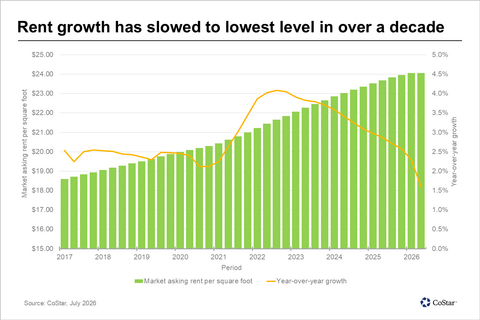
Rent growth has slowed to lowest level in over a decade
In Q2 2026, national asking rent growth decelerated to +
“The slowdown in asking rent growth is less a sign of weakening demand than a function of normalization,” said Brandon Svec, national director of retail analytics at CoStar Group. "While retail fundamentals remain healthy by historical standards, softer consumer spending growth, elevated interest rates and greater tenant cost pressures have reduced landlords’ ability to push rents at the aggressive pace seen earlier in the cycle.”
Despite slower rent growth, landlords continue to realize substantial rent spreads when space turns over, particularly in high-traffic retail corridors where available space remains scarce.
“While rent spreads have moderated somewhat from the record levels achieved in 2022 through 2024, they remain near multi-decade highs in many markets as rents on expiring leases often sit well below current market rates,” said Svec. “The combination of elevated lease spreads and larger contractual rent escalations is allowing many owners to continue generating meaningful revenue growth even as rent appreciation slows.”
Asking rent growth deceleration is evident across most major markets, but performance continues to vary considerably by region.
Several Sun Belt markets that led rent growth earlier in the cycle, including
Read the full analysis here.
For more information about the company and its products and services, please visit costargroup.com.
About CoStar Group
CoStar Group (NASDAQ: CSGP) is a global leader in commercial real estate information, analytics, online marketplaces, and 3D digital twin technology. Founded in 1986, CoStar Group is dedicated to digitizing the world’s real estate, empowering all people to discover properties, insights, and connections that improve their businesses and lives.
CoStar Group’s major brands include CoStar, a leading global provider of commercial real estate data, analytics, and news; LoopNet, the most trafficked commercial real estate marketplace; Apartments.com, the leading platform for apartment rentals; Homes.com, the fastest-growing residential real estate marketplace; and Domain, one of Australia’s leading property marketplaces. CoStar Group’s industry-leading brands also include Matterport, a leading spatial data company whose platform turns buildings into data to make every space more valuable and accessible; STR, a global leader in hospitality data and benchmarking; Ten-X, an online platform for commercial real estate auctions and negotiated bids; and OnTheMarket, a leading residential property portal in the United Kingdom.
CoStar Group’s websites attracted over 131 million average monthly unique visitors in the first quarter of 2026, serving clients around the world. Headquartered in Arlington, Virginia, CoStar Group is committed to transforming the real estate industry through innovative technology and comprehensive market intelligence. From time to time, we plan to utilize our corporate website as a channel of distribution for material company information. For more information, visit CoStarGroup.com.
View source version on businesswire.com: https://www.businesswire.com/news/home/20260717599595/en/
News Media:
Haley Luther
Senior Communications Manager
(216) 278-0627
hluther@costar.com
Source: CoStar Group