
Curaleaf Issues Fact Sheet to Address What It Believes Are Misleading Statements From Aurora
Curaleaf uses premium metrics, cash-flow comparisons and trading data to argue its mostly stock offer for Aurora is attractive versus Aurora’s standalone plan.
Sentiment and the balance of points
Rhea-AI Sentiment reads the wording of the document, how positive or negative its language is on a 1 to 5 scale. The balance of points shown with the takes weighs what the document actually discloses, so the two can disagree, for example when a trial that missed its main goal is described in upbeat language.
Rhea-AI Summary
Curaleaf (CURLF) released a detailed fact sheet supporting its proposal to acquire Aurora Cannabis and contrasting the two companies’ performance and outlook.
Curaleaf states its bid implies a 45% premium to Aurora’s prior trading price, or 110% excluding Aurora’s cash balance*, and describes this as among the higher Canadian M&A premiums of the past decade. The company highlights that Aurora has recorded about C$5 billion of impairments, roughly C$130 million of business transformation costs, and more than C$480 million of negative operating cash flow since FY21, while Curaleaf reports $447 million of positive operating cash flow since FY21. Curaleaf notes cash is about 19% of its US$4.00 offer, the US$5.00 cap equates to a premium within the 92nd percentile of Canadian M&A premiums over 10 years, and says it trades more value on the TSX year‑to‑date than Aurora on Nasdaq.
Positive
- Offer premium of 45% headline and 110% excluding Aurora’s cash balance*
- Curaleaf reports $447 million of positive operating cash flow since FY21
- Aurora has more than C$480 million negative operating cash flow since FY21
- Aurora has recorded about C$5 billion in impairments and ~C$130 million in transformation costs
- Cash component is ~19% of the US$4.00 offer price
- US$5.00 cap premium is within the 92nd percentile of Canadian M&A premiums over 10 years
Negative
- None.
News Explained
Aurora holders face ongoing ownership dilution from new ATM shares, while Curaleaf’s acquisition remains unnegotiated and mostly stock-based.
Curaleaf’s proposal to acquire Aurora remains a proposal; the release says Aurora continues selling new shares through an at-the-market program, which would reduce existing holders’ percentage ownership absent offsetting changes.
The proposed consideration is mostly Curaleaf stock: cash is about
The release also says Aurora rejected the proposal without a confidentiality agreement, price discussion, or counteroffer, so the disclosed process has not reached a negotiated transaction.
The next material markers are whether Aurora’s ATM issuances continue and whether the 105-day bid period is shortened to 35 days or a deal is negotiated.
Details
News Market Reaction – CURLF
On Sep 8, the day this news came out, CURLF closed 0.40% above the previous close.
Data tracked by StockTitan Argus for the Sep 8 session.
AI-generated analysis. How Rhea-AI works. Not financial advice.




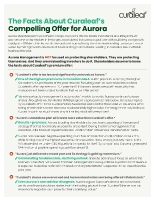
Curaleaf believes shareholders deserve the facts. While Aurora has focused on criticizing Curaleaf's proposal, shareholders should focus on the fundamental question: which company has a clearer vision for the future and a stronger record of creating shareholder value? The fact sheet below helps shareholders evaluate the choice between Curaleaf's premium offer and Aurora's standalone plan.
Read the fact sheet and learn more at grow.curaleaf.com.
MYTH: "Curaleaf's offer is too low and significantly undervalues Aurora."
FACT: One of the highest premiums in Canadian M&A. A
More importantly, management's actions don't match its words. Aurora continues to issue shares through its At-the-Market (ATM) program at prices materially below the value implied by Curaleaf's offer. Since Curaleaf's bid, Aurora has accelerated these dilutive issuances while telling shareholders not to tender to a substantially higher value. If management truly believes Aurora is worth so much more, why is it selling stock at lower prices?
MYTH: "Aurora's standalone plan will create more value than Curaleaf's offer."
FACT: Results > promises. Aurora is asking shareholders to continue supporting a "turnaround" strategy that has had nearly six years to prove itself. During this time, management has recorded
Aurora has overseen negative operating cash flow of more than
MYTH: "Aurora just delivered a record year and its strategy is gaining momentum."
FACT: Deteriorating fundamentals, declining outlook. Shareholders should focus on where the business is headed, not where it has been. Management's own guidance says fiscal 2027 revenue is expected to decline to fiscal 2025 levels and adjusted EBITDA is expected to be lower than the prior year.
MYTH: "Curaleaf's shares are overvalued and Aurora shareholders are being offered inflated stock."
FACT: Even Aurora's own advisor disagrees. Aurora argues Curaleaf's shares are overvalued, yet its own financial advisor states that "the trading price of those [Curaleaf] shares can be reasonably regarded as a proxy for their underlying value."
Curaleaf consistently commands a premium because it is the largest publicly traded cannabis company in the world and a leader in profitability and cash flow generation. Aurora can't have it both ways: if Curaleaf's valuation is too high, why is it not high enough for Aurora?
MYTH: "Curaleaf's leverage presents a risk to future equity holders."
FACT: Debt can be repaid; dilution is forever. Curaleaf is the largest cannabis operator by revenue and market cap, among the most profitable by adjusted EBITDA, and is a cash flow leader. Curaleaf's balance sheet compares favorably to peers, and the company's profitability and cash flows support its debt load.
In contrast, Aurora promotes a "debt-free" balance sheet but ignores how that balance sheet was and is being financed. Aurora has raised more than
MYTH: "ACB had substantive discussions with Curaleaf before rejecting our offer."
FACT: They never even discussed price. Aurora never entered into a confidentiality agreement with Curaleaf and never once discussed price. Rather than testing whether additional value could be secured for shareholders, Aurora simply rejected the proposal without even discussing a counteroffer.
MYTH: "The
FACT: If the cap is the issue, the Board can fix it. Aurora's criticism of the cap structure is a distraction from the significant premium represented by the
The
If Aurora's Board was truly concerned about the cap, they can choose to shorten the 105-day bid period to 35 days and engage constructively with Curaleaf on the particulars of a deal.
MYTH: "Aurora shareholders would trade independent ownership for a minority stake in a company controlled by one individual through multi-voting shares."
FACT: This is about scale, not governance. Aurora shareholders would retain a minority stake in the combined company because Curaleaf is substantially larger than Aurora (>13x market cap prior to the offer).
CURA insiders have nearly
Multi-class voting structures are not a rarity. They are used by many of the largest founder-owned sector leaders, including Alphabet, Meta, Shopify, Palantir, DoorDash, and, among leading cannabis companies, Green Thumb, and Trulieve among others.
MYTH: "Why should Aurora shareholders accept mostly Curaleaf stock?"
FACT: Get paid today, participate in upside tomorrow. Cash consideration represents ~
MYTH: "Regulatory reform is already priced into Curaleaf's stock. There isn't much upside left."
FACT: The biggest benefits are still ahead. Federal reform is not a one-time event. The value creation comes from what follows: immediately, materially lower cash taxes and improved free cash flow, and potentially broader institutional ownership, lower financing costs, greater M&A flexibility, access to credit cards, and uplisting to a major
MYTH: "Most of Curaleaf's business is Adult Use sales in
FACT: Exposure to the world's largest cannabis market is an advantage, not a risk. Our
MYTH: "The transaction is not tax efficient for
FACT: Stay invested in the upside. A significant portion of the consideration consists of CURA shares, allowing shareholders to continue their investment in the combined company rather than fully liquidating their position. If tax structuring is a priority for Aurora, they should engage with Curaleaf to negotiate it.
MYTH: "Why would Nasdaq-listed shareholders accept OTC paper?"
FACT: It's about the business, not the exchange. Curaleaf trades on the TSX which is among the largest exchanges globally and is the leading exchange for cannabis issuers. On a 2026 YTD basis, CURA has traded meaningfully more value on the TSX relative to ACB on NASDAQ. Additionally, a Nasdaq listing has not prevented value destruction for ACB shareholders. Lastly, CURA is expected to also trade on a major
Cautionary Statement Regarding Forward-Looking Statements
This press release contains certain "forward-looking statements" within the meaning of such statements under applicable securities laws. Forward-looking statements are frequently characterized by words such as "plan", "continue", "expect", "project", "intend", "believe", "anticipate", "estimate", "may", "will", "potential", "proposed" and other similar words, or statements that certain events or conditions "may" or "will" occur. These statements are only predictions. Forward looking statements in this news release include statements regarding the terms of the Offer, the expected benefits of the Offer to the combined company and the financial and strategic benefits of the Offer noted above, synergies and efficiencies that may be achieved upon a combination of the businesses of Aurora and Curaleaf; and expectations with respect to business and geographical diversification of the combined entity. Various assumptions were used in drawing the conclusions or making the projections contained in the forward-looking statements throughout this press release, including assumptions based upon Aurora's publicly disclosed information, and that there will be no change in the business, prospects or capitalization of Aurora or Curaleaf. Forward-looking statements are based on the opinions and estimates of management at the date the statements are made and are subject to a variety of risks and uncertainties and other factors that could cause actual events or results to differ materially from those projected in the forward-looking statements. The Company is under no obligation, and expressly disclaims any intention or obligation, to update or revise any forward-looking statements, whether as a result of new information, future events or otherwise, except as expressly required by applicable law. A more complete discussion of the risks and uncertainties facing the Company appears in the Company's Annual Information Form and continuous disclosure filings, which are available at www.sedarplus.ca.
Cautionary Statement Respecting Aurora Information
The information concerning Aurora contained in this press release has been taken from, or is based upon, publicly available information filed by Aurora with securities regulatory authorities in Canada prior to the date of this press release and other public sources. Aurora has not reviewed this press release and has not confirmed the accuracy and completeness of the Aurora information contained herein. Neither Curaleaf, nor any of its officers or directors, assumes any responsibility for the accuracy or completeness of such Aurora information. Curaleaf has no means of verifying the accuracy or completeness of any of the Aurora information contained in this press release.
Notice to U.S. Holders
The Offer is being made for the securities of a company formed outside of the United States. The Offer is subject to disclosure requirements of Canada that are different from those of the United States. Financial statements included in the documents, if any, will be prepared in accordance with Canadian accounting standards and may not be comparable to the financial statements of United States companies.
It may be difficult for a securityholder in the United States to enforce his/her/its rights and any claim a securityholder may have arising under the U.S. federal securities laws, since the issuer is located in Canada, and some or all of its officers or directors may be residents of Canada or another country outside of the United States. A securityholder may not be able to sue a Canadian company or its officers or directors in a court in Canada or elsewhere outside of the United States for violations of U.S. securities laws. It may be difficult to compel a Canadian company and its affiliates to subject themselves to a U.S. court's judgment.
Securityholders should be aware that the issuer may purchase securities otherwise than under the Offer, such as in open market or privately negotiated purchases.
About Curaleaf Holdings
Curaleaf Holdings, Inc. (TSX: CURA) (OTCQX: CURLF) ("Curaleaf") is a leading international provider of consumer products in cannabis with a mission to enhance lives by cultivating, sharing and celebrating the power of the plant. As a high-growth cannabis company known for quality, expertise and reliability, the Company and its brands, including Curaleaf, Select, Grassroots, Find, Dark Heart, and Anthem provide industry-leading service, product selection and accessibility across the medical and adult use markets. Curaleaf International is powered by a strong presence in all stages of the supply chain. Its unique distribution network throughout Europe, Canada and Australasia brings together pioneering science and research with cutting-edge cultivation, extraction and production. Curaleaf is listed on the Toronto Stock Exchange under the symbol CURA and trades on the OTCQX market under the symbol CURLF. For more information, please visit https://ir.curaleaf.com.
Contacts
Media Contact
Kekst CNC
Kekst-Curaleaf@kekstcnc.com
Investor Contact
Curaleaf Holdings, Inc.
IR@curaleaf.com
Shareholder Contact
Carson Proxy Advisors
North American Toll Free Phone: 1-800-530-5189
Local (Collect outside North America): 416-751-2066
Email: info@carsonproxy.com
 View original content to download multimedia:https://www.prnewswire.com/news-releases/curaleaf-issues-fact-sheet-to-address-what-it-believes-are-misleading-statements-from-aurora-302872359.html
SOURCE Curaleaf Holdings, Inc.
FAQ
AI-generated questions and answers. How Rhea-AI works. Not financial advice.
How does Curaleaf describe Aurora’s forward guidance relative to recent results?
Curaleaf cites Aurora’s own guidance that fiscal 2027 revenue is expected to decline to fiscal 2025 levels and that adjusted EBITDA is expected to be lower than the prior year. Curaleaf presents this as indicating deteriorating fundamentals and a declining outlook despite Aurora referring to a recent year as “record”.
What does Curaleaf say about its leverage and Aurora’s use of equity financing?
Curaleaf states it is the largest cannabis operator by revenue and market cap, among the most profitable by adjusted EBITDA, and a cash flow leader, and that its profitability and cash flows support its debt load. It contrasts this with Aurora, which it says has raised more than US$400 million since September 2020 through equity issuances, including at-the-market programs that Curaleaf characterizes as dilutive to existing shareholders.
What ownership and incentive alignment does Curaleaf highlight for a combined company?
Curaleaf states that its insiders have nearly US$500 million of their own capital invested, representing approximately 20% insider ownership. It contrasts this with what it describes as approximately 1% insider ownership at Aurora and notes that Aurora insiders have around 10% of the transaction value payable upon a change in control. Curaleaf presents these figures as showing stronger alignment between its management and shareholders.
How much of the consideration is Curaleaf stock, and what rationale is given?
Curaleaf states that cash consideration is about 19% of the US$4.00 offer price, with the remaining consideration in Curaleaf shares. The company says this mix provides immediate value while allowing Aurora shareholders to retain ownership in what it calls the largest cannabis company in the sector, with broader market exposure, stronger cash generation, and multiple future growth catalysts.
What benefits from potential U.S. regulatory reform does Curaleaf describe?
Curaleaf states that federal reform is not a one-time event and that value creation comes from follow‑on effects, including immediately and materially lower cash taxes, improved free cash flow, potentially broader institutional ownership, lower financing costs, greater M&A flexibility, access to credit cards, and an uplisting to a major U.S. exchange. The company says these benefits compound over time and have only begun.
How does Curaleaf characterize its U.S. business mix and regulatory exposure?
Curaleaf states that its U.S. medical business represents approximately 60% of its operations. It describes exposure to the U.S., which it calls the world’s largest cannabis market, as a benefit and competitive advantage, and says U.S. cannabis regulation has been moving toward greater normalization, broader acceptance, and reduced regulatory barriers.
What information is provided to U.S. holders regarding legal rights and enforcement?
The notice to U.S. holders explains that the offer is for a company formed outside the United States and is subject to Canadian disclosure requirements that differ from those of the United States. Financial statements, if included, will follow Canadian accounting standards and may not be comparable to those of U.S. companies. It warns that it may be difficult for U.S. securityholders to enforce rights or claims under U.S. federal securities laws because the issuer is in Canada and some officers or directors may reside outside the United States, and it may be difficult to compel a Canadian company and its affiliates to submit to a U.S. court’s judgment. It also notes the issuer may purchase securities outside the offer, including in open‑market or privately negotiated transactions.