Rhea-AI Sentiment reads the wording of the document, how positive or negative its language is on a 1 to 5 scale. The balance of points shown with the takes weighs what the document actually discloses, so the two can disagree, for example when a trial that missed its main goal is described in upbeat language.
Cushman & Wakefield’s 2026 Global Data Center Market Comparison finds development pipelines surging worldwide as operators expand beyond traditional hubs
NEW YORK--(BUSINESS WIRE)--
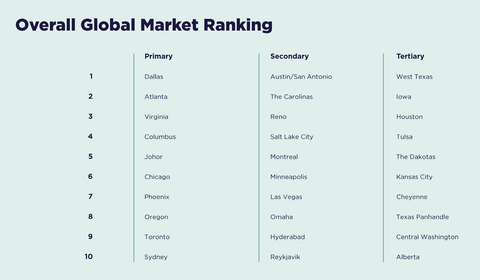
Global data center markets are entering a new phase of expansion defined not simply by growth, but by increasingly strategic and selective development, according to Cushman & Wakefield’s 2026 Global Data Center Market Comparison report. For the first time, Dallas ranked as the No. 1 primary data center market in the world, followed by Atlanta (2), Virginia (3), Columbus (4) and Johor (5). Austin-San Antonio and West Texas led the secondary and tertiary market rankings, underscoring Texas’ growing importance as a large-scale AI infrastructure hub.
Top cities for data centers as ranked by Cushman & Wakefield's 2026 Global Data Center Market Comparison
Driven by accelerating AI adoption, cloud computing demand and digital infrastructure investment, global capacity under construction approached 31.7 gigawatts (GW) in 2025, more than doubling from 12.5GW reported in the prior edition of the report. At the same time, developers, occupiers and investors are facing intensifying constraints tied to power availability, land use, permitting timelines and growing regulatory scrutiny.
“The global data center industry has entered a period of managed growth,” said John McWilliams, Head of Data Center Insights at Cushman & Wakefield. “Demand fundamentals remain extraordinarily strong, but the industry is no longer operating in an environment of unconstrained expansion. Power delivery timelines, land availability, community sentiment and regulation are now playing a much larger role in determining where and how data centers get built.”
The report analyzes 107 global markets across 24 variables tied to commercial real estate fundamentals, power infrastructure, development activity, regulation and operational risk and provides a more forward looking approach to evaluate market dynamics than previous editions.
Americas Continue to Dominate Global Development Activity
The Americas remain the center of global data center development activity, accounting for approximately 80% of all capacity currently under construction worldwide.
Virginia maintained its position as the world’s largest data center market with 11.3GW of operational capacity, while Texas emerged as one of the industry’s fastest-growing and most scalable regions as large scale data center development activity expands into numerous parts of the state.
The report highlights West Texas as a rapidly growing AI infrastructure hub, with 2.9GW currently under construction, exceeding the entire amount of capacity underway across the EMEA region.
“The scale of development occurring across parts of the U.S. is unprecedented from a commercial real estate perspective,” McWilliams said. “Developers are increasingly prioritizing markets that can provide scalable land, reliable power infrastructure and a regulatory environment supportive of long-term expansion.”
Across the Americas, preleasing activity remains exceptionally strong. Approximately 89% of capacity currently under construction is already pre-committed when hyperscale self-build activity is included, underscoring continued imbalance between supply and demand.
The report also notes that planned capacity across the Americas increased more than fourfold year-over-year, rising from 46.1GW in 2024 to 191.3GW by the end of 2025.
Power Availability Continues to be a Defining Commercial Real Estate Variable
According to the report, access to power has remained one of the defining variables shaping global data center development strategy.
Globally, average power delivery timelines for new large-load requests now stand at 4.4 years, with timelines extending to approximately five years across both the Americas and EMEA.
As a result, developers are increasingly pursuing powered land opportunities, integrating private generation into projects and expanding into secondary and tertiary markets where infrastructure constraints may be less severe.
“The industry’s focus has shifted from simply securing land to securing deliverable power,” said McWilliams. “That dynamic is fundamentally reshaping data center real estate strategy worldwide.”
The report also identifies growing divergence between markets able to support long-term AI infrastructure expansion and those facing mounting regulatory, infrastructure or community-related barriers to growth.
About the Report
The 2026 Global Data Center Market Comparison evaluates 107 global markets using 24 variables across market fundamentals, terrestrial considerations, power infrastructure and political/regulatory conditions. The report examines operational capacity, development pipelines, vacancy, absorption, cloud presence, land availability, power delivery timelines and other factors influencing global data center development decisions.
Cushman & Wakefield (NYSE: CWK) is a leading global commercial real estate services firm for occupiers and investors with approximately 53,000 employees in over 350 offices and nearly 60 countries. In 2025, the firm reported revenue of $10.3 billion across its core service lines of Services, Leasing, Capital markets, and Valuation and other. Built around the belief that Better never settles, the firm receives numerous industry and business accolades for its award-winning culture. For additional information, visit www.cushmanwakefield.com.
A gigawatt (GW) is a measure of electrical power equal to one billion watts and tells you how much electricity a plant or project can produce at a given moment. For investors it signals scale and revenue potential—larger GW capacity usually means bigger sales, grid impact and capital needs—much like knowing a factory’s production line size helps predict output and cash flow.
preleasingfinancial
Preleasing is when a landlord or developer signs tenants or obtains firm commitments to occupy space before construction finishes or before the lease term begins. Like getting buyers’ deposits before a new product ships, preleasing lowers the risk of vacant space, helps secure loans and predictable cash flow, and signals demand—factors that directly affect a property’s value and an investor’s expected return.
hyperscaletechnical
Hyperscale describes the ability of a system or operation to grow rapidly and handle extremely large amounts of work or data. It’s like a massive factory that can quickly expand its production capacity to meet soaring demand. For investors, hyperscale indicates a business’s potential to scale efficiently, often leading to increased growth and profitability.
operational capacitytechnical
Operational capacity is the amount of goods or services a company can produce and deliver using its current facilities, staff and equipment under normal conditions, like how many meals a kitchen can prepare per hour. It matters to investors because it limits how fast revenue can grow, affects costs per unit and shows whether the business can meet spikes in demand or needs investment to expand.
powered landtechnical
Powered land is property that already has a reliable connection to electrical power and basic utility infrastructure, meaning a developer can plug in equipment or buildings without arranging new grid hookups. For investors, it matters because ready access to power reduces upfront cost, shortens project timelines and lowers the risk of delays—think of it like buying a house that already has running water and a working electrical panel versus one that needs all utilities installed.
development pipelinestechnical
A company’s development pipelines are the lineup of products, drugs or projects moving through stages from early research to testing and regulatory approval, showing what the business is building for the future. Investors treat pipelines like a roadmap: a deep, diverse pipeline can signal potential future revenue and growth, while timelines, technical hurdles and approval risk indicate how likely and how soon that value will materialize—like checking planted crops to predict next season’s harvest.
permitting timelinesregulatory
Permitting timelines are the expected schedules for obtaining government or regulatory approvals required to start or continue a project, such as building, operating a facility, or selling a regulated product. They matter to investors because delays or faster approvals change when a project can earn revenue and how much it will cost; think of them like waiting for a building permit before starting a renovation — timing determines when you can begin and how the budget holds up.
regulatory scrutinyregulatory
Regulatory scrutiny is when government agencies closely review a company's actions, products or filings to ensure they follow laws and safety rules. For investors, heightened scrutiny can mean slowed approvals, fines, operational changes or reputational risk — like a detailed safety inspection that can delay a product launch or reveal costly fixes, and therefore can affect revenue, costs and share price.