Doximity Outranks OpenEvidence, Frontier Models in Independent Stanford-Harvard Study of Clinical AI Safety
Doximity Inc reported $644.9M in revenue and $196.1M in net income for fiscal 2026.
See the full DOCS financial statements: income statement, balance sheet, cash flow and ratios, each column linked to its SEC filing.
Doximity Outranks OpenEvidence, Frontier Models in Independent Stanford-Harvard Study of Clinical AI Safety
Doximity Ask outranked OpenEvidence, GPT-5.6 Sol, Claude Fable 5, and other frontier models
SAN FRANCISCO--(BUSINESS WIRE)--
Doximity, Inc. (NYSE: DOCS), the leading digital platform for U.S. medical professionals, today announced that Doximity Ask, its HIPAA-compliant clinical AI platform, outperformed leading frontier AI models in the NOHARM (Numerous Options Harm Assessment for Risk in Medicine) benchmark, one of the most comprehensive independent evaluations of clinical AI safety to date.
Doximity Outranks OpenEvidence, Frontier Models in Independent Stanford-Harvard Study of Clinical AI Safety
The study, conducted by ARISE, a clinical AI research team led by physicians from Stanford and Harvard Medical Schools, evaluated how AI models perform when researchers prompted them with simulated patient cases.
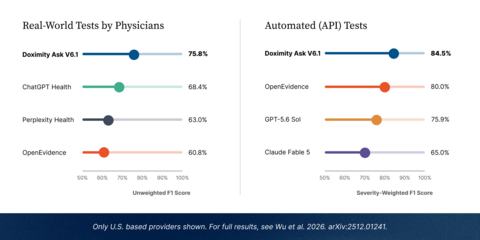
Doximity Ask ranked first among all AI systems evaluated on the study's real-world clinical sample, the portion of the benchmark that most closely mirrors how physicians use these tools in practice. Across the broader automated evaluation, purpose-built clinical AI systems outperformed general-purpose frontier models by a wide margin.
Why Doximity Ask Outperformed
Doximity Ask is a HIPAA-compliant AI assistant built specifically for clinical workflows.
Our performance traces directly to our investment in physician authorship at scale. Through our PeerCheck™ program, more than 11,000 cited physician experts have evaluated and improved Doximity Ask outputs.
"We have long believed that the path to trustworthy healthcare AI runs through physicians, not around them," said Dr. Louis-Antoine Mullie, Head of Medical AI at Doximity. "Continuous physician review isn't a differentiator. It's a requirement. This result reinforces the importance of combining advanced AI systems with rigorous clinical oversight and independent safety evaluations like NOHARM."
Doximity's Clinical AI Suite, including Ask, has been reviewed, approved, and deployed across more than 150 health systems, including eight of the nation's top 20 hospitals.
The platform includes end-to-end encryption, role-based access controls, audit logging, and session isolation to help healthcare organizations deploy AI while maintaining enterprise-grade security and privacy standards.
The chart on the left shows how the top U.S. models performed on F1 score, which balances precision and recall, before the cases and answers were made public.
The chart on the right shows automated testing across more than 1,100 scenarios spanning 10 medical specialties. The benchmark was developed by more than 50 researchers with contributions from 29 board-certified physicians.
About Doximity
Founded in 2010, Doximity is the leading digital platform for U.S. medical professionals. The company's network members include more than 85% of U.S. physicians across all specialties and practice areas. Doximity provides its verified clinical membership with digital tools built for medicine, enabling them to collaborate with colleagues, stay current on medical news and research, manage their careers and on-call schedules, streamline documentation and administrative paperwork, and conduct virtual patient visits. With new AI-powered clinical reference and search capabilities, Doximity also helps doctors access trusted, peer-reviewed information and medical literature. Doximity's mission is to help doctors be more productive so they can provide better care for their patients.
HIPAA-compliant means that a product, service, or organization follows the U.S. Health Insurance Portability and Accountability Act’s rules for protecting patients’ private health information, including technical controls, physical safeguards, and record-keeping. For investors, compliance matters because it reduces risks of costly fines, lawsuits and reputational damage, and it can be a requirement to sell into healthcare markets — like having a certified lockbox and an audit trail that reassures customers and regulators.
f1 scoretechnical
F1 score is a single-number measure of how well a predictive model balances two kinds of mistakes: false alarms and missed detections. Think of it as a single grade that rewards a tool that both finds real positives and avoids crying wolf; a higher F1 means the model is reliable at spotting true cases without producing too many false alerts. Investors use it to judge the quality of risk, fraud, or forecasting models that inform decisions.
precision and recalltechnical
Precision is the share of positive predictions that are actually correct, while recall is the share of actual positives that the model successfully finds. Think of picking ripe apples from a tree: precision is how many of the apples you picked were truly ripe, and recall is how many of all the ripe apples on the tree you managed to pick. These metrics matter to investors because they quantify the trade-off between false alarms and missed opportunities in models used for trading signals, risk screening, fraud detection, and other data-driven decisions.
role-based access controlstechnical
Role-based access controls are a system that gives people access to a company’s digital information and tools based on the job they do, like giving employees different keys to different rooms. For investors this matters because it reduces the risk of leaks, fraud, and costly regulatory breaches, helps ensure smoother operations, and can affect a company’s security costs and overall valuation.
audit loggingtechnical
Audit logging is the systematic recording of who did what, when, and where within a company’s digital systems, like a detailed event diary for computers and applications. Investors care because these records help prove that controls are working, detect fraud or mistakes quickly, and support regulatory compliance—similar to having security camera footage and receipts that make a business more trustworthy and reduce the risk of costly surprises.