
Eagle Plains' Partner Xcite Uranium Inc. Commences Drill Program at the Don Lake Uranium Project, Saskatchewan
Eagle Plains Resources (OTCQB:EGPLF) reports that partner Xcite Uranium (TSXV:XRI) has started a 1,500m, 14‑hole diamond drill program at Eagle Plains’ 100%-owned Don Lake uranium project near Uranium City, Saskatchewan.
Sentiment and the balance of points
Rhea-AI Sentiment reads the wording of the document, how positive or negative its language is on a 1 to 5 scale. The balance of points shown with the takes weighs what the document actually discloses, so the two can disagree, for example when a trial that missed its main goal is described in upbeat language.
Rhea-AI Summary
Eagle Plains Resources (OTCQB:EGPLF) reports that partner Xcite Uranium (TSXV:XRI) has started a 1,500m, 14‑hole diamond drill program at Eagle Plains’ 100%-owned Don Lake uranium project near Uranium City, Saskatchewan. The 2026 Don Lake budget is approximately $1.1 million, including $200,000 in completed fieldwork and $900,000 allocated to drilling, managed by TerraLogic Exploration.
The program will test structurally controlled uranium targets at the Don and Midas areas, following soil geochemistry, radiometric and magnetic surveys, LiDAR and VTEM modelling that outlined multiple anomalies. Don Lake hosts 12 SMDI uranium occurrences, a past-producing mine and historically reported high‑grade U3O8 intercepts from trenches and shallow drilling.
Under an existing option, Xcite may earn up to an 80% interest in each of six Beaverlodge‑area uranium projects by funding $3.2M in exploration per project (aggregate $19.2M), issuing 4.5M shares and paying $330,000 in cash to Eagle Plains, which will retain a 2% NSR and a 20% carried JV interest upon earn‑in.
Positive
- $1.1M approved 2026 budget for Don Lake, including 1500m drilling
- Partner-funded earn-in of up to $19.2M exploration across six projects
- Potential receipt of 4.5M Xcite shares and $330,000 cash over four years
- Eagle Plains to retain 20% carried JV interest and 2% NSR on each property
- Drill program targets multiple geophysical and geochemical uranium anomalies defined in 2025–2026 work
Negative
- None.
Details
News Market Reaction – EGPLF
On Aug 20, the day this news came out, EGPLF closed 0.66% above the previous close.
Data tracked by StockTitan Argus for the Aug 20 session.
AI-generated analysis. How Rhea-AI works. Not financial advice.




CRANBROOK, BC / ACCESS Newswire / August 20, 2026 / Eagle Plains Resources Ltd. (TSXV:EPL)(OTCQB:EGPLF) ("EPL" or "Eagle Plains") is pleased to announce that partner Xcite Uranium Inc. (TSXV:XRI) ("XRI or Xcite"), has commenced a diamond drilling program at Eagle Plains'
The Don Lake uranium project is located near Uranium City, Saskatchewan, and hosts near surface uranium mineralization as well as a past producing uranium mine. In December 2023 Eagle Plains granted Xcite the exclusive right to earn up to an
Don Lake Project Highlights
Twelve SMDI uranium occurrences
Tenures cover past producing Beta Gamma Mine (SMDI 1394) and the Don Lake Uranium Deposit (SMDI 1393)
Historical drilling at A Zone returned values of
10.7% U3O8 over 0.3m and2.14% U3O8 over 0.67m (AF 74N10-0422).Trench samples up to
1.17% U3O8 over 1.98m (AF 74N10-0422).
"The last significant boots on the ground fieldwork at the Don Lake property was almost fifty years ago" commented Chuck Downie, President and CEO of Eagle Plains Resources. "For context, as we read about groundbreaking at the NexGen Rook Project, 50 years ago the only significant uranium discovery on the west side of the Athabasca Basin was the Cluff Lake mine. The long history of exploration and historic mining in the Beaverlodge Camp, combined with the current uranium price and forecasts for future uranium consumption, are perfect catalysts to refocus on new, near surface discoveries on the north side of the basin."
The approved 2026 budget for Don Lake is approximately
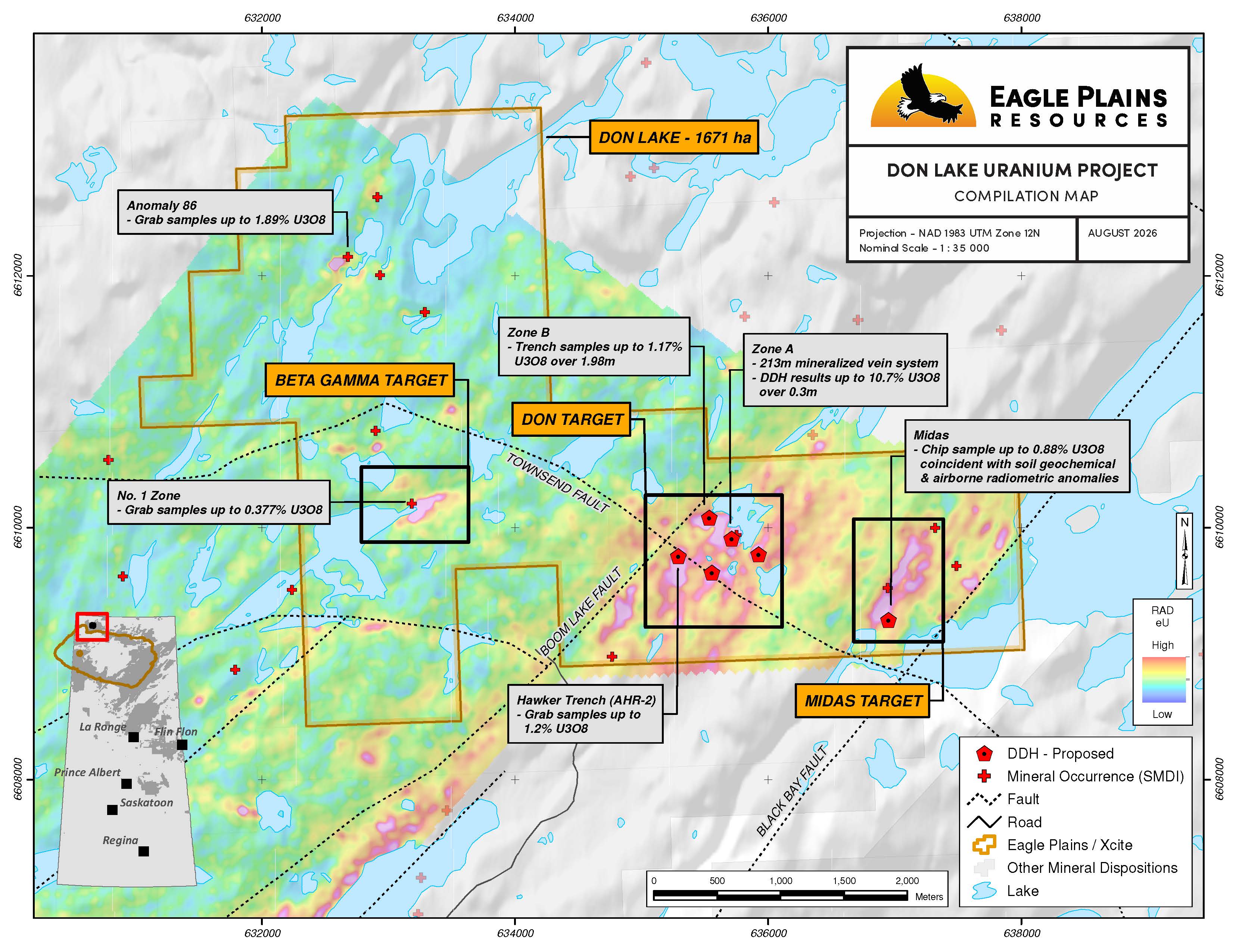
Don Lake Compilation Map
2026 Don Lake Field Program
2026 work was focused on the central and eastern part of the claims between the NE trending Boom Lake and Black Bay faults and the SE trending Townsend Fault. Fieldwork included soil sampling, prospecting, structural mapping, and scintillometer surveying. Geophysical work included 682 line-km of airborne radiometric and magnetic completed by Precision GeoSurveys, and 2.9 km2 of drone LiDar surveying. In addition, Condor Consulting was contracted to complete interpretation and modelling of 72 line-km of VTEM data collected in 2025.
A total of 282 soil samples were collected east of the Black Bay Fault, a regional structure that is inferred to control uranium mineralization in the Beaverlodge camp. At the Midas Target, geochemical results defined a number of highly anomalous uranium values interpreted to define structural splays from the main fault zone.
At the Don Target area, a drone based LiDar survey was used to accurately locate historical trenches and workings. This was followed up with structural mapping, prospecting and sampling.
The radiometric survey defined several features of interest including broad total uranium (eU) anomalies over the historic A, B and C Zone areas and Hawker Trench area (the Don Target), and the Midas Target area. West of the Boom Lake Fault, the survey located an additional radiometric anomaly coincident with the historic Beta Gamma Mine.
Don Lake Drill Program
The 2026 drilling program will test for structurally-controlled uranium mineralization west of the Black Bay Fault, and north of the Townsend Fault, within the Don and Midas Targets. The holes are aligned to target the intersection between NE-trending and NW-trending structures. In the Don Target area, the drilling will test for extensions of high-grade uranium mineralization beneath the A, B, C Zone trenches and the Hawker trenches. At the Midas, drilling will target the source of the coincident 2026 uranium geochemical anomaly and the strong anomaly defined by the 2026 radiometric survey.
The program will consist of 1500m of diamond drilling, with 14 holes from 6 different pad locations. The 2026 drilling was contracted to Apex Drilling with crews based out of Uranium City.
See Don Lake Project Information and Map here
About the Don Lake Project
The road accessible 1671ha project overlies 12 Saskatchewan Mineral Deposit Index ("SMDI") occurrences associated with Beaverlodge-type basement hosted uranium mineralization.
The property is transversed by the parallel, northeasterly-striking Boom Lake and Black Bay Fault, the latter of which is a regional structure that is inferred to control uranium mineralization in the Beaverlodge camp. In the southeast corner of the property Martin Group sediments form an unconformable contact with older Tazin Group gneisses, along the hanging wall of the Black Bay Fault.
Uranium mineralization at Don Lake is structurally controlled, occurring as pitchblende hosted in fractures and veins associated with faults and shear zones, and often associated with graphite and sulphides.
Three zones of radioactivity and U mineralization have been identified at the Don Lake A, B and C Zones (SMDI 1393), which has been traced by historical drilling and trenching over approximately 525m.
Zone A is a vein system with a length of 213.4 m, that crosses the trend of a northeast-striking lineament. Fourteen trenches and 20 shallow drill holes have been completed over the zone. Analytical results range from trace values up to
Zone B, positioned to the northwest and interpreted to be a continuation of the mineralized trend observed at Zone A, has seen 12 shallow diamond drill holes and 20 trenches completed. Trench sampling reported grades as high as1.
Zone C is positioned to the southeast of Zones A and B and further defines the NW-SE mineralized trend. 6 shallow drillholes and 9 trenches have been completed at Zone C, where trench samples returned from trace amounts up to
At Radioactive Occurrence 50-CC3-10 and -44 (SMDI 1383), and the Midas Cu-U Showing (SMDI 1384) pitchblende occurs as in shears associated with the Crackingstone Fault. Showings associated with the Townsend Fault Uranium Showings (SMDI 1385) host pitchblende in fracture splays and breccia zones. A 10 ft (3.1 m) channel sample taken across a width of 1.0 ft (0.30 m) assayed
At the A.R. Hawker Trench ARH-2 (SMDI 2116) structurally controlled uranium and sulphide mineralization is associated with net textured quartz veins. Grab samples from trenches and surface showings returned from trace values up to
Don Lake History
Anomalous radioactivity at Don Lake was first noted by the Geological Survey of Canada in 1948, with the first claims recorded later that year by the Eldorado Mining and Refining Company. In 1950, Aurora Yellowknife Mines identified 28 radioactive occurrences on the property, including the 50-CC3-10 and 50-CC3-44 (SMDI 1383), Midas Cu-U Showing (1384) and Townsend Fault Uranium Showings (SMDI 1385). The same year Eldorado completed three short diamond drill holes at the Don Lake Zone A showing (SMDI 1393), with hole D-1 returning
Between 1948-1968, various operators conducted work within the current Don Lake tenure, including prospecting, scintillometer surveying, trenching and limited diamond drilling. Most of this work is poorly documented. The next significant work was by Matrix Exploration in 1969, who carried out prospecting, scintillometer surveying, trenching and the 1200m of diamond drilling in 37 holes at the Don Lake A, B, and C Zones. Trenching in the A Zone returned from trace values up to
Between 1971-78 August Hawker, Matrix Exploration and Kodiak Developments carried out prospecting, scintillometer surveys, trenching, and ground geophysics on various areas of the current Don Lake tenure.
Parts of the property were covered by airborne geophysics flown by Greater Lenora Resources Corp in 1997 (EM) and by the Geological Survey of Canada and Saskatchewan Energy and Mines who contracted Sander Geophysics to obtain gamma-ray spectrometric, aeromagnetic and VLF-EM data in 2000, the last significant work on the property.
See Uranium City Projects map here
The Uranium City projects are included in a formal Exploration Agreement between Eagle Plains and the Ya'thi Néné Lands and Resource Office ("YNLR"), representing the Athabasca Denesułiné First Nations of Hatchet Lake, Black Lake, and Fond du Lac, the Northern Hamlet of Stony Rapids, and the Northern Settlements of Uranium City, Wollaston Lake and Camsell Portage.
Rock grab samples are selective samples by nature and as such are not necessarily representative of the mineralization hosted across the property. Some of the above results were taken directly from the SMDI descriptions and assessment reports (AF) filed with the Saskatchewan government. Management cautions that historical results were collected and reported by past operators and have not been verified nor confirmed by a Qualified Person, but form a basis for ongoing work on the subject properties. Management cautions that past results or discoveries on proximate land are not necessarily indicative of the results that may be achieved on the subject properties.
About the Beaverlodge Uranium District
The Beaver River, Black Bay, Don Lake, Gulch, Lorado, and Smitty projects are located in the Beaverlodge District near Uranium City in the Lake Athabasca region of Saskatchewan. Occurrences of uranium mineralization are abundant in the Uranium City area and have been explored and documented since the 1940s. The Beaverlodge camp was the first uranium producer in Canada, with historic production of approximately 70.25 million pounds of U3O8 between 1950-1982, from ore grades averaging
The Uranium City area projects have potential for both Beaverlodge-style and basement-hosted uranium mineralization. Key features about the projects include:
Outcropping, largely northeast-southwest-trending tectonic fabric;
Electromagnetic conductors that have been confirmed as graphite-rich pelites within or near major faults;
Anomalous uranium geochemistry and radioactivity associated with graphitic faults;
Compelling property-wide evidence for hydrothermal alteration;
Uranium mineralization with corresponding elevations in pathfinder elements.
These factors, along with the presence of a substantial uranium endowment in both basement rocks and Athabasca basin cover rocks, indicate excellent potential for economic uranium mineralization within the project. The mineralization, structures and alteration identified on the claims to date are strong indicators of the possibility of a nearby source for the uranium mineralization.
Uranium City Option Agreement
Under the terms of the agreements, Xcite may earn an
Qualified Person
Technical information in this News Release has been reviewed and approved by C.C. Downie, P.Geo., a director and officer of Eagle Plains, hereby identified as the "Qualified Person" under N.I. 43-101.
About Eagle Plains Resources
Based in Cranbrook, B.C., Eagle Plains is a well-funded, prolific project generator that continues to conduct research, acquire and explore mineral projects throughout western Canada, with a focus on critical metals integral to an increasingly electrified, decarbonized economy.
The Company was formed in 1992 and is the fourth-oldest listed issuer on the TSX-V (and the only one of these four that has not seen a roll-back or restructuring of its shares). Eagle Plains has continued to deliver shareholder value over the years and through numerous spin outs has transferred over
On October 2, 2024, Eagle Plains announced the formation of a separate division within the Company that will give Eagle Plains' shareholders direct exposure to strategic opportunities in Canadian green energy transition. As a wholly owned subsidiary of Eagle Plains, Osprey Power Inc. ("OP") will focus on identifying and advancing innovative and diverse clean energy project portfolios in target markets throughout Canada, with an initial focus on Western Canada.
Eagle Plains' core business is acquiring grassroots critical- and precious-metal exploration properties. The Company is committed to steadily enhancing shareholder value by advancing our diverse portfolio of projects toward discovery through collaborative partnerships and development of a highly experienced technical team.
Expenditures from 2010-2025 on Eagle Plains-related projects exceed
Throughout the exploration process, our mission is to help maintain prosperous communities by exploring for and discovering resource opportunities while building lasting relationships through honest and respectful business practices.
On behalf of the Board of Directors of Eagle Plains
"C.C. (Chuck) Downie, P.Geo"
President and CEO
For further information on EPL, please contact Andrew Wilson at 1 866 HUNT ORE (486 8673)
Email: abw@eagleplains.com or visit our website at https://www.eagleplains.com
Cautionary Note Regarding Forward-Looking Statements
Neither the TSX Venture Exchange nor its Regulation Services Provider (as that term is defined in the policies of the TSX Venture Exchange) accepts responsibility for the adequacy or accuracy of this release. This news release may contain forward-looking statements including but not limited to comments regarding the timing and content of upcoming work programs, geological interpretations, receipt of property titles, potential mineral recovery processes, etc. Forward-looking statements address future events and conditions and therefore, involve inherent risks and uncertainties. Actual results may differ materially from those currently anticipated in such statements.

SOURCE: Eagle Plains Resources Ltd.
View the original press release on ACCESS Newswire
FAQ
AI-generated questions and answers. How Rhea-AI works. Not financial advice.