
ESGold Surpasses 4,000 Metres Drilled at Montauban, Expanding Drilling Beyond the Historic Mine
Laboratory assays will determine metal grades as equipment shipments support the next stages of the Montauban mill build-out.
Sentiment and the balance of points
Rhea-AI Sentiment reads the wording of the document, how positive or negative its language is on a 1 to 5 scale. The balance of points shown with the takes weighs what the document actually discloses, so the two can disagree, for example when a trial that missed its main goal is described in upbeat language.
Rhea-AI Summary
ESGold (ESAUF) has surpassed 4,000 metres of drilling at Montauban, extending exploration beyond the historic mine into southern and deeper targets. Approximately 4,074 metres have been drilled, more than 80% of the planned 5,000-metre program. Laboratory assays remain pending; observed veins and sulphide minerals do not establish metal grades or continuity.
Hole MM-26-27 reached approximately 408 metres. As of October 4, 2026, MM-26-28 was underway with a planned length of approximately 600 metres. For the tailings processing facility, 19 equipment containers are on the water from China, with eight scheduled to leave this week. ESGold is advancing installation, equipment integration, testing and commissioning toward gold and silver production.
How this balance works
Rhea-AI gives every point it takes from this document a weight. Minor counts 1, Moderate 3 and Major 9, so one Major point outweighs several Minor ones. The bar adds up the weights on each side, and when neither side holds more than 65% of the total the balance reads Mixed.
It reads the document as published, with the same rules for every company, and it does not look at what the market expected or at how the stock traded, so a point can be objectively good on a day the stock falls.
Rhea-AI Sentiment measures something else, the tone of the wording.
Hollow bars mark forward-looking points. How the balance works
Positive
- Minor pointDrilling reached approximately 4,074 metres, exceeding 80% of the planned 5,000-metre program.
- Minor pointExploration has expanded into southern and deeper targets beyond the historic mine workings.
- Minor point. Forward-looking: it has not happened yet and may not happen.Hole MM-26-28 had a planned length of approximately 600 metres as of October 4, 2026.
- Minor pointHole MM-26-11 contains an approximately 48-centimetre interval visually described as massive sulphides at 24.07 metres.
- Minor pointNew drill information is being added to the 3D geological model to refine follow-up targets.
2 minor points
- Minor point. Forward-looking: it has not happened yet and may not happen.Processing equipment shipments include 19 containers on the water and eight scheduled to leave China this week.
- Minor pointMill build-out work is advancing toward installation, integration, testing and commissioning for tailings processing.
Negative
- Moderate point. Forward-looking: it has not happened yet and may not happen.Production progress depends on arrival and integration of remaining equipment at the Montauban facility.
- Minor pointLaboratory assays remain pending; visual observations do not establish metal grades, continuity or economic viability.
AI-generated analysis. How Rhea-AI works. Not financial advice.


VANCOUVER, BC / ACCESS Newswire / October 20, 2026 / ESGold Corp. (CSE:ESAU)(OTCQB:ESAUF)(FSE:Z7D) (the "Company" or "ESGold") is pleased to provide an update on its 2026 diamond drilling program at its flagship Montauban project ("Montauban" or the "Montauban Project"), located approximately 80 kilometres west of Québec City, Québec.
ESGold has surpassed 4,000 metres ("m") of drilling at Montauban, completing more than
The expanding drill coverage marks an important step in probing Montauban's broader exploration potential. By integrating direct observations from drill core with historic mine records, geophysical surveys and its 3D geological model, ESGold is building a stronger foundation for identifying and prioritizing follow-up targets. Laboratory assays will determine metal grades and the significance of the observed intervals.
"We are entering an exciting stage at Montauban as drilling takes us beyond the initial mine-area holes and into southern and deeper targets," said Gordon Robb, CEO and Director of ESGold. "The veins, altered rock and sulphides we are seeing give our team tangible and positive geological indications to pursue. Montauban's mining history provides a compelling starting point, and we are excited by the opportunity to evaluate what may lie beyond and below the former workings. Each hole adds to our understanding, while laboratory results will establish metal grades and help guide our future exploration decisions."
Drilling and Equipment Highlights
- Approximately 4,074 metres have been drilled, advancing the planned 5,000-metre program beyond
80% completion and marking an important exploration milestone. Final totals remain subject to database reconciliation. - Drilling has progressed into the south zone and toward additional targets as ESGold evaluates potential extensions beyond the former workings.
- Drill hole MM-26-27 reached approximately 408 metres in length, while drill hole MM-26-28 is currently underway with a planned length of approximately 600 metres, broadening the geological picture beneath Montauban. These lengths represent distance along each drill hole.
- Core logging has identified sulphide-bearing veins and narrow bands in drill holes MM-26-10 and MM-26-11, providing positive geological signs to guide further exploration. Laboratory assays are required to establish metal grades.
- Ongoing core logging and sampling are adding direct drill information to ESGold's 3D geological model, helping the team prioritize follow-up targets and evaluate Montauban's broader potential.
- Nineteen containers of equipment are on the water from China, with the remaining eight scheduled to leave China this week. This equipment supports the next stages of installation and integration at the Company's Montauban processing facility.
Moving Beyond the Historic Mine
Initial drill holes in the program focused on the historic mine area, several of which intersected former underground openings. Later drill holes (e.g., MM-26-21) extend southward toward additional targets, including the Marcor zone (a key exploration sector within the Company's Montauban Project). Extended drill holes are also broadening the area tested, with holes MM-26-23, MM-26-25 and MM-26-27 reaching approximately 255 metres, 261 metres and 408 metres, respectively.
As of the October 4, 2026 reporting cut-off, hole MM-26-28 was in progress with a planned length of approximately 600 metres to test deeper features interpreted beneath the project. This work will help ESGold evaluate potential extensions beyond the historic workings and identify follow-up targets.
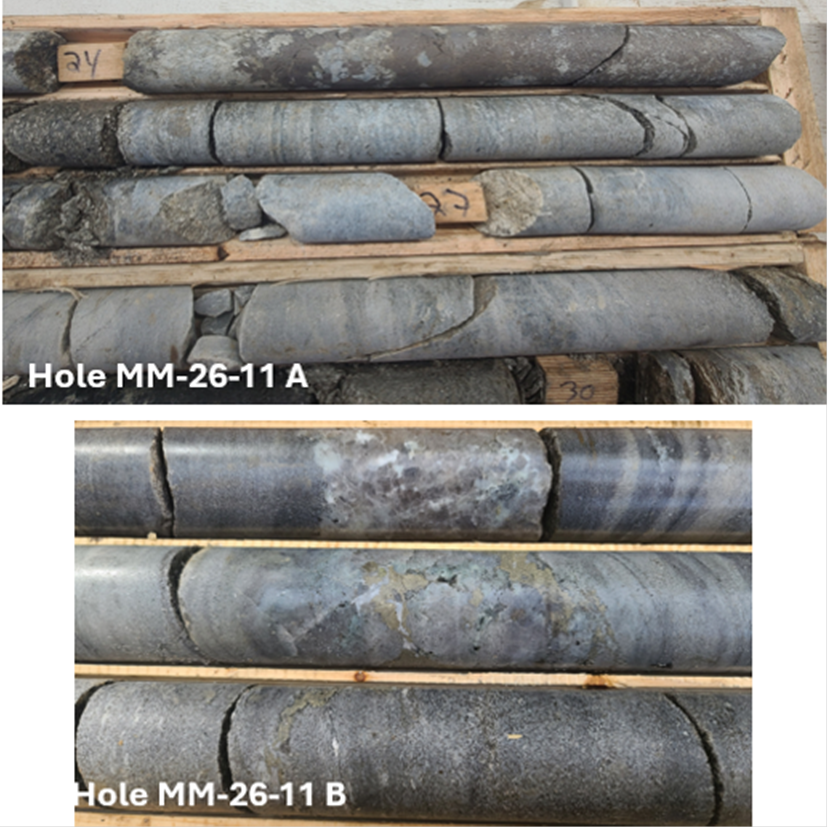
Figure 1: Hole MM-26-11 - 24.0 metres to 30.2 metres, showing altered rock with quartz-carbonate veining and visible sulphides, including pyrite, pyrrhotite and chalcopyrite.
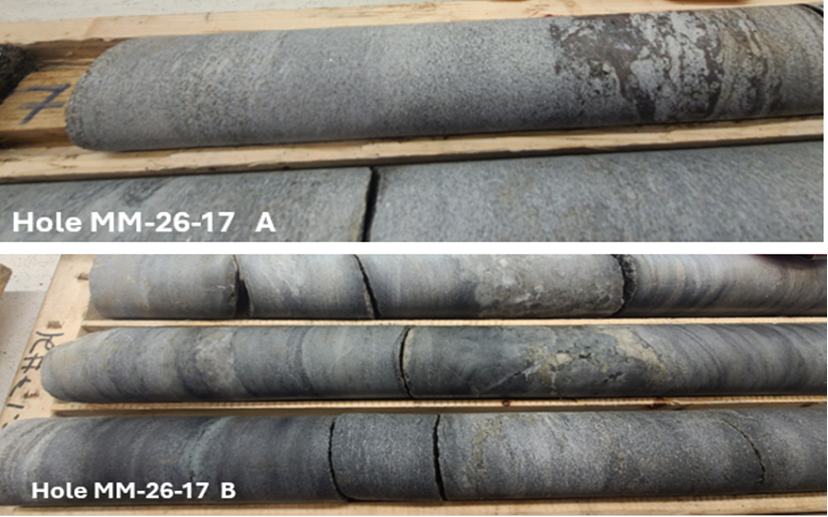
Figure 2: Hole MM-26-17 - 75.21 metres to 93.2 metres, showing quartz-carbonate veining with visible sulphides, including pyrite and pyrrhotite.
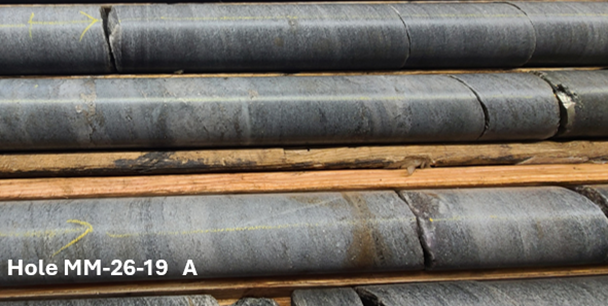
Figure 3: Hole MM-26-19 - 42.4 metres to 43.8 metres, showing quartz-carbonate veins with pyrrhotite and pyrite.
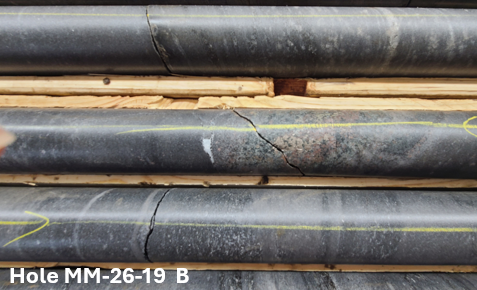
Figure 4: Hole MM-26-19 - 30.7 metres, showing quartz-carbonate veining with approximately
All photograph captions describe visual geological observations. Core lengths are not necessarily true widths. The photos do not establish metal grades, mineral continuity or economic viability.
Encouraging Sulphide Observations in Three Drill Holes
The photographs above show sulphide-rich material in hole MM-26-11 and narrower quartz-carbonate veins carrying sulphides in holes MM-26-17 and MM-26-19. The logged minerals include the iron sulphides pyrite and pyrrhotite, and locally chalcopyrite, a copper-bearing mineral. These geological indications help the team identify areas for further evaluation.
In hole MM-26-11, the geological team describes an approximately 48-centimetre interval at 24.07 metres as containing massive sulphides within altered rock. Together with the veins in holes MM-26-17 and MM-26-19, these observations help refine follow-up targets. Reported depths and widths appear below. The observations do not establish connections between holes or continuous mineralization across the broader host-rock intervals.
Drill Hole | Depth / Core Length | Visual Observations |
|---|---|---|
MM-26-10 | 92.6 m - 95.7 m | Silica-rich altered rock with irregular veins, pyrrhotite and pyrite, and trace chalcopyrite. |
MM-26-10 | At approximately 123.5 m | A sulphide-rich vein described in the log as massive to semi-massive pyrrhotite with chalcopyrite. |
MM-26-11 | Within 20.6 m - 31.9 m | Several narrow sulphide-rich bands centered near 21.12 m, 22.05 m and 24.07 m. The reported width at 24.07 m is approximately 48 cm. Widths of the other individual bands require confirmation. |
MM-26-11 | At 24.07 m | Interval described by the geological team as massive sulphides, including pyrrhotite, pyrite and trace chalcopyrite, within altered gneiss. |
MM-26-13 | At 52.51 m | A quartz-carbonate vein with pyrite near its upper contact. |
MM-26-13 | Beginning at 66.77 m | Strongly silica-rich altered rock with epidote and trace pyrite. |
MM-26-17 | At 75.21 m | Quartz-carbonate vein with trace pyrrhotite and rare pyrite. |
MM-26-17 | At 93.2 m | Quartz-carbonate vein containing pyrite in locally silica-altered rock. |
MM-26-19 | At 30.7 m | Quartz-carbonate vein containing pyrrhotite, locally associated with pinkish feldspar and chlorite. |
MM-26-19 | 42.4 m - 43.8 m | Local quartz-carbonate veins containing pyrrhotite and pyrite. The full 1.4 m host interval is not represented as continuously mineralized. |
All depths are measured along the drill core. Reported widths are core lengths and are not necessarily true widths, as true widths have not been established. These are visual geological observations, not laboratory assay results. Visual observations do not establish metal grades, continuity or economic viability.
Drill holes MM-26-12 and MM-26-13 also intersected historic underground openings, helping the team locate the former workings more accurately within the updated geological model.
Turning Exploration Data Into Better Targets
ESGold is adding the new drill information to its 3D geological model and comparing it with historic mine records and Ambient Noise Tomography ("ANT"), a geophysical method used to image features beneath the surface. The ANT surveys were completed by CAUR Technologies, with integrated 3D modelling undertaken by Geomatic World.
Each drill hole provides direct geological evidence used to validate interpretations and refine subsequent drill targeting. This work evaluates exploration potential, and the geophysical interpretation does not establish a mineral resource or reserve for the bedrock targets being tested.
Equipment Delivery and Mill Build-Out Update
ESGold continues to advance equipment deliveries for its fully permitted Montauban tailings reprocessing project, with all remaining equipment either on site or in transit from China.
These shipments represent a major milestone in the final stages of the mill build-out, consolidating the equipment required to recover gold and silver from historic tailings. As deliveries continue, the team remains focused on completing installation, integrating equipment into the processing circuit, and advancing testing and commissioning activities. The arrival and integration of the remaining equipment will represent another important step toward bringing production at Montauban online.
Continued progress on equipment delivery reinforces ESGold's strategy of establishing a cash-flow-generating tailings processing operation while concurrently advancing exploration across the broader Montauban property.
Qualified Person
The scientific and technical information contained in this news release has been reviewed and approved by Merouane Rachidi, Ph.D., P.Geo., an independent Qualified Person as defined under National Instrument 43-101 - Standards of Disclosure for Mineral Projects.
About ESGold Corp.
ESGold Corp. (CSE: ESAU | OTCQB: ESAUF | FSE: Z7D) is a fully permitted, fully funded, pre-production mining company advancing a scalable clean mining model across North America. The Company's flagship Montauban Gold-Silver Project in Québec is under construction. With a dual-track strategy focused on advancing toward near-term gold and silver production while systematically evaluating district-scale exploration potential, ESGold is building a foundation for sustainable growth and long-term shareholder value.
For more information, please contact ESGold Corp. at 1-888-370-1059 or visit esgold.com for additional resources, including a French version of this press release, past news releases, a 3D model of the Montauban processing plant, media interviews, and opinion-editorial pieces.
Stay connected by following us on X (formerly Twitter), LinkedIn, and joining our Telegram channel.
For further information on the Company please contact:
Email: ir@esgold.com or info@esgold.com or gordon@esgold.com
Phone: 604-885-1348 or 1-888-370-1059 or 250-217-2321
On behalf of the Board of Directors of ESGold Corp.
Gordon Robb
Chief Executive Officer & Director
Forward-Looking Statements
This news release contains "forward-looking information" within the meaning of applicable Canadian securities laws, including statements regarding current and future drilling plans and results, the ANT survey, the 3D model, and current and future exploration activities and potential. Forward-looking information is based on reasonable assumptions believed to be current but involves known and unknown risks and uncertainties that may cause actual results to differ materially. Historical data referenced herein is not current, has not been independently verified by ESGold, and should not be relied upon for investment decisions. ESGold disclaims any obligation to update or revise forward-looking information except as required by law.
These forward-looking statements reflect the Company's current views with respect to future events and are necessarily based upon a number of assumptions that, while considered reasonable by the Company, are inherently subject to significant drilling, operational, business, economic and regulatory uncertainties and contingencies. These assumptions include, among other things: the current and any future drill program and results therefrom and exploration activities at the Montauban Project, the ANT-based 3D geological model, its results and interpretation of the same, conditions in general economic and financial markets; accuracy of assay results; geological interpretations from drilling results, timing and amount of capital expenditures; performance of available laboratory and other related services; future operating costs; the historical basis for current estimates of potential quantities and grades of target zones; the availability of skilled labour and no labour related disruptions at any of the Company's operations; no unplanned delays or interruptions in scheduled activities; all necessary permits, licenses and regulatory approvals for operations are received in a timely manner; the ability to secure and maintain title and ownership to properties and the surface rights necessary for operations; and the Company's ability to comply with environmental, health and safety laws. The foregoing list of assumptions is not exhaustive.
The Company cautions the reader that forward-looking statements involve known and unknown risks, uncertainties and other factors that may cause actual results and developments to differ materially from those expressed or implied by such forward-looking statements contained in this news release and the Company has made assumptions and estimates based on or related to many of these factors. Such factors include, without limitation: the timing and content of work programs; results of exploration activities and development of mineral properties; the interpretation and uncertainties of drilling results and other geological data; receipt, maintenance and security of permits and mineral property titles; environmental and other regulatory risks; project costs overruns or unanticipated costs and expenses; availability of funds; failure to delineate potential quantities and grades of the target zones based on historical data; general market and industry conditions; and those factors identified under the caption "Risk Factors" in the Company's continuous disclosure documents filed on SEDAR+ at www.sedarplus.ca.
Forward-looking statements are based on the expectations and opinions of the Company's management on the date the statements are made. The assumptions used in the preparation of such statements, although considered reasonable at the time of preparation, may prove to be imprecise and, as such, readers are cautioned not to place undue reliance on these forward-looking statements, which speak only as of the date the statements were made. The Company undertakes no obligation to update or revise any forward-looking statements included in this news release if these beliefs, estimates and opinions or other circumstances should change, except as otherwise required by applicable law.
Neither the Canadian Securities Exchange nor its Regulation Services Provider accepts responsibility for the adequacy or accuracy of this release.
SOURCE: ESGold Corp
View the original press release on ACCESS Newswire
FAQ
AI-generated questions and answers. How Rhea-AI works. Not financial advice.
How much drilling has ESGold completed at Montauban?
ESGold has drilled approximately 4,074 metres, exceeding 80% of its planned 5,000-metre program. Exploration has moved beyond the historic mine area toward southern and deeper targets. Final drilling totals remain subject to database reconciliation.
Has ESGold reported metal grades from the Montauban drilling program?
Laboratory assays are pending, so the reported visual observations do not establish metal grades. Logged core includes quartz-carbonate veins and sulphide minerals, but these observations also do not establish mineral continuity or economic viability.
What did ESGold's Montauban drilling reveal about the historic underground workings?
Drill holes MM-26-12 and MM-26-13 intersected historic underground openings, helping locate the former workings more accurately in the updated geological model. Several initial holes in the program also intersected former underground openings.