
Vertical Aerospace’s Final Full-Scale Prototype Completes First Piloted Flight




- Full-scale prototype to accelerate flight testing, support piloted demonstrations and advance Vertical's hybrid-electric aircraft programme
- Latest prototype will progress through all phases of piloted flight testing, including thrustborne, wingborne and transition flight
- Final prototype before Critical Design Review (CDR), which will establish the certifiable aircraft design and pave the way for assembly of Vertical's first pre-production aircraft
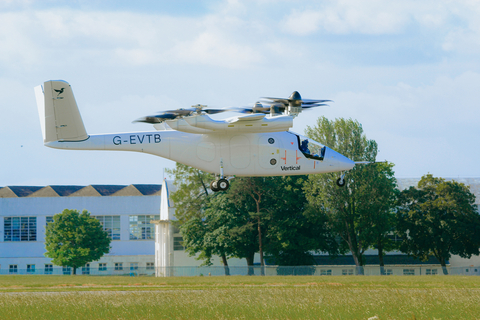
Vertical Test Pilot Paul Stone conducted the latest prototype's maiden flight at 8:49 BST on 5 June 2026.
The flight follows the issuance of a new Permit to Fly from the
The new prototype is the final aircraft to join Vertical's flight test fleet before the Company completes Critical Design Review (CDR), a major programme milestone that establishes the design baseline for certification. Following CDR, Vertical will begin preparations for assembly of its first pre-production aircraft as it continues toward certification and commercial service.
Stuart Simpson, CEO of Vertical Aerospace, said: “Getting our latest prototype into flight testing is an important milestone because it allows us to learn faster in real world conditions and keep building momentum towards certification. Expanding the flight test fleet will help us validate the aircraft more quickly, reduce risk, and move more efficiently towards bringing Valo into service.”
This aircraft doubles the Company’s flight testing capacity and supports additional public demonstrations this year. Following the completion of all flight test phases - thrustborne, wingborne and transition flight - in its all-electric configuration, Vertical intends to retrofit this prototype for hybrid-electric flight testing. The hybrid-electric variant is expected to support applications demanding greater range and payload capability across defense, logistics, and wider commercial sectors.
The prototype shares the same configuration as Vertical's current full-scale aircraft, which has already completed all flight test phases. Vertical's flight test programme is built around full-scale, piloted prototype aircraft with architecture, systems and flight characteristics closely aligned to the production-standard Valo aircraft, enabling the Company to validate the technologies, systems integration and flight models that will support certification.
About Vertical Aerospace
Vertical Aerospace is a global aerospace and technology company pioneering electric aviation. Vertical is creating a safer, cleaner, and quieter way to travel. Valo is a piloted, four-passenger, Electric Vertical Take-Off and Landing (eVTOL) aircraft, with zero operating emissions. Vertical is also developing a hybrid-electric variant, offering increased range and mission flexibility to meet the evolving needs of the advanced air mobility market.
Vertical combines partnerships with leading aerospace companies, including Honeywell, Syensqo and Aciturri, with its own proprietary battery and propeller technology to develop the world’s most advanced and safest eVTOL.
Vertical has c.1,500 pre-orders of Valo, with customers across four continents, including American Airlines, Avolon, Bristow, GOL and Japan Airlines. Certain customer obligations are expected to be fulfilled via third-party agreements. Headquartered in Bristol, UK, Vertical’s experienced leadership team comes from top-tier aerospace and automotive companies such as Rolls-Royce, Airbus, GM, and Leonardo. Together, they have previously certified and supported over 30 different civil and military aircraft and propulsion systems.
Forward Looking Statements
This press release contains forward-looking statements within the meaning of the Private Securities Litigation Reform Act of 1995. Any express or implied statements contained in this press release that are not statements of historical fact may be deemed to be forward-looking statements, including, without limitation, statements regarding the building and testing of our prototype aircrafts on timelines projected, completion of the piloted test programme phases, the design and manufacture of the Valo aircraft and the hybrid-electric variant, certification and the commercialization of the Valo aircraft and our ability to achieve regulatory certification of our aircraft product on any particular timeline or at all, progress toward Critical Design Review (CDR); the features and capabilities of the VX4, business strategy and plans and objectives of management for future operations, including the , selection of suppliers; our ability to raise additional capital to fund our operations; our plans for capital expenditures which could be higher than anticipated; the differential strategy compared to our peer group; the features and capabilities of the Valo aircraft; potential revenue opportunities; expectations surrounding pre-orders and commitments; the assumptions underlying the Company’s Flightpath 2030; as well as statements that include the words “goals,” “targets,” “objectives,” “expect,” “intend,” “plan,” “believe,” “project,” “forecast,” “estimate,” “may,” “should,” “anticipate,” “will,” “aim,” “potential,” “continue,” “is/are likely to” and similar statements of a future or forward-looking nature. These forward-looking statements reflect our current views with respect to future events and are not a guarantee of future performance. Actual outcomes may differ materially from the information contained in the forward-looking statements as a result of a number of factors, including, without limitation, the important factors discussed under the caption “Risk Factors” in the Company's Annual Report on Form 20-F filed with the U.S. Securities and Exchange Commission (“SEC”) on March 24, 2026, as such factors may be updated from time to time in the Company’s other filings with the SEC. Any forward-looking statements contained in this press release speak only as of the date hereof and accordingly undue reliance should not be placed on such statements. The Company disclaims any obligation or undertaking to update or revise any forward-looking statements contained in this press release, whether as a result of new information, future events or otherwise, other than to the extent required by applicable law.
View source version on businesswire.com: https://www.businesswire.com/news/home/20260609702899/en/
Vertical Aerospace Media Contact
Justin Bates, Head of Communications
justin.bates@vertical-aerospace.com
+44 7878 357 463
Samuel Emden, Head of Investor Affairs
samuel.emden@vertical-aerospace.com
+44 7816 459 904
Source: Vertical Aerospace