
Edgewise Therapeutics Announces Positive Top-Line Data from 12-Week Phase 2 CIRRUS-HCM Trial with EDG-7500 in Obstructive and Nonobstructive Hypertrophic Cardiomyopathy (HCM)
Edgewise Therapeutics (Nasdaq:EWTX) reported positive 12-week Phase 2 Part D CIRRUS-HCM data for EDG-7500 in obstructive and nonobstructive hypertrophic cardiomyopathy.
Rhea-AI Summary
Edgewise Therapeutics (Nasdaq:EWTX) reported positive 12-week Phase 2 Part D CIRRUS-HCM data for EDG-7500 in obstructive and nonobstructive hypertrophic cardiomyopathy.
Patients showed improvements in LVOT gradient, NT-proBNP, KCCQ scores, NYHA class and diastolic parameters, with no LVEF reductions below 50% and generally well-tolerated safety, supporting Phase 3 initiation targeted for Q4 2026.
Positive
- In oHCM, 90% of patients improved in hemodynamic LVOT-G measures
- In oHCM, 74% achieved NT-proBNP normalization or ≥50% reduction
- In nHCM, ~65% mean NT-proBNP reduction; 88% met key NT-proBNP response
- KCCQ-OSS improved by 24 points in oHCM and 13 points in nHCM
- NYHA class improved by at least one class in 70% oHCM and 64% nHCM patients
- No LVEF reductions below 50% across Part D; EDG-7500 generally well tolerated
- Data support advancing EDG-7500 into Phase 3, targeted to start Q4 2026
Negative
- None.
Details
News Market Reaction – EWTX
On Jun 16, the day this news came out, EWTX closed 3.58% below the previous close.
Data tracked by StockTitan Argus for the Jun 16 session.
Key Figures
- Part D patients
- 53 patients
- Completed 12-week Phase 2 CIRRUS-HCM Part D cohort
- oHCM hemodynamic improvement
- 90% of patients
- oHCM group with improvement in hemodynamic measures
- oHCM NT-proBNP response
- 74% of patients
- Achieved NT-proBNP normalization or ≥50% reduction in oHCM
- oHCM KCCQ-OSS
- 24-point mean increase
- Change in KCCQ Overall Summary Score for oHCM at 12 weeks
- oHCM NYHA improvement
- 70% of patients
- At least one class improvement in NYHA in oHCM
- nHCM NT-proBNP reduction
- ≈65% mean reduction
- Mean NT-proBNP decrease in nHCM at 12 weeks
- nHCM KCCQ-OSS
- 13-point mean increase
- Change in KCCQ Overall Summary Score for nHCM at 12 weeks
- nHCM e' lateral
- 37% mean increase
- Increase in early diastolic mitral annular velocity in nHCM
Previous Clinical trial Reports
-
Completion of CIRRUS-HCM Parts B/C and favorable interim Part D safety.
-
Positive four-week CIRRUS-HCM efficacy in HCM with strong biomarker changes.
-
CANYON Phase 2 Becker data meeting primary endpoint with safety support.
-
Phase 1 and early CIRRUS-HCM results with large LVOT and NT-proBNP reductions.
24h Move is the share-price change in the day after each event; other market factors may also have contributed.
Key Terms
left ventricular ejection fraction (LVEF) medical
LVEF medical
left ventricular outflow tract gradient (LVOT-G) medical
N-terminal pro-B-type natriuretic peptide (NT-proBNP) medical
Kansas City Cardiomyopathy Questionnaire Overall Summary Score (KCCQ-OSS) medical
New York Heart Association (NYHA) functional class medical
e' lateral medical
atrial fibrillation medical
AI-generated analysis. How Rhea-AI works. Not financial advice.




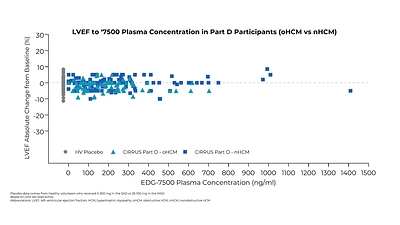
– No relationship observed between EDG-7500 exposure and LVEF; no LVEF reductions below
– Consistent and clinically meaningful improvements observed in echocardiogram parameters, biomarkers, symptoms and functional status across obstructive and nonobstructive HCM –
– EDG-7500 administration continued to be generally well tolerated –
– Company to host webcast today at 8:30 a.m. Eastern Time –
BOULDER, Colo., June 16, 2026 /PRNewswire/ -- Edgewise Therapeutics, Inc. (Nasdaq: EWTX), a leading muscle disease biopharmaceutical company, today announced positive top-line results from the 12-week Phase 2 Part D CIRRUS-HCM trial of EDG-7500 in obstructive (oHCM) and nonobstructive (nHCM) HCM. EDG-7500 is a novel, oral, selective cardiac sarcomere modulator designed to slow early contraction velocity and improve impaired cardiac relaxation in symptomatic HCM without compromising systolic function. To date, in over 700 echocardiograms performed in healthy adults and patients with HCM, there was no relationship observed between multiple measures of systolic function and concentration of EDG-7500.
CIRRUS-HCM is a multi-part (A-D), open label trial of EDG-7500 in patients with oHCM and nHCM. Part D is a 12-week cohort designed to inform a Phase 3 trial. In oHCM, dosing was guided by left ventricular outflow tract gradient (LVOT-G), while in nHCM, dosing was guided by N-terminal pro-B-type natriuretic peptide (NT-proBNP), a key biomarker of heart failure. Patients in both groups received doses ranging from 25 mg to 150 mg. A total of 53 patients (20 with oHCM and 33 with nHCM) completed Part D 12-week study.
Results in Patients with oHCM
Patients with oHCM receiving EDG-7500 demonstrated broad and clinically meaningful responses across key measures of hemodynamics, biomarkers, patient-reported health status and functional status. Consistent with previous findings, significant reductions in LVOT-G were observed at rest and post Valsalva, with
Results in Patients with nHCM
Patients with nHCM receiving EDG-7500 demonstrated robust diastolic and symptomatic improvement at 12 weeks. Similar to oHCM, an approximately
Overall Safety
EDG-7500 was generally well tolerated in Part D patients (n=53) and there were no new safety signals identified. Nearly all AEs were considered mild to moderate in severity. There were no meaningful changes in left ventricular ejection fraction (LVEF) or reductions in LVEF to below
"From the outset, our goal was to identify a cardiovascular therapy with a profile that avoids the liability of the CMI class, with EDG-7500 emerging from that effort," said Kevin Koch, Ph.D., President and Chief Executive Officer, Edgewise Therapeutics. "These Phase 2 data mark an important milestone for Edgewise and the HCM community, reinforcing EDG-7500's unique approach with the potential to address diastolic dysfunction across HCM without meaningful impact on LVEF."
"The totality of the Phase 2 efficacy and tolerability data continues to support a differentiated profile for EDG-7500 across HCM," said Matthew Martinez, M.D., a leading HCM expert and President of the HCM Society. "What is especially encouraging is the consistency of symptom and functional improvement across dose levels without evidence of systolic liability or heart failure risk. The EDG-7500 profile is particularly relevant in nonobstructive HCM, where preserving systolic function while improving relaxation may offer a meaningful new approach to addressing a significant unmet need."
Phase 3 Preparation
Data from CIRRUS-HCM support advancing EDG-7500 into Phase 3 clinical development, with program initiation targeted for the fourth quarter of 2026.
EDG-7500 Top-line Data Webcast Event
Members of the Edgewise management team will hold a live webcast on Tuesday, June 16, 2026, at 8:30 a.m. ET to discuss the top-line data, and will be joined by leading cardiology experts, Anjali T. Owens, M.D., Medical Director, Center for Inherited Cardiac Disease, Associate Professor of Medicine, in the Perelman School of Medicine at the University of Pennsylvania. An accompanying slide presentation will also be available. To register for the live webcast and replay, please visit the Edgewise events page.
About CIRRUS-HCM
CIRRUS-HCM is a multi-part, open label trial of EDG-7500 in patients with obstructive and nonobstructive HCM at over 20 clinical sites in the U.S. Part A of the trial evaluated the safety and tolerability of a single oral dose of EDG-7500 in patients with obstructive HCM (oHCM). Parts B and C evaluated fixed doses of EDG-7500 over 28 days in oHCM and nonobstructive HCM (nHCM), respectively; the results can be found here. Part D is a 12-week study with an open-label extension including patients with oHCM and nHCM designed to explore dose response and optimization. To learn more about CIRRUS-HCM, visit clinicaltrials.gov, NCT06347159.
About Hypertrophic Cardiomyopathy
HCM is the most common form of genetic heart disease, affecting approximately one in 500 people, and is associated with reduced quality of life and an elevated risk of heart failure, abnormal heart rhythms, and sudden cardiac death. Individuals with HCM can become extremely limited in their functional capacity and ability to perform the activities of daily living. Commonly experienced symptoms include breathlessness, irregular heartbeats, chest pain, tiredness, dizziness, or even fainting. These symptoms are caused by excessive contraction and thickening (hypertrophy) of the left ventricular wall of the heart. Over time, the thickened muscle becomes stiff, making it difficult for the heart to relax and fill with blood (diastolic dysfunction). There are two major forms of HCM obstructive and nonobstructive. Despite advancements in treatment options for some patients with HCM, there remains a significant unmet need for additional therapeutic approaches for patients.
About Edgewise Therapeutics
Edgewise Therapeutics is a leading muscle disease biopharmaceutical company developing novel therapeutics for muscular dystrophies and serious cardiac conditions. The Company's deep expertise in muscle physiology is driving a new generation of novel therapeutics. Sevasemten is an orally administered first-in-class fast skeletal myosin inhibitor in late-stage clinical trials in Becker and Duchenne muscular dystrophies. EDG-7500 is a novel cardiac sarcomere modulator for the treatment of symptomatic hypertrophic cardiomyopathy, currently in Phase 2 clinical development. EDG-15400 is a novel cardiac sarcomere modulator for the treatment of heart failure, currently in Phase 1 clinical development. The entire team at Edgewise is dedicated to our mission: changing the lives of patients and families affected by serious muscle diseases. To learn more, go to edgewisetx.com or follow us on LinkedIn, X, Facebook and Instagram.
Cautionary Note Regarding Forward-Looking Statements
This press release contains forward-looking statements as that term is defined in Section 27A of the Securities Act of 1933 and Section 21E of the Securities Exchange Act of 1934. Statements in this press release that are not purely historical are forward-looking statements. Such forward-looking statements include, among other things, statements regarding the benefits and potential of, and expectations regarding, EDG-7500; statements regarding the market opportunity for EDG-7500; statements regarding Edgewise's expectations relating to its clinical trials, including timing of the initiation of the Phase 3 trials of EDG-7500; clinical outcomes from trials of EDG-7500, which may materially change as more patient data become available; and statements by Edgewise's President and Chief Executive Officer and the President of the HCM Society. Words such as "believes," "anticipates," "plans," "expects," "intends," "will," "goal," "potential" and similar expressions are intended to identify forward-looking statements. The forward-looking statements contained herein are based upon Edgewise's current expectations and involve assumptions that may never materialize or may prove to be incorrect. Actual results could differ materially from those projected in any forward-looking statements due to numerous risks and uncertainties, including but not limited to: the potential for the results of the ongoing or any future clinical trial of EDG-7500 to differ from the results of the Phase 2 CIRRUS-HCM trial; the risk of delays in initiating the planned Phase 3 trials of EDG-7500; risks associated with Edgewise's limited operating history, its products being early in development and not having products approved for commercial sale; risks associated with Edgewise not having generated any revenue to date; Edgewise's ability to achieve objectives relating to the discovery, development and commercialization of its product candidates, if approved; Edgewise's need for substantial additional capital to finance its operations; Edgewise's substantial dependence on the success of EDG-7500; Edgewise's ability to develop and commercialize EDG-7500; risks related to Edgewise's clinical trials of its product candidates not demonstrating safety and efficacy; risks related to Edgewise's product candidates causing serious adverse events, toxicities or other undesirable side effects; the outcome of preclinical testing and clinical trials not being predictive of the success of later clinical trials and the risks related to the results of Edgewise's clinical trials not satisfying the requirements of regulatory authorities; delays or difficulties in the enrollment and/or maintenance of patients in clinical trials; risks related to failure to capitalize on other indications or product candidates; risks related to competition; risks relating to interim, topline and preliminary data from Edgewise's clinical trials changing as more patient data becomes available; risks related to production of drugs by Edgewise's third-party manufacturers; risks related to changes in methods of product candidate manufacturing or formulation; risks related to not achieving adequate market acceptance; risks related to the regulatory approval processes of domestic and foreign authorities being lengthy, time consuming and inherently unpredictable; risks relating to disruptions at the FDA, the SEC and other government agencies; risks relating to Edgewise's ability to attract and retain highly skilled executive officers and employees; Edgewise's ability to obtain and maintain intellectual property protection for its product candidates; Edgewise's reliance on third parties; risks related to general economic and market conditions; and other risks. Information regarding the foregoing and additional risks may be found in the section entitled "Risk Factors" in documents that Edgewise files from time to time with the U.S. Securities and Exchange Commission. These forward-looking statements are made as of the date of this press release, and Edgewise assumes no obligation to update the forward-looking statements, or to update the reasons why actual results could differ from those projected in the forward-looking statements, except as required by law.
This press release contains hyperlinks to information that is not deemed to be incorporated by reference into this press release.

 View original content to download multimedia:https://www.prnewswire.com/news-releases/edgewise-therapeutics-announces-positive-top-line-data-from-12-week-phase-2-cirrus-hcm-trial-with-edg-7500-in-obstructive-and-nonobstructive-hypertrophic-cardiomyopathy-hcm-302801108.html
SOURCE Edgewise Therapeutics
FAQ
AI-generated questions and answers. How Rhea-AI works. Not financial advice.