
STOCK TITAN

Flex Showcases Scalable Power Solutions for Next-Generation AI Infrastructure at COMPUTEX 2026

Rhea-AI Impact
(Moderate)
Rhea-AI Sentiment
(Positive)
Tags
AI

Flex (FLEX) announced new scalable power solutions for next-generation AI data centers at COMPUTEX 2026. The portfolio additions include a 110 kW power shelf for NVIDIA Vera Rubin NVL72 platforms, a 30 kW capacitive energy storage system (CESS), and the BMR317 intermediate bus converter.

The 110 kW power shelf enables modular rack-level power distribution and supports future 800 VDC architectures. The 30 kW CESS improves power quality for dynamic AI workloads across AC and 800 VDC environments, while BMR317 targets high-density compute platforms such as accelerator cards, servers and xPU systems.

Loading...
Loading translation...

AI-generated analysis. Not financial advice.

Positive

  • None.

Negative

  • None.

Key Figures

Current Price: $148.01 24h Price Change: -1.84% 52-week Range: $41.43–$154.25 +5 more
8 metrics
Current Price $148.01 Pre-news trading level
24h Price Change -1.84% Move prior to article publication
52-week Range $41.43–$154.25 52-week low and high
Power Shelf Rating 110 kW Power shelf for NVIDIA Vera Rubin NVL72 platforms
CESS Capacity 30 kW Capacitive Energy Storage System for AI workloads
Power Architecture 800 VDC Target architecture for future AI data centers
Rack Widths 19-inch and 21-inch Supported rack configurations for CESS
Market Cap $55,242,463,230 Market capitalization before the news

Market Reality Check

Price: $150.78 Vol: Volume 4,585,458 is below...
low vol
$150.78 Last Close
Volume Volume 4,585,458 is below the 20-day average of 7,397,182, suggesting muted participation ahead of this AI power announcement. low
Technical Shares at $148.01 are trading above the 200-day MA of $70.7, reflecting a longer-term uptrend into this AI infrastructure news.

Peers on Argus

FLEX fell 1.84% while peers were mostly positive: JBL up 1.4%, CLS up 10.87%, TE...
2 Up

FLEX fell 1.84% while peers were mostly positive: JBL up 1.4%, CLS up 10.87%, TEL and GLW modestly higher, and FN down 0.88%. Momentum scanners flagged TTMI and CLS moving up, underscoring that FLEX’s weakness diverged from several related names.

Previous AI Reports

5 past events · Latest: Mar 16 (Positive)
Same Type Pattern 5 events
Date Event Sentiment Move Catalyst
Mar 16 AI factory designs Positive +1.5% New NVIDIA Omniverse DSX reference designs to speed AI factory deployment.
Oct 28 NVIDIA collaboration Positive -0.6% Collaboration with NVIDIA to accelerate modular, energy-efficient AI factories.
Oct 13 AI platform launch Positive +4.0% Launch of integrated AI infrastructure platform targeting faster giga-scale deployment.
Aug 04 AI power shelf Positive -0.8% New power shelf for NVIDIA GB300 NVL72 with high efficiency and 800 VDC focus.
Jun 05 AI research tie-up Positive -0.5% Collaboration with MIT to advance manufacturing using AI and automation.
Pattern Detected

AI-related announcements have generally been positive in tone but produced mixed price reactions, with several instances of slight declines or modest gains rather than consistent upside.

Recent Company History

This announcement extends Flex’s AI power and infrastructure story, adding a 110 kW power shelf, 30 kW capacitive energy storage and new bus converters to earlier 800 VDC and NVIDIA-focused initiatives. Prior AI releases on modular AI factories, NVIDIA collaborations, and advanced power shelves around 800 VDC and giga-scale deployments saw small positive and negative moves, indicating that similar strategic updates have not always produced strong, uniform price reactions.

Historical Comparison

+0.7% avg move · Past AI-tagged news for FLEX saw an average move of about 0.7%, whereas this AI power portfolio upda...
AI
+0.7%
Average Historical Move AI

Past AI-tagged news for FLEX saw an average move of about 0.7%, whereas this AI power portfolio update came as shares were down 1.84%, marking a weaker-than-typical reaction versus prior AI headlines.

AI-tagged history shows a steady build-out: from collaborations on giga-scale AI factories and 800 VDC infrastructure, to NVIDIA-specific power shelves and integrated platforms. This new 110 kW shelf, 30 kW CESS and bus converter deepen that progression into rack-level and chip-level AI power delivery.

Market Pulse Summary

This announcement expands Flex’s AI infrastructure capabilities with a 110 kW power shelf for NVIDIA...
Analysis

This announcement expands Flex’s AI infrastructure capabilities with a 110 kW power shelf for NVIDIA Vera Rubin NVL72 platforms, a 30 kW capacitive energy storage system, and the BMR317 bus converter, all aligned to future 800 VDC architectures. In context of prior AI factory and NVIDIA collaborations, it reinforces Flex’s role in rack- and chip-level power delivery. Investors may watch adoption across AI data centers and updates around the planned CPI spin-off.

Key Terms

intermediate bus converter, battery energy storage systems (BESS), 800 vdc
3 terms
intermediate bus converter technical
"the BMR317 intermediate bus converter extends Flex's chip-level power portfolio"
An intermediate bus converter is an electrical device that transforms a main power source into a stable, lower-voltage direct-current ‘bus’ that many subsystems draw from. Investors should care because consolidating power conversion into a single efficient, reliable bus can cut component count, improve overall system efficiency, lower manufacturing costs and reduce downtime risk—similar to a central power strip that supplies and protects multiple appliances in a building.
battery energy storage systems (BESS) technical
"works alongside battery energy storage systems (BESS) and UPS architectures"
Battery energy storage systems (BESS) are large installations that store electricity in batteries and release it when needed, like a giant rechargeable battery for the power grid. They matter to investors because they help smooth out supply and demand, support more renewable energy, and create new revenue streams (selling stored power, providing backup and stability), which can change utility costs, business models, and the value of energy-related companies.
800 vdc technical
"advance the transition to 800 VDC power architectures"
800 VDC denotes a direct current electrical potential of 800 volts, used to describe the voltage rating of batteries, charging systems or other power equipment. For investors it signals higher-power capability that can enable faster charging and greater efficiency but also requires different components, safety measures and capital investment—like a wider highway that allows faster traffic but needs stronger bridges and controls.

AI-generated analysis. Not financial advice.

See more from StockTitan in Google Search and AI answers. Adds StockTitan as a preferred source · opens Google
Add on Google

New power shelf for NVIDIA Vera Rubin NVL72 platforms, 30 kW capacitive energy storage system and power modules advance the transition to 800 VDC power architectures

News summary

  • 110 kW power shelf supports scalable power distribution for NVIDIA Vera Rubin NVL72 platforms and future high-density AI rack architectures
  • 30 kW capacitive energy storage system (CESS) helps smooth dynamic AI workloads and improve power quality across traditional AC and emerging 800 VDC environments
  • BMR317 intermediate bus converter extends Flex's chip-level power portfolio with compact, high-efficiency power modules for high-density compute platforms

TAIPEI, June 1, 2026 /PRNewswire/ -- Flex today introduced new additions to its power portfolio at COMPUTEX 2026, showcasing high-efficiency solutions designed to build and scale infrastructure for increasingly demanding AI workloads. The new solutions include a 110 kW power shelf for NVIDIA Vera Rubin NVL72 platforms, a 30 kW Capacitive Energy Storage System (CESS), and the BMR317 intermediate bus converter for high-density compute platforms. The new products will be showcased at COMPUTEX 2026 from June 2–5 at Flex booth #J0132.

As AI deployments continue driving unprecedented increases in rack power density and infrastructure complexity, Flex's latest power innovations are designed to improve efficiency, power quality, scalability and performance across AI data center environments. The solutions also support the industry's transition toward future 800 VDC architectures.

"The rapid growth of AI is driving new demands on data center power infrastructure, from rack-scale distribution to processor-level power delivery," said Chris Butler, President, Embedded and Critical Power, Flex. "At COMPUTEX 2026, we are showcasing how Flex helps customers scale AI infrastructure more efficiently with high-density power solutions designed for performance, quality, and efficiency."

The new 110 kW power shelf is designed to support NVIDIA Vera Rubin NVL72 platforms and other high-density AI environments. The solution enables modular rack-level power distribution and power disaggregation, helping customers maximize GPU density and infrastructure efficiency within the IT rack. Designed as a building block for future 800 VDC deployments, the power shelf supports scalable AI factory architectures while simplifying rack power management.

Flex will also showcase a new 30 kW CESS designed to improve power quality and stabilize highly dynamic AI workloads. Compatible with both traditional AC and emerging 800 VDC environments, the rack-integrated solution works alongside battery energy storage systems (BESS) and UPS architectures to help smooth transient AI power demands and improve infrastructure resiliency. The system supports both 19-inch and 21-inch rack configurations, enabling deployment flexibility across modern AI data centers.

To extend its AI power portfolio to high-density compute platforms, Flex also introduced the BMR317 intermediate bus converter, a compact, high-efficiency power module designed to support fast, dynamic AI processor loads in accelerator cards, servers and xPU platforms.

The new products join Flex's Cloud and Power Infrastructure portfolio, which enables customers to build and scale the products and digital infrastructure powering the world's most demanding AI workloads. Additional information about Flex's power portfolio is available here: https://flex.com/industries/data-center#power

About Flex
Flex (Reg. No. 199002645H) is the manufacturing partner of choice that helps leading brands design, build, and manage products that improve the world. With a global footprint spanning 30 countries, Flex delivers advanced manufacturing and supply chain solutions, innovative products and technology, and lifecycle services that support customers from concept to scale. In the AI era, Flex is helping customers accelerate data center deployment by solving power, heat, and scale challenges through cutting-edge power and cooling technology and scalable IT infrastructure solutions.

For information about Flex's intent to spin off its Cloud and Power Infrastructure portfolio, visit: https://flex.com/transaction-resources

Media contacts

Media & Press 
Christie Haber  
Senior Director, Commercial Marketing  
(602) 245-1057  
press@flex.com  

Investors & Analysts
Michelle Simmons
Senior Vice President, Global Investor Relations and Public Relations
(669) 242-6332
Michelle.Simmons@flex.com
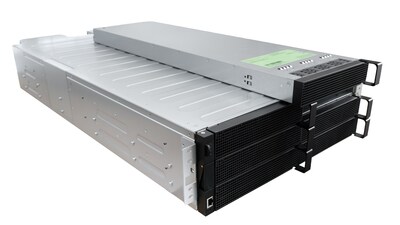
Flex's 110 kW power shelf supports scalable power distribution for NVIDIA Vera Rubin NVL72 platforms.

Cision View original content to download multimedia:https://www.prnewswire.com/news-releases/flex-showcases-scalable-power-solutions-for-next-generation-ai-infrastructure-at-computex-2026-302787411.html

SOURCE Flex

FAQ

What AI power solutions did Flex (FLEX) introduce at COMPUTEX 2026?

Flex introduced a 110 kW power shelf, a 30 kW capacitive energy storage system (CESS), and the BMR317 intermediate bus converter. According to Flex, these products target high-density AI racks, dynamic AI workloads, and chip-level power for accelerator cards, servers and xPU platforms.

How does Flex's 110 kW power shelf support NVIDIA Vera Rubin NVL72 platforms?

Flex’s 110 kW power shelf is designed to support NVIDIA Vera Rubin NVL72 platforms with modular rack-level power distribution. According to Flex, it enables power disaggregation, helps maximize GPU density and efficiency, and serves as a building block for future 800 VDC AI factory architectures.

What is Flex's 30 kW CESS and how does it benefit AI data centers (FLEX)?

Flex’s 30 kW CESS is a rack-integrated capacitive energy storage system that improves power quality and stabilizes dynamic AI workloads. According to Flex, it works with BESS and UPS architectures, smooths transient power demands, and supports both 19-inch and 21-inch rack configurations.

How does Flex support the transition to 800 VDC power architectures for AI infrastructure?

Flex supports the 800 VDC transition with its 110 kW power shelf and 30 kW CESS, both compatible with emerging 800 VDC environments. According to Flex, these solutions aim to improve efficiency, scalability and resiliency in future AI data center and rack-scale power architectures.

What is the BMR317 power module from Flex and where is it used?

The BMR317 is an intermediate bus converter power module aimed at high-density compute platforms. According to Flex, it is a compact, high-efficiency solution designed to support fast, dynamic AI processor loads in accelerator cards, servers and xPU platforms within AI infrastructure.

When and where will Flex showcase its new AI power products announced for COMPUTEX 2026?

Flex will showcase its new AI power products at COMPUTEX 2026 from June 2–5 at booth #J0132 in Taipei. According to Flex, visitors can see the 110 kW power shelf, 30 kW CESS, and BMR317 within its Cloud and Power Infrastructure portfolio.
