STOCK TITAN

Frontier Nuclear Partners with DISA Technologies to Remediate Legacy Uranium Mine Waste at the Maybell Uranium Project

(Moderate)
(Neutral)
Tags
partnership

Frontier Nuclear (NASDAQ:FNUC) signed an agreement with DISA Technologies to characterize and remediate legacy uranium mine waste at the 100%-owned Maybell uranium project in Colorado while recovering saleable uranium and other critical minerals.

Frontier will receive a net revenue royalty of 2.5%–4%, with DISA funding and operating the program across 17 identified waste dumps using its patented HPSA™ technology, which EPA testing showed can significantly reduce uranium and radium concentrations and concentrate over 90% of uranium into about 17% of processed mass.

Loading...
Loading translation...

AI-generated analysis. How Rhea-AI works. Not financial advice.

Positive

  • Sliding-scale net revenue royalty of 2.5%–4% on uranium and critical minerals
  • No capital or operating costs for remediation program payable by Frontier
  • DISA responsible for operating the Maybell Project waste remediation program
  • 17 prospective waste dumps identified for potential uranium and mineral recovery
  • EPA Study showed 61%–94% uranium reduction and similar radium-226 reductions using HPSA™
  • Over 90% of uranium concentrated into fines fraction representing about 17% of processed mass

Negative

  • None.

What This Means

The DISA partnership gives Frontier a 2.5%–4% royalty on Maybell waste recovery without capital cost...
Analysis

The DISA partnership gives Frontier a 2.5%–4% royalty on Maybell waste recovery without capital costs, backed by EPA-validated HPSA performance. Recent news has often met selling pressure, and relatively low short interest leaves future moves more tied to project execution milestones.

Key Figures

Net revenue royalty: 2.5%–4% Waste dumps identified: 17 dumps Uranium reduction: 61%–94% +5 more
8 metrics
Net revenue royalty 2.5%–4% Sliding scale based on uranium price from Maybell waste dump recoveries
Waste dumps identified 17 dumps Prospective waste dumps at Maybell Project identified through ground surveys
Uranium reduction 61%–94% HPSA process uranium concentration reduction in EPA Study, depending on waste
Uranium concentrated >90% into 17% mass EPA Study fines fraction uranium content vs total processed mass
Characterisation duration ≈6 months Expected length of DISA programme to determine quantities in waste dumps
Project area 9,497 acres Total Maybell Project size including federal claims and state lease
Federal mining claims 480 claims / 8,857 acres Federal component of Maybell Project land package
Historical production 5.3Mlbs U3O8 Historical uranium output from Maybell over two prior mining periods

Historical Context

4 past events · Latest: Apr 29 (Neutral)
Pattern 4 events
Date Event Sentiment 24h Move Catalyst
Apr 29 SMR validation update Neutral -3.1% Kadmos Energy launched dual experimental validation program for its SMR design.
Apr 23 SMR program update Neutral -6.8% Kadmos Energy advanced engineering validation program at Idaho Falls facility.
Apr 20 Conference participation Neutral -3.3% Frontier joined Maxim Group virtual critical minerals conference on uranium supply.
Mar 23 Corporate strategy update Positive +2.0% Company refocused on U.S. nuclear fuel cycle and uranium portfolio strategy.

24h Move is the share-price change in the day after each event; other market factors may also have contributed.

Pattern Detected

Across the last four company news events, three saw single-day share declines while one corporate update coincided with a modest gain.

Regulatory & Risk Context

Short Interest: 6.61%
Short Interest
6.61% of float
0% 15% 30%+
low as of 2026-06-15 Days to cover: 2.08

Short positioning appears relatively low, suggesting limited squeeze dynamics and a more typical volatility profile driven by fundamentals and news flow rather than forced covering.

Key Terms

high-pressure slurry ablation, gamma probe, u.s. nuclear regulatory commission, service providers license, +2 more
6 terms
high-pressure slurry ablation technical
"DISA will deploy its patented High-Pressure Slurry Ablation ("HPSA™") system"
A high-pressure slurry ablation is a medical procedure that removes unwanted tissue by directing a fast-flowing mix of fluid and tiny particles at the target, similar to using a power washer to strip away material from a surface. For investors, it matters because this technique can offer a less invasive alternative to surgery, potentially shortening recovery, lowering costs, and creating demand for specialized devices and regulatory approvals that affect company value.
gamma probe technical
"Launch a characterisation programme with a combination of assay and gamma probe"
A gamma probe is a handheld medical device that detects tiny amounts of radioactive material inside the body, helping surgeons locate tumors, lymph nodes or other targeted tissue during procedures. For investors, its importance lies in enabling faster, more precise surgeries and potentially improving patient outcomes, which can drive hospital adoption, device sales, reimbursement decisions and recurring revenue for companies that make or supply the probes and their radioactive tracers.
u.s. nuclear regulatory commission regulatory
"first company to receive a Service Providers License from the U.S. Nuclear Regulatory Commission"
A federal agency that licenses, inspects and enforces safety rules for civilian nuclear power plants and other uses of radioactive materials in the United States. Think of it as the official safety inspector and rulemaker for the nuclear industry—its approvals, inspections, fines and rule changes can speed up or delay projects, change operating costs, and alter legal and financial risk, so its actions directly affect companies’ prospects and investor value.
service providers license regulatory
"first company to receive a Service Providers License from the U.S. Nuclear Regulatory Commission"
A service providers license is a regulatory permit that authorizes a company to offer specific services—such as financial advice, payment processing, healthcare services, or telecommunications—within a jurisdiction. Like a driver's license for a business, it shows regulators have approved the firm's qualifications, controls, and compliance procedures; for investors it signals whether a company is legally allowed to earn revenue from those services and highlights potential regulatory or operational risks.
radium-226 medical
"with comparable reductions in radium-226."
A radioactive isotope of the element radium, radium-226 emits radiation as it decays and has a long half-life, meaning it remains active for many years. It matters to investors because its use, handling, transport, storage, and cleanup are tightly regulated and can create business opportunities or long-term liabilities—similar to owning a property with a stubborn, slow-moving hazard that affects costs, permits, and public safety obligations.
u3o8 technical
"historical production of approximately 5.3Mlbs U3O8 over two discrete"
U3O8 is the chemical name for a stable form of uranium oxide commonly called “yellowcake,” the concentrated powder produced after uranium ore is processed. Investors track U3O8 because it represents the raw material that is turned into nuclear fuel; its supply, demand and price act like a commodity indicator that can move the value of mining companies, utilities and firms tied to the nuclear fuel chain. Think of it as the crude oil equivalent for nuclear power — a basic feedstock whose availability and cost affect an entire industry.

AI-generated analysis. How Rhea-AI works. Not financial advice.

See more from StockTitan in Google Search and AI answers. Adds StockTitan as a preferred source · opens Google
Add on Google

Winnipeg, Manitoba--(Newsfile Corp. - July 7, 2026) - Frontier Nuclear and Minerals Inc. (NASDAQ: FNUC) ("Frontier"), a nuclear fuel cycle company, announces that it has signed an agreement with DISA Technologies Inc. ("DISA") to characterize and remediate legacy uranium mine waste dumps and to recover saleable uranium at Frontier's 100% owned Maybell uranium project (the "Maybell Project") in Colorado.

Environmental remediation and uranium recovery will occur simultaneously
at the former Maybell uranium mine

Highlights:

  • DISA will deploy its patented High-Pressure Slurry Ablation ("HPSA™") system in modular mobile plants to recover saleable uranium and other critical mineral concentrates from waste dumps at the Maybell Project
  • Frontier Nuclear will be paid a net revenue royalty based on a sliding scale royalty rate of between 2.5% to 4% based on uranium price and derived from the sale of uranium and other critical minerals extracted from the waste dumps at the Maybell Project
  • DISA will operate the waste remediation program at the Maybell Project and pay all associated costs
  • No capital or operating costs will be payable by Frontier
  • A total of 17 separate prospective waste dumps have been identified through ground surveys at the Maybell Project to date, and others may be added over time
  • HPSA™ is a patented, chemical-free, modular process that selectively separates uranium and other target minerals from waste material using high-velocity slurry collisions.1

CEO Remarks

"We are pleased to have partnered with DISA to apply its breakthrough process to remediate abandoned uranium mine waste at our Maybell Project, and to recover valuable uranium and critical minerals, while addressing the environmental impacts of historical uranium mining," said Frank Wheatley, CEO of Frontier.

"With uranium demand at multi-decade highs and the U.S. Government actively prioritizing domestic critical mineral recovery, the timing could not be better to unlock the value contained in our Maybell Project's legacy waste dumps."

Next Steps:

DISA will:

  • Launch a characterisation programme with a combination of assay and gamma probe to determine likely quantities of uranium and other recoverable minerals present in the waste dumps, expected to take approximately six months
  • Apply for all requisite permits necessary to commence treatment of waste and recovery of payable concentrates using HPSA™ technology
  • Pay Frontier a net revenue royalty on future sales of metals concentrates

Advantages of HPSA:

  • The HPSA™ process treats surface dumps of previously partially mined and aggregated material, and has been independently validated through a U.S. Environmental Protection Agency ("EPA") treatability study ("EPA Study") conducted at three Navajo abandoned uranium mine sites in 2022 and published in December 2023
  • In September 2025, DISA became the first company to receive a Service Providers License from the U.S. Nuclear Regulatory Commission, providing a regulatory license for DISA to remediate legacy uranium mine waste. DISA can now recover valuable uranium and critical minerals, and more importantly, leave the environment significantly improved
  • There is strong US Government support for domestic recovery of uranium and critical minerals from legacy mine waste. This activity is directly in line with the recent Secretarial Order No. 3436, which directs federal agencies to prioritize domestic recovery of critical and strategic minerals from mine waste

U.S. EPA Study

The EPA Study, carried out by Tetra Tech Inc. under EPA contract, found that the HPSA™ process reduced uranium concentrations in treated material by between 61% and 94% depending on waste characteristics, with comparable reductions in radium-226. A particularly significant finding: the process concentrates more than 90% of the uranium content into a fines fraction that represents just 17% of total processed mass — leaving the bulk of the treated material clean enough to remain on site and dramatically reducing the volume of material requiring regulated disposal. The EPA confirmed the HPSA™ process as a viable treatment technology for abandoned uranium mine waste on Navajo Nation lands and on other state and federal lands, a conclusion directly applicable to legacy mine waste sites such as the Maybell Project. The full study is publicly available on the EPA website.2

Maybell Uranium Project

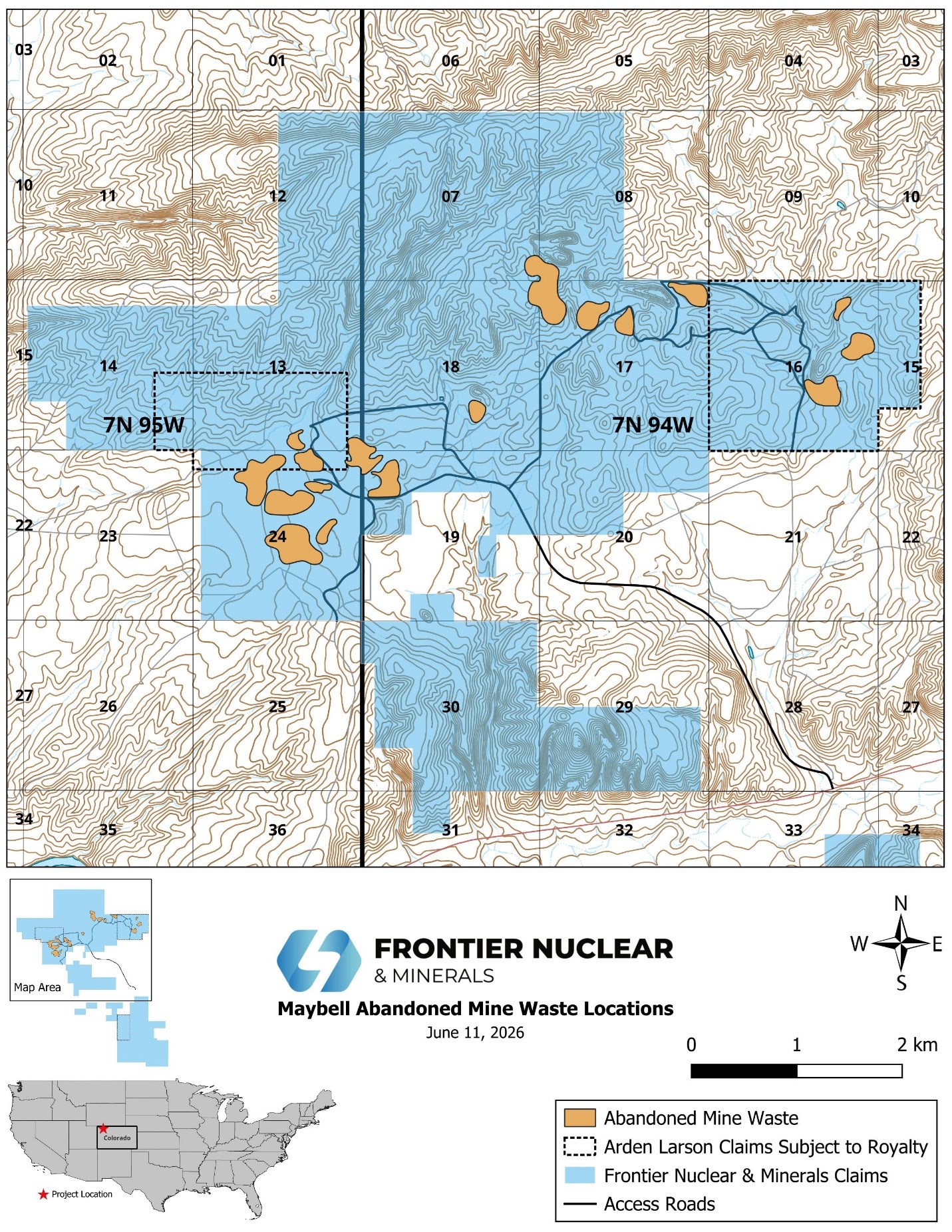
The Maybell Project, 100% owned by Frontier, is located at the southern end of the Sand Wash Basin between the towns of Maybell and Lay in Moffat County, Colorado. It covers an area of approximately 9,497 acres and is comprised of 480 Federal mining claims (8,857 acres) and one State Exploration Lease (640 acres). The Maybell Project has witnessed historical production of approximately 5.3Mlbs U3O8 over two discrete historical mining periods. The location of the waste dumps on the Maybell Project are set out in Figure 1, attached as Schedule A.

About DISA Technologies

Founded in 2018 and headquartered in Casper, Wyoming, DISA Technologies focuses on upgrading critical minerals from mined ore and legacy waste, serving both mining and remediation sectors. DISA's technology isolates targeted minerals from ores and legacy waste, including precious and industrial metals, hydrocarbons, and uranium, aiming to reduce costs and environmental impact while enhancing mineral processing and environmental remediation.3

About Frontier Nuclear and Minerals Inc.

Frontier Nuclear and Minerals Inc. is focused on building a U.S.-based nuclear fuel cycle platform through uranium exploration and development assets, together with targeted investments in Ubaryon Pty. Ltd., a private Australian company developing next generation enrichment technology, and Kadmos Energy Services LLC, a private U.S. company developing small modular light water reactors. Frontier continues to evaluate opportunities in the nuclear fuel cycle that align with its long-term strategic objectives.

For more information, visit: www.frontiernuclear.com

Forward-Looking Statements: This press release contains "forward-looking statements" within the meaning of Section 27A of the Securities Act of 1933, Section 21E of the Securities Exchange Act of 1934 and the "safe harbor" provisions under the Private Securities Litigation Reform Act of 1995 that are subject to substantial risks and uncertainties. All statements, other than statements of historical fact, contained in this press release are forward-looking statements, including without limitation statements with regard to Frontier Nuclear and Minerals Inc., the timing and outcome of the DISA program at Frontier's 100% owned Maybell Project to recover saleable uranium from abandoned uranium mine waste dumps, anticipated uranium demand, U.S. federal nuclear policy and funding initiatives, and Frontier Nuclear and Minerals Inc.'s strategic positioning. References to third-party statements, including industry estimates of future uranium demand and statements made by government agencies, are included for context and are not adopted by Frontier Nuclear and Minerals Inc. as projections of its own results. We base these forward-looking statements on our expectations and projections about future events, which we derive from the information currently available to us. Forward-looking statements contained in this press release may be identified by the use of words such as "anticipate," "believe," "contemplate," "could," "estimate," "expect," "intend," "seek," "may," "might," "plan," "potential," "predict," "project," "target," "aim," "should," "will," "would," or the negative of these words or other similar expressions, although not all forward-looking statements contain these words. Forward-looking statements are based on Frontier Nuclear and Minerals Inc.'s current expectations and are subject to inherent uncertainties, risks and assumptions that are difficult to predict. Further, certain forward-looking statements are based on assumptions as to future events that may not prove to be accurate. Some of these risks and uncertainties are described more fully in the section titled "Risk Factors" in our registration statements and annual reports filed with the Securities and Exchange Commission. Forward-looking statements contained in this announcement are made as of this date, and Frontier Nuclear and Minerals Inc. undertakes no duty to update such information except as required under applicable law.

For Further Information:

Frank WheatleyInvestor Relations
Chief Executive Officerir@frontiernuclear.com
fw@frontiernuclear.comwww.frontiernuclear.com


Schedule A

Cannot view this image? Visit: https://images.newsfilecorp.com/files/9547/304153_4b3218aee4ecead0_001.jpg

Figure 1 – Legacy Mine Waste at the Maybell Uranium Project

To view an enhanced version of this graphic, please visit:
https://images.newsfilecorp.com/files/9547/304153_4b3218aee4ecead0_001full.jpg


1 Technology | DISA Tech™
2 epa.gov/navajo-nation-uranium-cleanup/pilot-studies
3 DISA Tech™

To view the source version of this press release, please visit https://www.newsfilecorp.com/release/304153

FAQ

What did Frontier Nuclear (NASDAQ:FNUC) announce about the Maybell uranium project on July 7, 2026?

Frontier Nuclear announced a partnership with DISA Technologies to remediate legacy uranium mine waste and recover saleable uranium at the Maybell project. According to Frontier, DISA will operate and fund the program while Frontier receives a sliding-scale net revenue royalty from future uranium and critical mineral sales.

How will the DISA Technologies agreement generate revenue for Frontier Nuclear (FNUC)?

Frontier Nuclear will earn a net revenue royalty of 2.5%–4% from uranium and critical mineral sales recovered from Maybell waste dumps. According to Frontier, the royalty rate depends on uranium prices, and DISA will cover all capital and operating costs for the remediation program.

What is DISA’s HPSA™ technology being used at Frontier Nuclear’s Maybell project?

HPSA™ is a patented, chemical-free, modular process that separates uranium and other minerals from waste using high-velocity slurry collisions. According to Frontier, an EPA Study found HPSA™ reduced uranium by 61%–94% and concentrated over 90% of uranium into about 17% of processed mass.

What are the next steps for the Frontier Nuclear (FNUC) and DISA partnership at Maybell?

DISA will run a six-month characterization program and apply for necessary permits to begin treatment and concentrate recovery. According to Frontier, DISA will then operate the HPSA™-based remediation program and pay Frontier a net revenue royalty on future metal concentrate sales.

How many waste dumps will be targeted in Frontier Nuclear’s Maybell uranium project remediation?

The Maybell project currently has 17 identified prospective waste dumps targeted for characterization and potential uranium recovery. According to Frontier, additional dumps may be added over time as ground surveys progress, expanding the scope of potential legacy waste remediation and resource extraction.

Where is Frontier Nuclear’s Maybell uranium project located and how large is it?

The Maybell uranium project lies in Moffat County, Colorado, between the towns of Maybell and Lay. According to Frontier, it covers about 9,497 acres, including 480 federal mining claims and one state exploration lease, and has historical production of approximately 5.3 million pounds U3O8.

What environmental benefits are expected from the Frontier Nuclear–DISA remediation at Maybell?

The HPSA™ process is expected to lower uranium and radium concentrations in treated material while recovering saleable concentrates. According to Frontier, EPA testing showed significant contaminant reductions and that most treated material can remain on site, reducing regulated disposal volumes and improving environmental conditions.