
Gain Therapeutics Presents Positive Interim Data from Phase 1b Clinical Study of GT-02287 at 3rd International GBA1 Meeting 2026
Gain Therapeutics (Nasdaq: GANX) reported positive interim data from its Phase 1b study of GT-02287 in idiopathic and GBA1 Parkinson’s disease, presented at the 3rd International GBA1 Meeting 2026.
Rhea-AI Summary
Gain Therapeutics (Nasdaq: GANX) reported positive interim data from its Phase 1b study of GT-02287 in idiopathic and GBA1 Parkinson’s disease, presented at the 3rd International GBA1 Meeting 2026.
All 16 extension participants completed 150 days of dosing with stable MDS-UPDRS scores overall and a 4.8-point Part II+III difference favoring patients with high baseline CSF GluSph. According to Gain Therapeutics, CSF GluSph fell 81% after 90 days in patients with elevated baseline levels, with accompanying DDC decreases. Participants also commonly reported perceived improvements in smell and taste, balance or gait, and sleep. A Data Monitoring Committee recommended the study continue unchanged, and a Phase 2 trial is planned with objective smell and gait endpoints.
Positive
- 16 of 19 Phase 1b participants entered the nine-month extension and all remain on study at Day 150
- MDS-UPDRS scores remained stable across the overall population after 150 days of GT-02287 treatment
- 4.8-point difference in MDS-UPDRS Part II+III at Day 150 favoring high baseline CSF GluSph group
- Average 81% reduction in elevated CSF GluSph after 90 days of GT-02287 treatment
- Decreases in CSF DOPA decarboxylase observed after 90 days in participants with high baseline GluSph
- Unsolicited reports of improved smell and taste, balance or gait, and sleep after 90 days of dosing
- Data Monitoring Committee recommended the Phase 1b study continue without changes on March 5, 2026
Negative
- None.
News Market Reaction – GANX
In the May 26 session, GANX gained 2.25%, reflecting a moderate positive market reaction.
Data tracked by StockTitan Argus on the day of publication.
Key Figures
Previous Clinical trial Reports
| Date | Event | Sentiment | 24h Move | Catalyst |
|---|---|---|---|---|
| Mar 18 | Phase 1b data update | Positive | -25.6% | Presented additional Phase 1b and preclinical data for GT-02287 and GT-04686. |
| Dec 18 | Exploratory endpoint data | Positive | -44.4% | Reported first-ever CSF GluSph reduction and strong tolerability in Phase 1b GT-02287 study. |
| Oct 06 | Initial Phase 1b data | Positive | +15.6% | Presented initial Phase 1b data with stable or improving MDS‑UPDRS and no serious AEs. |
| Sep 04 | Dosing extension approval | Positive | -9.4% | Won Australian approval for nine‑month dosing extension and favorable DMC safety review. |
| Jun 30 | Enrollment completion | Positive | -12.8% | Completed target enrollment early in Phase 1b GT‑02287 trial with 16 participants. |
24h Move is the share-price change in the day after each event; other market factors may also have contributed.
Clinical trial headlines for GT-02287 have often been followed by negative price reactions, with only one of five similar past updates seeing a positive move.
Over the past year, Gain Therapeutics has repeatedly reported progress on GT-02287 through Phase 1b clinical milestones. Updates since June 30, 2025 have included completion of target enrollment, Australian approval of a dosing extension, and multiple interim data readouts showing tolerability, CSF biomarker reductions, and stable or improving MDS‑UPDRS scores. Despite largely positive clinical signals, four of five tagged clinical trial news events produced negative next‑day price moves, framing today’s favorable Parkinson’s data against a backdrop of historically cautious market reactions.
Key Terms
mds-updrs medical
glucosylsphingosine medical
cerebrospinal fluid medical
glucocerebrosidase medical
alpha synuclein medical
lysosomal medical
dopa decarboxylase medical
university of pennsylvania smell identification test (upsit) medical
AI-generated analysis. How Rhea-AI works. Not financial advice.




MDS-UPDRS scores remained stable and durable across overall study population after 150 days of treatment with GT-02287
Differential response between participants with low and high baseline GluSph continues, with a difference of 4.8 points in the sum of MDS-UPDRS Part II and Part III scores between the two groups at Day 150
Most common benefits reported by study participants include meaningful improvements in specific functional areas such as smell and taste, sleep, and balance or gait
BETHESDA, Md., May 26, 2026 (GLOBE NEWSWIRE) -- Gain Therapeutics, Inc. (Nasdaq: GANX) (“Gain”, or the “Company”), a clinical-stage biotechnology company leading the discovery and development of the next generation of allosteric small molecule therapies, today announced the presentation of an oral presentation at the 3rd International GBA1 Meeting 2026, held May 22-23, 2026, in Phoenix, AZ. The oral presentation outlined new clinical data from the Phase 1b study of GT-02287 further supporting disease-modifying potential in both idiopathic and GBA1 Parkinson’s disease (PD).
Gene Mack, President and CEO of Gain Therapeutics, stated, “These longer-term data continue to strengthen our belief that GT-02287 will be among the first therapies, if not the first, to slow or stop the progression of Parkinson’s disease and address the underlying biology causing PD symptoms. We continue to observe overall stability and durability in MDS-UPDRS scores associated with GT-02287 administration in the ongoing Phase 1b study. While we continue to track a potential variation in treatment response related to baseline GluSph in cerebrospinal fluid, we have also been further encouraged by the consistency in feedback among trial participants across different clinical sites regarding improvement in smell and taste, balance or gait, and sleep that we are incorporating as secondary endpoints into our upcoming Phase 2 study to help further understand how different baseline characteristics of Parkinson’s may drive the progression of symptoms.”
The oral presentation, titled, “An update on the development of the GCase modulator GT-02287 for Parkinson’s disease,” was delivered by the Company’s Chief Medical Officer Jonas Hannestad, M.D., Ph.D. The data presented, which includes safety, tolerability, biomarkers, and clinical scores from the Phase 1b nine-month study extension support continued development of GT-02287 for PD. As previously reported, 16 of 19 participants who completed dosing in Part 1 of the Phase 1b chose to continue in the ongoing nine-month extension (Part 2), further supporting the tolerability of GT-02287. A Data Monitoring Committee meeting on March 5, 2026, concluded that the study should continue without any changes.
To date, all 16 participants remain on study and have completed five months of dosing (Day 150).
As previously reported, in all participants with elevated baseline levels of glucosylsphingosine (GluSph) in cerebrospinal fluid (CSF), GluSph decreased by an average of
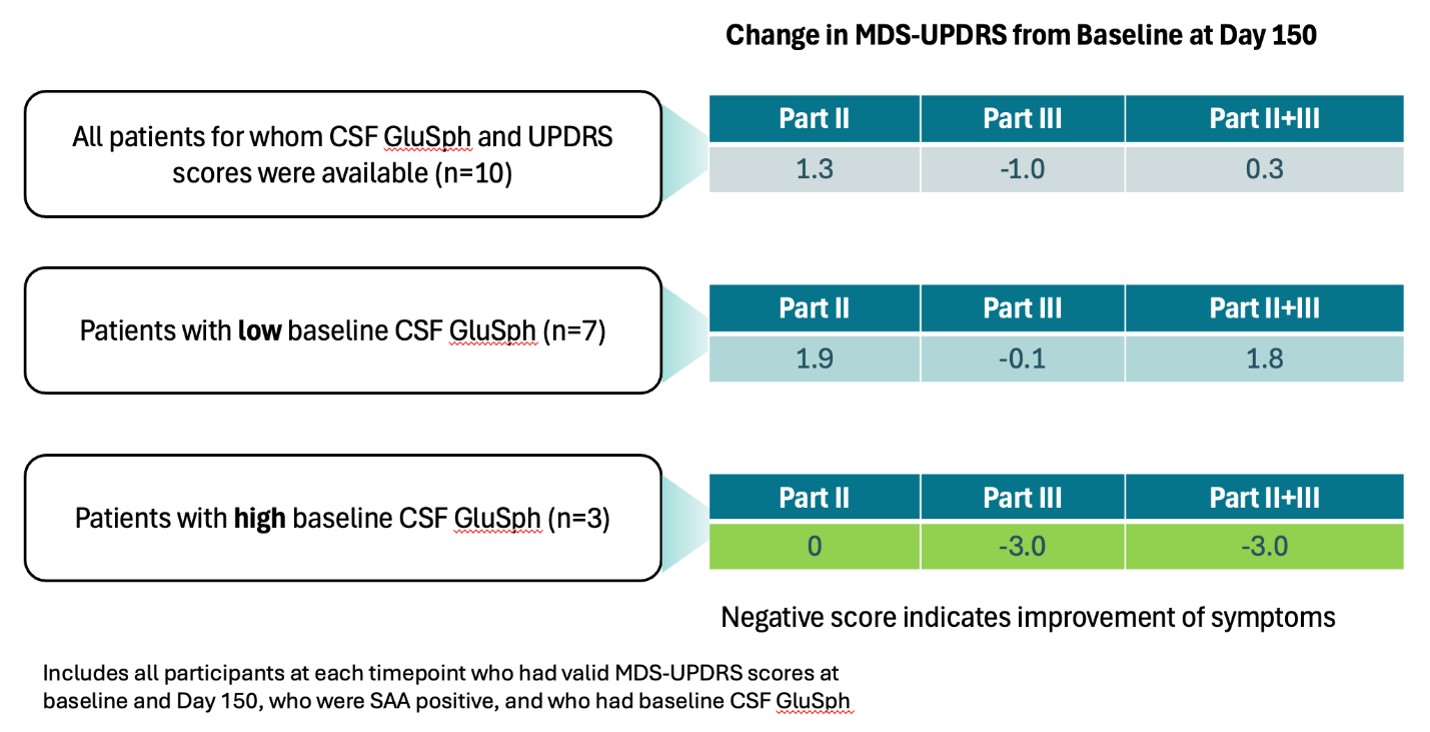
Figure 1. Change in MDS-UPDRS scores from Baseline at Day 150 in all patients for whom CSF GluSph and MDS-UPDRS scores were available, patients with low baseline GluSph, and patients with high baseline GluSph
Participants with elevated baseline levels of GluSph in CSF continued to benefit more than those with low baseline levels of GluSph in CSF after 150 days of dosing with GT-02287, with a difference of 4.8 points in the sum of MDS-UPDRS Part II and Part III scores between the two groups at Day 150. MDS-UPDRS scores remained stable and durable across overall study population after 150 days of treatment with GT-02287.
Additionally, participants in the Phase 1b study provided unsolicited descriptions of perceived benefit after 90 days of dosing with GT-02287. Perceived benefits most commonly described included four instances of improved sense of smell and taste, four instances of improved balance or gait, and three instances of improved sleep. The planned Phase 2 clinical trial is anticipated to include endpoints to further assess treatment effects beyond benefits perceived and informally reported, including administration of the University of Pennsylvania Smell Identification Test (UPSIT) at baseline and at the end of the study, as well as the use of Opal wearable sensors for in-clinic gait assessments to be conducted at multiple timepoints throughout the study.
Jonas Hannestad, Chief Medical Officer of Gain Therapeutics, commented on the results, saying, “We believe the alignment of MDS-UPDRS scores, novel biomarker evidence, and improvements in motor and non-motor symptoms suggest GT-02287 is impacting the causative biology of Parkinson’s disease and support continued development of GT-02287 in both idiopathic and GBA1 Parkinson’s disease.”
About GT-02287
Gain Therapeutics’ lead drug candidate, GT-02287, is in clinical development for the treatment of Parkinson’s disease (PD) with or without a GBA1 mutation. The orally administered, brain-penetrant small molecule is an allosteric enzyme modulator that restores the function of the lysosomal enzyme glucocerebrosidase (GCase) which becomes misfolded and impaired due to mutations in the GBA1 gene, the most common genetic abnormality associated with PD, or other age-related stress factors.
In preclinical models of PD, GT-02287 restored GCase enzymatic function, reduced ER stress, lysosomal and mitochondrial pathology, aggregated α-synuclein, neuroinflammation and neuronal death, as well as plasma neurofilament light chain (NfL) levels, a biomarker of neurodegeneration. In rodent models of both GBA1-PD and idiopathic PD, GT-02287 was shown to rescue deficits in motor function and gait and prevent the development of deficits in complex behaviors such as nesting. Compelling data in these models, demonstrating a disease-modifying effect of GT-02287, suggest that the drug candidate may have the potential to slow or stop the progression of Parkinson’s disease.
Results from a Phase 1 study of GT-02287 in healthy volunteers demonstrated favorable safety and tolerability, plasma and CNS exposures in the projected therapeutic range, and target engagement with an increase in GCase activity among those receiving GT-02287 at clinically relevant doses.
GT-02287 is currently being evaluated in a Phase 1b clinical trial for the treatment of Parkinson’s disease with or without a GBA1 mutation. The primary endpoint of the trial, which enrolled participants across seven sites in Australia, is to evaluate the safety and tolerability of GT-02287 after three months of dosing in people with Parkinson’s disease. The recently commenced Phase 1b study extension allows participants to continue to be treated with GT-02287 for up to a total of 12 months.
Initial results from the Phase 1b clinical trial in people with Parkinson’s disease demonstrated central nervous system target engagement, a reduction to baseline levels in the prespecified endpoint glucosylsphingosine (GluSph), and improvement or stabilization in MDS-UPDRS scores. Additionally, participants with elevated levels of CSF GluSph also exhibited elevated levels of DOPA decarboxylase (DDC), which decreased following treatment with GT-02287.
Gain’s lead program in Parkinson’s disease has been awarded funding support early in its development from The Michael J. Fox Foundation for Parkinson’s Research (MJFF) and The Silverstein Foundation for Parkinson’s with GBA, as well as from the Eurostars-2 joint program with co-funding from the European Union Horizon 2020 research and Innosuisse – Swiss Innovation Agency.
About Gain Therapeutics, Inc.
Gain Therapeutics, Inc. is a clinical-stage biotechnology company leading the discovery and development of next generation allosteric therapies. Gain’s lead drug candidate, GT-02287 is currently being evaluated for the treatment of Parkinson’s disease with or without a GBA1 mutation in a Phase 1b clinical trial. GT-02287 has further potential in Gaucher’s disease, dementia with Lewy bodies, and Alzheimer’s disease. Gain has multiple undisclosed preclinical assets targeting lysosomal storage disorders, metabolic diseases, and solid tumors.
Gain’s unique approach enables the discovery of novel, allosteric small molecule modulators that can restore or disrupt protein function. Deploying its highly advanced Magellan™ platform, Gain is accelerating drug discovery and unlocking novel disease-modifying treatments for untreatable or difficult-to-treat disorders including neurodegenerative diseases, rare genetic disorders and oncology.
Forward-Looking Statements
This release contains “forward-looking statements” made pursuant to the safe harbor provisions of the Private Securities Litigation Reform Act of 1995. These statements are typically preceded by words such as “believes,” “expects,” “anticipates,” “intends,” “will,” “may,” “should,” or similar expressions. These forward-looking statements reflect management’s current knowledge, assumptions, judgment and expectations regarding future performance or events. Although management believes that the expectations reflected in such statements are reasonable, they give no assurance that such expectations will prove to be correct or that those goals will be achieved, and you should be aware that actual results could differ materially from those contained in the forward-looking statements. Such forward-looking statements include, but are not limited to, statements regarding: the development of the Company’s current or future product candidates including GT-02287 and GT-04686; expectations regarding the completion and timing of results from a Phase 1b clinical study for GT-02287, including any extension studies; expectations regarding the timing of patient enrollment for a Phase 1b clinical study for GT-02287, including any extension studies; the timing of any submissions to the FDA or other regulatory bodies and agencies and the timing of any responses from the FDA or other regulatory bodies and agencies; the timing of the commencement of any Phase 2 clinical studies for GT-02287; and the potential therapeutic and clinical benefits of the Company’s product candidates, including GT-02287 and GT-04686. For a further description of the risks and uncertainties that could cause actual results to differ from those expressed in these forward-looking statements, as well as risks relating to the Company’s business in general, please refer to the Company’s Form 10-K for the year ended December 31, 2025, and other filings made with the SEC. All forward-looking statements are expressly qualified in their entirety by this cautionary notice. You are cautioned not to place undue reliance on any forward-looking statements, which speak only as of the date of this release. We have no obligation, and expressly disclaim any obligation, to update, revise or correct any of the forward-looking statements, whether because of new information, future events or otherwise.
Investors:
Gain Therapeutics, Inc.
Apaar Jammu
Director, Investor Relations and Public Relations
ajammu@gaintherapeutics.com
LifeSci Advisors LLC
Chuck Padala
Managing Director
chuck@lifesciadvisors.com
Media:
Russo Partners LLC
Nic Johnson and Elio Ambrosio
nic.johnson@russopartnersllc.com
elio.ambrosio@russopartnersllc.com
(760) 846-9256
A photo accompanying this announcement is available at https://www.globenewswire.com/NewsRoom/AttachmentNg/a9db1229-ee1e-4682-9900-5e1535759ca5
