
Green Bridge Metals Corporation Announces Phase 2 Diamond Drill Program at the Titac Titanium-Copper-Vanadium Project, Minnesota, USA
Green Bridge plans a multi-metal Phase 2 drill campaign at Titac, aiming to grow its titanium resource and collect data for future economic studies.
Rhea-AI Summary
Green Bridge Metals (GBMCF) has announced a Phase 2 diamond core drill program at its Titac titanium-copper-vanadium project in St. Louis County, Minnesota, expected to commence in October 2026. The program will focus on Titac North, with 6–7 holes totaling 2,500–3,000 metres at target depths of 400–600 metres and roughly 100-metre spacing, designed to test for Ti-Cu-V mineralization near historic drilling.
Objectives include evaluating expansion of the existing titanium inferred Mineral Resource Estimate (currently defined at Titac South), generating a copper resource for Titac, and systematically assaying additional metals such as vanadium, nickel, cobalt and PGEs. Fourteen drill sites are fully permitted by St. Louis County under an exploration plan that runs through April 1, 2028. Titac South currently hosts an inferred pit-constrained resource of 45.1 million tonnes at 15% TiO2.
Positive
- None.
Negative
- None.
AI-generated analysis. How Rhea-AI works. Not financial advice.




VANCOUVER, BC / ACCESS Newswire / September 23, 2026 / Green Bridge Metals Corporation (CSE:GRBM)(OTCQB:GBMCF)(FWB:J48, WKN:A3EW4S) ("Green Bridge" or the "Company") is pleased to announce a Phase 2 diamond core drill program at the Company's Titac Titanium-Copper-Vanadium Project (the "Project" or "Titac"), located in St. Louis County, Minnesota, USA, within the Duluth Complex (Figure 1), following the successful outcomes from the Phase 1 drilling at the Titac South prospect earlier in 2026 (please see news release dated September 10, 2026), with the Phase 2 program expected to commence in October, 2026.
Highlights
- Planned Phase 2 Drilling Program Accelerated: Six holes totaling 2,500-3,000 metres planned at Titac North, commencing in October, 2026.
- Goal to Expand the Inferred Mineral Resource: Test the potential to expand the existing Titac South titanium inferred mineral resource into Titac North.
- Please see the Company's technical report dated September 18, 2024, a copy of which may be obtained under the Company's profile at www.sedarplus.ca for more information.
- Inferred mineral resources have a great amount of uncertainty as to their existence and as to whether they can be mined economically. It cannot be assumed that all or any part of the inferred mineral resources will ever be upgraded to a higher category. Mineral resources that are not mineral reserves do not have demonstrated economic viability.
- Building a Multi-Metal Resource: Phase 1 and Phase 2 data to evaluate inclusion of copper and vanadium towards an updated Titac MRE.
- Advancing Toward a PEA: Generate key technical data for future resource and economic studies.
- Planning for Growth: 14 drill sites fully permitted by St. Louis County, providing flexibility for follow-up drilling and additional exploration work through April 2028.
David Suda, President and CEO, commented: "The results from our Phase 1 drilling at Titac South gave us the confidence to accelerate the next stage of work at Titac. With Phase 2, our drilling focus shifts to Titac North, where six planned holes will test the potential to expand the known mineralized system beyond the existing Titac South titanium inferred resource. We will integrate these new results with our Phase 1 work to evaluate the potential incorporation of copper and vanadium into a future updated Titac resource. Our objective is to build on an established titanium inferred resource while developing a much clearer understanding of the broader potential multi-metal opportunity at Titac. At the same time, our evolving 3-D geological and geophysical interpretation continues to identify opportunities for future growth beyond the areas being tested in the current program."
Inferred mineral resources have a great amount of uncertainty as to their existence and as to whether they can be mined economically. It cannot be assumed that all or any part of the inferred mineral resources will ever be upgraded to a higher category. Mineral resources that are not mineral reserves do not have demonstrated economic viability.
Program Objectives
The Phase 2 program is designed to achieve the following objectives:
- Drilling at Titac North (6 drillholes) aims to expand the existing titanium Mineral Resource Estimate (MRE) at Titac South, with a goal to augment the resource to cover both Titac North and South prospects.
- Generate a copper resource for Titac South with existing data, which could expand with the planned Phase 2 drilling at Titac North.
- Evaluate systematic multi-element assaying for other metals (V, Ni, Co, PGMs), which are not currently included in the MRE.
- Generate technical data to support the Company's longer-term objective of advancing Titac toward a Preliminary Economic Assessment ("PEA"), subject to results and further studies.
Inferred mineral resources have a great amount of uncertainty as to their existence and as to whether they can be mined economically. It cannot be assumed that all or any part of the inferred mineral resources will ever be upgraded to a higher category. Mineral resources that are not mineral reserves do not have demonstrated economic viability.
Program Overview
The Phase 2 Drill Program will consist of optimized drilling designed to systematically test for titanium-copper-vanadium mineralization delineated by historic drilling, incorporate the Titac North area into the existing inferred mineral resource evaluation, and assess the potential for V-Ni-Co-PGE mineralization (Figures 2 and 3). Program parameters will be as follows:
- Holes planned: 6-7 diamond core holes
- Target depths: 400 - 600 metres
- Total planned drilling: 2,500-3,000 metres
- Average hole spacing: approximately 100 metres
- Drill configuration: Optimized infill drilling proximal to historic drilling to provide sufficient coverage to generate a Ti-Cu-V resource addition to the current Titac South MRE.
Key Program Elements
- Drillhole Optimization: APEX Geoscience Ltd. has reviewed drilling locations and designed methods to advance the planned drilling to incorporate the MRE block model. This work prioritizes efficient allocation of drilling metres and cost while selecting locations intended to maximize the potential for potential resource expansion.
- Regulatory: The 14 drill sites included in the Company's exploration plan have been fully permitted by St. Louis County. The authorized exploration plan extends through April 1, 2028, providing the Company with flexibility to evaluate results from the first six Phase 2 holes and prioritize follow-up drilling, additional studies and data collection.
- Execution: Logistics and planning are advanced. The program will be executed on a phased basis utilizing a Cascade sonic drill rig to set casing, and a Foraco rig for diamond drilling, with both anticipated to start early to mid-October, 2026.
- Technical Advancement: Down-hole geophysical surveys will be conducted, with the aim of improving confidence in structural interpretation and to assist with future targeting.
- Dual-purpose Drilling: All drillholes are designed to serve as multifunctional holes to provide data for geologic, hydrogeologic, and geophysical data to further advance the technical foundation and evaluate the potential for resource expansion. This approach is also intended to support baseline data collection for future permitting and engineering studies.
- Assaying and Metallurgical Planning: Systematic multi-element assaying will be completed to evaluate potential metal contributions from V-Ni-Co-PGEs. Metallurgical studies are planned as part of the broader technical program.
- Exploration Potential: Ability to drill a new exploration target at Titac East, supported by the effectiveness of geophysical inversion modelling as a targeting tool for mineralized Oxide Ultramafic Intrusions (see news release dated September 10, 2026).
- Inferred mineral resources have a great amount of uncertainty as to their existence and as to whether they can be mined economically. It cannot be assumed that all or any part of the inferred mineral resources will ever be upgraded to a higher category. Mineral resources that are not mineral reserves do not have demonstrated economic viability.
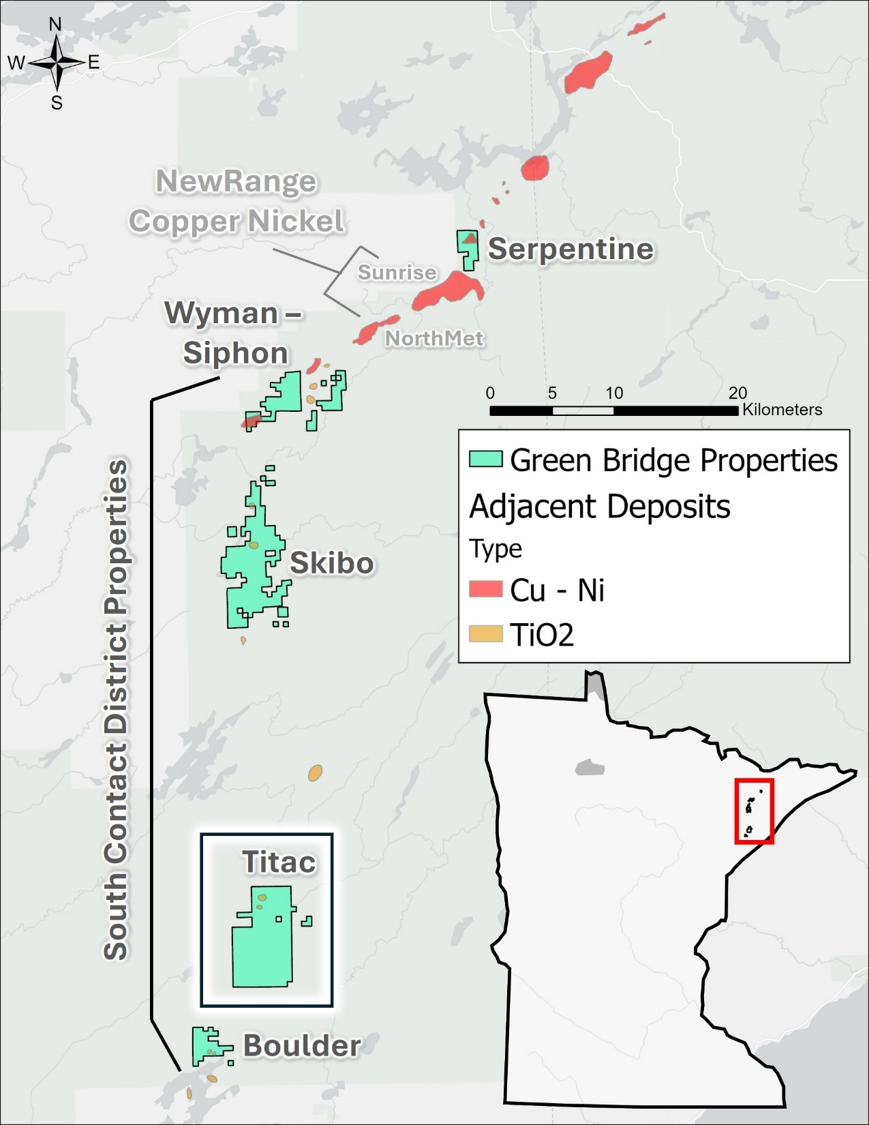
Figure 1: Map showing location of the Titac property in relation to other Minnesota properties and adjacent magmatic Cu - Ni and Oxide Ultramafic Intrusive TiO₂ deposits.
Technical Merit
The program benefits from Titac's Ti-Cu mineralization hosted in well-defined Oxide Ultramafic Intrusions, which is supported by existing geological modeling. Combined with down-hole geophysics and dual-purpose hydrogeology holes, the campaign is structured to advance both resource confidence and future technical and permitting readiness.
Titac South hosts a pit-constrained Mineral Resource Estimate (MRE) with an effective date of September 18, 2024, as reported in the independent NI 43-101 Technical Report titled "Technical Report and Mineral Resource Estimate for the South Contact Zone Project, St. Louis County, Minnesota, USA" (the "Technical Report"), available under the Company's profile on SEDAR+ (www.sedarplus.ca).
Highlights of this report include:
- Data verification has been completed by a qualified person through a site visit and sampling, historical assay and certificate checks, a review of the resource block model, and update of the MRE for titanium at the Titac South prospect.
- 45.1 million tonnes at
15% TiO2
- 45.1 million tonnes at
- Verification of historical drilling, assays and results reported for Cu, Ni, and PGE's at each of the four prospects; Wyman-Siphon, Skibo, Titac, and Boulder included in the Property.
Inferred mineral resources have a great amount of uncertainty as to their existence and as to whether they can be mined economically. It cannot be assumed that all or any part of the inferred mineral resources will ever be upgraded to a higher category. Mineral resources that are not mineral reserves do not have demonstrated economic viability.
Further Notes on the Mineral Resource Estimate:
- The estimate of Mineral Resources may be materially affected by environmental, permitting, legal, title, taxation, socio-political, marketing, or other relevant issues.
- The Mineral Resource Estimate was prepared by independent Qualified Persons and is constrained within an optimized pit shell. Full details, including estimation methodology, cut-off parameters, and data verification, are contained in the Technical Report.
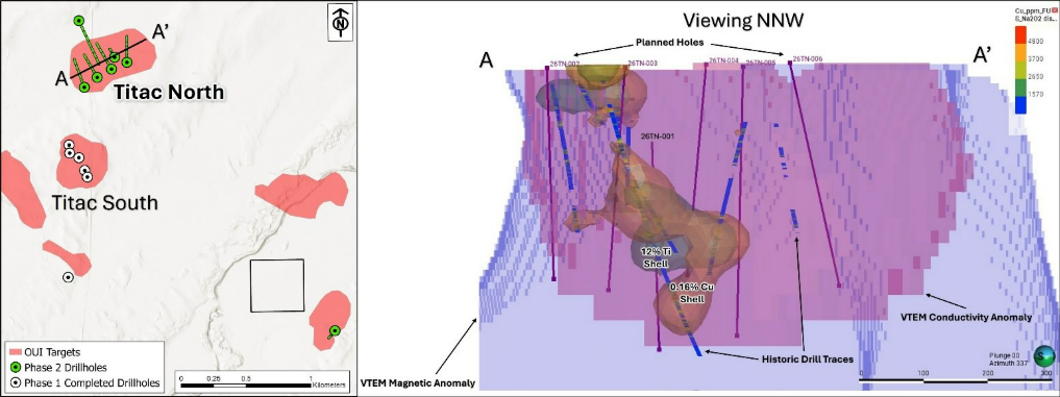
Figure 2: North-northwest oriented section at Titac North. Shown are modelled VTEM conductivity (magenta) and magnetic (blue) anomalies and historic drillholes with Ti (gray) and Cu (orange) grade shells; annotated for drillholes 001 - 006.
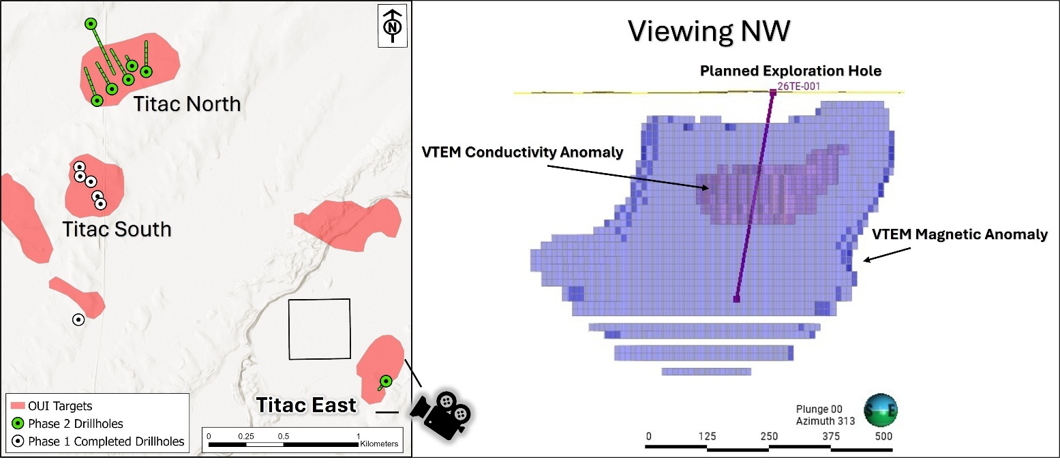
Figure 3: Northwest oriented section at Titac East with modelled conductivity and magnetic anomalies for the exploration drillhole.
Qualified Person
The scientific and technical information in this news release has been reviewed and approved by Mike Dufresne, M.Sc., P. Geol., P.Geo., who is an independent Qualified Person as defined by National Instrument 43-101 - Standards of Disclosure for Mineral Projects.
For a discussion of the Company's QA/QC and data verification procedures and processes, please see the Company's most recently-filed technical report, a copy of which may be obtained under the Company's profile at www.sedarplus.ca.
About Green Bridge Metals
Green Bridge Metals Corporation is a North American mineral exploration company focused on the discovery and development of critical mineral assets in tier-one jurisdictions. The Company's South Contact Zone Project in Minnesota hosts titanium-copper-vanadium mineralization within the Duluth Complex. The Company is committed to responsible exploration practices and the development of domestic supply chains for the minerals essential to the clean energy transition and national security.
On Behalf of Green Bridge Metals Corporation
David Suda, President and Chief Executive Officer
For further information, please contact:
David Suda President & CEO
Tel: 604-928-3101
Email: investors@greenbridgemetals.com
Forward-Looking Information.
This news release contains "forward-looking information" within the meaning of applicable Canadian securities legislation. Forward-looking information in this news release includes, but is not limited to, statements regarding: the timing, scope and execution of the Phase 2 drill program at Titac, including the anticipated October, 2026 commencement, the number, depth, metreage, spacing and configuration of the planned drillholes and the use and timing of the Cascade sonic and Foraco diamond drill rigs; the ability of the Phase 2 program to test extensions of mineralization at Titac North and expand the existing Titac South Mineral Resource Estimate to include Titac North; the potential generation of a copper resource at Titac South and the potential inclusion of copper, vanadium, nickel, cobalt and platinum group metals in a future updated Mineral Resource Estimate; the completion and results of down-hole geophysical surveys, hydrogeological work, multi-element assaying and metallurgical studies; the use and effectiveness of geological, geophysical and block-model interpretations, including for drill targeting and resource expansion; the potential for follow-up drilling and additional exploration at Titac East and elsewhere on the Project; the anticipated benefits of the existing permits and the Company's ability to conduct exploration work through April 1, 2028; and the Company's longer-term objective of advancing Titac toward an updated Mineral Resource Estimate, a preliminary economic assessment and further permitting and engineering studies. Forward-looking information is based on management's opinions, estimates and assumptions as of the date such statements are made, including assumptions regarding the availability of contractors, equipment, personnel and supplies; the timing, cost and completion of planned exploration activities; the accuracy and reliability of historical and current geological, geophysical, hydrogeological, assay and metallurgical data; geological continuity and the interpretation of mineralization; the receipt and continued effectiveness of required permits and approvals; commodity prices and market conditions; and the Company's ability to obtain financing on acceptable terms when required. Forward-looking information is subject to known and unknown risks, uncertainties and other factors that may cause actual results, performance or achievements to differ materially from those expressed or implied, including risks relating to delays, changes in scope or cancellation of exploration programs; contractor, equipment, labour, access, weather, logistical and cost-related constraints; unsuccessful or inconclusive drilling, assay, geophysical, hydrogeological or metallurgical results; uncertainty in geological interpretation and Mineral Resource estimation; the speculative nature of mineral exploration and development; the inability to expand, upgrade or add metals to the existing Mineral Resource Estimate; the possibility that mineralization may not be continuous or economically recoverable; permitting, environmental, community and regulatory risks; fluctuations in commodity prices and capital markets; financing and liquidity risks; and the other risks described in the Company's continuous disclosure filings available under its profile on SEDAR+. There can be no assurance that the Phase 2 drill program will commence or be completed as currently planned, that its results will support an expansion or update of the existing Mineral Resource Estimate, that any Inferred Mineral Resources will be upgraded to Indicated Mineral Resources, that copper, vanadium, nickel, cobalt or platinum group metals will be included in or contribute economically to a future Mineral Resource Estimate, that any further exploration program or technical study will be undertaken, or that a preliminary economic assessment will be completed. Although the Company believes that the assumptions and expectations reflected in such forward-looking information are reasonable, undue reliance should not be placed on forward-looking information because the Company can give no assurance that such expectations will prove to be correct. The Company disclaims any intention or obligation to update or revise any forward-looking information, whether as a result of new information, future events or otherwise, except as required by applicable securities laws.
Neither the Canadian Securities Exchange nor its Regulation Services Provider accepts responsibility for the adequacy or accuracy of this release.
SOURCE: Green Bridge Metals Corporation
View the original press release on ACCESS Newswire
FAQ
AI-generated questions and answers. How Rhea-AI works. Not financial advice.
What are the primary objectives of the Phase 2 drill program at Titac?
The Phase 2 program aims to: (1) test whether the existing titanium Mineral Resource Estimate at Titac South can be expanded to include Titac North; (2) generate a copper resource for Titac South using existing data, potentially expanded by new drilling at Titac North; (3) evaluate systematic multi-element assaying for metals such as vanadium, nickel, cobalt and PGEs, which are not currently included in the MRE; and (4) generate technical data to support advancing Titac toward a future Preliminary Economic Assessment, subject to results and further studies.
What are the key design parameters of the Phase 2 drilling program?
The Phase 2 drill program is planned to include 6–7 diamond core holes at Titac North, with target depths of 400–600 metres and total drilling of 2,500–3,000 metres. Average hole spacing is about 100 metres, and the configuration is optimized as infill drilling near historic holes to support a potential Ti-Cu-V resource addition. A Cascade sonic rig will set casing and a Foraco rig will complete the diamond drilling, both anticipated to start in early to mid-October 2026.
How long are the Titac drill permits valid and what flexibility do they provide?
Fourteen drill sites in the exploration plan are fully permitted by St. Louis County, with authorization extending through April 1, 2028. This timeframe provides flexibility for Green Bridge Metals to assess results from the initial Phase 2 holes, prioritize follow-up drilling, conduct additional studies, and continue data collection over several field seasons.
What existing Mineral Resource Estimate does Titac South currently have?
Titac South hosts a pit-constrained inferred Mineral Resource Estimate with an effective date of September 18, 2024. The Technical Report describes 45.1 million tonnes at 15% TiO2 for the Titac South prospect. The estimate was prepared by independent Qualified Persons and is constrained within an optimized pit shell, with full estimation and verification details available in the NI 43-101 Technical Report on SEDAR+.
Who is the Qualified Person responsible for the technical information in this announcement?
The scientific and technical information in the announcement has been reviewed and approved by Mike Dufresne, M.Sc., P. Geol., P.Geo., who is an independent Qualified Person as defined by National Instrument 43-101. The company directs readers to its most recently filed technical report for details on QA/QC and data verification procedures.