
Gen Z Driving the Shift from Cards to Digital Wallets, New Research from Global Payments Suggests
Key Terms
digital wallets technical
real-time payments technical
cross-border financial
mobile payments technical
tap-to-pay technical




"The Global Payments Report stands as the definitive guide to the evolving payments landscape, offering insights into how consumers and businesses transact across 42 global markets,” said Cameron Bready, chief executive officer of Global Payments. “As digital commerce accelerates and payment preferences diversify, our deep expertise and global reach uniquely position us to help clients navigate emerging trends—from real-time payments to cross-border innovation. With this report, we reaffirm our commitment to leading the industry forward, empowering enterprises and SMBs to thrive in a world where payments are always in motion."
Some notable trends from this year’s study include:
Plastic Preferred — For Now
The
-
In the
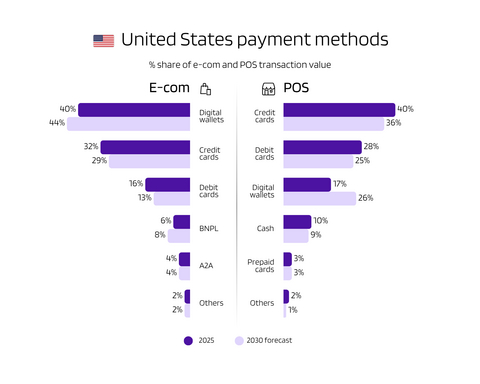
U.S. , direct use of cards accounted for49% of all online spending and71% of in‑store spending in 20251.
-
Globally, direct card usage is strong but accounts for a notably lower share, representing
31% of online and48% of in-store spending in the same year.
-
In APAC, the contrast is even more pronounced with direct use of cards accounting for just
15% of all online spending and20% of all in-store spending in 2025, less than half the global average and far below theU.S. usage.
-
In the
U.S. in 2025, people spent twice as much online using credit cards than debit cards, and in stores, credit card spending outpaced debit by43% .
-
However, direct use of cards in the
U.S. is forecast to fall online from49% in 2025 to43% in 2030, and in-store from71% in 2025 to64% in 2030 as people increasingly use their debit and credit cards via digital wallets.
This card‑first behavior sets the
The Rise of Digital Wallets in the
Even within this card-led landscape, digital wallets continue to gain traction:
-
In 2025, digital wallets accounted for
40% ofU.S. online spending and17% of in‑store spending.
-
Over the next five years (2025-2030), digital wallet spending is forecast to grow
10% annually across online and in-store.
-
By 2030,
$4.1 trillion U.S. spending is projected to take place through a digital wallet, which would represent a64% increase from 2025.
-
Globally, digital wallets already lead, representing
56% of online spending and33% of in-store spending in 2025.
-
In APAC, digital wallets were even more dominant, accounting for
77% of online spending and62% of in-store spending in 2025.
-
Payment apps across channels are forecast to reach
$23.4 trillion
Gen Z Leads in Digital Wallet Adoption
-
Younger consumers are driving much of the shift toward mobile payments in the
U.S. : digital wallets are already the most used online payment method for39% of 18–24-year-olds and41% of 25–34-year-olds.2
-
While younger generations lead the way, online wallet use is increasingly broad-based: wallets were cited as used most frequently by
33% of 35-44-year-olds to lead that demographic. Digital wallets are the go-to choice when shopping online for9% of respondents 65+.
As Gen Z matures, their digital first preferences will likely accelerate the long-term shift from plastic to mobile-first payments in everyday
“While cards still anchor
“The future belongs to businesses that understand how their customers want to pay. As expectations shift toward choice and flexibility, merchants must evolve their payment systems to serve every demographic – and those that do will unlock the next wave of growth.”
To download the full report, visit: https://worldpay.com/en/global-payments-report
Global Payments completed its acquisition of Worldpay in January 2026.
About The Global Payments Report (GPR)
Published continuously since 2015, the GPR offers a snapshot of today’s payments landscape: globally, by region and in 42 select markets. The report tracks consumer payments when shopping online and at the point of sale, identifies key payment trends, and projects future scenarios for payment method shares as well as market size. Methodology can be found on page 156 of the report.
About Global Payments
Global Payments (NYSE: GPN) is a leading payment technology and software company that powers commerce for businesses of all sizes worldwide. We help businesses grow with confidence by delivering innovative solutions that enable seamless payment acceptance, smarter operations and exceptional client experiences – online, in store and everywhere in between. With its global reach, local expertise and scale, Global Payments manages trillions in payments volume and billions of transactions across more than 175 countries. Headquartered in
1 Methodology can be found on page 156 of the report.
2 These generational insights are supported by GlobalData’s 2025 Financial Services Consumer Survey of 63,441 consumers across 42 markets conducted in Q2 2025.
View source version on businesswire.com: https://www.businesswire.com/news/home/20260331165747/en/
Investor Contact:
Nate Rozof
investor.relations@globalpay.com
Media Contact:
Matt
media.relations@globalpay.com
Source: Global Payments Inc.