
GRAIL Presents PATHFINDER 2 Results of More Than 35,000 Participants Showing the Galleri® Test Substantially Increased Cancer Detection With Robust Performance and Favorable Safety at 2026 ASCO Annual Meeting
GRAIL (Nasdaq: GRAL) reported full PATHFINDER 2 results in 35,878 adults 50+ using the Galleri multi-cancer early detection blood test alongside standard screenings.
Rhea-AI Summary
GRAIL (Nasdaq: GRAL) reported full PATHFINDER 2 results in 35,878 adults 50+ using the Galleri multi-cancer early detection blood test alongside standard screenings.
Adding Galleri increased screen-detected cancers up to 6.5-fold, with high specificity, 60.3% positive predictive value, strong episode sensitivity, and low invasive procedure rates.
Positive
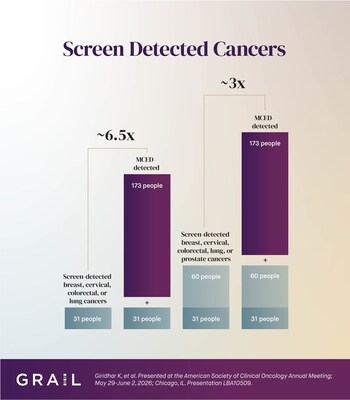
- Galleri increased screen-detected cancers up to 6.5-fold when added to USPSTF A/B screenings
- Galleri detected nearly 3x more cancers when added to A/B/C screenings including prostate
- 60.3% positive predictive value based on 173 cancers in 287 positive tests
- 99.6% specificity, corresponding to a false-positive rate under 0.4%
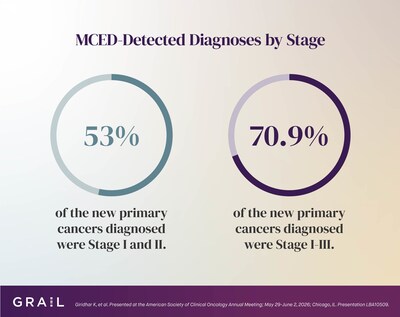
- 53% of new Galleri-detected cancers were stage I-II; 70.9% were stage I-III
- Cancer signal origin correctly identified in 91.3% of cases with a median 48-day diagnostic resolution
Negative
- Episode sensitivity for all cancers was 39.3%, below the 69.8% for 12 highest-mortality cancers
- Median time to diagnostic resolution of 48 days after a positive test
- Study-related adverse events and one serious adverse event occurred during diagnostic work-ups
- Participant anxiety increased temporarily after a positive test and cancer diagnosis
Key Figures
- PATHFINDER 2 cohort size
- 35,878 participants
- Prospective interventional study in adults 50 and older
- Increase in cancer detection
- 6.5 fold
- Added Galleri to recommended screenings for select cancers
- Early-stage detection share
- 53.0%
- New cancers detected by Galleri at stage I or II
- Detected stages I–III
- 70.9%
- New cancers detected by Galleri at stages I–III
- Positive predictive value (PPV)
- 60.3%
- Cancer diagnosis after a positive Galleri test
- Episode sensitivity (12 cancers)
- 69.8%
- Cancers responsible for two-thirds of U.S. cancer deaths
- Specificity
- 99.6%
- Galleri test specificity; false positive rate <0.4%
- Correct CSO identification
- 91.3%
- Accuracy in predicting Cancer Signal Origin (CSO)
Historical Context
-
RSU inducement awards to new hires under Nasdaq Listing Rule 5635(c)(4).
-
Announcement of presentation at Goldman Sachs 47th Annual Global Healthcare Conference.
-
Jefferies Global Healthcare Conference presentation scheduling and webcast availability.
-
Q1 2026 revenue growth, Galleri volume increase, PMA review, and ASCO data plans.
-
Planned presentation at BofA Securities 2026 Health Care Conference.
24h Move is the share-price change in the day after each event; other market factors may also have contributed.
Key Terms
multi-cancer early detection medical
mced medical
positive predictive value medical
specificity medical
false positive rate medical
cancer signal origin medical
invasive procedure medical
AI-generated analysis. How Rhea-AI works. Not financial advice.




The Galleri Multi-Cancer Early Detection (MCED) Test Increased Cancer Detection 6.5 Fold When Added to Recommended Screenings for Breast, Colorectal, Cervical and Lung Cancer
The PATHFINDER 2 study evaluated the safety and performance of the Galleri® multi-cancer early detection (MCED) test when used alongside standard-of-care cancer screenings in the
"Cancer outcomes depend not only on better treatments, but on finding cancer before it advances and spreads. Earlier detection can open the door to more treatment options at any stage and increase the chance for cure," said Josh Ofman, MD, MSHS, President and CEO-Elect at GRAIL. "These PATHFINDER 2 results add to the growing body of clinical evidence in a large, representative intended-use population showing that the Galleri test can meaningfully increase cancer detection beyond recommended screening with strong performance and a highly favorable safety profile. Along with the NHS-Galleri trial results, these findings reinforce the clinical benefit of Galleri and its potential to transform early cancer detection at population scale."
Galleri Increases the Number of Cancers Detected and Can Detect Them Early
While effective screening improves early cancer detection, in the
More than half (
"PATHFINDER 2 provides important additional data on the performance and safety of MCED testing," said Karthik Giridhar, M.D., assistant professor of oncology at Mayo Clinic and a principal investigator on the PATHFINDER 2 study. "MCED tests are not a replacement for existing screening, but they have the potential to complement current approaches by helping detect cancer signals across multiple cancer types, including some for which routine screening is not currently available."
Robust Performance Metrics Consistent with Previous Studies
The Galleri test detected a cancer signal in 287 participants, and of those, cancer was diagnosed in 173 participants. The likelihood of receiving a cancer diagnosis following a positive test result (positive predictive value or PPV) was
Since PATHFINDER 2 is a prospective clinical trial where the cancer status of participants is unknown at the outset, episode sensitivity – the ability to detect cancer that could be confirmed within 12 months after the blood draw – is evaluated in the study. Galleri demonstrated strong performance, with
Specificity was
"The up to 6.5 fold improvement in screen-detected cancers with Galleri in PATHFINDER 2 study, coupled with the greater than
Galleri Pinpoints Cancer Signal Origin Allowing Efficient Diagnostic Workups
A key benefit of the Galleri test is its ability to predict where in the body the cancer signal is coming from. The PATHFINDER 2 study demonstrated that the test correctly identified the Cancer Signal Origin (CSO)
Screening with the Galleri test had a favorable safety profile, with a low false-positive rate and a low rate of invasive procedures. There were five study-related adverse events reported during diagnostic evaluation, only in those with cancer diagnosis. Anxiety temporarily increased for participants with a positive MCED test and subsequent cancer diagnosis, and returned to baseline by 12 months, as has been observed for other screening tests. One serious adverse event related to the diagnostic work-up was identified after the data lock. Follow-up is ongoing; this and any other findings after data lock will be reported in full in the next interim analysis.
About PATHFINDER 2 (NCT05155605)
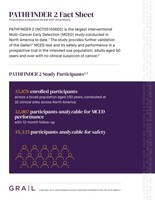
PATHFINDER 2 is a prospective, multi-center, interventional study evaluating the safety and performance of Galleri in approximately 35,000 individuals aged 50 years and older who are eligible for guideline-recommended cancer screening in
About GRAIL
GRAIL is a healthcare company whose mission is to detect cancer early, when it can be cured. GRAIL is focused on alleviating the global burden of cancer by using the power of next-generation sequencing, population-scale clinical studies, and state-of-the-art machine learning, software, and automation to detect and identify multiple deadly cancer types in earlier stages. GRAIL's targeted methylation-based platform can support the continuum of care for screening and precision oncology, including multi-cancer early detection in symptomatic patients, risk stratification, minimal residual disease detection, biomarker subtyping, treatment and recurrence monitoring. GRAIL is headquartered in
For more information, visit grail.com.
About Galleri®
The Galleri® multi-cancer early detection (MCED) test screens for more than 50 cancer types, including many deadly cancers that currently lack screening options, such as pancreatic, ovarian and liver/bile duct cancers[3]. The Galleri test is the only MCED test clinically proven through a randomized controlled trial to increase earlier cancer detection (Stage I-III) and reduce Stage IV diagnoses - enabling more patients to have curative treatment[4]. When added to standard-of-care screening, the Galleri test reduced Stage IV diagnosis by more than
For more information, visit galleri.com.
*A statistically significant reduction was not observed in combined stage III–IV diagnoses across three screening rounds for the 12 deadly cancers.
**Test performance metrics do not represent results of a head-to-head comparative study. Separate studies have different designs, objectives, and participant populations, which limits the ability to draw conclusions about comparative performance.
Important Galleri Safety Information
The Galleri test is recommended for use in adults with an elevated risk for cancer, such as those age 50 or older. The test does not detect all cancers and should be used in addition to routine cancer screening tests recommended by a healthcare provider. The Galleri test is intended to detect cancer signals and predict where in the body the cancer signal is located. Use of the test is not recommended in individuals who are pregnant, 21 years old or younger, or undergoing active cancer treatment. Results should be interpreted by a healthcare provider in the context of medical history, clinical signs, and symptoms. A test result of No Cancer Signal Detected does not rule out cancer. A test result of Cancer Signal Detected requires confirmatory diagnostic evaluation by medically established procedures (e.g., imaging) to confirm cancer. If cancer is not confirmed with further testing, it could mean that cancer is not present or testing was insufficient to detect cancer, including due to the cancer being located in a different part of the body. False positive (a cancer signal detected when cancer is not present) and false negative (a cancer signal not detected when cancer is present) test results do occur. Rx only.
Laboratory/Test Information
The GRAIL clinical laboratory is certified under the Clinical Laboratory Improvement Amendments of 1988 (CLIA) and accredited by the College of American Pathologists. The Galleri test was developed — and its performance characteristics were determined — by GRAIL. The Galleri test has not been cleared or approved by the Food and Drug Administration. The GRAIL clinical laboratory is regulated under CLIA to perform high-complexity testing. The Galleri test is intended for clinical purposes.
GRAIL Forward Looking Statements
This press release contains forward-looking statements. In some cases, you can identify these statements by forward-looking words such as "aim," "anticipate," "believe," "continue," "could," "estimate," "expect," "intend," "may," "might," "plan," "potential," "predict," "should," "would," or "will," the negative of these terms, and other comparable terminology. These forward-looking statements, which are subject to risks, uncertainties, and assumptions about us, may include statements related to the potential benefits, uses and impacts of the Galleri test, extrapolation of trends in the results, comparability of the results to a real world setting, benefits of population screening with Galleri, the applicability of the PATHFINDER 2 results to the commercial or FDA versions of the Galleri test, and plans to submit the results for publication, among others.
These statements are only predictions based on our current expectations and projections about future events and trends. There are important factors that could cause our actual results, level of activity, performance, or achievements to differ materially and adversely from those expressed or implied by the forward-looking statements, including those factors and numerous associated risks discussed under the section entitled "Risk Factors" in our Annual Report on Form 10-K for the period ended December 31, 2025. Moreover, we operate in a dynamic and rapidly changing environment. New risks emerge from time to time. It is not possible for our management to predict all risks, nor can we assess the impact of all factors on our business or the extent to which any factor, or combination of factors, may cause actual results, level of activity, performance, or achievements to differ materially and adversely from those contained in any forward-looking statements we may make.
Forward-looking statements relate to the future and, accordingly, are subject to inherent uncertainties, risks, and changes in circumstances that are difficult to predict and many of which are outside of our control. Although we believe the expectations and projections expressed or implied by the forward-looking statements are reasonable, we cannot guarantee future results, level of activity, performance, or achievements. Our actual results, financial condition and success in our business strategies and operations may differ materially from those indicated in the forward-looking statements. Except to the extent required by law, we undertake no obligation to update any of these forward-looking statements after the date of this press release to conform our prior statements to actual results or revised expectations or to reflect new information or the occurrence of unanticipated events.
[1] Giridhar K, et al. Safety and Performance Results From PATHFINDER 2 (PF2), a Registrational Study of a Multi-Cancer Early Detection (MCED) Test in an Intended-Use Population [presentation]. American Society of Clinical Oncology (ASCO) Annual Meeting; 2026 May 29-June 2
[2] NORC at the University of Chicago. Percent of cancers detected by screening in the U.S. https://cancerdetection.norc.org/ (2022).
[3] Klein EA, Richards D, Cohn A, et al. Clinical validation of a targeted methylation-based multi-cancer early detection test using an independent validation set. Ann Oncol. 2021 Sep;32(9):1167-77. doi: 10.1016/j.annonc.2021.05.806
[4] Swanton C. NHS-Galleri: Primary Results From a Randomised Controlled Trial to Assess the Clinical Utility of a Multi-Cancer Early Detection (MCED) Test in Population Screening [presentation]. American Society of Clinical Oncology (ASCO) Annual Meeting; 2026 May 29-June 2.
[5] GRAIL, Inc. False positive rate. [Data on file: GR-2025-0256]

 View original content to download multimedia:https://www.prnewswire.com/news-releases/grail-presents-pathfinder-2-results-of-more-than-35-000-participants-showing-the-galleri-test-substantially-increased-cancer-detection-with-robust-performance-and-favorable-safety-at-2026-asco-annual-meeting-302786352.html
SOURCE GRAIL, Inc.
FAQ
AI-generated questions and answers. How Rhea-AI works. Not financial advice.