
Honey Badger Silver Confirms Silver-Bearing Massive Pyrite and Reports Over 500 PPM Germanium at Nanisivik Mine, Nunavut
Selective samples support further exploration, but do not establish the grade or extent of mineralization in place.
Sentiment and the balance of points
Rhea-AI Sentiment reads the wording of the document, how positive or negative its language is on a 1 to 5 scale. The balance of points shown with the takes weighs what the document actually discloses, so the two can disagree, for example when a trial that missed its main goal is described in upbeat language.
Rhea-AI Summary
Honey Badger Silver (HBEIF) reported preliminary exploration results confirming silver-bearing massive pyrite and germanium at its wholly owned Nanisivik Project in Nunavut. Float sample E17589 returned greater than 500 ppm germanium, exceeding the method’s reporting limit, alongside 54.6% zinc, 5.3% lead and 178 g/t silver. Four massive-pyrite float samples returned 0.55–45.3 g/t silver.
The program collected 18 selective rock samples, predominantly loose material that may have moved from its source. Results do not establish average grades or mineralization continuity. A historical estimate of 50–100 million tonnes of massive pyrite has uncertain reliability and is not a current mineral resource. Additional germanium and over-limit sulphur and iron analyses are pending. The company is compiling historical drilling and building a geological model to guide future drilling; an economic evaluation of pyrite extraction is contemplated.
Positive
- Minor pointSample E17589 returned greater than 500 ppm germanium, with 54.6% zinc, 5.3% lead and 178 g/t silver.
- Minor pointSample E17590 returned 38 ppm germanium, with 56.4% lead, 7.1% zinc and 48.5 g/t silver.
- Minor pointFour massive-pyrite float samples returned 0.55–45.3 g/t silver; two exceeded 10 g/t.
- Minor pointHistorical drill-data compilation and 3D geological modelling are underway to guide further exploration.
- Minor point. Forward-looking: it has not happened yet and may not happen.The company plans future drilling design for pyrite testing, systematic germanium analysis and preliminary metallurgical testing.
- Minor point. Forward-looking: it has not happened yet and may not happen.An economic evaluation of pyrite extraction is contemplated.
Negative
- Minor pointThe 18 selective samples, predominantly float, do not establish average grades or mineralization extent and continuity.
- Minor pointThe historical 50–100 million-tonne pyrite estimate has uncertain reliability and is not a current mineral resource.
- Minor pointAdditional germanium and over-limit sulphur and iron analyses remain pending.
News Explained
All 18 samples were collected in and around known mineralized zones, former mine workings and historic mine waste; the company says they reflect previously known mineralization, not new occurrences.
AI-generated analysis. How Rhea-AI works. Not financial advice.


Toronto, Ontario--(Newsfile Corp. - November 5, 2026) - Honey Badger Silver Inc. (TSXV: TUF) (OTCQB: HBEIF) (FSE: 1QA) (Tradegate: 1QA) ("Honey Badger Silver" or the "Company") is pleased to report assay results from its 2026 field exploration program at its
The program was designed to test two concepts:
1) That the extensive massive pyrite system at Nanisivik contains silver and,
2) That germanium is present in the zinc-lead-silver mineralization.
The assay results confirm both of these concepts. Chad Williams, Executive Chairman and Interim CEO, commented:
"Nanisivik is known as a high-grade, former zinc-silver producing mine, but two significant things about it have been largely overlooked: the value of the massive pyrite surrounding it, and the germanium potential in its zinc mineralization. We staked Nanisivik several years ago based on the thesis that the massive pyrite zones could contain silver. The results disclosed today, albeit very preliminary, are an important step towards confirming this thesis. There were anecdotal reports that germanium was present in the zinc concentrates produced historically. Today's results, also preliminary, now indicate that this is likely. With germanium and sulphur both under supply pressure, we believe Nanisivik offers a rare combination: a past-producing silver-zinc district with critical-mineral and sulphur upside. Nanisivik is a very attractive asset."
Key Highlights:
Germanium potential identified: A zinc-rich sample returned greater than 500 ppm germanium, the upper reporting limit of the analytical method used, together with
54.6% zinc,5.3% lead and 178 g/t silver. Re-assaying of the germanium content of the remaining samples is now being done using another process that is specially designed for measuring the metal. Results are pending.Silver-bearing pyrite confirmed: Selective massive pyrite samples returned up to 45.3 g/t silver, indicating potential added value of the large existing massive pyrite system. The samples returned high (some over-limit) sulphur grades as well, which is positive. Historical technical publications have described an extensive massive pyrite system at Nanisivik, including a historical estimate of 50-100 million tonnes2. While this estimate is not compliant with current NI 43-101 standards and is not being treated as a mineral resource, the scale described in historical records provides a compelling rationale for further investigation of potential silver and sulphur mineralization.
Established mining district: Nanisivik operated between 1976 and 2002 and produced approximately 20.1 million ounces of silver and 3.55 billion pounds of zinc, with extensive historical geological and drilling data available to support future exploration.
Additional critical minerals exposure: Germanium is a strategically important mineral with applications in fibre optics, infrared imaging, semiconductor applications and other advanced technologies, representing a potential new exploration opportunity at the project.
Defined next steps: Honey Badger Silver is compiling historical drilling and developing a comprehensive geological model to guide future exploration, with additional assay results pending. An economic evaluation of pyrite extraction is contemplated.
The 2026 program consisted of 18 selective rock samples, predominantly float samples. Results are not representative of average grades and do not establish the extent or continuity of mineralization.
GERMANIUM IN THE ZINC-LEAD-SILVER MINERALIZATION
Germanium is understood to be hosted in sphalerite at Nanisivik, and historical work reports that the sphalerite carries germanium that was not credited by smelters.³ Germanium was not systematically assayed while the mine operated. The 2026 program is the Company's first modern test for it.
Float sample E17589, collected in a road cut near the West Open Pit and the north end of the South Pyrite Zone, returned greater than 500 ppm Ge by germanium-specific mixed-acid digestion with ICP-MS finish. This is the upper reporting limit of the method, thus the true germanium content is higher than 500 ppm. The sample also returned
The results importantly show that germanium is present in the Nanisivik zinc-lead-silver system, locally at high concentrations. Two float samples do not establish germanium grades or distribution, which will need systematic analysis of sphalerite-bearing drill core and outcrop.
MASSIVE PYRITE: SILVER CONFIRMED IN NEW SAMPLES
The 2026 program collected four float samples described in the field as massive pyrite, two from the north end of the South Pyrite Zone and two from the South Boundary Zone. Silver ranged from 0.55 to 45.3 g/t Ag, with two of the four above 10 g/t Ag. The two highest values came from pyrite-dominant samples with very little zinc or lead:
Sample #E17695 (South Pyrite, north end): 45.3 g/t Ag,
Sample #E17597 (South Boundary Zone, near historic hole 81-2): 29.3 g/t Ag,
The iron and sulphur data available so far support the field descriptions. All four exceeded the
Historical work describes extensive massive pyrite at Nanisivik, including the South Boundary and North Pyrite zones.² These results are the Company's first modern assays showing that this pyrite can carry silver. The samples are selective float and do not indicate the grade, thickness or extent of any pyrite body.
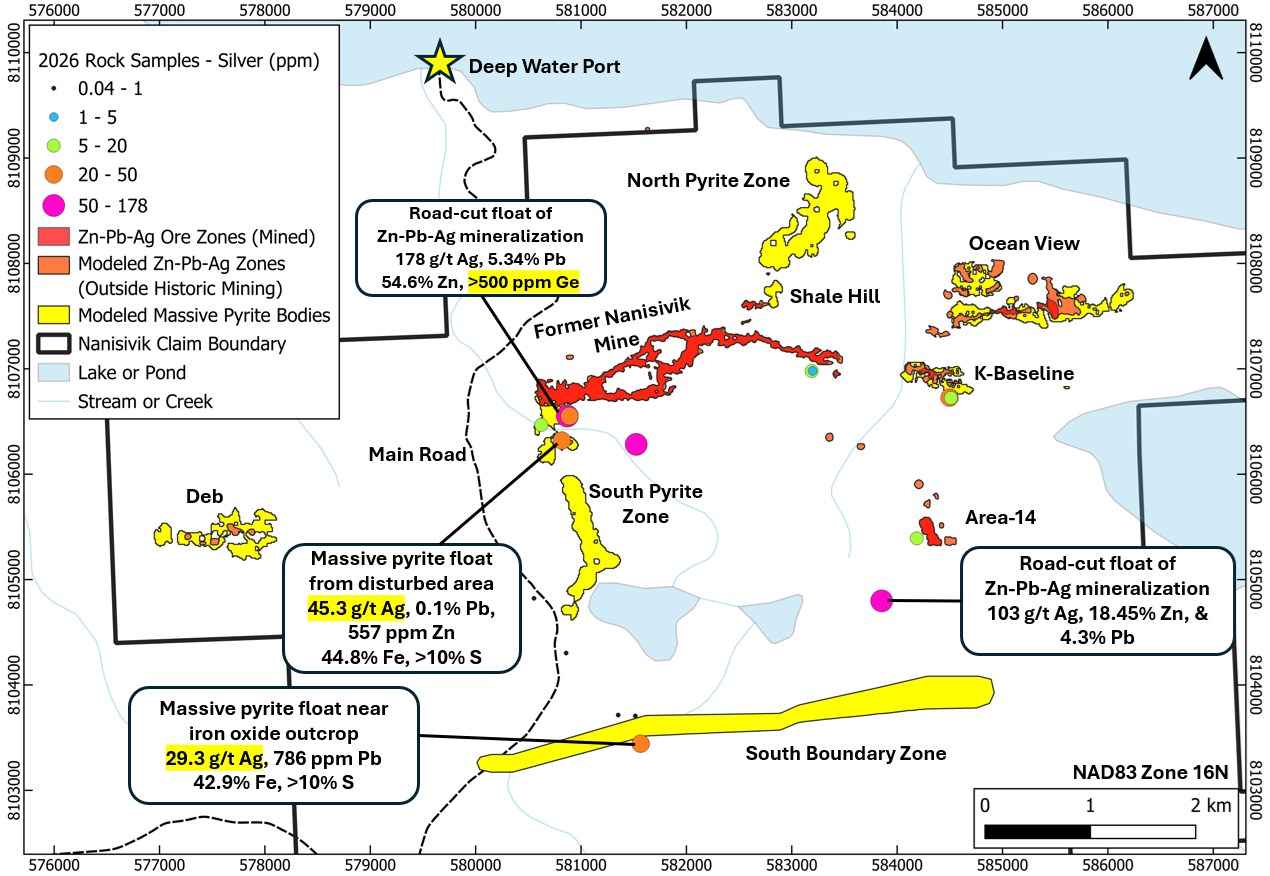
Figure 1. Nanisivik Project 2026 rock sample locations and silver results, with modelled massive pyrite bodies and zinc-lead-silver zones. Zinc-lead-silver zones are shown as historically mined, or as modelled and outside historically mined areas. Modelled outlines are the Company's interpretation of historic drilling and are not mineral resources. Samples are selective grab and float samples and may not represent average grades.
To view an enhanced version of this graphic, please visit:
https://images.newsfilecorp.com/files/3204/322774_68d2961ff4d818b7_001full.jpg
2026 PROGRAM SUMMARY
APEX Geoscience Ltd. ("APEX") completed the 2026 Nanisivik field program on behalf of the Company in August 2026, collecting 18 rock samples over a four-day period. Fourteen are float, three are outcrop and one is weathered, iron-rich carbonate material from a slope below the K-Baseline area that was analysed with the rock samples. Float is loose material that may have moved from its source, so these samples indicate the types of mineralization present but not their location, grade or extent in place. All samples were collected in and around known mineralized zones, former mine workings and historic mine waste, and reflect previously known mineralization rather than new occurrences. Grab samples are selective by nature and the values reported may not represent average grades of mineralization on the property.
Across all 18 rock samples, results ranged from 0.04 to 178 g/t Ag, below
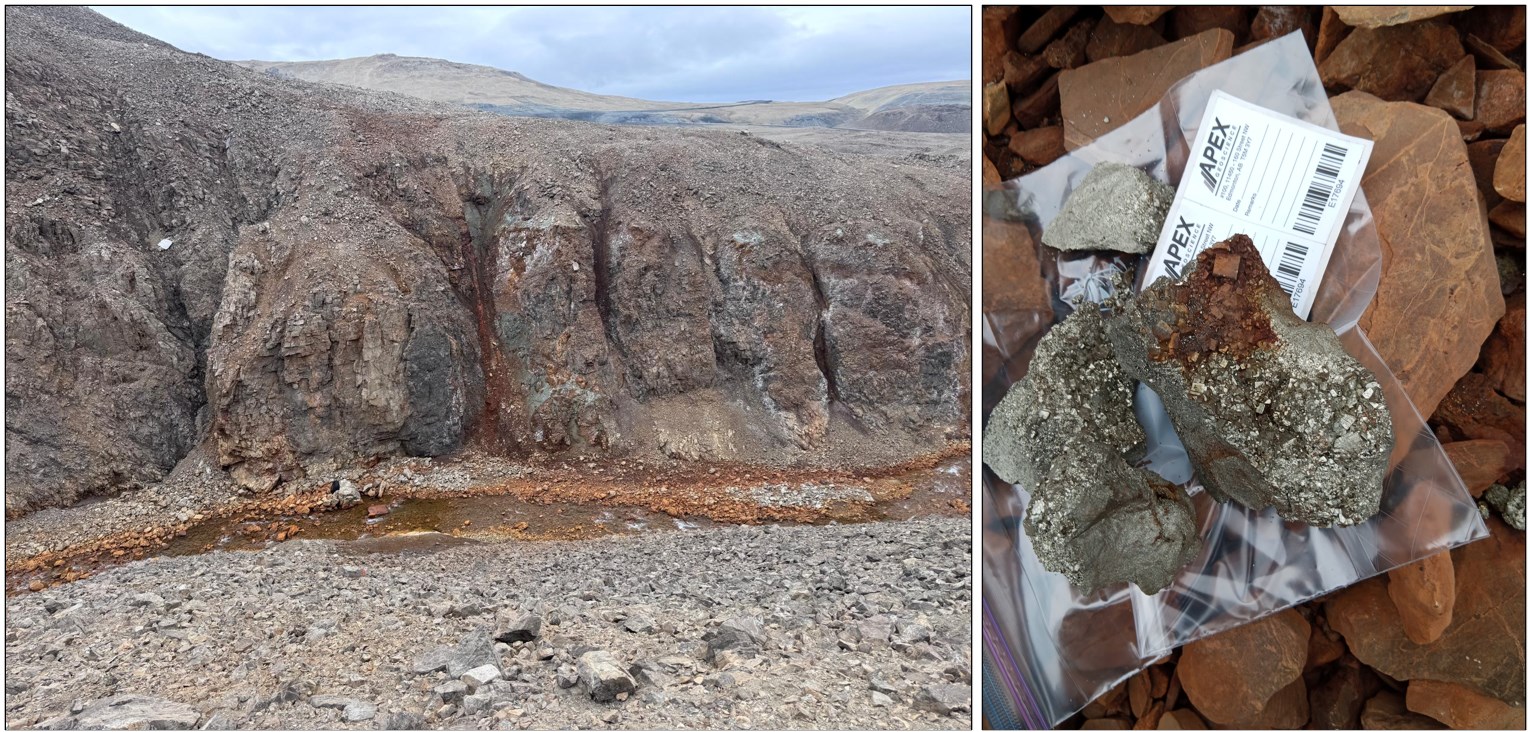
Figure 2. Photographs from the 2026 field program at Nanisivik where the crew located massive pyrite (E17694 - right image) in float material interpreted to have come from overlying gossanous outcrop (left image). This sample returned 6.5 g/t silver,
To view an enhanced version of this graphic, please visit:
https://images.newsfilecorp.com/files/3204/322774_68d2961ff4d818b7_002full.jpg
NEXT STEPS
The Company is advancing Nanisivik on several fronts:
- Pending analyses: germanium analyses of the remaining 2026 samples by Ge-MS66, and over-limit sulphur and iron analyses, are in progress. Results will be reported when received.
- Historic data evaluation: Compiling, validating and digitizing the historic Nanisivik surface and underground drill database, including drill logs that record massive pyrite intervals, historic silver assays and mine survey records.
- Geological modelling: Building a 3D geological model of the massive pyrite zones and the zinc-lead-silver mineralization, integrating historic drilling, mine workings, geophysics and the 2026 results.
- Drill program planning: Using the model to evaluate and design future drill programs to test the extent, thickness, sulphur content and silver grade of the massive pyrite zones, and to obtain fresh sphalerite-bearing material for systematic germanium analysis and preliminary metallurgical testing.
ABOUT NANISIVIK
The Nanisivik Project is located on northern Baffin Island, Nunavut, near the community of Arctic Bay and encompasses the area surrounding the former Nanisivik Mine. The mine operated from 1976 to 2002 and produced approximately 17.9 million tonnes of ore grading approximately
In addition to the mineralization that was mined, historical publications describing mining operations at Nanisivik indicate the presence of extensive massive pyrite mineralization within the South Boundary Zone and North Pyrite Zone (Figure 1).2 McNeil et al. (1993) reported a historical, non-compliant estimate ranging from 50 to 100 million tonnes of massive pyrite.2 The Company considers the estimate to be relevant as it highlights the potential for a large pyrite-bearing system at Nanisivik and supports the exploration rationale for evaluating the sulphur potential of the property. While the estimate was reported by authors familiar with mine operations and regional geology at the time, the reliability of the estimate is uncertain because the publication does not disclose sufficient information regarding the estimation methodology, assumptions, classification criteria, or supporting data necessary to evaluate the estimate under current CIM standards or NI 43-101 requirements. Verification and potential upgrading of the historical estimate would likely require review of available historical geological, sampling and drilling data, together with confirmatory drilling and sampling to validate the extent and continuity of the pyrite mineralization. A Qualified Person has not completed sufficient work to classify these historical figures as current mineral resources or mineral reserves, and the Company is not treating them as such.
QAQC
Eighteen rock samples (E17589 to E17600 and E17690 to E17695) were delivered to the ALS Canada Ltd. ("ALS") preparation laboratory in Yellowknife, Northwest Territories. Sulphur and iron over-limit analyses and Ge-MS66 analyses of the remaining samples are pending.
Samples were logged, weighed, fully crushed, riffle split and pulverized, with crush and pulverize size checks monitored under ALS's CRU-QC and PUL-QC programs. Pulps were shipped to ALS Vancouver for analysis. Gold was determined by 30 g fire assay with ICP-AES finish (Au-ICP21), and a 48-element suite by four-acid digestion with ICP-AES/ICP-MS finish (ME-MS61).
Samples above the ME-MS61 upper limits for silver, zinc or lead were re-analysed by ore-grade four-acid digestion (Ag-OG62, Zn-OG62 and Pb-OG62). Samples above the ore-grade limits were analysed by titration: E17589 for zinc (Zn-VOL50) and E17590 for lead (Pb-VOL70). Because germanium can be lost during four-acid digestion, pulps of E17589 and E17590 were retrieved (FND-02) and analysed for germanium by mixed-acid digestion with ICP-MS finish (Ge-MS66) at ALS Brisbane, Australia. Ge-MS66 has an upper reporting limit of 500 ppm Ge, which E17589 exceeded. Samples above the
For statistical purposes, values below detection were set to half the detection limit; over-limit values were re-assayed by the ore-grade methods above. ALS Vancouver is accredited to ISO/IEC 17025:2017 (SCC file 15722), with ME-MS61 and the OG62 methods within scope. ALS Brisbane is accredited to ISO/IEC 17025:2017 by the National Association of Testing Authorities, Australia (NATA accreditation no. 825). ALS is independent of the Company and of APEX.
No certified reference materials (CRMs), blanks or field duplicates were inserted into the sample sequence. Quality control for this work order relied on ALS's internal program.
Historical Information
(1) Dewing, K., Turner, E., and Harrison, J.C. (2007). Geological history, mineral occurrences and mineral potential of the sedimentary rocks of the Canadian Arctic Archipelago. In: Goodfellow, W.D. (ed.), Mineral Deposits of Canada: A Synthesis of Major Deposit-Types, District Metallogeny, the Evolution of Geological Provinces, and Exploration Methods. Geological Association of Canada, Mineral Deposits Division, Special Publication No. 5, p. 733-753.
(2) McNeil, W.H., Rawling, K.R. and Sutherland, R.A. (1993). Nanisivik Mine - Operations and Innovations in an Arctic Environment. Proceedings of World Zinc '93, pp. 41-52.
(3) Sutherland, R.A. and Dumka, D., (1995). Geology of Nanisivik Mine, N.W.T., Canada. In: Misra, K.C. (ed.), Carbonate-Hosted Lead-Zinc-Fluorite-Barite Deposits of North America. Society of Economic Geologists, Guidebook Series, Vol. 22, p. 4-12.
Neither the TSX Venture Exchange nor its Regulation Services Provider (as that term is defined in the policies of the TSX Venture Exchange) accepts responsibility for the adequacy or accuracy of this release.
Qualified Person
The scientific and technical information in this news release has been reviewed and approved by Andrew Jedemann, M.Sc., P.Geo., Vice President Exploration of the Company and a "qualified person" as defined in National Instrument 43-101.
Mr. Jedemann verified the data disclosed in this news release. He reviewed the sample locations, descriptions and sampling procedures provided by APEX Geoscience Ltd. He checked the reported assay values against the original ALS certificates, and he reviewed the analytical methods and ALS's internal quality control results. Because the Company did not insert field CRMs, blanks or duplicates, verification of analytical accuracy and precision relied on ALS's internal QC program. Based on this review, Mr. Jedemann considers the data adequate for the purposes of this news release.
This news release does not constitute an offer to sell or a solicitation of an offer to buy, nor shall there be any sale of any of the securities in any jurisdiction in which such offer, solicitation or sale would be unlawful, including any of the securities in the United States of America. The securities have not been and will not be registered under the United States Securities Act of 1933, as amended (the "1933 Act") or any state securities laws, and may not be offered or sold within the United States or to, or for account or benefit of, U.S. Persons (as defined in Regulation S under the 1933 Act) unless registered under the 1933 Act and applicable state securities laws, or an exemption from such registration requirements is available.
About Honey Badger Silver (TSXV: TUF) (OTCQB: HBEIF) (FSE: 1QA) (Tradegate: 1QA)
Honey Badger Silver is a North American silver company. The Company's flagship is the fully permitted, high-grade PC Silver Mine (Prairie Creek) in the Northwest Territories. Honey Badger Silver also holds a portfolio of silver and critical minerals projects across the Northwest Territories, Yukon and Nunavut, including the Sunrise Lake, Plata, Yava and Nanisivik properties, providing district-scale exposure in metal-rich Canadian jurisdictions.
What sets Honey Badger Silver apart is its strategic blend of real silver ownership and growth leverage: the Company holds over 10,800 ounces of physical silver yielding
Led by a proven team of mine-builders and capital markets professionals, Honey Badger Silver is building a cash-generating, asset-backed platform for the bull cycle in precious and critical minerals.
More information is available at www.honeybadgersilver.com
Chad Williams
Executive Chairman, Interim CEO
Investor Relations
investors@honeybadgersilver.com | +1 (647) 226-7315
Cautionary Note Regarding Forward-Looking Information
This news release contains "forward-looking information" within the meaning of applicable Canadian securities legislation that is based on expectations, estimates, projections and interpretations as at the date of this news release, including, without limitation, Honey Badger Silver's strategic objectives and the potential of the Company's mineral projects. Any statement that involves discussions with respect to predictions, expectations, interpretations, beliefs, plans, projections, objectives, assumptions, future events or performance (often but not always using phrases such as "expects", or "does not expect", "is expected", "interpreted", "management's view", "anticipates" or "does not anticipate", "plans", "budget", "scheduled", "forecasts", "estimates", "believes" or "intends" or variations of such words and phrases or stating that certain actions, events or results "may" or "could", "would", "might" or "will" be taken to occur or be achieved) are not statements of historical fact and may be forward-looking information and are intended to identify forward-looking information. This forward-looking information is based on reasonable assumptions and estimates of management of the Company at the time such assumptions and estimates were made, and involves known and unknown risks, uncertainties and other factors which may cause the actual results, performance or achievements of Honey Badger Silver to be materially different from any future results, performance or achievements expressed or implied by such forward-looking information.
Such factors include, but are not limited to, risks relating to capital and operating costs varying significantly from estimates; delays in obtaining or failures to obtain required governmental, environmental or other project approvals; uncertainties relating to the availability and costs of financing needed in the future; changes in equity markets; inflation; fluctuations in commodity prices; delays in the development of projects; other risks involved in the mineral exploration and development industry; and those risks set out in the Company's public documents filed on SEDAR+ under Honey Badger Silver's issuer profile. Although the Company believes that the assumptions and factors used in preparing the forward-looking information in this news release are reasonable, undue reliance should not be placed on such information, which only applies as of the date of this news release, and no assurance can be given that such events will occur in the disclosed timeframes or at all. The Company disclaims any intention or obligation to update or revise any forward-looking information, whether as a result of new information, future events or otherwise, other than as required by law.
To view the source version of this press release, please visit https://www.newsfilecorp.com/release/322774
FAQ
AI-generated questions and answers. How Rhea-AI works. Not financial advice.
What germanium results did Honey Badger Silver report at Nanisivik?
Float sample E17589 returned greater than 500 ppm germanium, above the analytical method’s reporting limit, while E17590 returned 38 ppm. These two float samples do not establish germanium grades or distribution across the project; systematic analysis of mineralized drill core and outcrop is needed.
What did Honey Badger Silver’s Nanisivik massive-pyrite samples show?
Four selective massive-pyrite float samples returned 0.55 to 45.3 g/t silver, with two above 10 g/t. The samples do not establish the grade, thickness or extent of any pyrite body.
Why is Honey Badger Silver using a separate germanium analysis method at Nanisivik?
Germanium can be lost during four-acid digestion, so samples E17589 and E17590 were tested using germanium-specific mixed-acid digestion with an instrument-based measurement. That method has an upper reporting limit of 500 ppm, which E17589 exceeded. The remaining samples have also been submitted for germanium-specific analysis.