
Hesai Leads Global Robotaxi Lidar Market with 62% Share as Robotaxi Industry Moves Toward Scale, Yole Group Reports
Cumulative lidar deliveries surpassed 3.5 million units as Hesai advances a Bangkok factory expected to begin production in 2027.
Sentiment and the balance of points
Rhea-AI Sentiment reads the wording of the document, how positive or negative its language is on a 1 to 5 scale. The balance of points shown with the takes weighs what the document actually discloses, so the two can disagree, for example when a trial that missed its main goal is described in upbeat language.
Rhea-AI Summary
Hesai Group (HSAI) announced that Yole Group ranked it the largest global robotaxi lidar supplier, with a 62% market share. The share covers 2025, compared with 61% in Yole's previous report. Lidar uses light to measure distances for vehicle perception.
Hesai's upgraded ETX platform is undergoing customer validation and has reached information and quotation discussions with robotaxi operators and global automakers. Cumulative lidar deliveries surpassed 3.5 million units as of June 2026. Hesai is advancing construction of a Bangkok manufacturing facility, with production expected to begin in 2027. Its in-house production lines produce one lidar unit every eight seconds, with 100% automation across core processes.
How this balance works
Rhea-AI gives every point it takes from this document a weight. Minor counts 1, Moderate 3 and Major 9, so one Major point outweighs several Minor ones. The bar adds up the weights on each side, and when neither side holds more than 65% of the total the balance reads Mixed.
It reads the document as published, with the same rules for every company, and it does not look at what the market expected or at how the stock traded, so a point can be objectively good on a day the stock falls.
Rhea-AI Sentiment measures something else, the tone of the wording.
Hollow bars mark forward-looking points. How the balance works
Positive
- Moderate pointRobotaxi lidar market share reached 62% in 2025, versus 61% in Yole's previous report.
- Minor pointCumulative lidar deliveries surpassed 3.5 million units as of June 2026.
- Minor point. Forward-looking: it has not happened yet and may not happen.Bangkok manufacturing facility construction is advancing, with production expected to commence in 2027.
- Minor pointIn-house production lines deliver one lidar every eight seconds, with 100% automation across core processes.
Negative
- Minor pointUpgraded ETX remains under customer validation, with information and quotation discussions underway.
Key Figures
- Robotaxi lidar market share
- 62%
- Global market in 2025, according to Yole Group
- Prior robotaxi lidar market share
- 61%
- Yole Group's previous report
- Global robotaxi fleet projection
- Approximately 10,000 to 331,000 vehicles
- 2025 to 2031, Yole Group projection
- ETX configurations
- Up to 4,320 channels
- Upgraded ETX lidar platform
- ETX maximum detection range
- Up to 600 meters
- Upgraded ETX lidar platform
- Cumulative lidar deliveries
- More than 3.5 million units
- As of June 2026
- Manufacturing automation
- 100%
- Across core processes on in-house production lines
- Production cadence
- One lidar unit every 8 seconds
- Current in-house production lines
Key Terms
lidar technical
time-of-flight technical
point cloud technical
rfi technical
rfq technical
AI-generated analysis. How Rhea-AI works. Not financial advice.


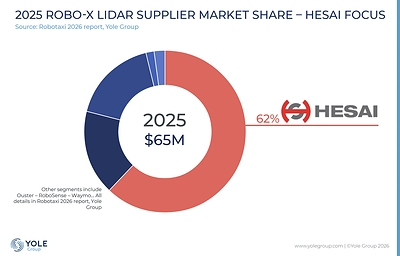
According to the Yole report, Hesai's lidar has been selected for leading Level 4 robotaxis and autonomous vehicles programs worldwide, including Baidu Apollo Go, Pony.ai, WeRide, DiDi, Motional, Aurora and KargoBot. The breadth of these deployments reflects the growing adoption of lidar across multiple robotaxi platforms and operating environments, rather than reliance on a single customer or program.
This year's report examines robotaxis and their enabling technologies in a dedicated study. Yole Group projects that the global robotaxi fleet will grow from approximately 10,000 vehicles in 2025 to 331,000 in 2031. As operators expand their fleets, they will need lidar that delivers precise perception in complex environments, consistent automotive-grade quality and reliable supply at scale.
"We are proud to be named the Robotaxi lidar leader in Yole Group's Robotaxi 2026 report," said Dr. Yifan "David" Li, Hesai's Co-Founder and CEO. "Robotaxis are moving into an important next phase, with operators increasingly focused on scaling deployment and delivering reliable autonomous mobility in real-world environments, and that raises the bar for every component on the vehicle. Operators need perception they can rely on across more vehicles, more roads and more hours of operation. Our continued market leadership reflects the trust we have earned through years of close collaboration with robotaxi developers, and our ability to deliver at scale."
As the robotaxi market expands, Hesai is also advancing its next-generation lidar platform for the next phase of autonomous driving. At the center of this effort is an upgraded ETX, Hesai's flagship lidar platform for Level 3 and higher autonomous driving. Powered by Hesai's proprietary Picasso SPAD-SoC, the next-generation ETX combines RGB sensing and time-of-flight ranging at the chip level, enabling it to capture both the geometry and color of its surroundings in a precisely aligned point cloud. With configurations of up to 4,320 channels and a maximum detection range of up to 600 meters, ETX is designed to give systems a more detailed view of distant objects and complex driving scenes. The Picasso-equipped ETX is undergoing customer validation and has progressed to RFI and RFQ discussions with leading robotaxi operators and global automakers, providing a pathway toward the next generation of high-performance perception systems.
Hesai is also scaling its manufacturing capabilities to support the anticipated growth in autonomous mobility. As of June 2026, the Company's cumulative lidar deliveries had surpassed 3.5 million units. Hesai is advancing construction of a new manufacturing facility in
About Hesai
Hesai Technology (Nasdaq: HSAI; HKEX: 2525) is a Physical AI infrastructure company. With a product portfolio spanning lidar, Kosmo spatial intelligence platform, and robotic actuation modules, Hesai is the only company in the industry covering the full robotics chain of "see, understand, and act" while achieving commercialization at scale. Leveraging full-stack proprietary ASIC capabilities and an integrated R&D-manufacturing approach, Hesai has established industry-leading positions across core physical AI domains, including autonomous mobility, spatial intelligence, embodied AI, and commercial robots, and holds a leading share of the global lidar market. Hesai has established offices in
About Yole Group
Yole Group is a leading international market research and strategy consulting firm, delivering in-depth analyses across market trends, technology developments, teardowns, and reverse costing. Leveraging deep semiconductor expertise, its team of analysts also provides custom consulting services, offering strategic, technical, and market insights tailored to address specific business challenges and opportunities. More information on yolegroup.com.
 View original content to download multimedia:https://www.prnewswire.com/news-releases/hesai-leads-global-robotaxi-lidar-market-with-62-share-as-robotaxi-industry-moves-toward-scale-yole-group-reports-302923694.html
SOURCE Hesai Group
FAQ
AI-generated questions and answers. How Rhea-AI works. Not financial advice.
Which autonomous-vehicle programs have selected Hesai lidar?
Hesai lidar has been selected for programs including Baidu Apollo Go, Pony.ai, WeRide, DiDi, Motional, Aurora and KargoBot. The selections cover Level 4 robotaxis and autonomous-vehicle programs worldwide.