
Intrepid Metals Identifies Prospective Porphyry Alteration Corridor at Corral Copper Project in Arizona
Intrepid Metals (OTCQB: IMTCF, TSXV: INTR) reported preliminary short-wave infrared (SWIR) alteration results from its Phase 1 exploration program at the district-scale Corral Copper Project in Cochise County, Arizona.
Sentiment and the balance of points
Rhea-AI Sentiment reads the wording of the document, how positive or negative its language is on a 1 to 5 scale. The balance of points shown with the takes weighs what the document actually discloses, so the two can disagree, for example when a trial that missed its main goal is described in upbeat language.
Rhea-AI Summary
Intrepid Metals (OTCQB: IMTCF, TSXV: INTR) reported preliminary short-wave infrared (SWIR) alteration results from its Phase 1 exploration program at the district-scale Corral Copper Project in Cochise County, Arizona. Analysis of 165 feldspathic rock samples has defined an extensive northeast-trending alteration corridor extending from the Curly Porphyry Target toward the Ringo Zone.
The work outlines strong white mica/sericite alteration between Curly and north of Ringo, localized low AlOH wavelength responses south of Ringo near elevated copper from pXRF sampling, and jarosite domains from Curly through Earp to Ringo. Epidote northwest of Curly may represent distal porphyry-style alteration. These spectral data are being integrated with mapping, geochemistry, pXRF, drilling and a 3D model to refine targets for an IP-MT survey and an approximately 10,000-metre drill program planned for later in 2026.
Positive
- Extensive alteration corridor defined from Curly toward Ringo, supporting a large hydrothermal system model
- Multiple spectral indicators (white mica, AlOH vectors, jarosite, epidote) strengthen Curly as a priority porphyry target
- Data-driven targeting to focus upcoming IP-MT survey and ~10,000-metre drill program later in 2026
Negative
- None.
Details
News Market Reaction – IMTCF
On Aug 13, the day this news came out, IMTCF closed 4.70% above the previous close.
Data tracked by StockTitan Argus for the Aug 13 session.
AI-generated analysis. How Rhea-AI works. Not financial advice.




Vancouver, British Columbia--(Newsfile Corp. - August 13, 2026) - Intrepid Metals Corp. (TSXV: INTR) (OTCQB: IMTCF) ("Intrepid" or the "Company") is pleased to announce preliminary surface results from short-wave infrared ("SWIR") spectral rock alteration analysis completed as part of the Phase 1 exploration program ("Phase 1 Program") at the Company's district-scale Corral Copper Project ("Corral" or the "Project") in Cochise County, Arizona. SWIR spectral analysis helps identify and map alteration minerals at surface, providing clues to the location of potential porphyry and related Carbonate Replacement Deposit ("CRD") mineralization. Intrepid is using these results to better define and prioritize exploration targets at Corral.
Analytical laboratory results from the systematic rock sampling campaign identify an extensive northeast-trending alteration corridor extending from the recently announced Curly Porphyry Target ("Curly") toward the Ringo Zone ("Ringo") (see Figure 1 below). Several independent porphyry-related spectral indicators occur within or adjacent to this corridor, including elevated white mica alteration, localized aluminum-hydroxyl ("AlOH") wavelength vectors, in addition to identification of jarosite and epidote domains. Collectively, these results provide additional evidence of an extensive hydrothermal system and further strengthen Curly as a priority target for the Company's upcoming induced polarization-magnetotelluric ("IP-MT") survey and planned drill campaign.
Additional analytical results and interpretation from the Phase 1 Sampling Program remain pending and will be released as they become available.
Highlights
Standardized interpretation of the SWIR spectral data was completed
The interpretation of spectral analyses of rock samples defines an extensive alteration corridor extending from Curly toward Ringo
The strongest mapped white mica alteration (relative spectral contribution) occurs between Curly and north of Ringo, defining a priority corridor for continued porphyry targeting
Low AlOH wavelength responses, which can provide a vector toward higher-temperature hydrothermal alteration in porphyry systems (considered a vector toward copper), occur south of Ringo near areas of elevated copper identified by portable X-ray fluorescence ("pXRF") analysis
Jarosite is concentrated principally along the corridor extending from Curly through Earp to Ringo and may reflect the weathering of sulphide-bearing alteration zones
Epidote identified immediately northwest of Curly may represent a "porphyry distal" alteration assemblage along the flank of a hydrothermal centre
The results are being integrated with geological mapping, geochemistry, pXRF data and the Company's three-dimensional geological model to refine targets for follow-up geophysical IP-MT survey and approximately 10,000-metre drill program planned for later this year
"The Phase 1 spectral results add another important layer to our evolving geological model at Corral and further strengthen Curly as a priority porphyry target," said Matt Lennox-King, Chairman and Interim Chief Executive Officer of Intrepid. "What is particularly encouraging is the emergence of a coherent alteration corridor supported by several independent mineral indicators. While these results do not identify a porphyry centre on their own, they provide valuable vectoring information that will help us focus the upcoming IP-MT survey and prioritize targets for drilling. With additional Phase 1 results still to come, we expect our targeting model to continue to evolve ahead of the planned drill program."
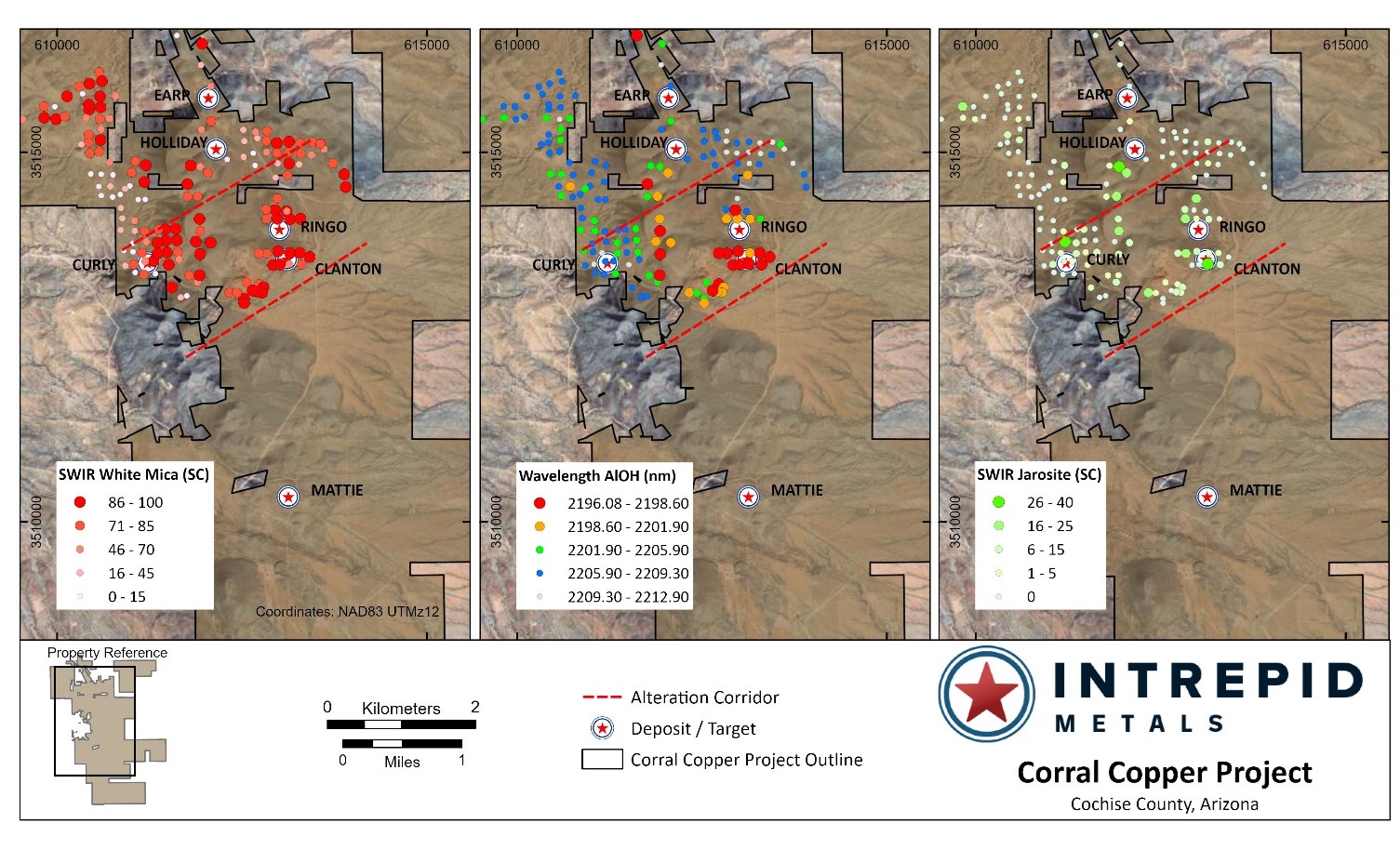
Figure 1: Map showing Corridor Extending from Curly to Ringo at Corral Copper
To view an enhanced version of this graphic, please visit:
https://images.newsfilecorp.com/files/6187/309432_54907d5994065b54_001full.jpg
Phase 1 Spectral Program
The preliminary interpretation is based on SWIR spectral data collected from surface samples during the Company's May and June 2026 field program. A total of 316 mineral interpretation results were generated from the raw spectral data. Because the sample population included a variety of rock types, including carbonate rocks, quartzite and intrusive rocks, the data were screened to focus on 165 samples representing feldspathic lithologies, predominantly intrusive rocks, where the selected spectral indicators are most applicable for this exercise.
SWIR spectroscopy identifies minerals based on their characteristic absorption features and can be used to map hydrothermal alteration mineralogy and variations in mineral chemistry. These patterns can help identify temperature and fluid gradients within mineralized systems and provide vectors toward prospective centres of hydrothermal activity.
The AlOH absorption wavelength data identify localized low-wavelength responses south of Ringo, near areas where pXRF sampling returned elevated copper values. Variations in the AlOH absorption feature of white mica can reflect changes in mineral chemistry associated with hydrothermal alteration and may provide a vectoring tool in porphyry exploration. These responses require interpretation alongside geology, geochemistry and geophysics and are not, by themselves, evidence of economic mineralization.
White mica is widespread throughout the sampled area, with particularly strong responses at Curly and additional concentrations in the Northwest target area and around Ringo. Independently mapped sericite intensity similarly highlights a corridor extending from Curly toward north of Ringo. This spatial relationship supports the interpretation of an extensive hydrothermal alteration system and identifies the corridor as a priority for further evaluation.
Jarosite was identified primarily along the corridor extending from Curly through Earp to Ringo. Jarosite commonly forms through the oxidation of iron-bearing sulphide minerals and may mark weathered portions of sulphide-bearing hydrothermal zones. Its distribution broadly overlaps the prospective alteration corridor, although further work is required to determine its relationship to the underlying geology and mineralization.
Epidote is most evident northwest of Curly. In porphyry systems, epidote can occur in more distal propylitic alteration assemblages and may help define the outer portions of a hydrothermal system. Intrepid is evaluating whether the epidote distribution represents the flank of a potential porphyry centre and whether faulting in the Curly area may have displaced or obscured corresponding alteration patterns.
Integration and Next Steps
The spectral results are being integrated with geological mapping, surface geochemistry, pXRF results, historical and recent drilling, and the Company's evolving three-dimensional geological model. The Company is also evaluating whether portions of the alteration system have been segmented or displaced into fault-bounded structural panels.
This work will support interpretation of the upcoming IP-MT survey and the selection of targets for the Company's planned 2026 drill program.
Quality Assurance and Quality Control
Approximately 2kg rock samples were collected by Intrepid staff and contractors in the field and sealed with numbered tickets in plastic sample bags. The bags were sealed with zap straps and shipped in batches to ALS Labs in Reno Nevada. Blank and standard samples were inserted into the sample string, in the field. Coarse rejects from the pulverizing process are separated by ALS Labs and sent for SWIR (Short-Wave Infrared) analysis by Terraspec.
Spectral scanning of coarse reject material was completed by ALS using a handheld spectrometer operating in the visible and near-infrared ("VNIR") and SWIR portions of the electromagnetic spectrum. As noted above, standardized interpretation of the spectral data was completed.
Note that white mica is a generalized term for white mica minerals including sericite, illite, muscovite, phengite, and paragonite.
Technical Information
All scientific and technical information in this news release has been prepared by, or approved by Daniel MacNeil, P.Geo. (the "QP"). Mr. MacNeil is a Technical Advisor to the Company and is a qualified person for the purposes of National Instrument 43-101 - Standards of Disclosure for Mineral Projects.
About Intrepid Metals Corp.
Intrepid Metals Corp. is focused on exploring for high-grade essential metals, including copper, silver, and zinc, in established mining jurisdictions in southeastern Arizona, USA. The Company's portfolio is anchored by the Corral Copper Property, an advanced exploration-stage, district-scale system with extensive drilling and significant shallow results, complemented by the Tombstone South and Mesa Well Properties. Intrepid is led by an experienced technical and management team with a strong track record of advancing and permitting projects across North America. The Company trades on the TSX Venture Exchange under the symbol "INTR" and on the OTCQB Venture Market under the symbol "IMTCF". For more information, visit www.intrepidmetals.com.
INTREPID METALS CORP.
On behalf of the Company
"Matthew Lennox-King"
Chairman & Interim-CEO
For further information regarding this news release, please contact:
Matthew Lennox-King, Chairman & Interim CEO
Evelyn Cox, VP Corporate Development
604-506-0552
invest@intrepidmetals.com
Cautionary Note Regarding Forward-Looking Information
Certain statements contained in this release constitute forward-looking information within the meaning of applicable Canadian securities laws. Such forward-looking statements relate to: the potential of the property; the timeline, goals and expectations regarding planned exploration and drilling programs at the Company's mineral projects; the interpretation of exploration results; the potential for a porphyry copper-gold system; the mineral potential of the Corral district; and the exploration potential of the Corral Copper Property and the Company's other mineral projects.
In certain cases, forward-looking information can be identified by the use of words such as "plans", "expects", "budget", "scheduled", "estimates", "forecasts", "intends", "anticipates" or "believes", or variations of such words and phrases or state that certain actions, events or results "may", "could", "would", "might", "occur" or "be achieved" suggesting future outcomes, or other expectations, beliefs, plans, objectives, assumptions, intentions or statements about future events or performance. Forward-looking information contained in this news release is based on certain factors and assumptions regarding, among other things, the Company can raise additional financing to continue operations; the results of exploration activities, commodity prices, the timing and amount of future exploration and development expenditures, the availability of labour and materials, receipt of and compliance with necessary regulatory approvals and permits, the estimation of insurance coverage, and assumptions with respect to currency fluctuations, environmental risks, title disputes or claims, and other similar matters. While the Company considers these assumptions to be reasonable based on information currently available to it, they may prove to be incorrect.
Forward looking information involves known and unknown risks, uncertainties and other factors which may cause the actual results, performance or achievements of the Company to be materially different from any future results, performance or achievements expressed or implied by the forward-looking information. Such factors include risks inherent in the exploration and development of mineral deposits, including risks relating to the ability to access infrastructure, risks relating to the failure to access financing, risks relating to changes in commodity prices, risk related to unanticipated geological or structural formations and characteristics risks related to current global financial conditions, risks related to current global financial conditions and the impact of any future global pandemic on the Company's business, reliance on key personnel, operational risks inherent in the conduct of exploration and development activities, including the risk of accidents, labour disputes and cave-ins, regulatory risks including the risk that permits may not be obtained in a timely fashion or at all, financing, capitalization and liquidity risks, risks related to disputes concerning property titles and interests, environmental risks and the additional risks identified in the "Risk Factors" section of the Company's reports and filings with applicable Canadian securities regulators.
Although the Company has attempted to identify important factors that could cause actual actions, events or results to differ materially from those described in forward-looking information, there may be other factors that cause actions, events or results not to be as anticipated, estimated or intended. Accordingly, readers should not place undue reliance on forward-looking information. The forward-looking information is made as of the date of this news release. Except as required by applicable securities laws, the Company does not undertake any obligation to publicly update or revise any forward-looking information.
Neither the TSX Venture Exchange nor its Regulation Services Provider (as that term is defined in the policies of the TSX Venture Exchange) has reviewed or accepts responsibility for the adequacy or accuracy of this release.

To view the source version of this press release, please visit https://www.newsfilecorp.com/release/309432
FAQ
AI-generated questions and answers. How Rhea-AI works. Not financial advice.