
Kingfisher Reports 8.8 m of 38.50 g/t AuEq Within 27 m of 13.61 g/t AuEq at HWY 37 Project, Golden Triangle
Kingfisher reports its best polymetallic intercept to date at HWY 37, while assays for most 2026 drill holes remain pending.
Rhea-AI Summary
Kingfisher Metals (KGFMF) reported a high‑grade polymetallic intercept from drill hole HW-26-015 at the HWY 37 Project’s Hank porphyry target in the Golden Triangle. The hole cut an 8.8 m interval grading 20.33 g/t Au, 937.6 g/t Ag, 2.98% Cu, 11.08% Zn and 0.99% Pb, equivalent to 38.50 g/t AuEq(1), within a broader 27 m zone averaging 13.61 g/t AuEq(1) from 461.0 m to 488.0 m.
The mineralization occurs in a newly recognized high‑grade polymetallic vein on the margin of porphyry-style mineralization, with visible gold reported. HW-26-015 continues to 1,067 m and encountered porphyry-style copper-bearing veins from 660 m to end of hole; standard multi‑element assays for the remainder are pending. Across the 2026 program, 17 diamond drill holes totaling about 9,500 m have been drilled or are in progress at multiple targets within the Hank-Mary District, with several holes showing visually strong porphyry-style copper mineralization where assays are not yet available.
Positive
- 8.8 m interval at 38.50 g/t AuEq within HW-26-015, including 20.33 g/t Au and 937.6 g/t Ag
- 27 m zone at 13.61 g/t AuEq from 461.0 m to 488.0 m in HW-26-015
- Approximately 9,500 m drilled in 17 holes across the Hank-Mary District in 2026
- HW-26-019 remained in copper-bearing porphyry for 643–1,085 m with visually more abundant copper than discovery hole HW-25-011
Negative
- Assay results are pending for the remainder of HW-26-015 and all other 2026 drill holes
- Reported HW-26-015 interval is a rush assay and is not representative of the entire hole
AI-generated analysis. How Rhea-AI works. Not financial advice.




Vancouver, British Columbia--(Newsfile Corp. - September 21, 2026) - Kingfisher Metals Corp. (TSXV: KFR) (FSE: 9700) (OTCQX: KGFMF) ("Kingfisher" or the "Company") reports that HW-26-015 contained visible gold (Figure 1) and the assay returned 8.8 m of 20.33 g/t Au, 937.6 g/t Ag,
This assay result is the first received this season and covers a single 27 m interval within HW-26-015. Standard multi-element assay results for the remainder of the hole are pending. To date this season, 13 diamond drill holes have been completed, and 4 are in progress, for a total of approximately 9,500 m across the Hank-Mary District.
Highlights from this release include:
Sub-intercept of 8.8 m of 38.50 g/t AuEq(1)
Visible gold observed within a high-grade polymetallic (Au-Ag-Cu-Zn-Pb) vein
Hydrothermal alteration, veins, and base metal mineralization continue below the reported intercept before transitioning into porphyry alteration and mineralization
Visually strongest mineralization(4) at the Hank Porphyry observed to date in HW-26-019
4th diamond drill added to the HWY 37 Project
Over 9,500 m drilled in 17 holes, including 4 holes in progress
Dustin Perry, CEO and President of the Company, states: "HW-26-015 has returned the best polymetallic intercept drilled to date on the HWY 37 Project with 8.8 meters of 38.50 g/t gold equivalent.
Serendipitously intersecting mineralization of this tenor en route to a porphyry speaks to the fertility of the magmatic-hydrothermal system at Hank. Due to glaciation in British Columbia, it is unusual to see such high levels of preservation as we see at the Hank porphyry-epithermal system, with lithocap alteration on the ridges, disseminated gold at surface, and polymetallic veins that transition into porphyry systems at depth.
The scale of the alteration system at Hank continues to impress us. Every hole drilled to date has intersected hydrothermal alteration, and while assays are pending, our visual observations suggest we are vectoring toward the higher-temperature core of the Hank porphyry, with the strongest alteration and mineralization yet observed in HW-26-019.
With four rigs turning, we continue to test both the shallow and deeper environments of this extensive system, and we look forward to receiving and reporting results from this year's drill program."
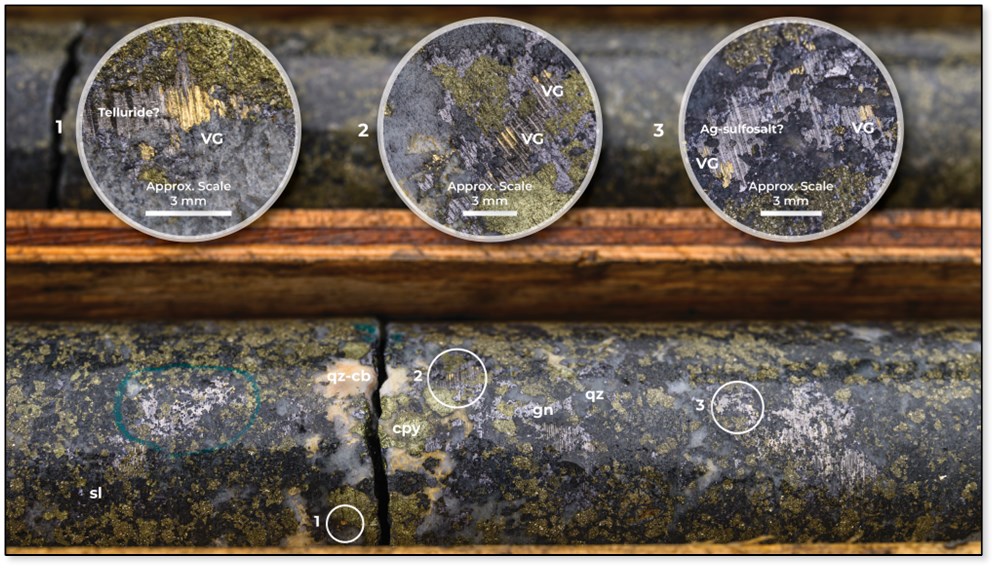
Figure 1: Visible gold in drill core from HW-26-015 at 464.3 m downhole. VG (visible gold/electrum), cpy (chalcopyrite), sl (sphalerite), gn (galena), qz (quartz), cb (carbonate). Interpreted Ag-Au tellurides and Ag-sulfosalts are also annotated. Scale bars are approximate.
To view an enhanced version of this graphic, please visit:
https://images.newsfilecorp.com/files/11630/315105_e0d913c2c48bb9d3_001full.jpg
HW-26-015 Overview
HW-26-015 was collared to test the Hank porphyry Cu-Au target, first identified in discovery hole HW-25-011, and was not designed to test for vein-hosted precious metal mineralization. The hole intersected a high-grade polymetallic vein containing visible Au (Figure 1) on the shoulder (margin) of porphyry-style mineralization and alteration. The vein returned an 8.8 m interval grading 38.50 g/t AuEq (20.33 g/t Au, 937.6 g/t Ag,
An Intact Porphyry-Epithermal System
HW-26-015 traversed the Hank system from an epithermal expression through to porphyry levels in a single hole. From the surface, the hole passed through quartz-sericite-carbonate-pyrite altered volcaniclastic rocks and into a broad silica-sulfide interval containing jasperoid-cement breccia, the polymetallic vein reported here, followed by silica flooding and silica-cement breccia below it. From 660 m to the end of the hole at 1,067 m, the hole intersected porphyry-style veins with visible chalcopyrite(4) and transitional potassic alteration comprising quartz-biotite-chlorite-magnetite-chalcopyrite-pyrite with trace molybdenite (Figure 2).
The greater Hank mineral system includes a vertical succession from lithocap and high-sulfidation alteration at the surface, intermediate-sulfidation and polymetallic vein mineralization at intermediate levels, and porphyry Cu-Au mineralization at depth, and the Company interprets it as a porphyry-epithermal system preserved in its entirety. Systems of this type are commonly truncated by erosion, with the upper epithermal levels removed and only the porphyry root remaining, or alternatively with the lithocap preserved but the underlying porphyry beyond the depth of practical exploration. At Hank, the Company interprets that limited post-mineral erosion has preserved the full column, and that each level of the system remains available to be explored.
The Vein in System Context
Polymetallic Au-Ag-Cu-Zn-Pb vein mineralization of this style commonly develops on the outer margins of porphyry Cu-Au systems, where cooler fluids are structurally focused above and lateral to the porphyry centre. Kingfisher interprets the HW-26-015 vein as the intermediate-sulfidation level of the Hank system rather than an isolated occurrence. The Company believes this grade and metal endowment indicate a magmatic-hydrothermal source of substantial scale.
Implications for the Hank Area
The vein was intersected in a hole directed at a porphyry target. The Company regards this as a meaningful indicator of both the fertility of the Hank mineral system and the degree to which the Hank area remains underexplored. Drill density across the Hank area is low relative to the scale of the system, and the mineralization tenor reported herein had not previously been recognized in the area. Kingfisher's exploration strategy focuses on systematically testing each level of the preserved system, and drilling is ongoing across the Hank area.
Table 1: Partial assay results from this release
| Hole No. | From (m) | To (m) | Interval (m)(3) | Cu (%) | Au (g/t) | Ag (g/t) | Zn (%) | Pb (%) | AuEq (g/t)(1) |
| HW-26-015 | 0 | 461 | Assays Pending | ||||||
| HW-26-015 | 461.0 | 488.0 | 27 | 1.01 | 7.33 | 322.0 | 4.05 | 0.54 | 13.61 |
| incl. | 462.0 | 470.8 | 8.8 | 2.98 | 20.33 | 937.6 | 11.08 | 0.99 | 38.50 |
| HW-26-015 | 488.0 | 1,067 | Assays Pending | ||||||
| (1) AuEq (g/t) = Au (g/t) + (Cu (%) x 0.9428) + (Ag (g/t) x 0.01375) + (Zn (%) x 0.2228). Differences may occur due to rounding. See Footnote (1) below for full assumptions. Pb is not included in the AuEq calculation. Note: This result represents a rush assay for a single interval within HW-26-015 that was selected for priority analysis because visible mineralization was observed in the core, and is not representative of the entire drill hole. Standard multi-element assay results for the remainder of the hole are pending. | |||||||||
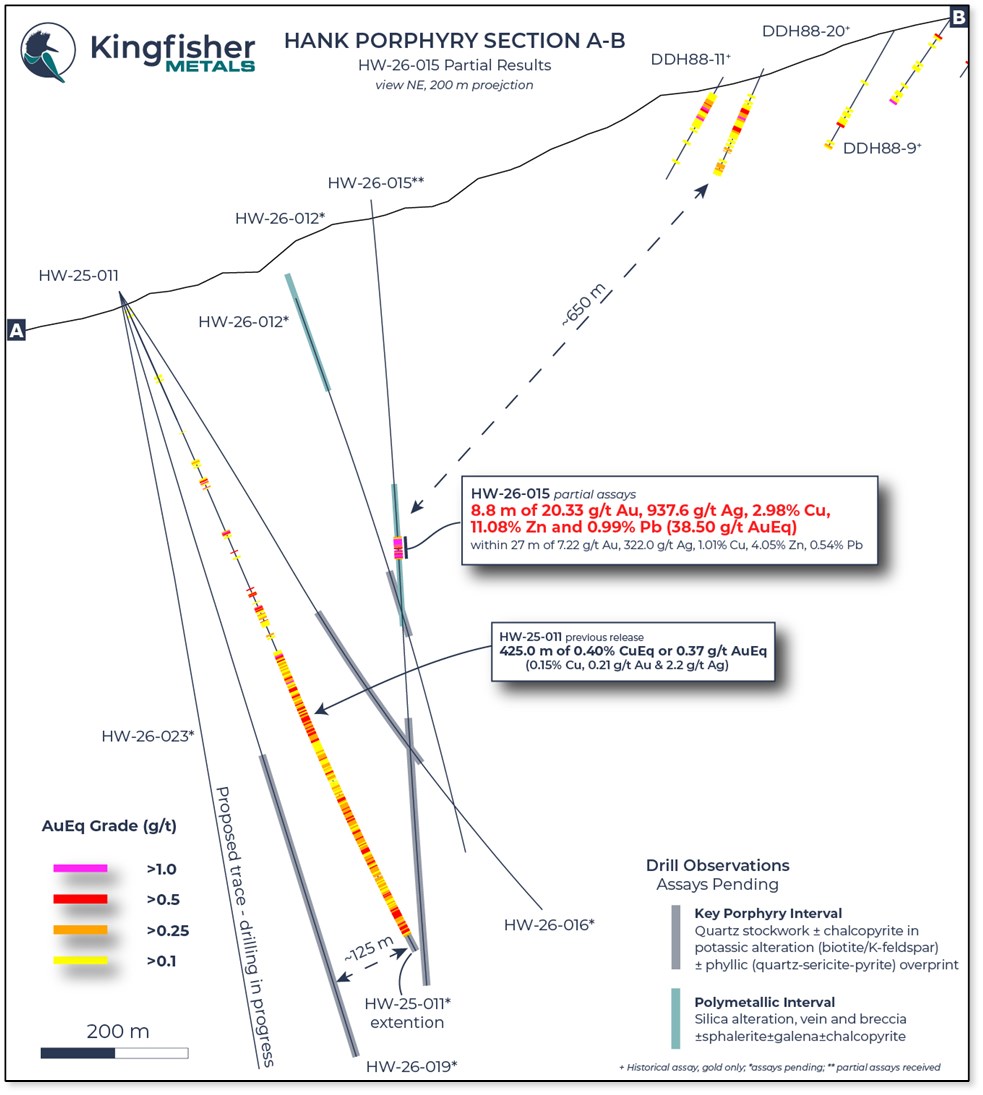
Figure 2: Cross section of HW-26-015
To view an enhanced version of this graphic, please visit:
https://images.newsfilecorp.com/files/11630/315105_e0d913c2c48bb9d3_002full.jpg
2026 Drill Program Update
As of September 17, 2026, 17 diamond drill holes have been drilled or are currently drilling for a total of approximately 9,500 m in the 2026 program within the Hank-Mary District (Table 2). Drill targeting continues to focus on the Hank porphyry target, the shallow Hank gold system, and new discovery-type targets. There are 2 drill rigs that are drilling the Hank Porphyry Targets, and 2 drill rigs are assigned to drill the Upper Hank gold targets and the new discovery targets.
Hank Porphyry Targets
Drilling at the Hank Porphyry Target this season has consistently intersected the porphyry system. Collectively, the results suggest an exploration vector to the north-northeast, with the porphyry system remaining open at depth and along strike. Assay results are pending for the remainder of HW-26-015 and for all other holes completed to date this season. HW-26-019 returned the strongest visual copper mineralization observed to date, exceeding that observed in HW-25-011, and is discussed above and below.
HW-25-011 (Extension): The season began with re-entry of discovery hole HW-25-011, confirming that porphyry copper-gold mineralization continues from 959 m to the end of the hole at 983.4 m. The mineralization is consistent with the original intercept; however, difficult ground conditions prevented the hole from being advanced deeper.
HW-26-012 (884 m): Collared approximately 350 m northeast to test the northern edge of the HW-25-011 mineralization, this hole intersected a structural zone with elevated zinc and lead mineralization from 57 m to 219 m, a quartz-chlorite-pyrite stockwork with sheeted quartz veins from 554 m to 648 m, and high temperature alteration interpreted as porphyry-flanking through to the end of the hole.
HW-26-015 (1,067 m): Drilled upslope of discovery hole HW-25-011, this hole intersected a broad silica-sulfide zone hosting the high-grade polymetallic vein reported above, then entered porphyry-style veins with visible copper mineralization(4) from 660 m to the end of the hole (Figure 2).
HW-26-016 (1,021 m): A shallower-dipping hole drilled from the same pad as HW-25-011, HW-26-016 intersected 268 m of porphyry mineralization from 514 m to 782 m, including visible copper mineralization.
HW-26-017 (883 m): Collared approximately 350 m south to test a geophysical anomaly, this hole reached the margin of the porphyry from 683 m to the end of the hole, extending the interpreted alteration footprint to the south.
HW-26-019 (1,085 m): The deepest hole drilled at Hank to date remained in copper-bearing porphyry mineralization from 643 m to the bottom of the hole, with visibly more abundant(4) copper mineralization than discovery hole HW-25-011. Trace bornite, a high-grade copper mineral of higher copper content than chalcopyrite, was visually identified(4) in the uppermost approximately 50 m of the intercept. The Company regards this as an excellent indicator that HW-26-019 is vectoring toward a copper-enriched core to the Hank porphyry system. Assays for this interval are pending.
HW-26-023 (in progress): This hole was designed to test the Hank porphyry west of HW-26-019, which contains the highest (4) visual copper mineralization observed to date within the Hank Porphyry (Figure 2). At the time of writing, the hole had intersected porphyry alteration comprising chlorite-biotite-magnetite, with pyrite dominant over chalcopyrite and trace molybdenite visually identified(4) from approximately 780 m downhole. The hole is currently being drilled with assays and detailed logging pending.
Upper Hank Gold Targets
All holes drilled into the Upper Hank gold system have intersected widespread alteration with associated pyrite and many have anomalous base metal mineralization that can be an indication for hosting Au-Ag mineralization.
HW-26-013 (Pits Extension - 406 m): Tested a new interpretation that the Pits epithermal gold-silver mineralization is fed by a steeply dipping east-trending structure; collared approximately 330 m east of the Pits and 370 m north of HW-25-006, which returned 110 m of 0.47 g/t Au(7). The hole remained within that structural zone from near surface to the end of the hole, and additional pads have been built to test additional feeder targets this season.
HW-26-018 (Flats - 508 m): The purpose of this hole was to extend mineralization around drill hole DDH88-16(6), which reported 74 m at 0.43 g/t Au from 25.5 m depth, with the hole ending with an assay of 0.92 g/t Au(5) over 4 m. This hole intersected alteration dominated by QSP-phyllic from 49 m to the 508 m end of hole. Pyrite ± galena ± sphalerite occur in veins and disseminations throughout the hole, with local hydrothermal breccia.
HW-26-020 (Pits extension/Source - 504 m): Pits extension/source tested a geological and geophysical target NE of Pits. An alternating hematite-alteration / green-phyllic sequence occurs from 33 m to 504 m with pyrite disseminated throughout.
HW-26-025 (Flats - in progress): currently being drilled and logged. This hole is testing the Flats target area within the Upper Hank gold system. Similar to HW-26-018, this hole is testing for additional mineralization in an area of historical and depth limited drilling. In this area DDH87-8(6) returned 123 m @ 0.34 g/t Au(5). Proposed depth of this hole is 400 m.
New Discovery Targets
Target areas tested or currently being drilled are Rojo Grande, Rojo Chico, Cash, LAZ Porphyry and Turquoise target areas (Figure 3).
HW-26-014 (Cash - 652 m): The first hole into the Cash target and a test of a chargeability body exceeding 30 mV/V, intersected multiple previously unrecognized diorite to syenite porphyry stocks from 9.3 m to the end of the hole, interpreted as a porphyry-flanking position approximately 800 m north-northeast of HW-26-013 and warranting follow-up drilling.
HW-26-021 (LAZ Porphyry - 665 m): Collared 140 m west of historic hole HNK18-011(6) at LAZ, which ended in favorable geochemical zonation consistent with proximity to a porphyry. Hole HW-26-021 intersected QSP alteration with 8
-12% disseminated pyrite and polymetallic quartz veins to 380 m. Below 400 m, alteration transitions to a higher temperature assemblage of chlorite±magnetite±biotite±epidote and trace K-feldspar with variable QSP to 665 m. It is significant because epidote and magnetite together define a discrete 'inner propylitic' shell to the core potassic body at both Hank and Williams porphyry deposits.HW-26-022 (Turquoise - 411 m): Propylitic alteration near surface grades into an alternating grey argillic-advanced argillic / phyllic sequence to ~310 m, then green-phyllic alteration to end of hole. Pyrite ± magnetite occurs in veins and stockwork/breccia zones at 139-257 m. This is a comparatively short, shallow hole that appears peripheral to the main system.
HW-26-024 (Rojo Chico - 175 m): This hole was testing below Rojo Chico. QSP-phyllic alteration with pyrite, silicification and local breccia occurs from 17 m to EOH 174.3 m. The hole was stopped before proposed final depth because of difficult drilling conditions.
HW-26-026 (unnamed - in progress): This hole is planned to a final depth of 250 m and is testing gold-silver-bearing structures north of Rojo Chico and northwest of Rojo Grande.
HW-26-027 (Rojo Grande - in progress): This hole is the first-ever drill test into the large southern possible continuation of the upper Hank gold system. The hole collars more than 1,200 m east of the nearest hole at Flats, is more than 1,200 m from the nearest drilling to the NW and more than 900 m from the nearest hole at Felsite hill. The initial test targets structurally controlled, advanced argillic alteration of pyrite-dickite-silica-alunite-kaolinite. This hole is proposed to a depth of 425 m.
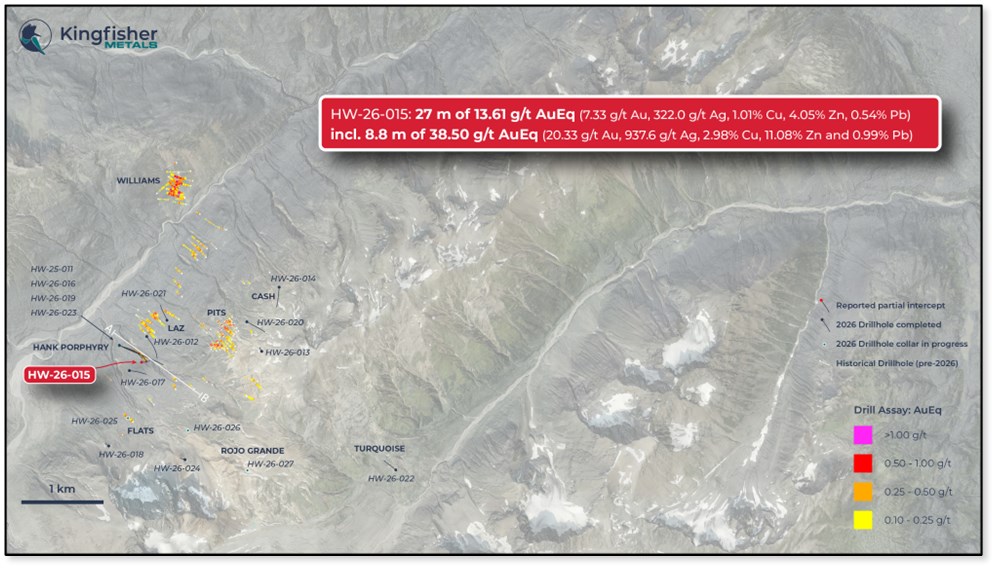
Figure 3: Plan view of current drilling within the Hank-Mary District
To view an enhanced version of this graphic, please visit:
https://images.newsfilecorp.com/files/11630/315105_e0d913c2c48bb9d3_003full.jpg
Table 2: Location of completed and current drillholes
| Hole ID | Status | Easting (mE) | Northing (mN) | Azimuth (°) | Dip (°) | Final Depth (m) | Target Area |
| HW-25-011 | Complete | 408790 | 6342028 | 111 | -64 | 983.4 | Hank Porphyry - HW-25-011 Extension |
| HW-26-012 | Complete | 409125 | 6342136 | 145 | -68 | 884 | Hank Porphyry |
| HW-26-013 | Complete | 410523 | 6341955 | 328 | -81 | 406 | Upper Hank Gold - Pits Extension |
| HW-26-A | Abandoned | 410384 | 6341755 | 140 | -75 | 26 | Upper Hank Gold |
| HW-26-014 | Complete | 410735 | 6342736 | 185 | -65 | 652 | New Discovery - Cash |
| HW-26-015 | Complete | 409062 | 6341823 | 99 | -83 | 1067 | Hank Porphyry |
| HW-26-016 | Complete | 408791 | 6342030 | 117 | -56 | 1021 | Hank Porphyry |
| HW-26-017 | Complete | 408914 | 6341721 | 100 | -76 | 883 | Hank Porphyry |
| HW-26-018 | Complete | 408663 | 6340805 | 300 | -85 | 508 | Upper Hank Gold - Flats Zone |
| HW-26-019 | Complete | 408791 | 6342030 | 110 | -72 | 1085 | Hank Porphyry |
| HW-26-020 | Complete | 410342 | 6342315 | 115 | -60 | 504 | Upper Hank Gold - Pits Extension |
| HW-26-021 | Complete | 409371 | 6342334 | 335 | -72 | 665 | New Discovery - LAZ Porphyry |
| HW-26-022 | Complete | 412154 | 6340513 | 310 | -63 | 411 | New Discovery - Turquoise |
| HW-26-023 | Drilling | 408791 | 6342030 | 110 | -78 | In progress | Hank Porphyry |
| HW-26-024 | Complete | 409590 | 6340638 | 289 | -70 | 175 | New Discovery - Rojo Chico |
| HW-26-025 | Drilling | 408896 | 6341143 | 306 | -80 | In progress | Upper Hank Gold - Flats Zone |
| HW-26-026 | Drilling | 409626 | 6340992 | 160 | -55 | In progress | New Discovery - Rojo Chico / Rojo Grande |
| HW-26-027 | Drilling | 410349 | 6340507 | 240 | -56 | In progress | New Discovery - Rojo Grande |
2026 Regional Exploration Update & Other Work
2,452 soil geochemical samples have been taken within the Hank-Mary District as well as at the Mess Creek Target.
Geological mapping at RDN (Forrest Kerr), Hank-Mary Trend, Rainbow, Northmore, and Mess Creek with 128 rock samples collected and submitted for geochemical assay.
14.1 line-km of ground IP within the Hank-Mary District, with work ongoing; 11.8 line-km of ground induced polarization geophysics (IP) at the Forrest Kerr RDN prospect; and Vector IP covering approximately 25.5 km2 at Mess Creek.
1,180 line km of airborne MMT and magnetics over Forrest Kerr.
185 km² of new LiDAR coverage over Forrest Kerr and parts of HWY 37, approximately one-third of the planned 548 km², with acquisition slowed this season by late snowmelt and adverse weather.
Scanning of 5,600+ m of historical core from Mary using shortwave infrared hyperspectral.
Initial construction activities of a second, recently permitted, camp underway, with occupancy expected for 2027.
Ongoing baseline environmental sampling.
30 km² of Additional Tenure Added to Forrest Kerr Project
30 km² of new ground immediately adjacent to Forrest Kerr to the west has recently been approved by the Mineral Titles Office. This brings the total Forrest Kerr tenure to 232 km² and the HWY 37 tenure to 933 km² for a total of 1,165 km² (Figure 4).
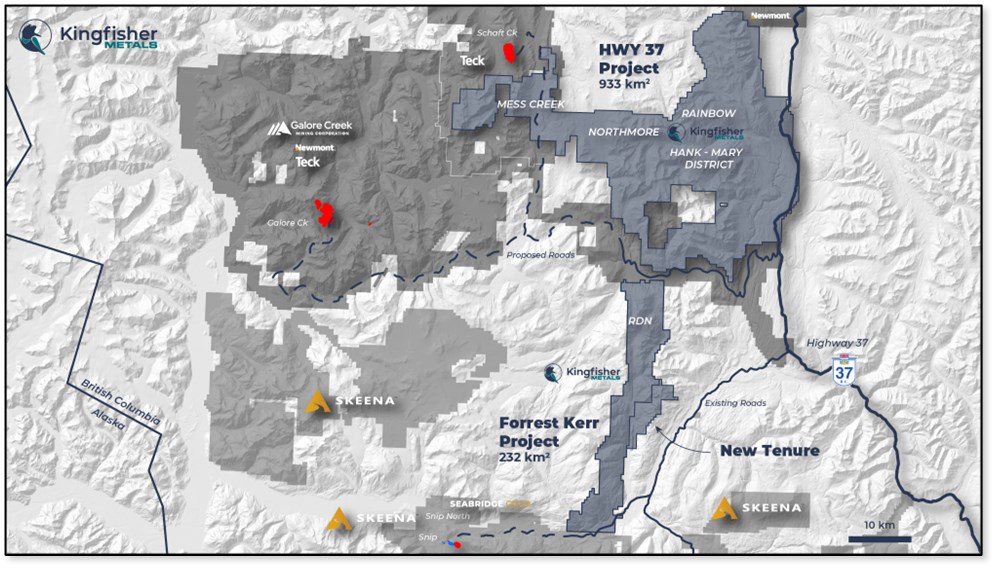
Figure 4: Plan map showing prospect locations and Kingfisher's new tenure adjacent the Forrest Kerr Project.
To view an enhanced version of this graphic, please visit:
https://images.newsfilecorp.com/files/11630/315105_e0d913c2c48bb9d3_004full.jpg
Quality Assurance / Quality Control (QAQC)
Drilling on site at the HWY 37 Project was supervised by on-site Kingfisher personnel who implemented a full QAQC program using coarse blanks, pulp blanks, standards, and duplicates inserted into the sample stream at regular intervals to monitor analytical accuracy and precision. Samples consist of sawn half core collected at a nominal 2 m sample length, reduced to a nominal 1 m sample length in higher-grade zones. The samples were sealed on site using tamper-proof seals with unique identifiers. The samples were sent to the Bureau Veritas (BV) lab in Vancouver, British Columbia. BV's quality control system complies with global certifications for Quality ISO/IEC 17025:2017 General requirements for the competence of testing and calibration laboratories. All QC samples returned results with acceptable limits. Diamond drill core samples were analyzed using a combination of BV's MA200 process for low level concentrations (4 acid digestion/ICP-ES/MS) and MA370 process for higher level concentrations (4 acid digestion/ICP-ES). Gold assaying was completed using FA430, a 30-gram fire assay with AAS finish. Given the high grades encountered, samples were re-assayed using metallics screening and/or gravimetric finish where applicable to more accurately account for coarse or nuggety gold. If applicable, base metal overlimits were finalized with titration, and gold overlimits completed with a gravimetric finish.
Qualified Person
Technical aspects of this news release have been reviewed, verified, and approved by Tyler Caswell, P.Geo., Vice President, Exploration, of Kingfisher, who is a qualified person as defined by National Instrument 43-101 - Standards of Disclosure for Mineral Projects. Mr. Caswell is not independent of the Company. Mr. Caswell has verified the scientific and technical information disclosed in this news release, including the sampling, analytical and quality control data underlying the assay results reported herein.
About Kingfisher Metals Corp.
Kingfisher Metals Corp. (https://kingfishermetals.com/) is a Canadian-based exploration company focused on copper-gold exploration in the Golden Triangle, British Columbia. Through outright purchases and option earn-in agreements (Orogen Royalties, Golden Ridge Resources, and Aben Gold), the Company has quickly consolidated one of the largest land positions in the Golden Triangle region with the 933 km² HWY 37 Project and the 232 km² Forrest Kerr Project. Kingfisher also owns (
For further information, please contact:
Dustin Perry, P.Geo.
CEO and President
Phone: +1 778 606 2507
E-Mail: info@kingfishermetals.com
Neither the TSX-V nor its Regulation Services Provider (as that term is defined in the policies of the TSX-V) accepts responsibility for the adequacy or accuracy of this release.
Cautionary Note Regarding Forward-Looking Statements
Mineralization hosted on adjacent and/or nearby properties is not necessarily indicative of mineralization hosted on the Company's property. This news release contains statements that constitute "forward-looking statements." Such forward-looking statements involve known and unknown risks, uncertainties and other factors that may cause the Company's actual results, performance or achievements, or developments to differ materially from the anticipated results, performance or achievements expressed or implied by such forward-looking statements. Forward-looking statements are statements that are not historical facts and are generally, but not always, identified by the words "expects," "plans," "anticipates," "believes," "intends," "estimates," "projects," "potential" and similar expressions, or that events or conditions "will," "would," "may," "could" or "should" occur.
Forward-looking statements in this news release include, among others, statements relating to expectations regarding the projects, including without limitation statements regarding the timing and results of pending assays for HW-26-015 and for the other 2026 drill holes referenced herein; the Company's interpretation of the Hank system as an intact, preserved porphyry-epithermal system and the other geological, alteration and mineralization interpretations described in this news release; anticipated further drilling, exploration and expenditure plans for the remainder of the 2026 program and beyond; and the potential significance of visual observations of mineralization pending confirmation by laboratory assay, and other statements that are not historical facts. By their nature, forward-looking statements involve known and unknown risks, uncertainties and other factors which may cause our actual results, performance or achievements, or other future events, to be materially different from any future results, performance or achievements expressed or implied by such forward-looking statements. Such factors and risks include, among others: the Company may require additional financing from time to time in order to continue its operations which may not be available when needed or on acceptable terms and conditions acceptable; compliance with extensive government regulation; domestic and foreign laws and regulations could adversely affect the Company's business and results of operations; the inherent risks and hazards associated with mineral exploration generally; the preliminary and interpretive nature of the geological, alteration and mineralization observations disclosed herein and the risk that further exploration, including pending assay results, may not confirm such interpretations; the risk that visual estimates of mineralization, including reported observations of visible gold and copper minerals, may not be confirmed by laboratory assay and should not be relied upon; fluctuations in the market prices of gold, silver, copper, zinc and other commodities; environmental, permitting and title risks associated with mineral exploration properties; and the remote location, difficult terrain and weather-dependent access affecting the Company's properties; the stock markets have experienced volatility that often has been unrelated to the performance of companies and these fluctuations may adversely affect the price of the Company's securities, regardless of its operating performance.
The forward-looking information contained in this news release represents the expectations of the Company as of the date of this news release and, accordingly, is subject to change after such date. Readers should not place undue importance on forward-looking information and should not rely upon this information as of any other date. The Company undertakes no obligation to update these forward-looking statements in the event that management's beliefs, estimates or opinions, or other factors, should change.
Footnotes
(1) Assumptions used in USD for the metal equivalent calculation were metal prices of
(2) See news release dated January 22, 2026, available at www.kingfishermetals.com and on the Company's SEDAR+ profile at www.sedarplus.ca.(3) All drill intervals reported in this news release are downhole lengths. True widths of the reported mineralized intervals have not been determined.
(4) Visual estimates have not been confirmed by laboratory assay and should not be relied upon.
(5) Only assayed for Au.
(6) Historical drill results referred to in this news release, being holes DDH87-8, DDH88-16 and HNK18-011, were completed by previous operators and are taken from historical exploration records available to the Company. The Company's qualified person has not verified the sampling, analytical or test data underlying these historical results, true widths have not been determined, and the reported intervals are downhole lengths. Readers are cautioned that these results are historical in nature, that the Company is not treating them as current, and that they are not necessarily indicative of mineralization on the Company's project.
(7) See news release dated November 10, 2025, available at www.kingfishermetals.com and on the Company's SEDAR+ profile at www.sedarplus.ca.

To view the source version of this press release, please visit https://www.newsfilecorp.com/release/315105
FAQ
AI-generated questions and answers. How Rhea-AI works. Not financial advice.
What exactly was intersected in HW-26-015 at the HWY 37 Project?
HW-26-015 intersected a high-grade polymetallic Au-Ag-Cu-Zn-Pb vein on the shoulder of porphyry-style mineralization. Within this, a 27 m zone from 461.0 m to 488.0 m graded 13.61 g/t AuEq(1) (7.33 g/t Au, 322.0 g/t Ag, 1.01% Cu, 4.05% Zn, 0.54% Pb), including 8.8 m from 462.0 m grading 38.50 g/t AuEq(1) (20.33 g/t Au, 937.6 g/t Ag, 2.98% Cu, 11.08% Zn, 0.99% Pb).
How is the gold equivalent (AuEq) grade calculated for the HW-26-015 intercept?
The AuEq value in g/t is calculated as: AuEq (g/t) = Au (g/t) + (Cu (%) × 0.9428) + (Ag (g/t) × 0.01375) + (Zn (%) × 0.2228). Lead (Pb) is not included in the AuEq calculation. The company notes that differences may occur due to rounding.
What portion of HW-26-015 has been assayed so far and what is pending?
The reported result represents a rush assay for a single 27 m interval from 461.0 m to 488.0 m that was selected because visible mineralization was observed. Assays from 0–461 m and from 488–1,067 m in HW-26-015 are pending, as are standard multi‑element assay results for the rest of the hole.
What is the current status and focus of the 2026 drill program at Hank-Mary?
As of September 17, 2026, 17 diamond drill holes totaling about 9,500 m have been drilled or are in progress within the Hank-Mary District. Two drill rigs are testing the Hank porphyry targets and two are focused on Upper Hank gold and new discovery targets such as Rojo Grande, Rojo Chico, Cash, LAZ Porphyry and Turquoise.
How does HW-26-019 relate to the Hank porphyry copper-gold system?
HW-26-019, the deepest hole drilled at Hank to date at 1,085 m, remained in copper-bearing porphyry mineralization from 643 m to the bottom of the hole. The company reports visibly more abundant copper mineralization than in discovery hole HW-25-011 and trace bornite in the upper ~50 m of the intercept, and regards this as an indicator that the hole may be vectoring toward a copper-enriched core. Assays are pending.