
Kiora Pharmaceuticals In-Licenses Late-Stage, Oral Neuroprotective Calpain Inhibitor for Central Retinal Artery Occlusion (CRAO) with Planned Expansion into NAION; Asset Completed Phase 3 Clinical Trial in CRAO in Japan
The license adds upfront and milestone obligations as Kiora evaluates financing for development outside Asia.
Sentiment and the balance of points
Rhea-AI Sentiment reads the wording of the document, how positive or negative its language is on a 1 to 5 scale. The balance of points shown with the takes weighs what the document actually discloses, so the two can disagree, for example when a trial that missed its main goal is described in upbeat language.
Rhea-AI Summary
Kiora Pharmaceuticals (NASDAQ: KPRX) obtained exclusive rights outside Asia to develop and commercialize Senju Pharmaceutical's KIO-401 for acute retinal disease. The license requires a $3.5 million upfront payment, a low-teen-million technology-transfer milestone, additional contingent milestones and single-digit royalties.
In Japan, Phase 2a visual-acuity improvement versus an observational registry was statistically significant (p=0.0398). Phase 3 showed improved best-corrected visual acuity, with statistical significance in patients legally blind at baseline (p=0.0195). Kiora targets a multinational Phase 3 trial for central retinal artery occlusion in 2027 and Phase 2b for non-arteritic anterior ischemic optic neuropathy in 2028, subject to funding and regulatory considerations. Kiora is evaluating financing, prioritizing KIO-401 and partnered KIO-301, and discontinuing KIO-104 research and development.
How this balance works
Rhea-AI gives every point it takes from this document a weight. Minor counts 1, Moderate 3 and Major 9, so one Major point outweighs several Minor ones. The bar adds up the weights on each side, and when neither side holds more than 65% of the total the balance reads Mixed.
It reads the document as published, with the same rules for every company, and it does not look at what the market expected or at how the stock traded, so a point can be objectively good on a day the stock falls.
Rhea-AI Sentiment measures something else, the tone of the wording.
Hollow bars mark forward-looking points. How the balance works
Positive
- Major pointExclusive KIO-401 rights outside Asia add a late-stage asset licensed from Senju Pharmaceutical.
- Moderate pointPhase 2a visual-acuity improvement versus a prospective observational registry was statistically significant in Japan (p=0.0398).
- Moderate point. Forward-looking: it has not happened yet and may not happen.CRAO Phase 3 initiation targeted for 2027 advances Kiora's planned multinational registration program.
- Moderate point. Forward-looking: it has not happened yet and may not happen.NAION Phase 2b initiation targeted for 2028 would expand KIO-401 development into another indication.
- Moderate pointKIO-301 economics include eligibility for up to $285 million in additional milestones and tiered royalties reaching the low 20% range. 27× market cap
5 minor points
- Minor pointPhase 3 in Japan improved best-corrected visual acuity; the legally blind baseline subgroup showed statistical significance (p=0.0195).
- Minor point. Forward-looking: it has not happened yet and may not happen.Additional ophthalmic indications, including glaucoma, are planned for evaluation as potential KIO-401 expansion opportunities.
- Minor point. Forward-looking: it has not happened yet and may not happen.KIO-301 clinical resources are expected to transition to KIO-401 as the Phase 2 ABACUS-2 trial completes enrollment.
- Minor pointKIO-301 R&D expenses are reimbursed by partner Théa Open Innovation, which holds commercialization rights outside Asia.
- Minor pointKIO-104 partnering and out-licensing opportunities remain under consideration following development discontinuation.
Negative
- Major point$3.5 million upfront payment is required under the KIO-401 license. 34% of market cap
- Moderate point. Forward-looking: it has not happened yet and may not happen.CRAO Phase 3 initiation depends on funding and regulatory alignment; Kiora is evaluating financing alternatives.
- Moderate point. Forward-looking: it has not happened yet and may not happen.NAION Phase 2b initiation is subject to funding and regulatory considerations.
- Moderate pointKIO-104 research and development is being discontinued as Kiora prioritizes other programs.
- Minor point. Forward-looking: it has not happened yet and may not happen.Low-teen-million technology-transfer milestone follows, with transfer expected in 2027; a portion may offset future milestone obligations.
4 minor points
- Minor point. Forward-looking: it has not happened yet and may not happen.Additional regulatory and commercial milestone payments become payable upon specified achievements.
- Minor point. Forward-looking: it has not happened yet and may not happen.Single-digit royalties apply to applicable KIO-401 net sales outside Asia.
- Minor point. Forward-looking: it has not happened yet and may not happen.CRAO trial design, including enrollment criteria, primary endpoint and sample size, awaits regulatory discussions.
- Minor point. Forward-looking: it has not happened yet and may not happen.Additional KIO-401 indications would require further preclinical and clinical evaluation.
Details
Market move: KPRX -23.73% vs previous close. KIO-401 license agreement
On Oct 29, the day this news came out, the latest delayed price for KPRX is 23.73% below the previous close. Our momentum scanner has recorded 41 alerts for this stock so far that day. The latest delayed price is $1.80. Relative volume is exceptionally heavy at 27.2x the average.
Data tracked by StockTitan Argus (15 min delayed). Upgrade to Gold for real-time data.
Key Figures
- Upfront payment
- $3.5 million
- KIO-401 license agreement
- Technology-transfer milestone
- Low teen millions
- One-time payment upon technology transfer expected in 2027
- Royalties
- Single-digit royalties
- Applicable net sales outside Asia
- ETDRS visual acuity p-value
- p=0.0398
- Randomized Phase 2a CRAO study in Japan; improvement from baseline versus prospective observational registry
- BCVA p-value
- p=0.0195
- Phase 3 CRAO study in Japan; significant improvement among patients legally blind at baseline
- Planned CRAO trial size
- More than 100 patients
- Estimated size; final design subject to regulatory discussions
- Targeted CRAO trial initiation
- 2027
- Multinational Phase 3 registration trial; subject to funding and regulatory alignment
- Targeted NAION study initiation
- 2028
- Phase 2b study; subject to funding and regulatory considerations
Key Terms
calpain inhibitor medical
naion medical
etdrs medical
bcva medical
AI-generated analysis. How Rhea-AI works. Not financial advice.


- The oral small-molecule calpain inhibitor demonstrated meaningful visual acuity improvement in Phase 2 and Phase 3 CRAO studies conducted in Japan compared to controls.
- No therapeutics exist today to treat patients that experience CRAO vision loss.
- Kiora plans to advance KIO-401 (mitucapistat) into a multinational Phase 3 registration trial in CRAO, with initiation targeted for 2027.
- Company also plans to evaluate KIO-401 in a Phase 2b clinical trial in non-arteritic anterior ischemic optic neuropathy ("NAION").
San Diego, California--(Newsfile Corp. - October 29, 2026) - Kiora Pharmaceuticals, Inc. (NASDAQ: KPRX) ("Kiora" or the "Company") today announced that it has obtained exclusive development and commercialization rights, outside Asia, to KIO-401, a late-stage neuroprotective, oral small-molecule calpain inhibitor, from Senju Pharmaceutical Co., Ltd. ("Senju"). KIO-401 is being developed as a potential treatment for central retinal artery occlusion ("CRAO"), a rare, acute ischemic retinal disease described as "stroke of the eye" that can result in severe, permanent vision loss and for which there are currently no approved therapies.
A presentation reviewing KIO-401, its clinical data and Kiora's planned development program is available in the Investors section of the Company's website at ir.kiorapharma.com.
Senju has completed both Phase 2 and Phase 3 clinical studies of KIO-401 in patients with CRAO in Japan, providing an established clinical foundation for Kiora's planned multinational Phase 3 registration program. The Company is targeting initiation of the study in 2027 and also plans to expand development of KIO-401 into a Phase 2b clinical trial in patients with NAION, another rare, acute, ischemic, ophthalmic disease with no approved treatment.
"KIO-401 addresses a significant unmet need for patients with CRAO and NAION, two rare, acute ophthalmic diseases that result in permanent vision loss and have no approved therapies today," said Brian M. Strem, Ph.D., President and Chief Executive Officer of Kiora. "We have an established relationship with Senju through our KIO-301 partnership, which facilitated our partnership on KIO-401. After reviewing results from Senju's previous work, we identified KIO-401 as a compelling late-stage asset. We now plan to build on those findings with a larger, adequately powered multinational Phase 3 trial designed to more definitively evaluate its clinical benefit. We believe KIO-401 has the potential to meaningfully improve patient outcomes and achieve significant commercial value in the U.S., Europe and other regions."
KIO-401: Late-Stage Program for Acute Ischemic Retinal Disease
KIO-401 (mitucapistat), designated by Senju as SJP-0008 in Japan and Asia, is a neuroprotective, oral small molecule designed to inhibit activated calpain, a calcium-dependent protease implicated in cellular injury following ischemia. CRAO is an acute retinal ischemic event caused by interruption of blood flow to the retina. NAION is caused by reduced blood flow to the optic nerve. Both conditions can trigger cellular injury through oxygen deprivation, increased intracellular calcium accumulation and excessive calpain activation. By inhibiting activated calpain, KIO-401 is intended to reduce downstream cellular damage and preserve visual function following ischemic injury.
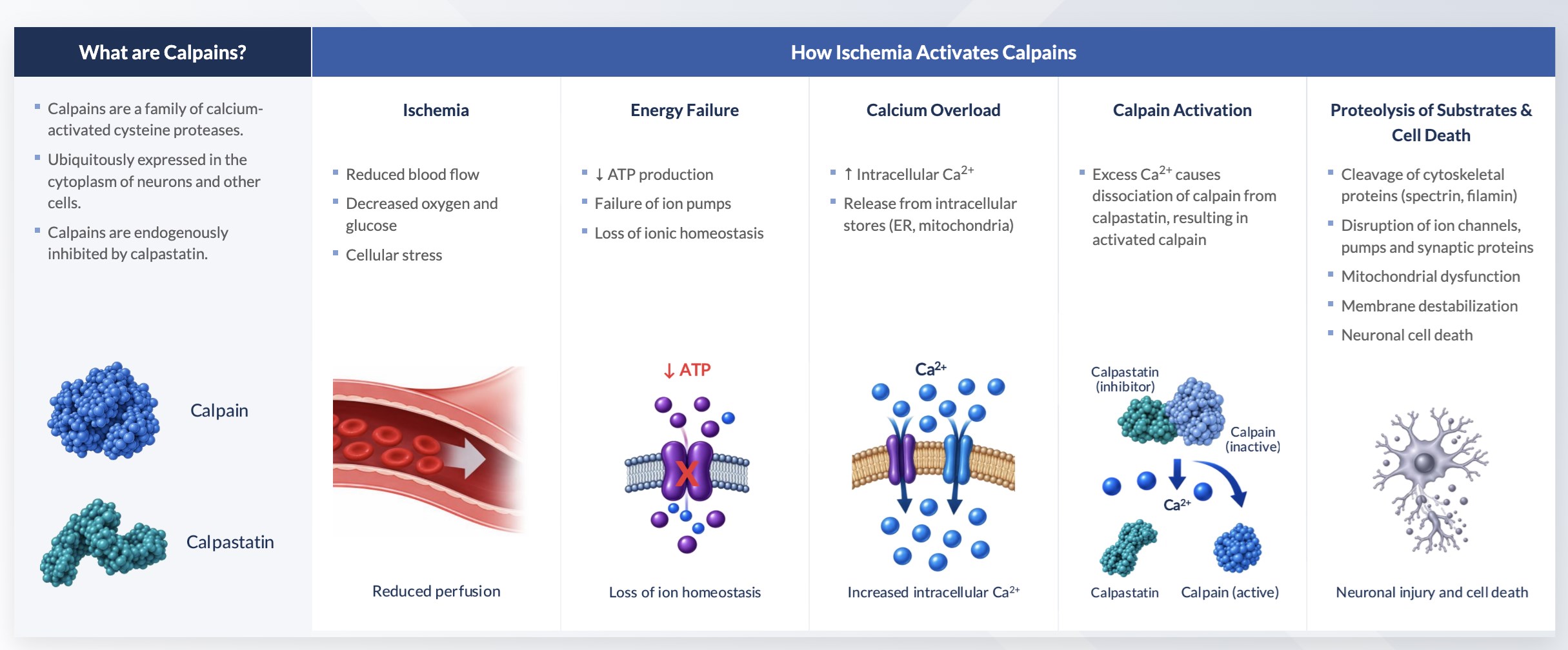
To view an enhanced version of this graphic, please visit:
https://images.newsfilecorp.com/files/8481/321503_b3b0375694a08aac_001full.jpg
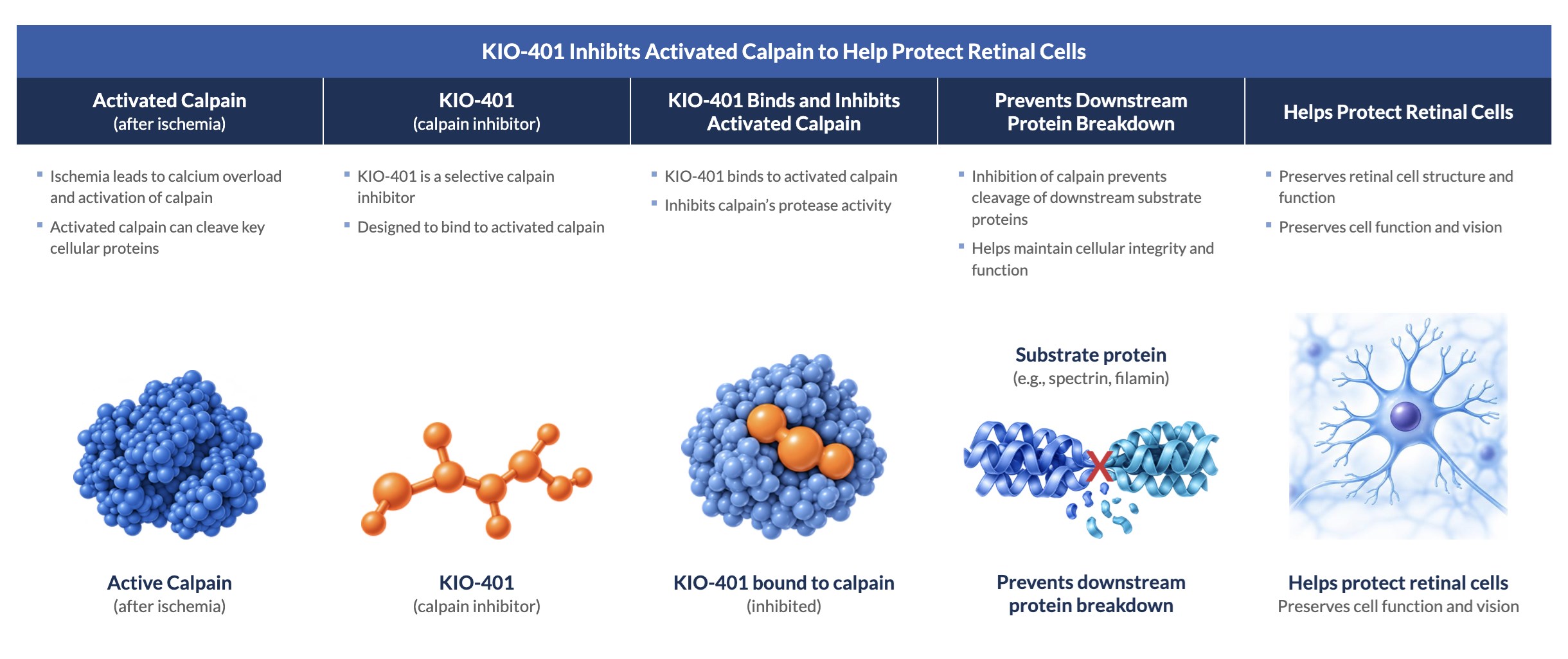
To view an enhanced version of this graphic, please visit:
https://images.newsfilecorp.com/files/8481/321503_b3b0375694a08aac_002full.jpg
In the randomized Phase 2a study in Japan conducted by Senju and its partners, KIO-401 demonstrated a statistically significant improvement from baseline in Early Treatment Diabetic Retinopathy Study (ETDRS) visual acuity compared with a prospective, observational registry (p=0.0398). Senju subsequently completed a randomized, double-masked Phase 3 study in Japan, which demonstrated improvement in best-corrected visual acuity (BCVA), including a statistically significant improvement among patients who were legally blind at baseline according to World Health Organization criteria (p=0.0195).
"CRAO remains an under-recognized medical emergency, and even when diagnosed, there is no approved therapy specifically shown to preserve vision," said Brian Mac Grory, MB BCh BAO, MRCP, Associate Professor of Neurology and Ophthalmology at Duke University School of Medicine and Chair of the writing group for the American Heart Association scientific statement on CRAO. "An effective oral treatment could galvanize systems of care for acute CRAO recognition and management and expand treatment access to patients in regional and community hospitals. The reported clinical trial outcomes are the first encouraging results for a neuroprotective drug for CRAO and strongly support further evaluation of KIO-401."
Planned Clinical Development in CRAO and NAION
Kiora intends to build upon the clinical experience generated by Senju in Japan through a US-focused, multinational Phase 3 registration trial in CRAO. The Company is targeting initiation in 2027, subject to funding and regulatory alignment. The planned randomized, double-masked, controlled trial will evaluate the efficacy and safety of KIO-401 in patients with acute CRAO, with visual function outcomes expected to play a central role in the assessment of treatment benefit. The final study design, including enrollment criteria, primary endpoint and sample size, estimated to be more than 100 patients, will be determined following discussions with regulatory authorities.
"The clinical results generated in Japan support continued global development of this compound as a potential treatment for acute retinal ischemia," said Shuhei Yoshida, President & CEO of Senju Pharmaceutical. "Kiora brings retinal drug development expertise and a focused strategy for advancing the program outside Asia. Combining Senju's expertise in Japan and broader Asia with Kiora's leadership in global development, we view Kiora as a strong partner to lead development in the United States, Europe and other ex-Asia markets, with a shared goal of bringing a new treatment option to patients suffering from these ischemic insults."
In parallel, Kiora plans to advance KIO-401 into Phase 2b clinical development for NAION, an acute ischemic optic neuropathy that can cause substantial and permanent vision loss. The Company believes the shared involvement of ischemia-related cellular injury and calpain activation in CRAO and NAION provides a scientific rationale for evaluating KIO-401 in both indications. Initiation of the NAION study is targeted for 2028, subject to funding and regulatory considerations.
Kiora also intends to evaluate opportunities to expand the KIO-401 platform into additional ophthalmic indications in which calpain-mediated cellular injury may contribute to disease progression, including glaucoma. These potential indications would require further preclinical and clinical evaluation.
License Agreement with Senju Pharmaceutical
Under the terms of the agreement, Kiora has obtained exclusive rights to develop and commercialize KIO-401 outside Asia, while Senju retains rights within Asia. The agreement builds on an existing relationship between the companies involving KIO-301, Kiora's photoswitch therapy in development for advanced retinitis pigmentosa.
Under the license agreement, Kiora will make an upfront payment of
Financing and Clinical Development Strategy
Kiora is evaluating financing alternatives to fund advanced KIO-401 development in CRAO and NAION.
"Our priority is to secure capital to advance KIO-401 through late-stage development while leveraging our existing clinical infrastructure," said Melissa Tosca, CPA, Chief Financial Officer of Kiora. "We will prioritize KIO-401 and partnered KIO-301 while pursuing out-licensing opportunities for KIO-104 following discontinuation of its development."
As KIO-301's Phase 2 ABACUS-2 trial completes enrollment, Kiora expects to transition clinical resources to KIO-401's Phase 3 CRAO program. KIO-301 partner Théa Open Innovation reimburses R&D expenses and holds commercialization rights outside Asia. Kiora is eligible for up to
As Kiora prioritizes investment in KIO-401 and completes the ABACUS-2 trial, the Company made the decision to discontinue research and development of KIO-104. This decision is part of Kiora's portfolio optimization strategy and reflects the Company's current priorities. Kiora will report data from enrolled patients in the KLARITY clinical trial and consider partnering and out-licensing opportunities for the asset.
KO Law PC served as legal counsel to Kiora in connection with the KIO-401 licensing transaction.
About Kiora Pharmaceuticals
Kiora Pharmaceuticals is a late-stage retinal therapeutics company developing small-molecule therapies targeting differentiated biological pathways implicated in vision-threatening diseases.
KIO-401 is an oral, neuroprotective calpain inhibitor in development for central retinal artery occlusion (CRAO) and non-arteritic anterior ischemic optic neuropathy (NAION), two rare, acute ischemic ophthalmic diseases with no approved pharmacologic treatments. Kiora is planning a multinational Phase 3 registration trial in CRAO and a Phase 2b clinical trial in NAION. The KIO-401 platform also has potential applications in additional ophthalmic indications, including glaucoma, where calpain-mediated injury may contribute to disease progression.
KIO-301 is a partnered Phase 2 photoswitch therapy for advanced retinitis pigmentosa. KIO-104, a DHODH inhibitor previously evaluated in the KLARITY clinical trial for retinal inflammation and fibrosis, is available for partnering or out-licensing.
For more information, visit www.kiorapharma.com.
Forward-Looking Statements
Some of the statements in this press release are "forward-looking" statements made pursuant to the safe harbor provisions of the Private Securities Litigation Reform Act of 1995. These statements include, without limitation, statements concerning Kiora's planned development and potential commercialization of KIO-401; the anticipated timing, design, initiation, conduct, enrollment, endpoints and results of clinical trials in CRAO and NAION; the potential efficacy, safety, therapeutic benefit and commercial opportunity of KIO-401; the interpretation and applicability of clinical results generated by Senju Pharmaceutical in Japan; the potential for calpain inhibition in additional ophthalmic indications; anticipated regulatory interactions and approvals; the ability to leverage existing clinical development infrastructure; the expected progression of the KIO-301 program and related clinical operations; the Company's plans for KIO-104; the expected capital requirements associated with its development programs, including the clinical trials of KIO-401 in CRAO and NAION; and Kiora's ability to secure additional financing to support its operations.
These forward-looking statements are based on management's current expectations and assumptions and involve risks and uncertainties that could cause actual results to differ materially from those expressed or implied. Such risks include, among others, uncertainties associated with clinical development and regulatory review; the possibility that results observed in previous clinical studies will not be reproduced in future trials; the cost, timing, enrollment, conduct and outcomes of clinical trials; the ability to obtain sufficient capital to fund planned development activities; the availability and terms of future financing; the potential dilution to existing stockholders; the Company's ability to execute its development strategy and licensing obligations; and other risks described under "Risk Factors" in Kiora's Annual Report on Form 10-K filed with the SEC on March 25, 2026, and in its subsequent filings with the SEC.
Kiora's results may also be affected by factors of which the Company is not currently aware. Forward-looking statements speak only as of the date of this release. Except as required by law, Kiora undertakes no obligation to publicly update or revise any forward-looking statement to reflect subsequent events, circumstances or changes in expectations.
Contacts
Investors
Investors@kiorapharma.com
Media
Susan Sharpe
Linnden Communications
susan@linndencom.com
To view the source version of this press release, please visit https://www.newsfilecorp.com/release/321503
FAQ
AI-generated questions and answers. How Rhea-AI works. Not financial advice.
What rights and payment obligations does Kiora's KIO-401 license include?
Kiora obtained exclusive development and commercialization rights outside Asia, while Senju retains Asian rights. Kiora owes $3.5 million upfront, followed by a low-teen-million payment upon technology transfer expected in 2027. Additional specified regulatory and commercial milestones and single-digit royalties on applicable net sales outside Asia also apply.
What did Kiora's KIO-401 clinical studies in Japan show?
The Phase 2a study showed statistically significant visual-acuity improvement from baseline versus a prospective observational registry (p=0.0398). The randomized, double-masked Phase 3 study showed improved best-corrected visual acuity, including statistically significant improvement among patients legally blind at baseline under World Health Organization criteria (p=0.0195).
How does Kiora plan to design its KIO-401 Phase 3 CRAO trial?
Kiora plans a US-focused, multinational, randomized, double-masked, controlled trial evaluating efficacy and safety in acute central retinal artery occlusion. Visual-function outcomes are expected to be central to assessing benefit. Enrollment criteria, the primary endpoint and sample size, estimated at more than 100 patients, will be determined after regulatory discussions.
Will Kiora report KIO-104 KLARITY results after discontinuing development?
Kiora plans to report data from patients enrolled in the KLARITY trial despite discontinuing KIO-104 research and development. The company will also consider partnering and out-licensing opportunities for the asset.