
Lockheed Martin-built Orion Spacecraft Sends Astronauts Moonward for the First Time in 53 Years
Lockheed Martin (NYSE: LMT) built the Orion spacecraft that launched April 1, 2026 on NASA's Artemis II, a 10-day crewed test flight returning humans to lunar vicinity for the first time in 53 years.
Sentiment and the balance of points
Rhea-AI Sentiment reads the wording of the document, how positive or negative its language is on a 1 to 5 scale. The balance of points shown with the takes weighs what the document actually discloses, so the two can disagree, for example when a trial that missed its main goal is described in upbeat language.
Rhea-AI Summary
Lockheed Martin (NYSE: LMT) built the Orion spacecraft that launched April 1, 2026 on NASA's Artemis II, a 10-day crewed test flight returning humans to lunar vicinity for the first time in 53 years. Four crew members will orbit Earth, travel nearly 250,000 miles, and fly about 5,000 miles beyond the Moon's far side.
The spacecraft named Integrity carries upgraded environmental life support, updated crew displays, an experimental laser communications link, a launch abort system, exercise and hygiene systems, and a waste management bay. Splashdown is planned April 10 off San Diego.
Positive
- Launch completed April 1, 2026 initiating Artemis II
- 10-day mission providing deep-space systems and human-health data
- New systems onboard: laser comms, life support, abort capability
Negative
- Crewed test flight inherently exposes schedule and operational risk during 10-day mission
- Mission-dependent visibility may cause short-term stock sentiment swings tied to mission milestones
Details
News Market Reaction – LMT
On Apr 2, the first trading day after this news, LMT closed 0.83% above the previous close.
Data tracked by StockTitan Argus for the Apr 2 session.
Key Figures
- Launch time
- 6:35 p.m. ET
- Artemis II Orion launch from Kennedy Space Center
- Crew size
- 4 astronauts
- First crewed Artemis II Orion mission
- Mission duration
- 10 days
- Artemis II crewed test flight length
- Distance beyond Moon
- nearly 5,000 miles
- Planned distance beyond far side of the Moon
- Max distance from Earth
- almost 250,000 miles
- Planned maximum distance from Earth during mission
- Re-entry speed
- 30 times speed of sound
- Orion atmospheric re-entry on return to Earth
- Splashdown speed
- just under 20 mph
- Speed at splashdown in Pacific Ocean
Historical Context
-
Opened Rapid Fielding Center to speed prototype development and production.
-
Framework to quadruple Precision Strike Missile production capacity.
-
ForwardEdge ASIC partnership to embed neuromorphic AI in edge systems.
-
CEO and CFO scheduled to speak at Citi industrial tech conference.
-
Declared $3.45 per share first‑quarter 2026 dividend.
24h Move is the share-price change in the day after each event; other market factors may also have contributed.
Key Terms
space launch system technical
environmental control and life support systems technical
launch abort system technical
laser communication system technical
free-return trajectory technical
AI-generated analysis. How Rhea-AI works. Not financial advice.




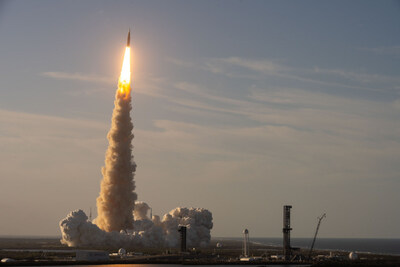
For this first crewed test flight of the Artemis program, Orion is carrying four crew members – NASA astronauts Reid Wiseman, Victor Glover and Christina Koch, and Canadian Space Agency astronaut Jeremy Hansen. During the 10-day mission, the astronauts will complete two orbits around Earth before traveling nearly 5,000 miles beyond the far side of the Moon and almost 250,000 miles from Earth.
"Today's launch is just the beginning of this mission, where we look forward to testing the Orion systems and proving it will be capable of transporting crews to the lunar surface and return them home," said Robert Lightfoot, president, Lockheed Martin Space. "This historic moment marks a renewed journey to the Moon and a critical step toward future crewed landings."
What's New on Orion Artemis II
The Orion spacecraft for this mission – named Integrity by its astronaut crew – features several new systems to help keep humans safe in deep space. These include:
- Environmental control and life support systems, critical to keep the crew safe and comfortable
- Updated displays and controls for the crew to fly Orion
- Audio communications including an experimental laser communication system to communicate with NASA mission control in
Houston - Fully functional Launch Abort System to pull Orion and the crew to safety in the event of an emergency during launch
- Exercise machine, potable water and galley to maintain strength, hydration and nutrition
- Waste management system and hygiene bay, a first for a deep space mission
An Epic 10-Day Journey
Over the 10-day mission, the crew will perform a multitude of critical system checkouts, including a proximity maneuvering demo, to verify the vehicle's readiness for deep space operations. They will travel on a free-return trajectory around the Moon – conducting observations and imaging of the far side lunar surface – that will generate essential data on spacecraft performance and human health in deep space to enable future landing missions.
On April 10, after completing its 10-day mission around the Moon, Orion and its crew will re-enter the Earth's atmosphere at 30 times the speed of sound and then slow down to just under 20 mph, splashing down in the Pacific Ocean off the coast of
"Our team has poured years of precision, problem solving and passion into building Orion and seeing it on its way to taking astronauts around the Moon in this test flight is incredible," said Kirk Shireman, VP and Orion program manager at Lockheed Martin Space. "We are excited for this mission to prepare for future crewed flights, seeing humans go farther than we've gone before and proving the Moon is once again within our reach."
The public can track Orion and its crew in real time during the mission, including distances from the Earth and Moon, mission duration, and more. NASA's Artemis Real-time Orbit Website (AROW) will create visuals from Orion data. Updates will also be sent out in real-time over Lockheed Martin Space's X channel.
About Lockheed Martin
Lockheed Martin is a global defense technology company driving innovation and advancing scientific discovery. Our all-domain mission solutions and 21st Century Security vision accelerate the delivery of transformative technologies to ensure those we serve always stay ahead of ready. More information at Lockheedmartin.com.

 View original content to download multimedia:https://www.prnewswire.com/news-releases/lockheed-martin-built-orion-spacecraft-sends-astronauts-moonward-for-the-first-time-in-53-years-302732167.html
SOURCE Lockheed Martin
FAQ
AI-generated questions and answers. How Rhea-AI works. Not financial advice.