
Lunai Bioworks (NASDAQ: LNAI) Launches National Chemical Defense Consortium Targeting $400M-$1.2B U.S. Countermeasure Programs; 3-Year AI Antidote Development Model
Lunai Bioworks (NASDAQ: LNAI) launched the Pathfinder Consortium on March 19, 2026, a national academic–industry alliance to accelerate chemical countermeasure discovery and federal stockpiling.
Sentiment and the balance of points
Rhea-AI Sentiment reads the wording of the document, how positive or negative its language is on a 1 to 5 scale. The balance of points shown with the takes weighs what the document actually discloses, so the two can disagree, for example when a trial that missed its main goal is described in upbeat language.
Rhea-AI Summary
Lunai Bioworks (NASDAQ: LNAI) launched the Pathfinder Consortium on March 19, 2026, a national academic–industry alliance to accelerate chemical countermeasure discovery and federal stockpiling.
The consortium aims to compress countermeasure development to ~36 months and target U.S. procurement programs sized between $400M and $1.2B per program, leveraging BioSymetrics' AI phenotypic platform and multi‑partner execution.
Positive
- 36-month accelerated countermeasure development timeline
- Targets $400M–$1.2B U.S. federal procurement programs per program
- Leverages proprietary AI-enabled phenotypic and high-throughput vertebrate screening
- Access to non-dilutive funding and large federal programs (BARDA, DoD, DHS)
Negative
- Dependence on federal awards and procurement cycles for material revenue
- Program success conditional on regulatory validation and animal/human study outcomes
Details
News Market Reaction – LNAI
On Mar 19, the day this news came out, LNAI closed 4.21% below the previous close.
Data tracked by StockTitan Argus for the Mar 19 session.
Key Figures
- Program procurement range
- $400 million–$1.2 billion
- Typical U.S. government stockpiling program size for validated countermeasures
- Regulatory timeline
- 3 years
- Targeted regulatory pathway for chemical countermeasures
- Traditional drug timeline
- 10 years
- Conventional pharmaceutical development cycle cited for contrast
- Phase I size
- 50 persons
- Planned Phase I safety study in Pathfinder model
- Development duration
- 36 months
- Stated time to complete full countermeasure development process
- AUROC
- 0.94
- AI model performance for distinguishing active AChE inhibitors
- AUD affected individuals
- ~30 million
- U.S. individuals affected by Alcohol Use Disorder
- AUD economic cost
- ~$250 billion
- Annual U.S. economic cost of Alcohol Use Disorder
Previous AI Reports
-
Issuance of core AI patent for debiasing drug discovery predictions.
-
CNBC segment highlighting Lunai’s AI drug discovery and biodefense platform.
-
Launch of Sentinel AI tool to block generation of novel chemical weapons.
-
Completion of NIH milestone and launch of AUD AI drug-discovery program.
-
Reported strong AI performance (AUROC 0.94) for detecting neurotoxic compounds.
24h Move is the share-price change in the day after each event; other market factors may also have contributed.
Key Terms
phase i medical
zebrafish models medical
high-throughput technical
phenotypic medical
machine learning technical
AI-generated analysis. How Rhea-AI works. Not financial advice.




AI platform integrates academic and defense research to accelerate rapid antidote discovery and federal stockpiling for emerging chemical threats.
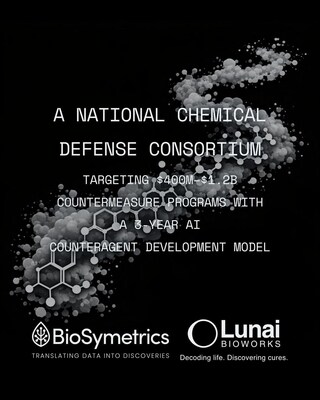
For decades, America's chemical defense capabilities have existed in fragmented silos: academic toxicology labs, military research units, federal agencies, and biotech innovators operating independently. Pathfinder integrates these capabilities into a coordinated framework engineered for speed, capital efficiency, and national readiness.
A 3-year regulatory pathway, not a 10-year drug timeline
Unlike traditional pharmaceutical development cycles, chemical countermeasures can follow accelerated regulatory pathways.
The Pathfinder model is structured to:
- Demonstrate efficacy in yeast and cell-based systems
- Validate therapeutic effects in FDA-recognized zebrafish models
- Complete two confirmatory animal studies
- Conduct a 50-person Phase I safety study
The full process can be completed in approximately 36 months.
In many cases, existing FDA-approved drugs may be repurposed, potentially reducing timelines even further.
"Chemical defense cannot operate on a decade-long pharmaceutical clock," said David Weinstein, CEO of Lunai Bioworks. "The regulatory framework allos for speed, and Pathfinder is designed to execute within that accelerated pathway."
Responding to the new invisible battlefield
With rising geopolitical tensions in
The modern battlefield is no longer confined to visible front lines. It is algorithmic. It is airborne. It is chemical.
Pathfinder represents a strategic response, a scalable national platform positioned for what the Company envisions as a potential "Warp Speed 2" era of chemical preparedness.
Strategic and financial significance
Validated countermeasures are typically procured by the
By mobilizing and organizing national capabilities, Pathfinder positions BioSymetrics to:
- Access non-dilutive funding sources Compete for BARDA, DoD, and Homeland Security programs
- Pursue large-scale federal procurement contracts
- Monetize repurposed compounds through rapid deployment pathways
- Diversify revenue beyond traditional biotech development cycles
The Consortium leverages BioSymetrics' proprietary AI-enabled phenotypic platform, integrating machine learning analytics with high-throughput vertebrate screening to rapidly identify toxicologic signatures and therapeutic leads.
National Leadership and Execution Framework
Pathfinder includes collaboration with nationally recognized experts, including:
- Dr. Calum MacRae (Brigham and Women's Hospital and Harvard Medical School)
- Dr. Vik Bebarta (Colonel,
U.S. Air Force Reserve; University ofColorado ) - Dr. Randall Peterson (University of
Utah ) - Dr. Vincent Jo Davidson (Purdue University)
By aligning academic, military, and AI-driven biotech capabilities under a single operational structure, Pathfinder transitions chemical defense from a fragmented research model into an execution-oriented national preparedness platform.
About Lunai Bioworks
Lunai Bioworks (NASDAQ: LNAI) is an AI-enabled biotechnology company advancing rapid in vivo phenotypic drug discovery across CNS and biodefense applications. By integrating high-throughput vertebrate screening with machine learning analytics, Lunai seeks to accelerate therapeutic discovery while reducing cost, time, and capital intensity.
For more information, visit www.lunaibioworks.com.

 View original content to download multimedia:https://www.prnewswire.com/news-releases/lunai-bioworks-nasdaq-lnai-launches-national-chemical-defense-consortium-targeting-400m1-2b-us-countermeasure-programs-3-year-ai-antidote-development-model-302718827.html
SOURCE Lunai Bioworks Inc.
FAQ
AI-generated questions and answers. How Rhea-AI works. Not financial advice.