
John Hancock and MIT AgeLab: Americans Recognize Importance of Preparing for Longer Lives but Actual Readiness Lags
John Hancock, a unit of Manulife (MFC), and MIT AgeLab released their second annual index measuring Americans’ preparedness for longer lives.
Sentiment and the balance of points
Rhea-AI Sentiment reads the wording of the document, how positive or negative its language is on a 1 to 5 scale. The balance of points shown with the takes weighs what the document actually discloses, so the two can disagree, for example when a trial that missed its main goal is described in upbeat language.
Rhea-AI Summary
John Hancock, a unit of Manulife (MFC), and MIT AgeLab released their second annual index measuring Americans’ preparedness for longer lives. The 2026 Longevity Preparedness Index averaged 60 out of 100, unchanged from 2025 across eight domains. Community scored 71 and social connection 69, while care scored 43 and home and health each scored 56. Life transitions improved by 2 points.
Respondents who work with financial professionals scored 67 overall, compared with 58 for those who have never worked with one. John Hancock is using the findings to support customer planning resources and offers a public, 10-minute preparedness questionnaire developed with MIT AgeLab.
AI-generated analysis. How Rhea-AI works. Not financial advice.


- Second annual Longevity Preparedness Index shows continued need for improvement despite growing awareness, with care the weakest area of readiness and community and social connection the strongest
- John
Hancock turns insights into action with targeted support to help customers prepare for longer, healthier, better lives
"The data tells us that awareness – while profoundly important – is not enough," said Brooks Tingle, President and CEO, John Hancock. "Most Americans are living longer, but the systems, policies, workplaces, and support needed to help them thrive have not kept pace. The next chapter of longevity leadership must be about turning insight into collective action. How we answer this call will define the resiliency of future generations."
Key LPI Insights
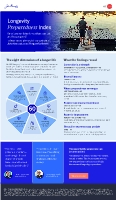
Longevity preparedness in the US in 2026 remains low with respondents scoring an average 60 out of a possible 100, unchanged from 2025, across the eight domains of aging. Results show:
- Americans are most prepared in the community (71) and social connection (69) domains.
- Americans appear slightly more prepared this year (2026 vs. 2025) in the life transitions domain (2 points higher).
- Americans continue to have the greatest room for improvement in the care (43), home (56), and health (56) domains, underscoring the need to actively plan for future care needs.
- Those who work with financial professionals score higher (67) than those who have never worked with financial professionals (58) overall, and within each domain.
"Our research is clear: people who work with a financial professional are better prepared for longer lives, not only financially, but across key aspects of overall well-being," said Wayne Park, CEO, Manulife John Hancock Retirement. "Preparing for longevity requires a fulsome plan. Financial professionals can help people connect the dots between their finances, health, caregiving responsibilities and life transitions so they can approach the future with greater confidence."
Taking Action
John
- Helping families prepare for caregiving and aging at home through planning resources and access to John Hancock Pathways,* an aging-well platform that provides eligible policyholders personalized guidance, incentives and rewards to help build healthy habits and support lasting independence.
- Offering the industry-leading John Hancock Vitality Program, which includes access to prevention and early detection technology to help translate health awareness into action. Depending on eligibility, some offers for life insurance, wealth, or retirement customers include access to technology-enabled tools like GRAIL's Galleri, Prenuvo and Function Health, as well as heart-health resources that provide personalized insights and can help people take earlier, more informed steps to protect their healthspan.
- Investing in resources, education, and platforms – including the Longer. Healthier. Better. Network – to equip financial professionals with access to longevity subject matter experts, dedicated sales support, business-development opportunities, and turnkey resources that help them bring health, care, home, life transitions, and financial security into more fulsome client conversations.
- Supporting overall longevity preparedness with John Hancock's Longevity Preparedness Tool, an interactive 10-minute questionnaire built with the MIT AgeLab, which assesses individuals' readiness across the same eight domains as the LPI, offering actionable insights for meaningful improvement. The tool is available to the broader public here.
"Preparedness for longer lives is one of the defining economic and social challenges of the 21st century," said Dr. Joe Coughlin, Founder and Director, MIT AgeLab. "The conversation can no longer be just about how much money you've saved for retirement. More Americans need to be asking themselves, 'Where will I live?' 'Who will I live with?' and 'Who will take care of me?' And more organizations need to be thinking about how they can help people make meaningful progress."
The full 2026 Longevity Preparedness Index findings and personal assessment tool can be found at www.johnhancock.com/prepareforbetter.
Longevity Preparedness Index Methodology
The LPI was conducted online and by phone interview in English, sourced through the NORC AmeriSpeak Panel. The sample was a US representative sample comprised of 1,340 Americans, aged 18 and up, with specific oversamples of Non-Hispanic Black panelists, Hispanic panelists, and Non-Hispanic Asian American and Pacific Islander panelists to ensure adequate sample size for sub-group analysis. During analysis, survey responses were weighted to represent the US population. Survey data were collected from May 8th, 2026, to May 26th, 2026.
LPI scores can range from 0 (not at all prepared for longevity) to 100 (completely prepared for longevity). The overall LPI is composed of 8 domains. Each domain captures positive behaviors toward longevity preparedness and awareness of the importance of a domain. Domain scores are each calculated independently and can range from 0 to 100. All eight domain scores are averaged to calculate an overall LPI score.
The Longevity Preparedness Index was developed in collaboration with MIT Age Lab and funded by John Hancock. John
About John Hancock and Manulife
John Hancock is a unit of Manulife Financial Corporation, a leading international financial services provider that helps people make their decisions easier and lives better by providing financial advice, insurance, and wealth and asset management solutions. Manulife Financial Corporation trades as MFC on the TSX, NYSE, and PSE, and under 945 on the SEHK. Manulife can be found at manulife.com.
One of the largest life insurers in the United States, John Hancock supports more than ten million Americans with a broad range of financial products, including life insurance and annuities. John Hancock also supports US investors by bringing investment capabilities and retirement planning and administration expertise to individuals and institutions. Additional information about John Hancock may be found at johnhancock.com.
Disclosures
*John Hancock Pathways is a platform provided by Personify Health, Inc. ("Personify Health"), made available to eligible policyholders with policies issued or administered by John Hancock. The materials available on Personify Health's website are neither provided by, nor do they constitute an endorsement by John Hancock. John Hancock Pathways is not owned or operated by John Hancock or its affiliates. John Hancock and Personify Health are independent companies. John Hancock does not provide medical services or advice and is not involved in the design or provision of the services provided by or through Personify Health's website (John Hancock Pathways) or mobile app. The services and their availability are subject to change and may be discontinued at any time.
John Hancock does not provide medical advice. Vitality is the provider of the John Hancock Vitality Program in connection with life insurance policies issued by John Hancock. John Hancock Vitality Program rewards and discounts are available only to the person insured under the eligible life insurance policy.
John Hancock is not an affiliate of any external third-party products or services offered or made available under the John Hancock Vitality Program (hereinafter "External Provider(s)"). External Providers are independent third parties that offer discounts, rewards, or other promotional benefits to their products or services. External Providers are not sponsors of the John Hancock Vitality Program.
Products and/or services offered by any External Provider are not administered, designed, distributed, or manufactured by John Hancock. John Hancock is not responsible for the accuracy, quality, or performance of any External Providers' products or services. Products or services offered under the John Hancock Vitality Program are not insurance and are subject to change.
Access to External Providers' products or services offered through the John Hancock Vitality Program to eligible insureds are not currently available in all states and are subject to change. Each External Provider offer is subject to its own terms, conditions, and eligibility requirements determined by John Hancock and/or the External Provider in their sole discretion.
Insurance policies and/or associated riders and features may not be available in all states.
This material is not an endorsement of any particular product, service or organization; nor is it intended to provide financial, investment, insurance, or health advice. It is intended to promote awareness and is for educational purposes only. This material and the Longevity Preparedness Index Score are provided solely for informational and educational purposes. Results are general in nature and do not account for an individual's specific financial, health, or personal circumstances. One should not solely rely on score results when making decisions regarding future preparations and should independently evaluate their options and circumstances before taking any action.
Insurance products are issued by: John Hancock Life Insurance Company (U.S.A.), Boston, MA 02116 (not licensed in New York) and John Hancock Life Insurance Company of New York, Valhalla, NY 10595 and securities offered through John Hancock Distributors LLC through other broker/dealers that have a selling agreement with John Hancock Distributors LLC., 200 Berkeley Street, Boston, MA 02116.
John Hancock Retirement Plan Services LLC, 200 Berkeley Street, Boston, MA 02116.
Media Contact
news@jhancock.com
MGR1005265973371

 View original content to download multimedia:https://www.prnewswire.com/news-releases/john-hancock-and-mit-agelab-americans-recognize-importance-of-preparing-for-longer-lives-but-actual-readiness-lags-302920721.html
SOURCE John Hancock
FAQ
AI-generated questions and answers. How Rhea-AI works. Not financial advice.
What did John Hancock’s 2026 Longevity Preparedness Index find?
Americans’ average preparedness score was 60 out of 100, unchanged from 2025. Community and social connection had the highest scores, at 71 and 69 respectively. Care had the lowest score at 43, followed by home and health at 56 each.
How was John Hancock’s 2026 Longevity Preparedness Index conducted?
The research surveyed 1,340 Americans aged 18 and up online and by phone in English through the NORC AmeriSpeak Panel. Data were collected from May 8 to May 26, 2026, and responses were weighted to represent the US population. John Hancock funded the research but did not influence its findings, methodology or conclusions.