
STOCK TITAN

MAYFAIR GOLD REPORTS FINAL POSITIVE RESULTS AND ANALYSIS FROM GRADE CONTROL DRILLING PROGRAM

(Neutral)
Tags

Mayfair Gold (NYSE American:MINE) reported final positive results from its 2025 grade control drilling program at the Fenn-Gib project. The tight-spaced drilling confirmed about 1.0M tonnes of ore-grade material classified as probable reserves in the PFS, roughly 25% of Phase 1.

For blocks above 3.0 g/t Au, the grade control model outlined 28% more tonnes at 7% higher grade, equating to 37% more gold than the reserve model in the test area. The results validate the mineral reserve block model in the starter pit, support early high-grade production scheduling, and are expected to aid future project financing discussions. Findings apply only to the specific 60 x 70 metre test area.

Loading...
Loading translation...

Positive

  • Grade control validates reserve model for ~1.0M tonnes, ~25% of Phase 1
  • Higher-grade >3.0 g/t Au: 28% more tonnes, 7% higher grade, 37% more gold
  • Results support de-risking of early high-grade feed and cash flow profile
  • Improved confidence in early cash flows may support project financing talks
  • Tighter-spaced drilling enhances confidence in ore boundary definition

Negative

  • Results are limited to one 60 x 70 metre test area only
  • Conclusions apply only to areas with similar ore characteristics and behavior

News Market Reaction – MINE

-2.63%
1 alert
-2.63% Session close to close
$168.52M Market Cap
0.8x Rel. Volume

In the Jun 18 session, MINE declined 2.63%, reflecting a moderate negative market reaction.

Data tracked by StockTitan Argus on the day of publication.

Market Context

This announcement confirms more high-grade tonnes and close alignment with the reserve model in a ke...
Analysis

This announcement confirms more high-grade tonnes and close alignment with the reserve model in a key starter pit area. Past news has drawn mixed reactions, and future financing or execution steps remain an important risk to monitor.

Key Figures

Grade control tonnage: 1.0M tonnes Phase 1 portion: 25% Cut-off grade: 0.8 g/t Au +5 more
8 metrics
Grade control tonnage 1.0M tonnes Probable mineral reserves tested from 2026 PFS Phase 1
Phase 1 portion 25% Share of Phase 1 probable reserves covered by GC program
Cut-off grade 0.8 g/t Au Threshold used to compare GC and reserve models
Contained metal uplift 2% more contained metal GC model vs reserve model at 0.8 g/t Au cut-off
High-grade tonnage increase 28% more tonnes Material above 3.0 g/t Au COG in GC model
High-grade grade lift 7% higher grade Material above 3.0 g/t Au COG in GC model
Drill holes 56 diamond drill holes Grade control program nominally to 75 metres depth
Drill spacing 10-by-10 metre spacing Grade control drilling grid over 60 x 70 metre area

Historical Context

5 past events · Latest: May 28 (Neutral)
Pattern 5 events
Date Event Sentiment 24h Move Catalyst
May 28 Project hire Neutral +7.0% Appointment of Director of Projects to advance Fenn-Gib toward development.
May 21 Exploration update Neutral -4.9% Launch of regional exploration program across newly acquired Timmins properties.
May 13 Q1 2026 results Neutral +0.0% Release of Q1 2026 operating and financial results and project update reference.
May 13 Management hires Neutral -3.5% Addition of VP Exploration and VP Mineral Resource Management for Fenn-Gib and district.
May 04 CEO transition Neutral +0.7% Appointment of new CEO with prior role leading Fenn-Gib PFS and FEED work.

24h Move is the share-price change in the day after each event; other market factors may also have contributed.

Pattern Detected

Recent news has produced mixed reactions, with both double-digit basis-point gains and declines following project and management updates.

Key Terms

grade control, cut-off grade, inverse distance squared, quality assurance/quality control (qa/qc), +2 more
6 terms
grade control technical
"final results and evaluation of the tight-spaced Grade Control ("GC") drilling program"
Grade control is the process used by mining and resource companies to measure and manage how rich or poor rock and ore are before they go into production, like checking the ripeness of fruit before it’s packed. It matters to investors because accurate grade control helps companies decide what to mine and when, directly affecting how much saleable material is produced, processing costs, and expected revenue — similar to choosing the best fruit to sell to maximize profit.
cut-off grade technical
"At a 0.8 g/t Au cut-off grade, the Grade Control model returned"
The cut-off grade is the minimum concentration of a mineral in rock that makes extraction and processing economically worthwhile; material below that level is treated as waste. It sets the boundary between ore and waste and directly affects reported reserves, projected mine life, and expected profits. Think of it like deciding which fruit on a tree is worth picking after accounting for the time and cost to harvest — raising or lowering that threshold can change how much “good” product a project appears to have.
inverse distance squared technical
"estimated on five-cubic-metre blocks using an inverse distance squared methodology"
Inverse distance squared is a rule that says the influence or intensity of something falls off proportionally to the square of the distance from its source: double the distance and the effect becomes one quarter. Investors encounter this in models that weight nearby events or data more heavily—for example, how local market shocks, pollutant exposure, or sensor readings affect valuations—so it helps quantify how quickly impact weakens with distance, like a light that gets dim much faster as you step away.
quality assurance/quality control (qa/qc) technical
"Mayfair Gold maintains a Quality Assurance/Quality Control (QA/QC) program aligned"
Quality assurance and quality control (QA/QC) are the systems a company uses to prevent defects and verify products, services, or data meet agreed standards—think of QA as the company’s rulebook and QC as the spot checks that catch mistakes. Investors care because strong QA/QC reduces costly recalls, regulatory fines, and reputation damage, supports reliable revenue, and makes a company’s results and guidance more predictable—similar to regular maintenance keeping a car running safely and reliably.
fire assay technical
"meets the ISO/IEC 17025 standards for gold analysis by fire assay with gravimetric finish"
Fire assay is a laboratory process used to accurately measure the amount of precious metals, like gold or silver, in a sample of ore or material. It involves heating the sample intensely to separate the metals from other substances, much like melting and purifying metal to determine its purity. This method is important to investors because it provides precise data on the metal content, helping to assess the value of mining operations or mineral deposits.
iso/iec 17025 technical
"accredited by the Canadian Association for Laboratory Accreditation Inc. (CALA) and meets the ISO/IEC 17025 standards"
An internationally recognized accreditation for testing and calibration laboratories that confirms they produce reliable, traceable results and follow consistent quality controls. Think of it like a professional license for labs: it shows their methods, equipment and staff competence meet independent standards, which matters to investors because accredited test data lowers technical and regulatory risk, supports product claims, and can speed approvals, supplier selection, and market trust.

AI-generated analysis. How Rhea-AI works. Not financial advice.

See more from StockTitan in Google Search and AI answers. Adds StockTitan as a preferred source · opens Google
Add on Google

TORONTO, June 18, 2026 /PRNewswire/ - Mayfair Gold Corp. ("Mayfair", "Mayfair Gold", or the "Company") (TSXV: MFG) (NYSE American: MINE) is pleased to announce final results and evaluation of the tight-spaced Grade Control ("GC") drilling program.

Highlights and analysis from the Grade Control ("GC") drilling test area1:

  • Grade Control program tested ~1.0M tonnes of the probable mineral reserves from the 2026 Pre-Feasibility Study (the "PFS")2, about 25% of Phase 1
  • Reserve model validated in test area
  • At a 0.8 g/t Au cut-off grade, the Grade Control model returned the similar grade as the reserve model, with approximately 2% more contained metal
  • 28% more tonnes at 7% higher grade for material above 3.0 g/t Au
  • De-risking of early years' high-grade feed and cash flow profile
  • Improved confidence in early cash flows will facilitate project financing discussions with counter parties
  • Potential to bring forward higher-grade production

Mayfair Gold reports positive results from the analysis of the grade control ("GC") program completed in late 2025 at the Fenn-Gib Project, confirming approximately 1 million tonnes of ore-grade material that was categorized as probable reserves in the PFS, or roughly 25% of the Phase 1 planned design. The program was designed to validate the distribution and continuity of mineralization and refine planning assumptions related to ore shapes, dilution and ore loss. Previous, interim results were released in the News Release dated February 11, 2026.

Drew Anwyll, P.Eng Mayfair's CEO said, "The grade control drilling program has reinforced our confidence and further de-risked the FennGib deposit. The results confirm that the Mineral Reserve Estimate is an accurate representation of the orebody, demonstrating strong predictability between the model and what we are seeing in the field. Importantly, the program gives us confidence that the highgrade material scheduled for the early years of the mine plan is present and can be delivered as modeled. Grade control drilling has also identified the potential strengthening of the early production profile by utilizing more tonnes of a higher-grade material."

_________________________

1 Please note: The results, analysis and conclusions from the Grade Control program are specific to the area tested. Readers should not infer that these results are representative of, or applicable to, the remainder of the Mineral Reserve or Mineral Resource Estimate.

2 Please refer to the technical report entitled "Fenn-Gib Gold Project NI 43-101 Technical Report and pre-Feasibility Study" dated effective December 19, 2025 available on SEDAR+ at www.sedarplus.ca for further details.

The program included 56 diamond drill holes to a nominal depth of 75 metres, designed to simulate the outcomes of a reverse circulation or blast-hole GC program. Gold grades were estimated in a block model and mineable ore shapes were developed to assess the tonnage and grade of material that could be classified for production.

Results from the program confirmed the mineral reserve model and metal content in the area tested while providing valuable information of contacts between high- and low-grade material. For material above a 0.80 g/t gold cut-off grade ("COG"), the GC model returned similar grade and 2% more tonnes than predicted by the probable reserve model. For the higher-grade portion, above a 3.0 g/t Au COG, the GC model identified 28% more tonnes at 7% higher grade, representing 37% more gold than the probable reserve model for the GC drilling test area.

The findings support the accuracy of the mineral reserve block model in the Stage 1 starter pit area tested and validate the higher-grade component of the mineral reserve for mine planning. The results also suggest there may be opportunities to process higher-grade ore earlier in the initial mining sequence.

The drilling campaign was completed on a 10-by-10 metre spacing across an area measuring 60 by 70 metres. All NQ-size holes were planned as nominally vertical holes to a depth of 75 metres. Overburden thickness encountered during the program ranged from 5.7 to 13.0 metres and averaged 8.7 metres. All core was logged and sampled, with one half submitted for gold assay and the other retained for reference.

Assays were completed on one-metre intervals to capture close-spaced variability and support compositing analysis. Gold assay procedures and QA/QC protocols were consistent with previous Mayfair drilling programs and are summarized in the QA/QC section. Three holes, totalling 78 metres, were abandoned because of excessive downhole deviation and were redrilled from the same locations.

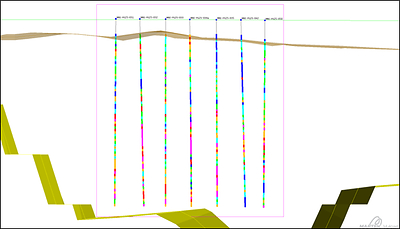
Figure 1: GC drilling test area

Figure 2: 2025 GC drilling cross section 5,375,330N with Phase 1 pit (looking North)

A defined test area surrounding the grade control drilling was used to compare new assay data with the existing exploration database. Within that area, average gold grades were identical at a zero COG. The new grade control drilling returned a slightly higher proportion of material below 0.30 g/t Au, while material above a 0.80 g/t Au COG showed a similar tonnage distribution and a modestly higher grade.

Grade control evaluation

The program targeted approximately 1.0 million tonnes of probable mineral reserves from the PFS. To evaluate the conversion of the mineral reserve model into a production model, all GC assays were composited to 1.5 metres and estimated on five-cubic-metre blocks using an inverse distance squared methodology. Mineable ore shapes were then designed to reflect practical open-pit mining conditions. This methodology therefore addresses the conversion of a reserve to a production model by addressing the minability of economic material.
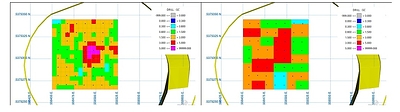
Figure 3: Resource model 5m blocks vs grade control shapes on Levels 5250

These results indicate that, in areas of similar ore characteristics, the current mineral reserve model should provide sufficient definition for mine planning without requiring significant additional dilution, ore loss assumptions or conversion factors. The Company believes the program also highlights the potential to bring forward some gold production by identifying zones of higher-grade material that may be processed earlier in the mine sequence. 

Overall, the program demonstrated that tighter-spaced grade control drilling can enhance confidence in ore boundary definition while confirming the reliability of the existing mineral reserve model in the area tested. Mayfair is evaluating the potential for a second GC test area to assess whether similar results can be replicated in other ore types across the project.

Furthermore, the program highlighted areas of higher-grade material and may potentially allow for processing while deferring lower grade tonnes, thus bringing forward some gold production.

These results further indicate that, for areas with similar ore behavior as the area tested, the reservemodel is an excellent indicator of what the project can expect from production.

QA/QC

Mayfair Gold maintains a Quality Assurance/Quality Control (QA/QC) program aligned with NI 43‑101 requirements and industry best practices. NQ‑size surface drilling was carried out by Black Diamond Drilling of Matheson, Ontario, under the supervision of Mayfair Gold's exploration team. The drill program includes detailed geological logging and systematic sampling of drill core at Mayfair's secure facility in Matheson, Ontario.

Drill core selected for analysis was cut longitudinally using a diamond‑blade saw. One half of the core was retained in the core box for reference, and the other half was bagged, sealed, and prepared for shipment. Analytical work was completed by Swastika Laboratories Ltd. in Swastika, Ontario. Swastika Laboratories is independent of Mayfair Gold and accredited by the Canadian Association for Laboratory Accreditation Inc. (CALA) and meets the ISO/IEC 17025 standards for gold analysis by fire assay with gravimetric finish and fire assay with flame atomic absorption spectroscopy (FAAS) finish.

Samples were delivered directly to Swastika Laboratories by Mayfair personnel. Samples are crushed to minimum 80% passing 1,700 μm. Samples are then split to obtain a 300–500 g sample using a rotary divider. 300–500 g samples are pulverized to minimum 85% passing 74 μm. Gold assays were completed using a 30‑gram fire assay with FAAS finish. Samples returning gold grades greater than 10 g/t were re‑assayed using a 30‑gram fire assay with gravimetric finish. As part of Mayfair's QA/QC protocol, one certified reference material (CRM), one coarse blank, and one coarse duplicate sample were inserted into the sequence of every 25 samples. Routine third‑party check assays are also performed.

All holes in the program were drilled fully vertical (-90° dip) and true thickness is not estimated.

About Mayfair Gold

Mayfair Gold is a Canadian development-stage gold company focused on advancing the 100% controlled Fenn-Gib Project in the Timmins region of Northern Ontario. Fenn-Gib hosts a 4.3 million ounce indicated mineral resource of gold (181.3Mt at an average grade of 0.74 g/t) and the expected strategy outlined in the 2026 Pre-Feasibility Study (the "PFS") is to develop the project under the provincial permitting process, targeting the higher-grade 1 million ounce probable mineral reserve (25.1Mt at an average grade of 1.29g/t) sitting near-surface, highlighting the optionality and scalability provided by the deposit. The PFS also outlines the potential to develop Fenn-Gib into a new Canadian gold producer, with initial development capital of C$450 million, a base-case payback period of 2.7 years, and cumulative free cash flow3 of US$896 million over the first six years of production based on a US$3,100/oz gold price. The Company is advancing permitting activities, detailed engineering, and stakeholder engagement with the goal of starting construction in 2028 with initial production in 2030. The Company also remains focused on exploration around the broader land package with the goal of enhancing mineral resource scale and growth opportunities.

The content of this news release has been reviewed on behalf of the Company and approved by Drew Anwyll, P.Eng., Chief Executive Officer of Mayfair, a QP as defined in NI 43-101.

_____________________________

3 free cash flow does not have a standardized meaning and may not be comparable to similar measures presented by other issuers, referred to as non-GAAP financial measures. As the Company is not in production, the company does not have historical non-GAAP financial measures nor historical comparable measures under IFRS, and therefore the foregoing prospective non-GAAP financial measures may not be reconciled to the nearest comparable measures under IFRS.

Cautionary Note Regarding Forward-Looking Information

This news release contains certain forward-looking information within the meaning of applicable Canadian securities legislation and forward-looking statements within the meaning of applicable United States securities legislation (collectively, "forward-looking information"). The use of the words "will" and "expected" and similar expressions is intended to identify forward-looking information. Forward-looking information in this news release includes, but is not limited to, the expected strategy to develop the project under the provincial permitting process, de-risking of early years' high-grade feed and cash flow profile, the potential to bring forward higher-grade production, targeting the higher-grade mineral reserve, building and operating the Fenn-Gib Project and all disclosure related to the PFS, including commencement of construction and production. Although Mayfair Gold believes that the expectations reflected in such forward-looking information is reasonable, readers are cautioned that actual results may vary from the forward-looking information. The Company has based the forward-looking information on the Company's current expectations and assumptions about future events. This information also involves known and unknown risks, uncertainties, and other factors that may cause actual results or events to differ materially from those anticipated in such forward-looking information, including the risks, uncertainties, and other factors identified in the annual information form and Form 40-F of the Company for the year ended December 31, 2025, available under the Company's profiles on SEDAR+ at www.sedarplus.ca and EDGAR at www.sec.gov, respectively. Furthermore, the forward-looking information contained in this news release is as at the date of this news release, and Mayfair does not undertake any obligation to publicly update or revise any of this forward-looking information except as may be required by applicable securities laws. 

Neither the TSX Venture Exchange ("TSXV") nor its Regulation Services Provider (as that term is defined in the policies of the TSXV) accepts responsibility for the adequacy or accuracy of this news release.

Mayfair Gold Corp Logo

Cision View original content to download multimedia:https://www.prnewswire.com/news-releases/mayfair-gold-reports-final-positive-results-and-analysis-from-grade-control-drilling-program-302803558.html

SOURCE Mayfair Gold Corp.

FAQ

What did Mayfair Gold (NYSE American:MINE) announce about the Fenn-Gib grade control drilling on June 18, 2026?

Mayfair Gold announced final positive results from its 2025 grade control drilling program at the Fenn-Gib project. According to Mayfair Gold, the program confirmed approximately 1.0 million tonnes of ore-grade material already classified as probable mineral reserves in the 2026 Pre-Feasibility Study.

How much of Phase 1 reserves did Mayfair Gold's Fenn-Gib grade control program test?

The grade control drilling tested about 1.0 million tonnes, roughly 25% of the planned Phase 1 probable reserves. According to Mayfair Gold, this tight-spaced program focused on the Stage 1 starter pit area to validate reserve continuity and support mine planning assumptions.

What were the high-grade results above 3.0 g/t Au in Mayfair Gold's Fenn-Gib program (MINE)?

For material above 3.0 g/t Au, the grade control model outlined 28% more tonnes at 7% higher grade. According to Mayfair Gold, this equals 37% more gold than the probable reserve model in the test area, potentially supporting stronger early production scheduling.

How does the Fenn-Gib grade control drilling impact Mayfair Gold's early cash flow outlook?

The results are expected to improve confidence in early high-grade feed and cash flow. According to Mayfair Gold, confirming modeled high-grade zones and identifying additional high-grade tonnes could allow higher-grade ore to be processed earlier in the mine plan.

Does Mayfair Gold’s Fenn-Gib grade control data apply to the entire mineral reserve?

No, the results apply only to the specific grade control test area around the starter pit. According to Mayfair Gold, readers should not infer these outcomes for the remainder of the mineral reserve or resource, as behavior may differ in other ore types.

What drilling setup and spacing did Mayfair Gold use in the Fenn-Gib grade control program?

The program used 56 NQ-size diamond drill holes on a 10-by-10 metre spacing to about 75 metres depth. According to Mayfair Gold, this configuration was designed to simulate reverse circulation or blast-hole grade control drilling in an open-pit environment.

How did Mayfair Gold ensure QA/QC for the Fenn-Gib grade control assays?

Mayfair Gold followed NI 43-101 aligned QA/QC, using an independent CALA-accredited lab and systematic controls. According to Mayfair Gold, protocols included certified reference materials, coarse blanks, duplicates, and third-party check assays, with fire assay and FAAS or gravimetric finishes.
