
MiniMed Launches MiniMed Flex™, its Smallest and Most Discrete Insulin Pump, in Europe
Sentiment and the balance of points
Rhea-AI Sentiment reads the wording of the document, how positive or negative its language is on a 1 to 5 scale. The balance of points shown with the takes weighs what the document actually discloses, so the two can disagree, for example when a trial that missed its main goal is described in upbeat language.
Rhea-AI Summary
MiniMed (Nasdaq: MMED) began commercial shipments of its MiniMed Flex automated insulin delivery system across Europe following an initial customer experience phase. The screenless pump is the company's first app-controlled insulin pump and uses the same SmartGuard algorithm as the MiniMed 780G system.
European CE marking covers individuals aged two years and older with insulin-treated diabetes, including type 1 and type 2 diabetes, and use during pregnancy. The gradual rollout starts with the Simplera Sync sensor; MiniMed plans compatibility with Abbott's Instinct sensor in Europe in 2027. The company also plans wireless software updates for future improvements, including a next-generation algorithm that remains in development and is not yet regulator-approved or commercially available. Clinical findings cited for SmartGuard were obtained in MiniMed 780G users, not a separate Flex study.
How this balance works
Rhea-AI gives every point it takes from this document a weight. Minor counts 1, Moderate 3 and Major 9, so one Major point outweighs several Minor ones. The bar adds up the weights on each side, and when neither side holds more than 65% of the total the balance reads Mixed.
It reads the document as published, with the same rules for every company, and it does not look at what the market expected or at how the stock traded, so a point can be objectively good on a day the stock falls.
Rhea-AI Sentiment measures something else, the tone of the wording.
Hollow bars mark forward-looking points. How the balance works
Positive
- Moderate pointMiniMed Flex commercial shipments began across Europe following an initial customer experience phase.
- Minor pointEuropean CE marking covers insulin-treated diabetes in individuals aged two years and older, including pregnancy use.
- Minor point. Forward-looking: it has not happened yet and may not happen.Abbott Instinct sensor compatibility is planned for MiniMed Flex in Europe in 2027.
Negative
- None.
News Explained
MiniMed Flex is a hybrid system, not fully automated: in SmartGuard mode it adjusts basal insulin and delivers correction doses, but users must still announce meals; the release says bolusing 15 to 20 minutes before eating helps control post-meal glucose.
Key Figures
- Insulin capacity
- Up to 300 units
- MiniMed Flex pump
- Infusion set wear
- Up to seven days
- MiniMed Extended infusion set
- Fewer injections
- Up to 96% fewer injections
- Compared with traditional insulin therapy
- Time in range
- 80%
- Real-world MiniMed 780G users with recommended optimal settings
- Overnight time in range
- More than 90%
- Real-world study of MiniMed 780G users
- European indicated age
- Aged two years and older
- CE Marked for insulin-treated diabetes, including type 1 and type 2
- Instinct sensor compatibility
- Planned to follow in 2027
- Europe
Key Terms
automated insulin delivery medical
time in range (tir) medical
continuous glucose monitor medical
hybrid closed-loop system medical
ce marked regulatory
AI-generated analysis. How Rhea-AI works. Not financial advice.


New app-controlled pump aims to make diabetes management easier and combines dependable clinical performance with convenient design
"People with diabetes want strong outcomes and technology that fits their lives," said Slobodan Radumilo, Senior Vice President and Chief Commercial Officer for EMEA and APAC at MiniMed. "MiniMed Flex™ combines our proven SmartGuard™ algorithm with a discreet, intuitive design to help make diabetes management easier. We look forward to expanding access in the months ahead."
A New Kind of Pump for Everyday Life
For many people living with insulin-requiring diabetes, automated insulin delivery systems have significantly reduced the daily burden of glucose management. Yet for some, the physical presence of a pump — its size, its visibility, and the need to interact with it directly in the course of a working day, a family meal, a classroom, or a social setting — remains a source of friction that technology has not yet fully addressed.
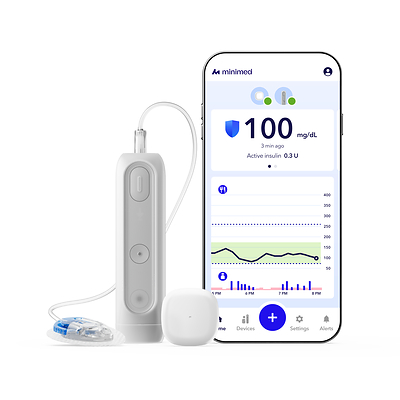
MiniMed Flex™ is designed to change that. About half the size of previous MiniMed pumps and roughly the volume of two stacked insulin vials,* the system delivers meaningful capacity and flexibility in a compact form. The pump holds up to 300 units of insulin, supporting a broad range of daily insulin needs, and pairs with MiniMed's Extended™ infusion set, which can be worn for up to seven days, delivering up to
The pump has no screen. All primary functions are managed through a compatible mobile app on iOS and Android devices. The Flex platform will facilitate wireless software updates that will allow users to access future improvements, including MiniMed's next generation algorithm which is currently in development and not yet approved by regulators or commercially available.
"Our son, Otto, belongs to a generation that is used to managing everything through their phones, so this feels completely natural to him. One of the biggest changes with the MiniMed Flex is that he feels much more in control of his own diabetes management - it's becoming more discreet and more independent. As parents, we no longer have to constantly hover around him or interfere." – Olof Wretling, parent of Otto, 14, diagnosed with type 1 diabetes at age 9, Karlstad,
"In my early experience with MiniMed Flex™, what stands out is how adults who have been living with type 1 diabetes for years respond to a pump that stays out of sight and is controlled from their phone," said Dr. Sharona Azriel, a specialist in Endocrinology and Nutrition at the Infanta Sofía University Hospital,
The Same Proven Algorithm, Now in a Smaller Design
MiniMed Flex™ is powered by the same SmartGuard™ algorithm as the MiniMed™ 780G system, which has been used by hundreds of thousands of people with diabetes across the globe. The SmartGuard™ algorithm automatically adjusts insulin delivery every five minutes based on real-time glucose readings from the MiniMed continuous glucose monitor. It also includes Meal Detection™ technology, which detects rapid rises in sensor glucose and delivers an automatic correction dose when meal boluses are occasionally missed or carbohydrate counts are underestimated.§
Real-world findings on the MiniMed™ 780G system's clinical performance are directly relevant to MiniMed Flex™ users because both systems use the same SmartGuard™ algorithm. Key findings** include:
80% time in range (TIR) achieved by real-world MiniMed™ 780G system users with recommended optimal settings◊ 1,2- More than
90% overnight time in range demonstrated in a real-world study of MiniMed™ 780G system users, meaning fewer nighttime alarms and more consistent sleep3 - Sustained glycemic improvement over three years, with the percentage of insulin delivered automatically by the system increasing from
0% to17.2% over a three-year real-world observation period4 - 9 out of 10 MiniMed™ 780G system users who used optimal settings achieved the international goal of more than
70% time in range5
In
Frequently Asked Questions
Q: What is the MiniMed Flex™ system?
A: MiniMed Flex™ is MiniMed's smallest and only app-controlled automated insulin delivery system in
Q: How does MiniMed Flex™ differ from the MiniMed™ 780G system?
A: Both systems use the same SmartGuard™ algorithm and Meal Detection™ technology, delivering the same proven automated insulin delivery performance. MiniMed Flex™ introduces a new, more compact form factor — approximately half the size of the MiniMed™ 780G pump — along with a screenless design, app-based control, and a rechargeable battery.
Q: Which sensors are compatible with MiniMed Flex™ at launch in
A: MiniMed Flex™ is launching in
Q: Who is MiniMed Flex™ indicated for in
A: In Europe, the MiniMed Flex™ system is CE Marked for individuals aged two years and older with insulin-treated diabetes, including type 1 and type 2 diabetes. The system is also CE Marked for use during pregnancy. Suitability should always be determined in consultation with a healthcare professional.
Q: Is MiniMed Flex™ a fully automated system?
A: No. MiniMed Flex™ is an advanced hybrid closed-loop system. It automatically adjusts basal insulin and delivers correction doses when operating in SmartGuard™ mode, while still requiring users to announce meals. Administering a bolus 15 to 20 minutes before eating helps to keep blood sugar levels under control after eating.
Q: Is MiniMed Flex™ waterproof?
A: Yes. The MiniMed Flex™ pump is waterproof up to 2.4 meters (8 feet) for up to one hour and 45 minutes.
About MiniMed
MiniMed is a global leader in insulin delivery, constantly advancing therapies that support people with diabetes in more than 80 countries. Our full-stack, integrated ecosystem, including our insulin delivery systems, CGMs, algorithms, and easy-to-use app experience, is designed to work seamlessly together, supported by white-glove, wrap-around service. For over 40 years, we've pioneered therapies people can rely on by anticipating needs, reducing burden, and helping make life with diabetes easier. Our mission is to make every day a better day for people with diabetes.
Any forward-looking statements are subject to risks and uncertainties such as those described in MiniMed's periodic reports on file with the Securities and Exchange Commission. Actual results may differ materially from anticipated results.
* Compared to MiniMed™ 780G pump. Overall size related to volume.
** Individual results may vary and some user interaction is required.
§ Taking a bolus 15 to 20 minutes before a meal helps to keep blood sugar levels under control after eating. Refers to SmartGuard™ feature. Individual results may vary.
^ Assumes four injections per day for 30 days and one infusion set change every seven days.
◊ In users aged over 15 years, using the optimal settings that are the combination of glucose target at 100 mg/dL (5.5 mmol/L) and active insulin time of two hours for at least
- Thrasher JR, Arrieta A, Niu F, et al. Early Real-World Performance of the MiniMed™ 780G Advanced Hybrid Closed-Loop System and Recommended Settings Use in the United States. Diabetes Technol Ther. 2024;26(S3):24–31.
- Choudhary P, Arrieta A, van den Heuvel T, et al. Celebrating the Data from 100,000 Real-World Users of the MiniMed™ 780G System in Europe, Middle East, and Africa Collected Over 3 Years. Diabetes Technol Ther. 2024;26(S3):32–37.
- McVean JJF, Niu F, Liu M, et al. Automated insulin delivery with the MiniMed™ 780G system reduces burden by improving sleep and glycaemic control overnight. Diabetes Obes Metab. Published online January 8, 2026. doi:10.1111/dom.70380
- McVean J, et al. Achieved and sustained glycaemic outcomes with reduction in burden: three-year real-world follow-up of the MiniMed 780G system. Presented at: EASD 61st Annual Meeting; September 2025; Vienna.
- Choudhary P, et al. Diabetes Technol Ther. 2024;26(S3):32–37.



 View original content to download multimedia:https://www.prnewswire.com/news-releases/minimed-launches-minimed-flex-its-smallest-and-most-discrete-insulin-pump-in-europe-302939885.html
SOURCE MiniMed
FAQ
AI-generated questions and answers. How Rhea-AI works. Not financial advice.
Has MiniMed MMED launched MiniMed Flex in Europe?
Commercial shipments have begun across Europe, following an initial customer experience phase in select markets. MiniMed Flex is rolling out gradually with the Simplera Sync sensor.
Who can use MiniMed Flex in Europe?
MiniMed Flex is CE Marked for individuals aged two years and older with insulin-treated diabetes, including type 1 and type 2 diabetes. It is also CE Marked for use during pregnancy. Suitability should be determined in consultation with a healthcare professional.
Does MiniMed Flex still require users to announce meals?
Yes, MiniMed Flex still requires users to announce meals. It automatically adjusts basal insulin and delivers correction doses in SmartGuard mode, but is not fully automated. Administering a bolus, or mealtime insulin dose, 15 to 20 minutes before eating helps control blood sugar after meals.