
NexMetals Reports 11.15 Metres of 7.65% CuEq (3.10% Cu, 2.21% Ni) at Selebi Main, Highlighting a Kilometre-Scale Trend of Thick, High-Grade Massive Sulphides
NexMetals Mining (TSXV/NASDAQ: NEXM) reported new assay results from four drill holes (SMD-26-210, 212-W1, 213, 214) in the Flexure Zone of the Selebi Main deposit in Botswana.
Rhea-AI Summary
NexMetals Mining (TSXV/NASDAQ: NEXM) reported new assay results from four drill holes (SMD-26-210, 212-W1, 213, 214) in the Flexure Zone of the Selebi Main deposit in Botswana. According to NexMetals, wedge hole SMD-26-212-W1 intersected 11.15 metres grading 7.65% CuEq (3.09% Cu, 2.21% Ni) in the Main Zone, one of the strongest massive sulphide intervals drilled at Selebi Main to date.
All four holes intersected sulphide mineralization, contributing to a mineralized trend now exceeding one kilometre in strike length that remains open. Borehole EM anomalies indicate continuation north of current drilling. The surface program has completed 29,734 metres to date, and the 2026 Mineral Resource Estimate for Selebi remains on track for completion in Q3 2026, supported by a new 3D geological and structural model being developed with TECT Geological Consulting.
Positive
- 11.15 m @ 7.65% CuEq (3.09% Cu, 2.21% Ni) in SMD-26-212-W1 Main Zone
- Kilometre-scale mineralized trend of thick, high-grade massive sulphides now outlined at Selebi Main
- All four new holes intersected sulphide mineralization, including multiple massive sulphide intervals
- 29,734 metres of surface drilling completed in 2026 Selebi Main program to date
- 2026 Mineral Resource Estimate for Selebi on track for Q3 2026 completion
Negative
- None.
Details
News Market Reaction – NEXM
On Jul 22, the day this news came out, NEXM closed 2.23% above the previous close. Argus tracked a peak move of +2.6% during that session. Our momentum scanner recorded 3 alerts for this stock that day.
Data tracked by StockTitan Argus for the Jul 22 session.
AI-generated analysis. How Rhea-AI works. Not financial advice.




Vancouver, British Columbia--(Newsfile Corp. - July 22, 2026) - NexMetals Mining Corp. (TSXV: NEXM) (NASDAQ: NEXM) ("NEXM" or the "Company") is pleased to report assay results from drill holes SMD-26-210, 212-W1, 213 and 214, part of its 30,000-metre surface drilling program targeting the emerging Flexure Zone ("Flexure Zone") within the Selebi Main deposit in Botswana (see Figure 1). The latest results continue to validate the Company's data-driven exploration model, with drilling continuing to intersect thick, high-grade massive sulphides beyond the limits of the 2024 Mineral Resource Estimate ("2024 MRE"). Together with borehole electromagnetic ("BHEM") targeting, these results define a growing kilometre-scale trend that remains open and supports the expansion potential of the Selebi system.
Highlights:
What You Need to Know: Four New Intersections and Strong Intercept from SMD-26-212-W1
- Drill hole SMD-26-212-W1 intersected a 11.15 metre interval of massive sulphides grading
7.65% CuEq (3.10% Cu,2.21% Ni), one of the most significant massive sulphide intercepts drilled at Selebi Main. - The intercept confirms an emerging kilometre-scale trend of thick, high-grade massive sulphides, extending beyond the 2024 MRE.
- All four drill holes intersected sulphide mineralization, including multiple intervals of massive sulphides.
- The Flexure Zone is now defined by widely spaced drill holes approximately 200-300 metres apart, demonstrating significant lateral extent and continuity.
- Modeled BHEM anomalies show continuation north of drilling, indicating the system remains open for expansion.
What Does This Mean?
- Drilling at a nominal 200-metre spacing continues to intersect thick, high-grade massive sulphides demonstrating the growing scale of the Selebi Main deposit.
- SMD-26-212-W1 closely replicates SMD-25-205 (11.05 metres of
7.31% CuEq: see news release dated February 26, 2026) and correlates with historic hole sd119 (26.1m of8.29% CuEq,3.39% Cu,2.38% Ni: see Selebi Technical Report), demonstrating that the Flexure Zone contains multiple thick, high-grade massive sulphide intersections. - These results now outline a mineralized trend exceeding one kilometre in strike length, representing a compelling growth opportunity at Selebi Main.
- The close correlation between drill hole results and the strongest BHEM conductors validates the Company's data-driven exploration approach and provides confidence in additional high-priority targets along strike.
Next Steps
- The 2026 Mineral Resource Estimate ("2026 MRE") remains on track for completion in the third quarter of 2026.
- The Company has engaged TECT Geological Consulting to develop an integrated three-dimensional geological and structural model for Selebi North and Selebi Main. The model is expected to enhance the Company's understanding of the geological controls of mineralization across the mining license, support future resource growth and improve drill targeting of thicker, higher-grade zones, and identify potential regional exploration targets.
Sean Whiteford, CEO and Director of the Company, commented: "The Selebi Main deposit continues to exceed our expectations. Each phase of drilling has expanded our understanding of the system, while continuing to deliver exceptional grades and thicknesses. Historically, sd119 was viewed as a standalone thick, high-grade massive sulphide intersection. Today, results from SMD-25-205 and SMD-26-212-W1 demonstrate that even at a 200-metre drill spacing, we continue to intersect thick, high-grade massive sulphides. These results are defining an emerging trend extending for more than one kilometre beyond the 2024 MRE. Importantly, the trend remains open, and we are still refining our understanding of the geological and structural controls responsible for these thicker, higher-grade zones.
As we continue to define the scale and geometry of the system, understanding the geological and structural controls on mineralization is becoming increasingly important, not only to enhance drill targeting, but also to support future resource modelling and potential mine planning. We look forward to advancing our understanding through the development of an integrated geological and structural model with TECT Geological Consulting."
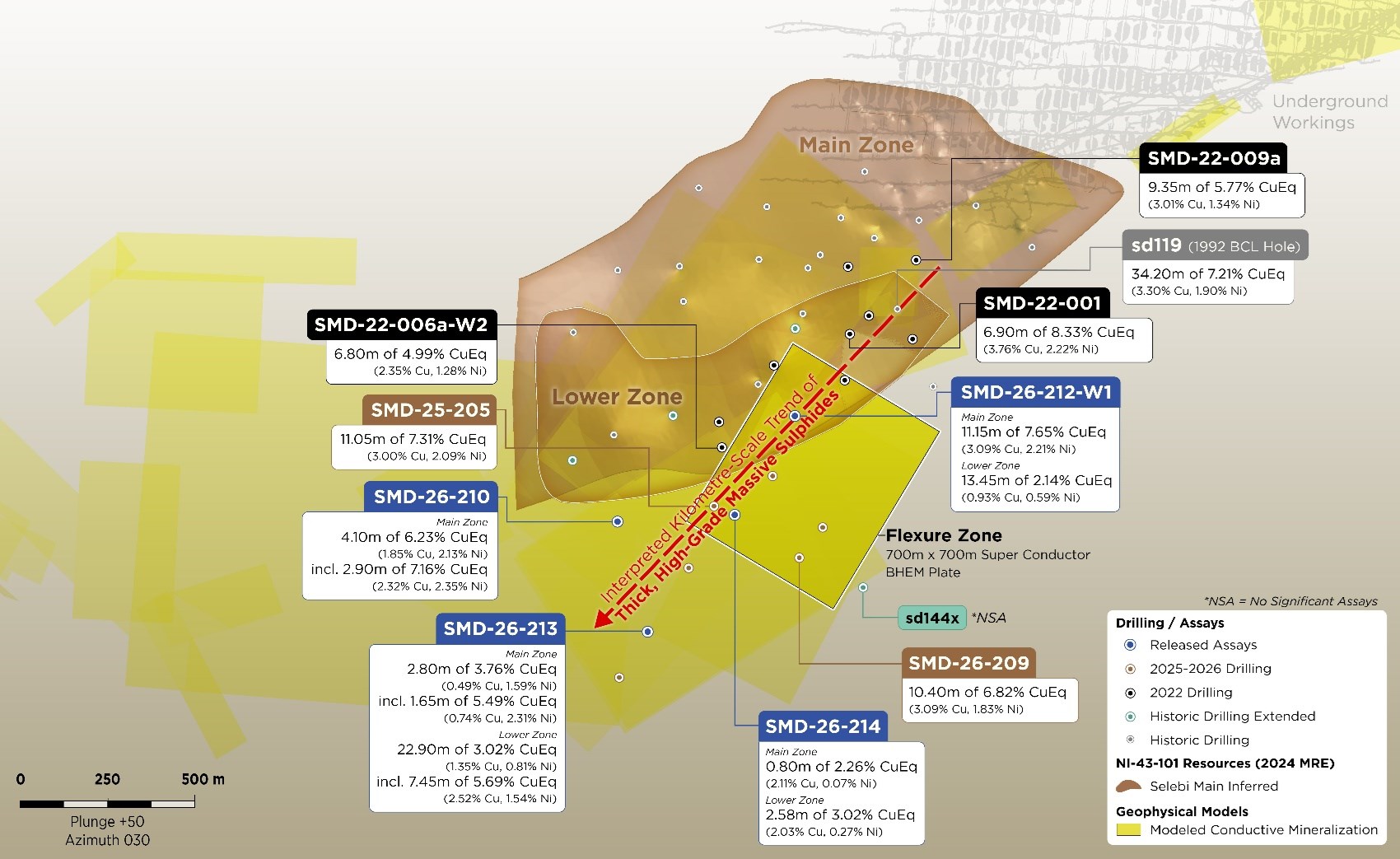
Figure 1: Inclined long section of Selebi Main highlighting drill holes SMD-26-210, 212-W1, 213 and 214 locations relative to the 2024 MRE and the expansion of the Flexure Zone. The Inferred Resource reference in Figure 1 is presented in accordance with NI 43-101, which may not be identical to Inferred Resource references under SK-1300.
To view an enhanced version of this graphic, please visit:
https://images.newsfilecorp.com/files/7759/306004_bd68f15f44dc8879_002full.jpg
Detailed Drilling and BHEM Information
SMD-26-210 was completed to 1,716.6 metres and intersected 4.10 metres of mineralization from 1,681.50 to 1686.60 metres corresponding to the Main Zone. The zone includes a total of 3.65 metres of massive sulphides in two intervals including a 2.90 metre interval. This hole is a 225-metre northward step-out from SMD-25-205 and is located 190 metres down dip of historic drill hole sd123 and 300 metres up dip of SMD-26-213.
SMD-26-212-W1 was completed to 1,636.2 metres and intersected two zones of mineralization starting at 1,520.10 metres downhole, including a significant 11.15 metre interval of massive sulphides corresponding to the Main Zone. Separated by 7.3 metres of gneiss, is a second zone comprising a 4.45 metre interval of semi-massive, net-textured and disseminated sulphides, followed by 18.3 metres of disseminated sulphides, indicating a broad sulphide system. SMD-26-212-W1 is located 160 metres down-dip of SMD-22-007a, 180 metres up dip of SMD-26-208, 185 metres along strike from SMD-022-008a and 220 metres from SMD-22-006a-W2.
SMD-26-213 was completed to 1,989.3 metres and intersected several 2 to 2.5 metre intervals of massive sulphides alternating with thick intervals of disseminated sulphides, including a 1.75 metre interval of massive sulphides corresponding to the Main Zone and a 20.80 metre zone corresponding to the Lower Zone. SMD-26-213 is located 155 metres down-dip of SMD-25-201 and 150 metres up-dip of SMD-25-203.
Details of the most significant mineralized intervals are shown in Table 1 and details of drillholes are provided in Table 2.
SMD-26-214 was completed to 1,815.3 metres and intersected two sulphide units beginning at 1,703.20 metres. The Main Zone is seen as an 0.80 metre interval of stringer sulphides and the Lower Zone is comprised of semi-massive and stringer sulphides over 1.55 metres. SMD-26-214 is located 53 metres southwest of SMD-25-205 and 210 metres northeast of SMD-26-209.
To date, a total of 29,734 metres in 12 completed holes, 1 hole extension, 3 pre-collared holes, 4 abandoned holes and 4 in-progress holes have been completed as part of the surface drilling program. Drill results are reported below in Table 1 and drill hole collar details are provided in Table 2.
Table 1: 2026 Surface Drilling Results
| Hole-ID | From (m) | To (m) | Length (m) | Est. True Thickness1 | Cu (%) | Ni (%) | Co (%)2 | Zone | CuEq (%)3 |
| SMD-26-210 | 1681.50 | 1685.60 | 4.10 | 4.05 | 1.85 | 2.13 | 0.09 | Main Zone | 6.23 |
| including | 1681.50 | 1684.40 | 2.90 | 2.85 | 2.32 | 2.35 | 0.10 | Main Zone | 7.16 |
| SMD-26-212-W1 | 1520.10 | 1531.25 | 11.15 | 11.15 | 3.09 | 2.21 | 0.09 | Main Zone | 7.65 |
| SMD-26-212-W1 | 1538.55 | 1552.00 | 13.45 | 13.45 | 0.93 | 0.59 | 0.03 | Lower Zone | 2.14 |
| including | 1539.00 | 1543.00 | 4.00 | 4.00 | 1.31 | 1.12 | 0.05 | Lower Zone | 3.63 |
| SMD-26-213 | 1887.80 | 1890.60 | 2.80 | 2.65 | 0.49 | 1.59 | 0.07 | Main Zone | 3.76 |
| including | 1888.85 | 1890.60 | 1.75 | 1.65 | 0.74 | 2.31 | 0.10 | Main Zone | 5.49 |
| SMD-26-213 | 1917.00 | 1939.90 | 22.90 | 21.90 | 1.35 | 0.81 | 0.04 | Lower Zone | 3.02 |
| including | 1921.55 | 1929.00 | 7.45 | 7.10 | 2.52 | 1.54 | 0.07 | Lower Zone | 5.69 |
| SMD-26-214 | 1703.20 | 1704.00 | 0.80 | 0.65 | 2.11 | 0.07 | 0.01 | Main Zone | 2.26 |
| SMD-26-214 | 1720.40 | 1721.95 | 1.55 | 1.40 | 2.03 | 0.27 | 0.02 | Lower Zone | 2.58 |
1Length refers to drillhole length and not true width. True widths are estimated where density of drilling is sufficient for an estimation. Some true widths cannot be estimated due to insufficient drill density.
2Co is not included in the MRE as cobalt analyses are not consistently available throughout the deposit.
3CuEq was calculated using the formula CuEq=Cu+2.06*Ni assuming long-term prices of US
4Assays pending.
Table 2: Surface Drilling Collar Information
| HOLE ID | UTM East | UTM North | Elevation | Dip | True North Azimuth | Hole Length | Comment |
| SMD-26-210 | 582807.4 | 7563850.3 | 901.2 | -74.4 | 115.2 | 1,717.6 | Surveyed collar |
| SMD-26-212-W1 | 582754.9 | 7563356.4 | 903.5 | -72.1 | 120.9 | 1,636.2 | Surveyed collar |
| SMD-26-213 | 582518.1 | 7563773.3 | 906.6 | -76.4 | 110.7 | 1,989.3 | Surveyed collar |
| SMD-26-214 | 582586.5 | 7563515.1 | 906.0 | -74.0 | 101.5 | 1,815.3 | Surveyed collar |
Qualified Person
All scientific and technical information in this news release has been reviewed and approved by Sharon Taylor, V.P. Exploration of the Company, MSc, P.Geo, and a "qualified person" for the purposes of National Instrument 43-101 and Subpart 1300 of Regulation S-K.
Quality Control
The program is being executed using three company-owned underground Zinex U5 drills which were converted into surface A5 drills, and two Marcotte HTM2500 drills purchased by the Company capable of drilling to depths of 2,550 metres (NQ core).
Drill core samples are either NQ (47.75 mm diameter) or BQ (36.40 mm diameter). All samples are ½ core samples cut by a diamond saw on site and the remaining half of the core is retained for reference purposes. Samples are generally 1.0 to 1.5 metre intervals or less at the discretion of the site geologists. Sample preparation and lab analysis was completed at ALS Geochemistry in Johannesburg, South Africa. Commercially prepared Blank samples and certified Cu/Ni sulphide analytical control standards with a range of grades are inserted in every batch of 20 samples or a minimum of one set per sample batch. Analyses for Ni, Cu and Co are completed using a peroxide fusion preparation and ICP-AES finish (ME-ICP81). Analyses for Pt, Pd, and Au are by fire assay (30 grams nominal sample weight) with an ICP-AES finish (PGM-ICP23).
Holes are numbered as follows: SMD (Selebi Main Deposit) + year + hole number starting at 201.
BHEM Surveys
The BHEM surveys at Selebi utilize the Crone PEM system operated by local Botswana staff. Survey data is collected using a 3-component fluxgate probe collecting full waveform data. Surveys have been collected using timebases between 50 and 1000ms (0.25 Hz to 5 Hz). The data has been processed to a calculated residual step response to better quantify the conductive sources. This added processing has proven to be highly valuable because of the size of the highly conductive mineralized system.
Technical Report
The 2024 MRE on the Selebi Mines is supported by the technical report entitled "Technical Report, Selebi Mines, Central District, Republic of Botswana" dated September 20, 2024 (with an effective date of June 30, 2024) (the "Selebi Technical Report"), and the technical report summary entitled "S-K 1300 Technical Report Summary Selebi Mines, Central District, Republic of Botswana, Premium Resources Ltd." dated December 17, 2024 (with an effective date of June 30, 2024) (the "Selebi Technical Report Summary"), each prepared by SLR Consulting (Canada) Ltd. for NEXM. Reference should be made to the full text of the Selebi Technical Report, which was prepared in accordance with NI 43-101 and is available on SEDAR+ (www.sedarplus.ca) and the Selebi Technical Report Summary, which was prepared in accordance with Subpart 1300 of Regulation S-K and is available in the Company's Annual Report on Form 10-K for the fiscal year ended December 31, 2025 filed with the U.S. Securities and Exchange Commission on EDGAR (www.sec.gov), in each case, under NEXM's issuer profile.
About NexMetals Mining Corp.
NexMetals Mining Corp. is a TSX.V and NASDAQ listed mineral exploration and development company focused on redeveloping the past-producing Selebi and Selkirk copper-nickel-cobalt-platinum group element mines in Botswana. NexMetals has confirmed the scale of mineralization is larger than historical estimates, supported by NI 43-101- and Regulation S-K 1300-compliant resource estimates, with ongoing down-hole geophysics, drilling, and metallurgical programs aimed at expanding resources and supporting future economic studies. The Company is led by an experienced management and technical team with a proven track record in global mineral projects, emphasizing disciplined execution, transparent governance, and long-term stakeholder value creation.
For further information about NexMetals Mining Corp., please contact:
Sean Whiteford
CEO
info@nexmetalsmining.com
1-866-794-NEXM (6396)
Neither the TSX Venture Exchange and its Regulation Services Provider (as that term is defined in the policies of the TSX Venture Exchange) nor the Nasdaq Stock Market LLC accepts responsibility for the adequacy or accuracy of this news release. No stock exchange, securities commission or other regulatory authority has approved or disapproved the information contained herein.
Follow Us
X: https://x.com/NexMetalsCorp
LinkedIn: https://www.linkedin.com/company/NexMetalsMiningCorp
Facebook: https://www.facebook.com/NexMetalsMiningCorp
Cautionary Note Regarding Forward-Looking Statements
This news release contains "forward-looking statements" within the meaning of the United States federal securities laws and "forward-looking information" within the meaning of applicable Canadian securities legislation (collectively, "forward-looking information") based on expectations, estimates and projections as at the date of this news release. Forward-looking information involves risks, uncertainties and other factors that could cause actual events, results, performance, prospects and opportunities to differ materially from those expressed or implied by such forward-looking information. For the purposes of this release, forward looking information includes, but is not limited to, the implementation of the objectives, goals and future plans of the Company, including the expansion potential of the Selebi Main system and the scale and continuity thereof; the expansion potential within the Flexure Zone; the receipt of pending assay results and the timing and results thereof; the Company's belief that the combination of massive, semi-massive and disseminated sulphides indicates a strong sulphide system with potential for scale, particularly when integrated with ongoing BHEM targeting; the expected timing of completion of the 2026 MRE in Q3 2026; the Company's belief in the benefits of its data-driven exploration approach; the anticipated benefits of TECT Geological Consulting's model, including enhancement of the Company's understanding of the geological controls of mineralization across the mining license, support for future resource growth and improvement of drill targeting of thicker, higher-grade zones, and the identification of potential regional exploration targets; and future resource modelling and potential mine planning. These forward-looking statements, by their nature, require the Company to make certain assumptions and necessarily involve known and unknown risks and uncertainties that could cause actual results to differ materially from those expressed or implied in these forward-looking statements. Factors that could cause actual results to differ materially from such forward-looking information include, but are not limited to, capital and operating costs varying significantly from estimates; the preliminary nature of drilling and metallurgical test results; the ability of exploration results to predict mineralization; the ability of the Company to implement its drilling, geoscience and metallurgical work on its properties and work plans generally; prefeasibility or the feasibility of mine production; delays in obtaining or failures to obtain required governmental, environmental or other project approvals; uncertainties relating to the availability and costs of financing needed in the future; changes in equity markets; inflation; fluctuations in commodity prices; delays in the development of projects; the other risks involved in the mineral exploration and development industry; and those risks set out in the Company's filings with the SEC on EDGAR (www.sec.gov) and public disclosure record on SEDAR+ (www.sedarplus.ca), in each case, under NEXM's issuer profile. Although the Company believes that the assumptions and factors used in preparing the forward-looking information in this news release are reasonable, undue reliance should not be placed on such information, which only applies as of the date of this news release, and no assurance can be given that such events will occur in the disclosed time frames or at all. The Company disclaims any intention or obligation to update or revise any forward-looking information, whether as a result of new information, future events or otherwise, other than as required by law.
To view the source version of this press release, please visit https://www.newsfilecorp.com/release/306004
FAQ
AI-generated questions and answers. How Rhea-AI works. Not financial advice.