
Nord Intersects 20,675 g/t Silver over 0.3 Metres and 10,413 g/t Silver over 0.3 Metres at Castle East
Castle East hole CS-26-140W1 delivers multiple ultra high-grade silver-cobalt hits that feed Nord’s updated geological model and targeting work.
Sentiment and the balance of points
Rhea-AI Sentiment reads the wording of the document, how positive or negative its language is on a 1 to 5 scale. The balance of points shown with the takes weighs what the document actually discloses, so the two can disagree, for example when a trial that missed its main goal is described in upbeat language.
Rhea-AI Summary
Nord Precious Metals Mining (NPMMF) reported new ultra high‑grade silver-cobalt assays from wedge hole CS-26-140W1 at the Castle East project near Gowganda, Ontario.
The hole intersected three separate mineralized intervals between 404.20 m and 463.60 m downhole, including an upper interval grading 4,683 g/t Ag with 0.53% Co over 2.00 m, with subintervals of 20,676 g/t Ag with 1.16% Co over 0.30 m and 6,159 g/t Ag with 2.32% Co over 0.30 m. A lower corridor averaged 1,546 g/t Ag over 4.20 m, including 4,540 g/t Ag over 0.90 m and a peak of 10,414 g/t Ag with 0.72% Co over 0.30 m; a middle interval returned 1,560 g/t Ag over 0.30 m.
The three intervals span 59.4 m downhole and lie roughly nine to ten metres from prior high‑grade holes CS‑21‑92 and CS‑20‑43, contributing to Nord’s expanded Castle East geological model and integrated surface‑to‑depth evaluation of the Castle property.
Positive
- Upper interval 4,683 g/t Ag, 0.53% Co over 2.00 m, including 20,676 g/t Ag over 0.30 m
- Lower interval averages 1,546 g/t Ag over 4.20 m, including 10,414 g/t Ag over 0.30 m
- Three mineralized zones occur within a 59.4 m downhole span, near previous high-grade intercepts
- Expanded 3D modelling now incorporates >75,000 m of drilling and 29 modelled veins at Castle East
Negative
- True widths of all reported intervals are unknown; only core lengths are provided
- Ongoing drilling and target refinement are explicitly subject to financing, permitting and technical review
News Explained
The assays expand the Castle East model, while zone continuity, geometry and further drilling remain unresolved or conditional.
Nord is incorporating the Castle East assay results into its expanded geological model, but the disclosure does not establish one continuous mineralized zone or confirmed geometry.
The reported lengths are core lengths rather than determined true widths, so the physical thickness and orientation of the mineralization remain unresolved.
Follow-up work will test continuity, orientation and the relationship to the Robinson and Big Silver structures; further drilling remains subject to financing, permitting and technical review.
Details
News Market Reaction – NPMMF
On Sep 9, the day this news came out, NPMMF closed 0.66% above the previous close.
Data tracked by StockTitan Argus for the Sep 9 session.
AI-generated analysis. How Rhea-AI works. Not financial advice.




Wedge hole CS-26-140W1 returned three separate silver-cobalt intervals across a 59.4 metre downhole span, led by 20,676 g/t (603 oz/ton) silver with
Cobalt, Ontario--(Newsfile Corp. - September 9, 2026) - Nord Precious Metals Mining Inc. (TSXV: NTH) (OTCQB: NPMMF) (FSE: QN3) ("Nord" or the "Company") reports assay results from wedge hole CS-26-140W1 at the Castle East high-grade silver project near Gowganda, Ontario. The hole returned three separate silver-cobalt mineralized intervals between 404.20 and 463.60 metres downhole, led by 4,683 g/t (136.6 oz/ton) silver with
Highlights
- Upper interval: 4,683 g/t Ag with
0.53% Co over 2.00 metres (404.20 to 406.20 m), including 20,676 g/t (603 oz/ton) Ag with1.16% Co over 0.30 metres and 6,159 g/t Ag with2.32% Co over 0.30 metres. - Lower interval: 4,540 g/t Ag with
0.24% Co over 0.90 metres, including 10,414 g/t (303.7 oz/ton) Ag with0.72% Co over 0.30 metres, and 1,991 g/t Ag over 1.20 metres, within a broader interval averaging 1,546 g/t Ag over 4.20 metres (459.40 to 463.60 m). - Middle interval: 1,560 g/t Ag over 0.30 metres (450.30 to 450.60 m).
- The intersections lie approximately nine metres from the 914 g/t over 0.5-metre Ag intercept in hole CS-21-92 at downhole depth of 438.55 to 439.05 metres and ten metres from the 992 g/t over 1.0-metre Ag intercept in hole CS-20-43 at a downhole depth of 466.0 to 467.0 metres.
CS-26-140W1 continues a model-led sequence that began with the Company's 2025 three-dimensional modelling review of more than 75,000 metres of drilling and 29 modelled veins. It follows the May 4, 2026 result of 2,343.7 g/t Ag over 1.85 metres in CS-26-129W2, the June 2, 2026 result of 2,848 g/t Ag over 6.65 metres in CS-21-73W1, and the June 29, 2026 result of 13,620.4 g/t Ag with
The three assayed intervals in CS-26-140W1 occur across a 59.4 metre downhole span and should not be interpreted as one continuous mineralized interval. The Company interprets the intersections in relation to the Robinson structure and the interpreted Big Silver structure, a parallel silver-bearing plane east of the Robinson Zone; correlation remains subject to detailed modelling and Qualified Person review.
"CS-26-140W1 adds three separate high-grade silver-cobalt intervals across a 59.4 metre downhole span and gives our technical team important new data for the Castle East model," said Frank J. Basa, P.Eng., Chief Executive Officer of Nord. "Set beside the surface gold work and the conceptual open-pit assessment, it completes the sequence we have been building: gold at surface, near-surface evaluation, and high-grade silver at depth, with each target advanced on its own geological merits."
Table 1: Assay results, hole CS-26-140W1
| Survey | From (m) | To (m) | Core length (m) | Au (ppb) | Ag (ppm) | Co (ppm) | Co (%) | Cu (ppm) | Ni (ppm) | Pb (ppm) | Zn (ppm) |
| CS-26-140W1 | 404.20 | 406.20 | 2.00 | 79.00 | 4,683.36 | 5,252.94 | 0.53 | 268.00 | 484.40 | 123.25 | 229.50 |
| Incl | 404.80 | 405.10 | 0.30 | 30.00 | 20,675.75 | 11,620.00 | 1.16 | 170.00 | 1,783.00 | 38.00 | 75.00 |
| Incl | 405.90 | 406.20 | 0.30 | 10.00 | 6,158.82 | 23,150.00 | 2.32 | 934.00 | 1,213.00 | 102.00 | 82.00 |
| And | 450.30 | 450.60 | 0.30 | 50.00 | 1,560.15 | 503.00 | 0.05 | 1,089.00 | 169.00 | 65.00 | 33.00 |
| And | 459.40 | 463.60 | 4.20 | 15.36 | 1,546.38 | 749.50 | 0.07 | 214.88 | 162.69 | 178.67 | 118.81 |
| Incl | 459.40 | 460.60 | 1.20 | 25.00 | 1,990.82 | 733.85 | 0.07 | 281.00 | 207.25 | 173.25 | 94.50 |
| Incl | 460.00 | 460.30 | 0.30 | 20.00 | 5,029.17 | 2,820.00 | 0.27 | 454.00 | 569.00 | 309.00 | 90.00 |
| Incl | 462.70 | 463.60 | 0.90 | 16.67 | 4,540.11 | 2,447.87 | 0.24 | 372.67 | 301.00 | 477.00 | 242.00 |
| Incl | 463.00 | 463.30 | 0.30 | 20.00 | 10,413.61 | 7,200.00 | 0.72 | 450.00 | 679.00 | 57.00 | 213.00 |
Notes: Intervals are measured core lengths and are not necessarily true widths. Silver values are expressed as ppm in the assay table and as g/t in the narrative; the units are equivalent on a mass basis. Composite intervals are length-weighted. The 4.20 metre interval contains approximately 2.1 metres of low-grade material between the mineralized veins reported separately above.
Visual Logging and Assay Alignment
Laurentia Exploration's July 14, 2026 core-logging compilation documented two visually mineralized downhole corridors in CS-26-140W1. In the lower corridor, logging recorded three calcite or calcite-chlorite veins approximately 2 to 4 centimetres thick, with native-silver stringers oriented orthogonal to the veins and millimetre-scale silver flakes around them. At 463.00 to 463.30 metres, native silver was concentrated along the vein contact.
The logged observations at 404.80 to 404.95 metres, 460.00 to 460.25 metres and 463.00 to 463.30 metres coincide spatially with assayed subintervals returning 20,675.75 g/t Ag with
Next Steps
Results from CS-26-140W1 are being incorporated into the expanded Castle East geological model. Follow-up work will focus on the interpreted continuity and orientation of the three mineralized intervals and their relationship to the Robinson and Big Silver structural framework. Assay results for additional holes from the ongoing program will be reported as received and reviewed. Drilling and target refinement continue subject to financing, permitting and technical review.
Core Photographs - Upper Interval
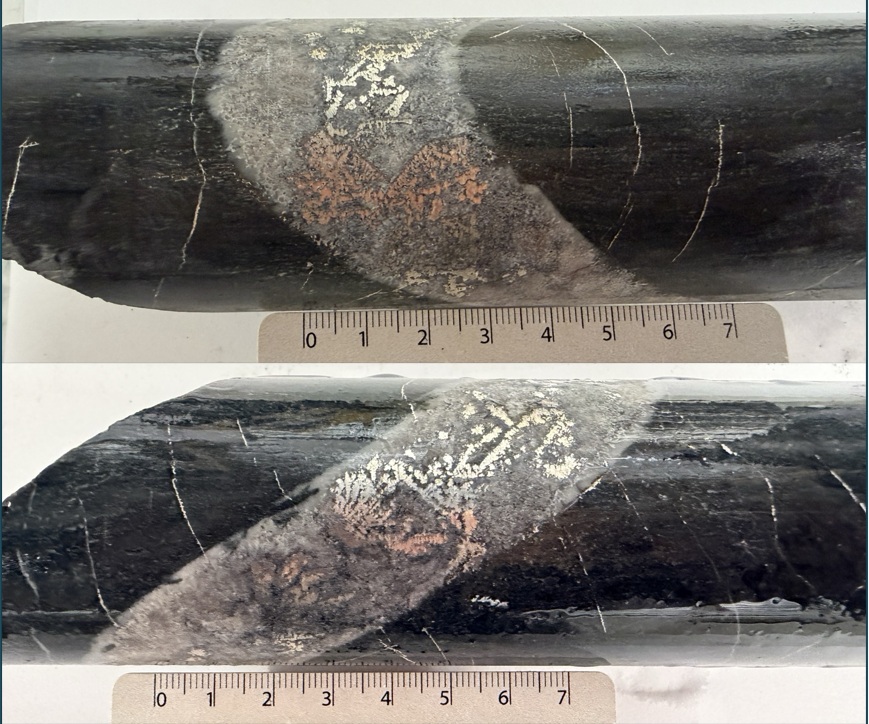
Figure 1. Core from CS-26-140W1 at approximately 404.80 metres downhole, showing native silver with plumose texture, cobalt mineralization and native-silver stringers proximal to the vein.
To view an enhanced version of this graphic, please visit:
https://images.newsfilecorp.com/files/2093/313609_nord_figure1.jpg
QA/QC
The drilling campaign and quality-control program were planned and supervised by Laurentia Exploration Inc. All core in this program is HQ-size drill core. Core logging and sampling were completed by Laurentia. The core was cut in half with a rock saw; one half was sent to Swastika Laboratories Ltd. for analysis and the other half was retained as witness core. Nord's quality-assurance and quality-control protocol includes the insertion of one blank and one standard every 20 samples, in addition to the laboratory's regular insertion of blanks, duplicates and standards. Silver values are determined by fire assay with a gravimetric finish, except for samples containing significant native silver, which are analyzed by fire assay with metallic screening. Copper, zinc, cobalt and nickel values are determined by sodium-peroxide total fusion.
Sample 13687 is a newly disclosed result from hole CS-20-43 from 466.0 to 467.0 metres downhole. The result is from SGS Canada Inc in B.C. and was analyzed by fire assay with metallic screening due to the presence of visible silver. Sample DH0008106 is a newly disclosed result from hole CS-21-92 from 438.55 to 439.05 metres downhole and was analyzed using 4-Acid Near-Total Digestion at Activation Laboratories Ltd. (Actlabs) in Ancaster, Ontario.
Qualified Person
The scientific and technical information in this news release has been reviewed and approved by Frank J. Basa, P.Eng. (PEO), a director of the Company and a qualified person as defined by NI 43-101. Mr. Basa is not independent of the Company.
About Nord Precious Metals Mining Inc.
Nord Precious Metals Mining Inc. (TSXV: NTH) is a silver exploration and development company focused on advancing the Gowganda Silver Tailings Project in Ontario into near-term production. The Company expects to complete a mineral resource estimate for the Project, prepared in accordance with NI 43-101, within the next six months, followed by a technical report on the economics of reprocessing. Nord then intends to finance development of the tailings project on the strength of that study, with cash flow from reprocessing intended to fund exploration across its district-scale, high-grade silver projects, which have the potential for a significant impact on the value of the Company.
Nord's production strategy is anchored by existing infrastructure. The Company operates TTL Laboratories, the only permitted high-grade milling facility in Ontario's historic Cobalt Camp, establishing an integrated position that connects the recovery of historical tailings and high-grade silver exploration with existing processing capacity.
The Company's 63 sq. km flagship Castle property, including 225 hectares of leases, hosts three of the five most productive past-producing silver mines in the Gowganda Camp (Siscoe-O'Brien, Castle and Millerett) along with the Castle East discovery, a high-grade native silver vein system that remains the focus of ongoing drilling, geological modelling and exploration targeting.
Nord's integrated processing strategy is intended to support multiple metal-recovery streams. The Re-2Ox hydrometallurgical process, validated at pilot scale through SGS Lakefield, is designed to address arsenic in complex silver-cobalt ores while producing technical-grade cobalt sulphate and other metal products. Together with TTL Laboratories and underground mine access, this approach positions Nord within Ontario's emerging critical-minerals supply chain.
More information is available at www.nordpreciousmetals.com.
For further information please contact:
Frank J. Basa, P.Eng.
Chief Executive Officer
416-625-2342
or
Wayne Cheveldayoff
Corporate Communications
P: 416-710-2410
E: waynecheveldayoff@gmail.com
Forward-Looking Statements
This news release contains statements that constitute "forward-looking statements." Such forward-looking statements involve known and unknown risks, uncertainties and other factors that may cause the Company's actual results, performance or achievements, or developments in the industry to differ materially from the anticipated results, performance or achievements expressed or implied by such forward-looking statements.
Forward-looking statements are statements that are not historical facts and are generally, but not always, identified by the words "expects," "plans," "anticipates," "believes," "intends," "estimates," "projects," "potential" and similar expressions, or that events or conditions "will," "would," "may," "could" or "should" occur.
Forward-looking statements in this news release include, but are not limited to, statements regarding: the interpretation, continuity and possible extension of the mineralized intervals reported from CS-26-140W1; the refinement of the Castle East geological model and the interpretation of the Robinson and Big Silver structural framework; the prioritization and completion of follow-up drilling, subject to financing and permitting; the timing and receipt of assay results for additional holes; the completion of a mineral resource estimate and subsequent technical report for the Gowganda Silver Tailings Project; and the intended use of future cash flow from tailings recovery to fund exploration.
Although the Company believes the forward-looking information contained in this news release is reasonable based on information available on the date hereof, by their nature forward-looking statements involve known and unknown risks, uncertainties and other factors which may cause actual results, performance or achievements, or other future events, to be materially different from any future results, performance or achievements expressed or implied by such forward-looking statements.
Examples of such assumptions, risks and uncertainties include, without limitation, assumptions, risks and uncertainties associated with: general economic conditions; adverse industry events; future legislative and regulatory developments; the Company's ability to access sufficient capital from internal and external sources; inability to access sufficient capital on favourable terms; the ability of the Company to implement its business strategies; competition; the ability of the Company to obtain and retain all applicable regulatory and other approvals; commodity price fluctuations; and other assumptions, risks and uncertainties.
THE FORWARD-LOOKING INFORMATION CONTAINED IN THIS NEWS RELEASE REPRESENTS THE EXPECTATIONS OF THE COMPANY AS OF THE DATE OF THIS NEWS RELEASE AND, ACCORDINGLY, IS SUBJECT TO CHANGE AFTER SUCH DATE. READERS SHOULD NOT PLACE UNDUE IMPORTANCE ON FORWARD-LOOKING INFORMATION AND SHOULD NOT RELY UPON THIS INFORMATION AS OF ANY OTHER DATE. WHILE THE COMPANY MAY ELECT TO, IT DOES NOT UNDERTAKE TO UPDATE THIS INFORMATION AT ANY PARTICULAR TIME EXCEPT AS REQUIRED IN ACCORDANCE WITH APPLICABLE LAWS.
Neither the TSX Venture Exchange nor its Regulation Services Provider (as that term is defined in the policies of the TSX Venture Exchange) accepts responsibility for the adequacy or accuracy of this release.

To view the source version of this press release, please visit https://www.newsfilecorp.com/release/313609
FAQ
AI-generated questions and answers. How Rhea-AI works. Not financial advice.
What are the detailed assay results for the three mineralized intervals in hole CS-26-140W1?
The upper interval from 404.20–406.20 m returned 4,683.36 ppm (g/t) Ag and 0.53% Co over 2.00 m, including 20,675.75 g/t Ag with 1.16% Co over 0.30 m and 6,158.82 g/t Ag with 2.32% Co over 0.30 m.
The middle interval from 450.30–450.60 m graded 1,560.15 g/t Ag over 0.30 m.
The lower interval from 459.40–463.60 m averaged 1,546.38 g/t Ag over 4.20 m, including 1,990.82 g/t Ag over 1.20 m, 5,029.17 g/t Ag over 0.30 m, 4,540.11 g/t Ag with 0.24% Co over 0.90 m, and a subinterval of 10,413.61 g/t Ag with 0.72% Co over 0.30 m.
How do these CS-26-140W1 results relate to earlier Castle East drill holes?
The three mineralized intervals in CS-26-140W1 occur roughly nine metres from a 914 g/t Ag over 0.50 m intercept in hole CS-21-92 and about ten metres from a 992 g/t Ag over 1.00 m intercept in hole CS-20-43. Nord interprets the new intersections in the context of the Robinson structure and the interpreted Big Silver structure, although detailed correlation remains subject to ongoing modelling and Qualified Person review.
What quality assurance and quality control procedures were used for the Castle East drilling?
All drilling used HQ-size core. Core logging and sampling were completed by Laurentia Exploration, with core cut in half; one half was sent for analysis and the other retained as witness core. Nord’s QA/QC protocol inserts one blank and one standard every 20 samples, alongside the laboratories’ own blanks, duplicates and standards. Silver was generally assayed by fire assay with gravimetric finish, while samples with significant native silver used fire assay with metallic screening. Copper, zinc, cobalt and nickel were analyzed by sodium‑peroxide total fusion.
What are Nord’s stated next steps at Castle East after these assay results?
The CS-26-140W1 results are being incorporated into the expanded Castle East geological model. Follow‑up work will focus on the interpreted continuity and orientation of the three mineralized intervals and their relationship to the Robinson and Big Silver structural framework. Assay results from additional holes will be released as they are received and reviewed, and drilling plus target refinement will continue subject to financing, permitting and technical review.
How does Castle East fit into Nord Precious Metals’ broader strategy and asset base?
Nord focuses on advancing the Gowganda Silver Tailings Project toward near‑term production and expects to complete an NI 43‑101 mineral resource estimate within six months, followed by a technical economic report. The Castle property, which includes three historic high‑production silver mines and the Castle East discovery, is the company’s 63 sq. km flagship asset. Nord’s strategy links historical tailings reprocessing and high‑grade silver exploration with existing processing infrastructure at TTL Laboratories and the Re‑2Ox hydrometallurgical process to support multiple metal‑recovery streams and participation in Ontario’s emerging critical‑minerals supply chain.