
Creating America’s First Transcontinental Railroad: Union Pacific and Norfolk Southern’s STB Merger Application Details Enhancements to Competition and Public Benefits
Union Pacific (UNP) and Norfolk Southern (NSC) filed a nearly 7,000-page application with the Surface Transportation Board on December 19, 2025, seeking approval to combine into a transcontinental railroad connecting 43 states and 100+ ports.




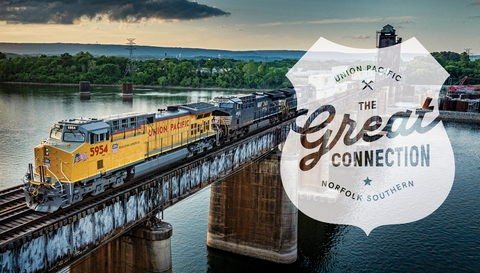
Union Pacific Railroad and Norfolk Southern have filed an historic application to create the nation's first transcontinental railroad. For more information, visit AmericasGreatConnection.com.
The nearly 7,000-page application provides comprehensive and compelling new details on how the end-to-end combination will enhance competition and deliver broad public benefits. The application includes a record-breaking 2,000 letters of support from stakeholders, joining shareholders at both companies who cast votes that were
America’s first transcontinental railroad will:
-
Connect
the United States from coast to coast, transforming 10,000 existing lanes from interline service into faster, more efficient single-line service – eliminating time-consuming handoffs between railroads. - Move freight more efficiently, eliminating an estimated 2,400 rail car and container handlings and 60,000 car-miles each day.
- Retain competitive shipping alternatives for the three customer locations out of more than 20,000 that are served by Union Pacific and Norfolk Southern but no other carrier.
- Compete more effectively with long-haul trucking, converting an estimated 2 million truckloads of freight from road to rail annually.
- Protect all union jobs – every employee with a union job at the time of the merger will continue to have one, and growth of the combined company is expected to create about 900 net new union jobs by the third year following the merger.
- Further enhance competition by voluntarily creating Committed Gateway Pricing, streamlining pricing of interline moves for thousands of customer locations that otherwise may not directly benefit from the merger.
- Keep open all existing gateways for eligible traffic on commercially reasonable terms.
- Provide customers with a unified digital experience, with one accountable partner for their entire rail journey.
-
Invest an estimated
$2.1 billion $133 million
“We look forward to working with the Surface Transportation Board as it reviews our historic application to create America’s first transcontinental railroad,” said Union Pacific CEO Jim Vena. “As time and technology continue to transform how freight is delivered, our industry must keep pace and move forward, reaching underserved markets with new rail solutions and strengthening the
“This combination will bring together Union Pacific’s expansive Western reach and Norfolk Southern’s unparalleled access to Eastern manufacturing and population centers in an end-to-end combination,” said Norfolk Southern President and CEO Mark George. “It will create a cohesive freight rail solution with 50,000 route miles that connect 43 states and more than 100 ports.”
Benefits for America
Enhanced railroad competition. The Union Pacific-Norfolk Southern combination is a classic end-to-end merger. Today, each railroad serves a distinct geographic region with complementary networks, customers and markets. Connecting the two systems will create a transcontinental network that bridges the gap between East and West, allowing freight to bypass congested interchanges and take the fastest and most efficient, price-competitive route. The result: substantial public benefits like expanded affordability; competitive options for customers in virtually every major corridor; and a stronger, more efficient national rail system. The combined network will move freight more efficiently, eliminating an estimated 2,400 rail car and container handlings and 60,000 car-miles each day. Faster, more reliable single-line rail service enhances competition – when it’s available, the share of freight traveling by rail versus the highway is roughly two to three times greater than interline service.
Less congestion and wear on America’s roadways. A seamless transcontinental railroad will compete more aggressively with long-haul trucking, shifting an estimated 2 million truckloads of freight from road to rail annually. The result will be reduced congestion, safer roads and less wear on taxpayer-funded roads.
An economic boost for America’s heartland. The Union Pacific-Norfolk Southern combination will remove the artificial barrier that divides America’s rail system between East and West, getting freight moving in the Watershed region. This previously underserved rail market – where trucking was often the only option because crossing the divide made rail too expensive and complicated due to handoffs between railroads – will have access to single-line manifest service for the first time. Leading industry advisor Oliver Wyman estimates that 105,000 carloads of merchandise traffic will convert from road to rail when single-line service is available to the Watershed markets. Providing domestic shippers a cheaper alternative to truck will make them more competitive, which strengthens the entire
More direct and reliable access to global markets. A transcontinental railroad will provide efficient, flexible and reliable single-line access to more than 100 ports connecting to global markets and 10 international gateways to markets in
Reduced emissions. Rail is already the most sustainable way to move freight over ground, according to the Association of American Railroads, with roughly
Dedicated support for passenger rail. Union Pacific and Norfolk Southern will maintain dedicated systems to support passenger rail. A route-by-route analysis of projected volume growth verified sufficient capacity to continue fulfilling all service obligations to Amtrak and commuter rail agencies.
Benefits for Customers
Faster, more efficient service. Integrating Union Pacific and Norfolk Southern into one network will transform 10,000 existing lanes from interline service – which requires time-consuming handoffs between railroads – into faster, more efficient single-line service. It also will create an additional 84,000 county-to-county lanes where shippers are moving freight by road that could – for the first time – move by single-line rail service.
Expanded service offerings. As part of its optimized operating plan, Union Pacific and Norfolk Southern will improve service without overhauling existing networks. The combined railroad anticipates adding several routes, including two new daily intermodal train pairs connecting the East and the West with more direct service – reducing estimated transit times from
Improved customer asset utilization. Customers who own rail cars will see improved productive use of their assets. With faster, more predictable service, they can turn cars more quickly, minimize idle time and lower equipment costs.
Simplified customer experience backed by innovative technology. A unified digital experience will allow shippers to integrate scheduling, tracking and shipment visibility. Customers will have one commercial team, one contract, one invoice and one accountable partner for their entire rail journey.
Streamlined pricing for interline moves. Committed Gateway Pricing will further enhance competition by streamlining pricing of interline moves for thousands of customer locations that otherwise may not directly benefit from the merger.
Efficient dispute resolution. As an added protection for customers, Union Pacific will voluntarily create an alternative dispute resolution program to efficiently address certain claims regarding merger-related service issues.
Growth for short lines. As Union Pacific and Norfolk Southern create new single-line routes, open competitive markets and streamline service, short lines are positioned to capture new volumes flowing directly onto their rails.
Benefits for Safety
Safety remains the No. 1 priority. A safety integration plan was created working with the Federal Railroad Administration (FRA) and submitted to the STB. The plan outlines how the new company will combine best practices from each railroad to further enhance the safety benefits for all. For example, comparing the first three quarters of 2023 to the same period in 2025, Union Pacific improved its personal injury rate by
Benefits for Railroad Employees
Protection for all union jobs. Railroading offers some of the best-paid industrial careers in America. Average compensation including benefits is
The Most Thoroughly Planned Merger in Railroad History
Union Pacific and Norfolk Southern are well-run, successful railroads coming together from positions of strength. They have the benefit of state-of-the-art transportation systems and anticipate investing an estimated
The transaction remains subject to STB review and approval within its statutory timeline and will be subject to continuing STB oversight post-closure. The Union Pacific and Norfolk Southern application to the STB is available for public review on its website. The statements contained herein are qualified in their entirety by reference to the full application to the STB.
The two companies expect the transaction to be completed by early 2027. For more information, visit AmericasGreatConnection.com.
About Union Pacific
Union Pacific (NYSE: UNP) delivers the goods families and businesses use every day with safe, reliable, and efficient service. Operating in 23 western states, the company connects its customers and communities to the global economy. Trains are the most environmentally responsible way to move freight, helping Union Pacific protect future generations. More information about Union Pacific is available at www.up.com.
About Norfolk Southern
Since 1827, Norfolk Southern Corporation (NYSE: NSC) and its predecessor companies have safely moved the goods and materials that drive the
Cautionary Note Regarding Forward-Looking Statements
Certain statements in this communication are “forward-looking statements” within the meaning of the “safe harbor” provisions of the Private Securities Litigation Reform Act of 1995, as amended. These statements relate to future events or future financial performance and involve known and unknown risks, uncertainties, and other factors that may cause Union Pacific’s, Norfolk Southern’s or the combined company’s actual results, levels of activity, performance, or achievements or those of the railroad industry to be materially different from those expressed or implied by any forward-looking statements. In some cases, forward-looking statements may be identified by the use of words like “may,” “will,” “could,” “would,” “should,” “expect,” “anticipate,” “believe,” “project,” “estimate,” “intend,” “plan,” “pro forma,” or any variations or other comparable terminology.
While Union Pacific and Norfolk Southern have based these forward-looking statements on those expectations, assumptions, estimates, beliefs and projections they view as reasonable, such forward-looking statements are only predictions and involve known and unknown risks and uncertainties, many of which involve factors or circumstances that are beyond Union Pacific’s, Norfolk Southern’s or the combined company’s control, including but not limited to, in addition to factors disclosed in Union Pacific’s and Norfolk Southern’s respective filings with the
This list of important factors is not intended to be exhaustive. These and other important factors, including those discussed under “Risk Factors” in Norfolk Southern’s Annual Report on Form 10-K for the year ended December 31, 2024 (available at https://www.sec.gov/ix?doc=/Archives/edgar/data/0000702165/000070216525000008/nsc-20241231.htm) and Norfolk Southern’s subsequent filings with the SEC, Union Pacific’s most recent Annual Report on Form 10-K for the year ended December 31, 2024, as filed with the SEC on February 7, 2025 (available at https://www.sec.gov/ix?doc=/Archives/edgar/data/0000100885/000010088525000042/unp-20241231.htm) and Union Pacific’s subsequent filings with the SEC, as well as the risks described in Union Pacific’s registration statement on Form S-4 (No. 290282), as filed with the SEC on September 16, 2025, as amended on September 30, 2025 (available at https://www.sec.gov/Archives/edgar/data/100885/000119312525224307/d908896ds4a.htm), may cause actual results, performance, or achievements to differ materially from those expressed or implied by these forward-looking statements. References to Union Pacific’s and Norfolk Southern’s website are provided for convenience and, therefore, information on or available through the website is not, and should not be deemed to be, incorporated by reference herein. The forward-looking statements herein are made only as of the date they were first issued, and unless otherwise required by applicable securities laws, Union Pacific and Norfolk Southern disclaims any intention or obligation to update or revise any forward-looking statements, whether as a result of new information, future events, or otherwise, except as may be required by applicable law or regulation.
View source version on businesswire.com: https://www.businesswire.com/news/home/20251219970368/en/
Union Pacific Media Inquiries:
media@up.com
Union Pacific Investor Inquiries:
Diana Prauner
402-544-4227 or dprauner@up.com
Norfolk Southern Media Inquiries:
Media Relations
Joseph Sala / Lucas Pers
Joele Frank, Wilkinson Brimmer Katcher
212-355-4449
Norfolk Southern Investor Inquiries:
Investor Relations
Source: Union Pacific Corporation