
New Study Demonstrates Multiple Advantages of Nevro1™, the Novel SI Joint Fusion System by Nevro, in Comparison to Posterolateral and Lateral Approaches
Nevro Corp. (NYSE: NVRO) has published new data demonstrating the advantages of its Nevro1™ SI Joint Fusion System compared to other approaches.
Rhea-AI Summary
Nevro Corp. (NYSE: NVRO) has published new data demonstrating the advantages of its Nevro1™ SI Joint Fusion System compared to other approaches. The study, published in Medical Devices: Evidence and Research, shows that Nevro1, a posterior integrated transfixation cage system, offers enhanced stability, minimized bone removal, and increased fusion potential versus posterolateral cylindrical threaded single-implant systems. The research revealed that Nevro1 and lateral triangular rods produced equivalent motion reduction, while providing the most surface area for fusion, enabling better SI joint arthrodesis opportunities.
Positive
- Nevro1 demonstrated superior stability and fusion potential compared to posterolateral systems
- System showed equivalent performance to lateral triangular rods in healthy bone
- Technology provides largest surface area for fusion among compared systems
- Requires minimal bone removal during procedure
Negative
- None.
Details
News Market Reaction – NVRO
The recorded move for NVRO in the trading session of this news was -5.09%.
Data tracked by StockTitan Argus. Session date unavailable.
AI-generated analysis. How Rhea-AI works. Not financial advice.




Furthering Nevro's body of evidence as an innovation leader in pain management, data highlights the company's posterior integrated transfixation cage system
The sacroiliac (SI) joints constitute two out of five joints within the spine-pelvic-hip complex and are responsible for facilitating load transfer to the torso and lower extremities.1-3 Joint dysfunction can arise from conditions such as degeneration, instability, infection or adjacent segment disease, causing significant pain and impacting daily activities like walking, sitting and lifting.4-6 Women, in particular, may experience pronounced discomfort and reduced quality of life due to SI joint pain.7-8
The study concurrently assessed and compared the fixation efficacy, invasiveness and fusion potential of a posterior integrated transfixation cage system (Nevro1) to the posterolateral threaded implant and lateral triangular rod systems.
Results concluded:
- Nevro1 and the lateral triangular rods produced equivalent motion reduction in all motion planes.
- Posterolateral cylindrical threaded implant produced less motion reduction than Nevro1 and lateral implants in flexion-extension.
- Using Nevro1 for the treatment of SI joint-related pain allows for the most surface area for fusion, which provides a significantly better opportunity for robust SI joint arthrodesis.
"The SI joint is a recognized contributor to low back pain, significantly affecting daily life for those impacted," said Douglas Beall, MD, FIPP, FSIR, Chief of Services, Comprehensive Specialty Care, Clinical Radiology of
"These findings illustrate the potential benefits of the Nevro1 sacroiliac joint transfixing device, especially in terms of the post-surgical experience for the patient and opportunity for long-term fusion and improved patient outcomes," said David Caraway MD, PhD, Nevro's chief medical officer. "This latest study further establishes this technology as a promising treatment for patients suffering from SI joint pain."
About the Nevro1™ SI Joint Fusion System
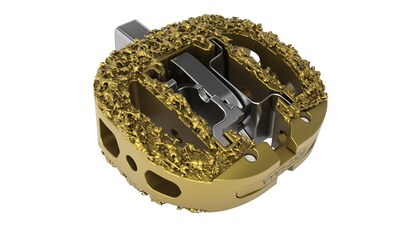
The Nevro1 System is an FDA 510k-cleared device intended to transfix the SI joint for immediate stability and long-term fusion. The mechanism of stabilization consists of integrated transfixing titanium anchors, which are deployed bilaterally and pierce through the cortices of the ilium and sacrum to provide immediate axial and rotational stability of the joint. This device has been proven to substantially reduce SI joint motion through comprehensive biomechanics testing performed in collaboration with the FDA. The proprietary implant design allows for a reduction in motion and abnormal stress on the SI joint without open surgery. Through a minimally invasive approach, the implant can be securely placed and may relieve pain and restore functionality to individuals suffering from chronic SI joint pain.
To learn more about Nevro's Nevro1 Sacroiliac Transfixing and Fusion System, visit https://nevro.com/English/us/safety/sij/default.aspx.
References
- Kiapour A, Joukar A, Elgafy H, Erbulut DU, Agarwal AK, Goel VK. Biomechanics of the sacroiliac joint: anatomy, function, biomechanics, sexual dimorphism, and causes of pain. Int J Spine Surg. 2020;14(Suppl 1):S3–S13. doi:10.14444/6077
- Newman DP, Soto AT. Sacroiliac joint dysfunction: diagnosis and treatment. AFP. 2022;105(3):239–245.
- Vleeming A, Schuenke MD, Masi AT, Carreiro JE, Danneels L, Willard FH. The sacroiliac joint: an overview of its anatomy, function and potential clinical implications. J Anat. 2012;221(6):537–567. doi:10.1111/j.1469-7580.2012.01564.x
- Lindsey DP, Parrish R, Gundanna M, Leasure J, Yerby SA, Kondrashov D. Biomechanics of unilateral and bilateral sacroiliac joint stabilization: laboratory investigation. J Neurosurg Spine. 2018;28(3):326–332. doi:10.3171/2017.7.SPINE17499
- Buchanan P, Vodapally S, Lee DW, et al. Successful diagnosis of sacroiliac joint dysfunction. J Pain Res. 2021;14:3135–3143. doi:10.2147/JPR. S327351
- Ha KY, Lee JS, Kim KW. Degeneration of sacroiliac joint after instrumented lumbar or lumbosacral fusion: a prospective cohort study over five-year follow-up. Spine. 2008;33(11):1192–1198. doi:10.1097/BRS.0b013e318170fd35
- Zusman N, Woelber E, McKibben N, et al. Acetabular fracture pattern is altered by pre-injury sacroiliac joint autofusion. Eurn J of Orthop Surg and Traumatol. 2023:1–8. doi:10.1007/s00590-023-03588-w.
- Fassihi SC, Lee D, Tran AA, et al. Total Hip arthroplasty in an adult patient with pelvic dysmorphism, unilateral sacroiliac joint autofusion, and developmental hip dysplasia. Arthroplasty Today. 2020;6(1):41–47. doi:10.1016/j.artd.2019.10.006.
Internet Posting of Information
Nevro routinely posts information that may be important to investors in the "Investors" section of its website at www.nevro.com. The company encourages investors and potential investors to consult the Nevro website regularly for important information about Nevro.
About Nevro
Headquartered in
Nevro recently added a minimally invasive treatment option for patients suffering from chronic sacroiliac joint ("SI joint") pain and now provides the most comprehensive portfolio of products in the SI joint fusion space, designed to meet the preferences of physicians and varying patient needs in order to improve outcomes and quality of life for patients.
Senza®, Senza II®, Senza Omnia™, and HFX iQ are the only SCS systems that deliver Nevro's proprietary 10 kHz Therapy. Nevro's unique support services provide every patient with an HFX Coach™ throughout their pain relief journey and every physician with Nevrocloud™ insights for enhanced patient and practice management.
SENZA, SENZA II, SENZA OMNIA, OMNIA, HF10, the HF10 logo, 10 kHz Therapy, HFX, the HFX logo, HFX iQ, the HFX iQ logo, HFX Algorithm, HFX CONNECT, the HFX Connect logo, HFX ACCESS, the HFX Access logo, HFX COACH, the HFX Coach logo, Nevrocloud, RELIEF MULTIPLIED, HFX AdaptivAI, the X logo, NEVRO, and the NEVRO logo are trademarks or registered trademarks of Nevro Corp. Patents covering Senza HFX iQ and other Nevro products are listed at Nevro.com/patents. Bluetooth® and the Bluetooth symbol are registered trademarks of their respective owners.
To learn more about Nevro, connect with us on LinkedIn, X, Facebook, and Instagram.
Investors and Media:
Angie McCabe
Vice President, Investor Relations & Corporate Communications
angeline.mccabe@nevro.com

 View original content to download multimedia:https://www.prnewswire.com/news-releases/new-study-demonstrates-multiple-advantages-of-nevro1-the-novel-si-joint-fusion-system-by-nevro-in-comparison-to-posterolateral-and-lateral-approaches-302307573.html
SOURCE Nevro Corp.
FAQ
AI-generated questions and answers. How Rhea-AI works. Not financial advice.