
Omai Gold Drills 708m Averaging 1.06 g/t Au from 365m at Gilt Creek Deposit Including Multiple Higher Grade Intervals
Omai Gold (OTCQB: OMGGF) reported assays from Hole 25ODD-122w at the Gilt Creek deposit (December 18, 2025).
Sentiment and the balance of points
Rhea-AI Sentiment reads the wording of the document, how positive or negative its language is on a 1 to 5 scale. The balance of points shown with the takes weighs what the document actually discloses, so the two can disagree, for example when a trial that missed its main goal is described in upbeat language.
Rhea-AI Summary
Omai Gold (OTCQB: OMGGF) reported assays from Hole 25ODD-122w at the Gilt Creek deposit (December 18, 2025). A 708.1m interval from 364.9m averaged 1.06 g/t Au with multiple higher-grade intervals, including 4.88 g/t Au over 7.0m and 5.70 g/t Au over 8.0m. Hole 122w reached 2,014m and intersected the Wenot shear at depth, returning seven significant gold zones and 3.61 g/t Au over 4.4m near the end of the hole. Gilt Creek MRE is stated as Indicated 1.151 Moz @ 3.22 g/t and Inferred 0.665 Moz @ 3.35 g/t. Metallic screening was used for samples >0.5 g/t to better measure coarse gold.
Positive
- Broad 708.1m interval averaging 1.06 g/t Au from 364.9m
- Multiple higher-grade shoots including 5.70 g/t Au over 8.0m
- Hole reached 2,014m and confirmed Wenot shear with seven zones
- Gilt Creek MRE: Indicated 1.151 Moz @ 3.22 g/t and Inferred 0.665 Moz @ 3.35 g/t
Negative
- Reported 708.1m average of 1.06 g/t Au is lower than reported resource grade (~3.2 g/t)
- Use of metallic screening increased assay turnaround time
- Grades reported as uncapped and a lower cutoff was applied, affecting direct comparability
Details
News Market Reaction – OMGGF
On Dec 18, the day this news came out, OMGGF closed 0.94% above the previous close.
Data tracked by StockTitan Argus for the Dec 18 session.
AI-generated analysis. How Rhea-AI works. Not financial advice.




Toronto, Ontario--(Newsfile Corp. - December 18, 2025) - Omai Gold Mines Corp. (TSXV: OMG) (OTCQB: OMGGF) ("Omai Gold" or the "Company") is pleased to announce assay results from the Company's second hole drilled on the Gilt Creek gold deposit. The Gilt Creek deposit is one of two orogenic gold deposits at its
Highlighted higher grade zones from the upper part of hole 25ODD-122w include:
- 1.06 g/t Au over 708.1m (from 364.9) includes
- 1.78 g/t Au over 46.2m (from 635.6 downhole) includes
- 4.88 g/t Au over 7.0m (from 566.3m)
- 1.32 g/t Au over 99.2m (from 702.0m) includes
- 5.7 g/t Au over 8.0m (from 766.9m)
- 3.10 g/t Au over 24.0m (from 395.5m)
- 1.99 g/t Au over 32.0m (from 462.0m)
- 2.98 g/t Au over 17.8m (from 643.8m)
- 2.04 g/t Au over 43.2m (from 952.2m)
- 1.78 g/t Au over 46.2m (from 635.6 downhole) includes
Elaine Ellingham, President & CEO, commented: "The much awaited results from Hole 122 further confirm the extent of gold mineralization within and beyond the known deposit. These assay results from the upper part of the 2,014m long hole show the robust and continuous nature of the gold-mineralized regime within the Gilt Creek quartz-diorite intrusive stock. This new hole, together with our earlier hole 095, provide valuable structural data for rock mechanics and material for metallurgical sampling, both that allow us to advance our mine plan for our upcoming updated Preliminary Economic Assessment ("PEA") that will include the Gilt Creek deposit. Due to the extent of mineralization and abundance of visible (coarse) gold, all samples >0.5 g/t Au were also assayed using a metallic screening process that provides a more representative total grade than fire-assay on a 50g sample alone. The downside was the additional turnaround time.
Mineralization in the Gilt Creek deposit first occurs just 46m downhole with 1.37 g/t Au over 7.5m in saprolite and ends at 2,014m with 3.61 g/t Au over 4.4m within less than 5m of the end of the hole in the adjacent Wenot deposit. This long hole across the two deposits exemplifies the sheer extent of gold mineralization on the Omai property."
The Gilt Creek orogenic gold deposit is located less than 500m north of the Wenot deposit, which has been the focus of most of the Company's drilling and resource expansion, as Wenot is predominantly an open pit target. The Gilt Creek gold deposit is hosted mostly within the Omai quartz diorite stock, but gold zones also occur within the adjacent volcanic rocks.
Hole 25ODD-122(w) was collared on the northwest flank of the old Gilt Creek pit. This is also at the eastern end of the recently drilled near-surface BBH gold trend. In fact, the initial gold zone in hole 122 of 1.71 g/t Au over 6.0m occurs in saprolite within 40m of surface and is part of the BBH target area. Hole 122 then drilled through mafic volcanic rocks to a downhole depth of 299m where it intersected the well-known diabase dike, with a true thickness of approximately 138m. Hole 122 was wedged within the diabase dike in order to flatten it sufficiently to reach the ultimate projected target depth under Wenot for this hole. It continued as hole 122w.
Below the diabase dike but before drilling into the intrusive complex, both hole 095 and 122 drilled a small interval of the surrounding mafic volcanics. In hole 122w, a gold zone within the volcanics assayed 3.10 g/t Au over 24.0m. Similarly in hole 095 the volcanics hosted gold mineralization, with assays of 2.09 g/t Au over 10.5m and a second zone of 1.59 g/t Au over 7.5m.
The Gilt Creek intrusive complex was first intersected at 367.5m downhole, continuing to 1078.5m, a total of 711m, with gold mineralization throughout much of this (Figure 1). All 711m of the Gilt Creek Intrusive drill core was sampled and 226 of the 572 samples or
The Gilt Creek drill holes (24ODD-095 and 25ODD-122) achieve several objectives; they: 1) assist in mine planning and metallurgical studies that will facilitate inclusion of Gilt Creek into an updated Preliminary Economic Assessment ("PEA") mine plan expected in H1 2026, 2) test and verify historical drilling and at the same time explore the lateral extent of gold mineralization beyond that previously identified, and 3) assist in the geological modelling of the Gilt Creek deposit in order to assess the overall exploration potential and extent of this very large gold system on the broader Omai property.
To facilitate mine planning, a televiewer system surveyed hole 095 in early 2025, together with select holes at the Wenot deposit. This optical and acoustic system provides detailed in-situ mapping of all rock structures, giving quality data to guide mine design and assist in a greater understanding of the structural geology. Neither hole 122(w) nor hole 095 encountered any high pressure or noteworthy water return during drilling or televiewer surveying.
Hole 122 was designed to continue much further, to test the adjacent Wenot gold deposit that lies only 450m south of the Gilt Creek deposit. The hole reached an impressive downhole depth of 2,014m and was successful in encountering the Wenot shear corridor at 1,739m downhole. It continued through 275m of the shear corridor, still within the Wenot shear zone at the end of the hole and with significant mineralization of 3.61 g/t Au over 4.4m, including VG within 5m of the end of the hole. Seven significant gold zones were encountered in this depth extension of Wenot, at the bottom of this same hole 122(w).
As noted upon the completion of hole 095, the sheer extent of gold mineralization within the Gilt Creek intrusive is impressive, well illustrated by the histogram in figure 2. By applying the same cut-off grade of 1.5 g/t Au as was used in the resource estimate3 (established for a US
Gilt Creek Deposit Background
The Gilt Creek gold deposit is a large 500m by 275m compact, intrusion-hosted orogenic gold deposit. It is located approximately 500m north of the Wenot gold deposit on the Omai property (Figure 1). The Mineral Resource Estimate3 ("MRE") for Gilt Creek comprises Indicated Resources of 1,151,000 ounces gold averaging 3.22 g/t Au in 11.1 million tonnes ("Mt") and Inferred Resources of 665,000 ounces gold averaging 3.35 g/t Au in 6.2 Mt, using a 1.5 g/t Au cutoff and a US
The upper portion of this Gilt Creek gold deposit was open pit mined between 1993 and 20052, producing 2.4 million ounces averaging 1.5 g/t Au. Continuation of this deposit at depth was confirmed by IAMGOLD Corporation in 2006-2007 with 46 drill holes totalling approximately 27,000m. This drilling showed gold mineralization down to a depth of 967m below surface, although only sparse drilling was completed to that depth.
Significantly, approximately
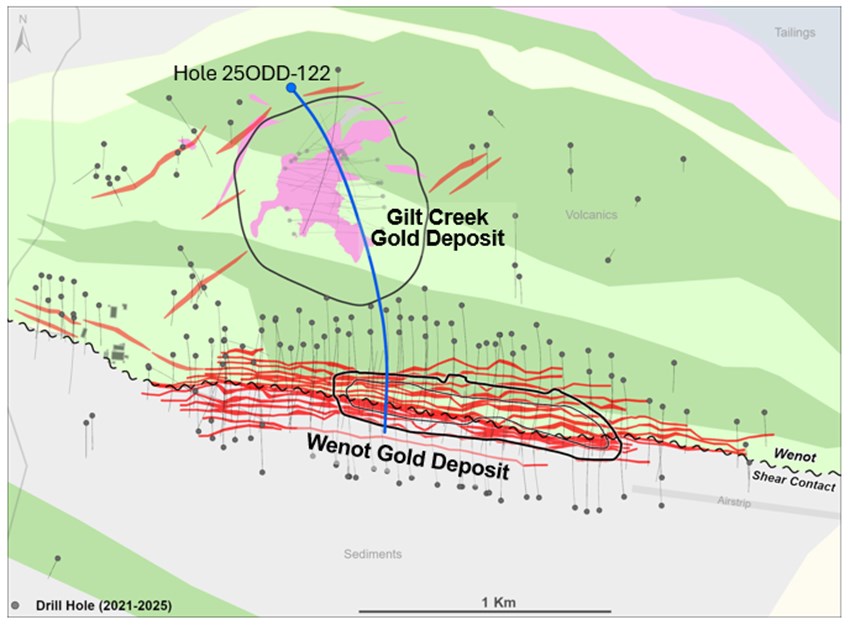
Figure 1. Omai Gold property geology map showing Gilt Creek and Wenot deposits and Location of Diamond Drill Hole 25ODD-122
To view an enhanced version of this graphic, please visit:
https://images.newsfilecorp.com/files/8712/278507_e403672a84d0dae4_001full.jpg
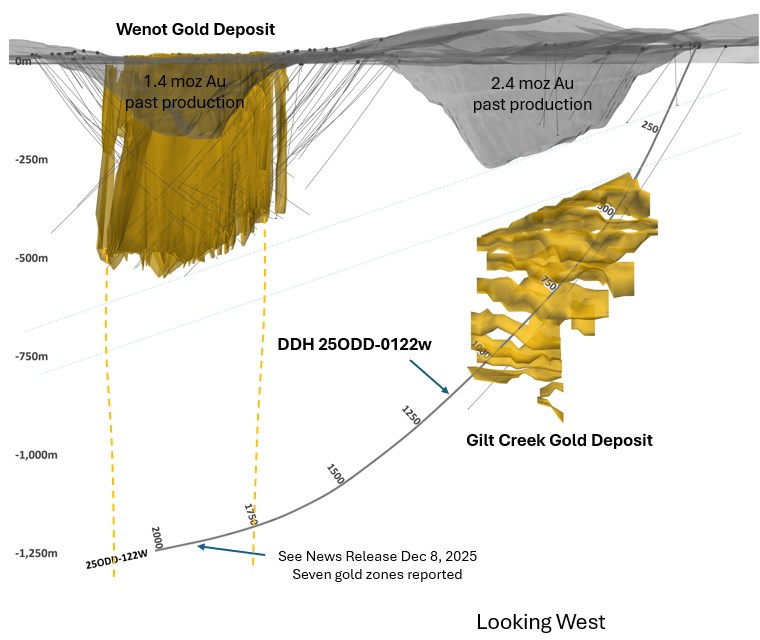
Figure 2. Cross section Illustrating Location of Hole 122w Relative to Gilt Creek and Weno Deposits, Omai Gold Project, Guyana
To view an enhanced version of this graphic, please visit:
https://images.newsfilecorp.com/files/8712/278507_e403672a84d0dae4_002full.jpg
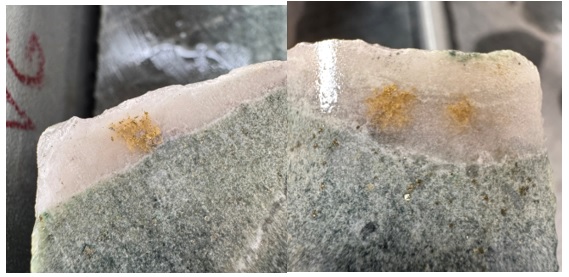
Photo 1. Visible Gold in Quartz Vein within Gilt Creek Gold Deposit (Hole 122W @ 652.7m- left and 656.1m - right and 1333.1m - bottom)
To view an enhanced version of this graphic, please visit:
https://images.newsfilecorp.com/files/8712/278507_omai.jpg
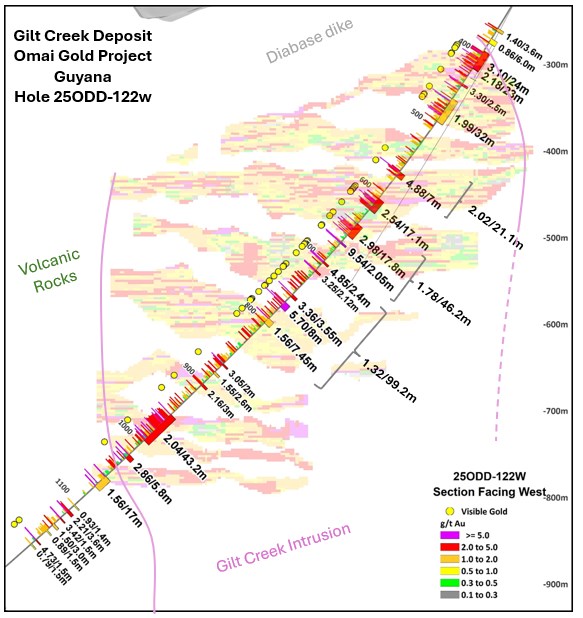
Figure 3. Cross-Section for DDH 25ODD-122w
To view an enhanced version of this graphic, please visit:
https://images.newsfilecorp.com/files/8712/278507_e403672a84d0dae4_005full.jpg
Table 1. Assay Results for Hole 25ODD-122W*
| Hole ID | From (m) | To (m) | Interval (m) | Grade (g/t Au) |
| 25ODD-122 | 46.5 | 54 | 7.5 | 1.37 |
| 395.5 | 419.5 | 24.0 | 3.10 | |
| including | 395.5 | 402.5 | 7.0 | 4.45 |
| and including | 408.2 | 415.5 | 7.4 | 4.58 |
| 25ODD-122W | 364.9 | 1073.0 | 708.1 | 1.06* |
| 397.0 | 420.0 | 23.0 | 2.18 | |
| including | 406.5 | 420.0 | 13.5 | 2.69 |
| 441.1 | 443.6 | 2.5 | 3.30 | |
| 462.0 | 494.0 | 32.0 | 1.99 | |
| including | 462.0 | 467.0 | 5.0 | 5.35 |
| and including | 479.0 | 486.3 | 7.3 | 2.89 |
| 566.3 | 573.4 | 7.0 | 4.88 | |
| 605.5 | 622.6 | 17.1 | 2.54 | |
| including | 609.5 | 621.6 | 12.1 | 3.08 |
| 635.6 | 681.7 | 46.1 | 1.78* | |
| including | 643.8 | 661.6 | 17.8 | 2.98 |
| including | 649.1 | 661.6 | 12.5 | 3.76 |
| 672.0 | 674.0 | 2.1 | 9.54 | |
| 702.0 | 801.2 | 99.2 | 1.32* | |
| Including | 702.0 | 704.4 | 2.4 | 4.85 |
| and including | 715.7 | 717.8 | 2.1 | 3.25 |
| and including | 754.7 | 758.3 | 3.6 | 3.36 |
| and including | 766.9 | 775.0 | 8.0 | 5.70 |
| and including | 793.7 | 801.2 | 7.5 | 1.56 |
| 868.0 | 870.0 | 2.0 | 3.05 | |
| 881.3 | 883.9 | 2.6 | 1.55 | |
| 901.0 | 904.0 | 3.0 | 2.16 | |
| 952.2 | 995.4 | 43.2 | 2.04 | |
| including | 962.9 | 977.3 | 14.5 | 2.80 |
| 1019.0 | 1024.8 | 5.8 | 2.86 | |
| 1056.0 | 1073.0 | 17.0 | 1.56 | |
| including | 1067.7 | 1073.0 | 5.3 | 3.17 |
*Estimated true widths at Gilt Creek are 75
Table 2. Drill Hole Coordinates
| Hole ID | Azimuth | Inclination | Easting | Northing | Length | Status |
| (degrees) | (degrees) | (m) | ||||
| 25ODD-122&W | 142 | -60 | 304648 | 602870 | 2,013.6 | Reporting down to 1,750m |
Quality Control
Omai maintains an internal QA/QC program to ensure sampling and analysis of all exploration work is conducted in accordance with best practices. Certified reference materials, blanks and duplicates are entered at regular intervals. Samples are sealed in plastic bags.
Drill core samples (halved-core) were shipped to Act Labs a certified laboratory in Georgetown Guyana, respecting the best chain of custody practices. At the laboratory, samples are dried, crushed up to
For hole 25ODD-122 and 122w, all samples with fire-assay of >0.5 g/t were selectively analysed at ActLabs by Metallic Screening, a technique to more accurately measure gold, especially samples with coarse or visible gold. A representative 500-gram sample split is sieved at 125 μm, with standard fire assays (FA) performed on the entire +125 μm fraction and two splits of the -125 μm fraction. When assays have been completed on the coarse and fine portions of the large sample, a final assay is calculated based on the weight of each fraction. This process provides a more representative total grade than standard 50g FA alone.
Qualified Person
Elaine Ellingham, P.Geo., is a Qualified Person (QP) under National Instrument 43-101 "Standards of Disclosure for Mineral Projects" and has approved the technical information contained in this news release. Ms. Ellingham is a director and officer of the Company and is not considered to be independent for the purposes of National Instrument 43-101.
ABOUT OMAI GOLD
Omai Gold Mines Corp. is a Canadian gold exploration and development company focused on rapidly expanding the two orogenic gold deposits at its
1 NI 43-101 Technical Report dated October 9, 2025 titled "UPDATED MINERAL RESOURCE ESTIMATE AND TECHNICAL REPORT ON THE OMAI GOLD PROPERTY, POTARO MINING DISTRICT NO.2, GUYANA" was prepared by P&E Mining Consultants Inc. and is available on www.sedarplus.ca and on the Company's website.
2 Past production at the Omai Mine (1993-2005) is summarized in several Cambior Inc. documents available on www.sedarplus.ca, including March 31, 2006 AIF and news release August 3, 2006.
For further information, please see our website www.omaigoldmines.com or contact:
Elaine Ellingham, P.Geo.
President & CEO
elaine@omaigoldmines.com
+1.416.473.5351
Neither the TSX Venture Exchange nor its Regulation Services Provider (as that term is defined in the policies of the TSX Venture Exchange) accepts responsibility for the adequacy or accuracy of this release.
Cautionary Note Regarding Forward-Looking Statements
This news release includes certain "forward-looking statements" under applicable Canadian securities legislation. Forward-looking statements include, but are not limited to, statements with respect to the timing of completion of the drill program, and the potential for the Omai Gold Project to allow Omai to build significant gold Mineral Resources at attractive grades, and forward-looking statements are necessarily based upon a number of estimates and assumptions that, while considered reasonable, are subject to known and unknown risks, uncertainties and other factors which may cause the actual results and future events to differ materially from those expressed or implied by such forward-looking statements. Such factors include, but are not limited to general business, economic, competitive, political and social uncertainties; delay or failure to receive regulatory approvals; the price of gold and copper; and the results of current exploration. Further, the Mineral Resource data set out in this news release are estimates, and no assurance can be given that the anticipated tonnages and grades will be achieved or that the indicated level of process recovery will be realized. There can be no assurance that forward-looking statements will prove to be accurate, as actual results and future events could differ materially from those anticipated in such statements. Accordingly, readers should not place undue reliance on forward-looking statements. The Company disclaims any intention or obligation to update or revise any forward-looking statements, whether as a result of new information, future events or otherwise, except as required by law.
Cautionary Note Regarding Mineral Resource Estimates
Until mineral deposits are actually mined and processed, Mineral Resources must be considered as estimates only. Mineral Resource Estimates that are not Mineral Reserves have not demonstrated economic viability. The estimation of Mineral Resources is inherently uncertain, involves subjective judgement about many relevant factors and may be materially affected by, among other things, environmental, permitting, legal, title, taxation, socio-political, marketing, or other relevant risks, uncertainties, contingencies and other factors described in the Company's public disclosure available on SEDAR+ at www.sedarplus.ca. The Inferred Mineral Resource in this estimate has a lower level of confidence than that applied to an Indicated Mineral Resource and must not be converted to a Mineral Reserve. It is reasonably expected that the majority of the Inferred Mineral Resource could be upgraded to an Indicated Mineral Resource with continued exploration. The accuracy of any Mineral Resource Estimates is a function of the quantity and quality of available data, and of the assumptions made and judgments used in engineering and geological interpretation, which may prove to be unreliable and depend, to a certain extent, upon the analysis of drilling results and statistical inferences that may ultimately prove to be inaccurate. Mineral Resource Estimates may have to be re-estimated based on, among other things: (i) fluctuations in mineral prices; (ii) results of drilling, and development; (iii) results of future test mining and other testing; (iv) metallurgical testing and other studies; (v) results of geological and structural modeling including block model design; (vi) proposed mining operations, including dilution; (vii) the evaluation of future mine plans subsequent to the date of any estimates; and (viii) the possible failure to receive required permits, licenses and other approvals. It cannot be assumed that all or any part of a "Inferred" or "Indicated" Mineral Resource Estimate will ever be upgraded to a higher category. The Mineral Resource Estimates disclosed in this news release were reported using Canadian Institute of Mining, Metallurgy and Petroleum Definition Standards for Mineral Resources and Mineral Reserves (the "CIM Standards") in accordance with National Instrument 43-101- Standards of Disclosure for Mineral Projects of the Canadian Securities Administrators ("NI 43-101").
Cautionary Statements to U.S. Readers
This news release uses the terms "Mineral Resource", "Indicated Mineral Resource" and "Inferred Mineral Resource" as defined in the CIM Standards in accordance with NI 43-101. While these terms are recognized and required by the Canadian Securities Administrators in accordance with Canadian securities laws, they may not be recognized by the United States Securities and Exchange Commission. The "Mineral Resource" Estimates and related information in this news release may not be comparable to similar information made public by U.S. companies subject to the reporting and disclosure requirements under the United States federal securities laws and the rules and regulations thereunder.

To view the source version of this press release, please visit https://www.newsfilecorp.com/release/278507
FAQ
AI-generated questions and answers. How Rhea-AI works. Not financial advice.