
Omai Gold Intersects Multiple Gold Zones in Each Wenot Hole Including 4.84 g/t Au over 38.4m and 12.57 g/t Au over 5.8m
Eighty-eight holes completed after the April resource estimate add drilling data ahead of a planned Q1 2027 update.
Sentiment and the balance of points
Rhea-AI Sentiment reads the wording of the document, how positive or negative its language is on a 1 to 5 scale. The balance of points shown with the takes weighs what the document actually discloses, so the two can disagree, for example when a trial that missed its main goal is described in upbeat language.
Rhea-AI Summary
Omai Gold Mines (OMGGF) reported results from 12 Wenot drill holes, each intersecting multiple gold zones at its project in Guyana. The holes totalled 6,913m. Highlights included 4.84 grams of gold per tonne (g/t Au) over 38.4m in hole 26ODD-204 and 12.57 g/t Au over 5.8m in hole 26ODD-207, both within central Wenot's Dike Corridor.
The company has completed 106 holes totalling 50,185m in 2026, including 88 holes drilled after the April 14 resource estimate. Assays are pending for another 42 holes. Six rigs are active, with five focused on Wenot. Omai targets an updated mineral resource estimate in Q1 2027 and is advancing work toward a feasibility study. Shallow drilling has begun at the BBH exploration target, and a Boneyard test hole is planned. Further metallurgical testing is underway at SGS Labs to determine plant optimization parameters.
How this balance works
Rhea-AI gives every point it takes from this document a weight. Minor counts 1, Moderate 3 and Major 9, so one Major point outweighs several Minor ones. The bar adds up the weights on each side, and when neither side holds more than 65% of the total the balance reads Mixed.
It reads the document as published, with the same rules for every company, and it does not look at what the market expected or at how the stock traded, so a point can be objectively good on a day the stock falls.
Rhea-AI Sentiment measures something else, the tone of the wording.
Hollow bars mark forward-looking points. How the balance works
Positive
- Moderate point. Forward-looking: it has not happened yet and may not happen.Resource-update drilling has completed 88 holes since the April 14, 2026 estimate; Omai targets an update in Q1 2027.
- Minor pointHole 26ODD-204 intersected 4.84 g/t Au over 38.4m in central Wenot's Dike Corridor.
- Minor pointHole 26ODD-207 intersected 12.57 g/t Au over 5.8m, plus 2.56 g/t Au over 9.0m.
- Minor pointHole 26ODD-203 returned 2.38 g/t Au over 23.9m, alongside additional gold zones.
- Minor pointHole 26ODD-200W returned 6.96 g/t Au over 5.2m, including 19.21 g/t Au over 1.6m.
12 minor points
- Minor pointWest Wenot hole 26ODD-202 returned 2.78 g/t Au over 20.2m across its multiple gold zones.
- Minor pointHole 26ODD-206 intersected 2.05 g/t Au over 20.8m and 9.43 g/t Au over 2.2m.
- Minor pointHole 26ODD-209 returned 15.21 g/t Au over 2.0m and 1.04 g/t Au over 26.0m.
- Minor pointHole 26ODD-220 returned 1.78 g/t Au over 23.0m and 0.86 g/t Au over 32.5m.
- Minor pointHole 26ODD-201 intersected 1.13 g/t Au over 17.0m and 0.88 g/t Au over 19.5m.
- Minor pointWest Wenot hole 26ODD-211 intersected 2.08 g/t Au over 12.6m.
- Minor pointEast Wenot hole 26ODD-205 returned 0.71 g/t Au over 33.7m and 1.92 g/t Au over 6.4m.
- Minor pointEast Wenot hole 26ODD-217 intersected 1.03 g/t Au over 22.6m.
- Minor pointBBH exploration has begun with 100–150m-deep vertical holes to test continuity of near-surface gold mineralization.
- Minor point. Forward-looking: it has not happened yet and may not happen.Boneyard exploration plans include a test hole targeting a geophysical signature similar to the Gilt intrusion.
- Minor point. Forward-looking: it has not happened yet and may not happen.Feasibility-study preparation includes planned November and early December site visits to establish engineering and site studies.
- Minor pointFurther metallurgical testing is underway at SGS Labs to determine plant optimization parameters.
Negative
- Minor pointBoneyard drilling attempts were previously impeded by wet terrain.
AI-generated analysis. How Rhea-AI works. Not financial advice.


Toronto, Ontario--(Newsfile Corp. - November 12, 2026) - Omai Gold Mines Corp. (TSXV: OMG) (OTCQB: OMGGF) ("Omai Gold" or the "Company") is pleased to announce results from 12 diamond drill holes (representing 6,913m) from the ongoing drill program at its
Highlights* from the recent drilling include:
Central Wenot Area
- Hole 26ODD-204
- 4.84 g/t Au over 38.4m
- Including 6.91 g/t Au over 18.3m
- 7.90 g/t Au over 2.8m
- 4.84 g/t Au over 38.4m
- Hole 26ODD-200W
- 6.96 g/t Au over 5.2m
- Including 19.21 g/t Au over 1.6m
- 0.73 g/t Au over 28.2m
- 6.96 g/t Au over 5.2m
- Hole 26ODD-207
- 12.57 g/t Au over 5.8m
- Including 20.97 g/t Au over 3.3m
- 2.56 g/t Au over 9.0m
- 12.57 g/t Au over 5.8m
- Hole 26ODD-203
- 2.38 g/t Au over 23.9m
- 1.44 g/t Au over 22.1m
- 4.02 g/t Au over 7.6m
- Hole 26ODD-220
- 1.78 g/t Au over 23.0m
- 0.86 g/t Au over 32.5m
- Hole 26ODD-201
- 1.13 g/t Au over 17.0m
- 0.88 g/t Au over 19.5m
West Wenot
- Hole 26ODD-202
- 2.78 g/t Au over 20.2m
- 2.00 g/t Au over 7.5m
- Including 8.05 g/t Au over 1.4m
- 1.15 g/t Au over 12.7m
- Hole 26ODD-206
- 2.05 g/t Au over 20.8m
- including 24.19 g/t Au over 1.0m
- 9.43 g/t Au over 2.2m
- 2.60 g/t Au over 10.2m
- 2.05 g/t Au over 20.8m
- Hole 26ODD-209
- 15.21 g/t Au over 2.0m
- 1.04 g/t Au over 26.0m
- 2.31 g/t Au over 8.5m
- Hole 26ODD-211
- 2.08 g/t Au over 12.6m
East Wenot
- Hole 26ODD-205
- 0.71 g/t Au over 33.7m
- 1.92 g/t Au over 6.4m
- Hole 26ODD-217
- 1.03 g/t Au over 22.6m
*Only the highest grade x width assay composites are listed; refer to Table 1 for full assay composites and downhole depths
Elaine Ellingham, President & CEO comments: "We are pleased that the 2026 drilling at Omai is progressing rapidly to support the next milestones for the project. With six rigs active, we are targeting an updated Mineral Resource Estimate early in the new year. Five drills are focused on the Wenot deposit and the conversion of the large Inferred resource, while concurrently testing some of the additional mineralized zones and splays that have been encountered at Wenot along the flanks and along strike. Focused drilling in late 2025 proved effective, both at expanding the Wenot resource and also upgrading over 480,000 ounces into the Indicated resource category, and we expect continued success with the current drilling. Wenot is a simple shear-hosted deposit without any notable folding or faulting; this is well evidenced by the deep hole 25ODD-122W that intersected the Wenot shear exactly as expected a full 700 m below the known deposit. As such, we expect the additional drilling to continue to confirm continuity within the well-developed geological model.
The recent addition of the sixth drill allows us to step out onto some of the exploration targets elsewhere on the Omai property. We have commenced a series of 100-150m deep vertical holes on the BBH target located roughly 1 km northwest of Wenot, where trenching identified high-grade gold in a series of flat lying veins. The goal of the new drilling is to test the continuity of the higher grade, near surface mineralization that could positively impact the early years of the mine plan. Plans are also in place for a hole to test the Boneyard area, an area distinguished by a distinctive low magnetic airborne geophysics signature, similar to that of the Gilt intrusion. Previous attempts were impeded by wet terrain, to a large degree related to historical artisanal mining over the target area. Both the Wenot and Gilt gold deposits have distinctive geophysical signatures and we plan to continue to test other similar anomalies. This 6th rig will also be used for geotechnical and condemnation drilling, in support of a feasibility study.
Following the robust PEA announced in August, we are executing on plans to advance work towards a feasibility study. Site visits later this month and in early December will establish the engineering and site studies. Favourable metallurgical test results earlier this year set the groundwork for the next phases which are underway at SGS Labs in Lakefield, Ontario to determine further plant optimizing parameters.
The Omai project has far exceeded our initial size expectations, with the recent PEA supporting an over 350,000 ounce per year operation over an 18 year mine life, for production of over 6.3 million ounces of gold1. Further, our deep drilling on both the Wenot and Gilt deposits to depths of 1200m suggests future potential for either a longer mine life or higher annual production levels, or both. The Omai geology has proven to be prolific for gold mineralization and provides the incentive to pursue exploration targets in the immediate vicinity."
Wenot Drill Results
At the Wenot Deposit, each hole encountered multiple gold zones (see Table 1 and Figure 1). For example, in central Wenot, hole 26ODD-204 intersected 16 discrete gold zones highlighted by 4.84 g/t Au over 38.4m including 6.91 g/t Au over 18.3m within the prolific Dike Corridor (Figure 3). Hole 26ODD-203, collared 225m east of hole 204 intersected 2.38 g/t Au over 23.9m within this same broad gold zone. An additional hole, 26ODD-207, collared a further 126m east of hole 203 but drilled from the south side of the deposit, intersected 13 gold mineralized zones with the highlights within the Dike Corridor being 12.57 g/t Au over 5.8m (including 20.97 g/t Au over 3.3m), 2.56 g/t Au over 9.0m and 1.54 g/t Au over 11.5m.
At the western end of the Wenot deposit, hole 26ODD-206 intersected 2.05 g/t Au over 20.8m within the quartz feldspar porphyry dike (CQFP) that occupies the central contact between the volcanic rock sequence to the north and the sedimentary rocks to the south. It also intersected six gold zones within the southern sediments, including 2.60 g/t Au over 10.2m, 9.43 g/t Au over 2.2m and 1.64 g/t Au over 9.3m. Hole 26ODD-202 (Figure 4), collared 87m to the west of hole 206 intersected 18 discrete gold zones. Highlights include narrow high-grade zones within the northern volcanics of 8.05 g/t Au over 1.4m and 7.10 g/t Au over 1.4m. Most zones were within the southern sedimentary sequence, as is typical of West Wenot, with the best zones including 2.78 g/t Au over 20.2m, 1.69 g/t Au over 7.0m, 0.81 g/t Au over 17.0m, 5.17 g/t Au over 2.0m and 1.15 g/t Au over 12.7m. In aggregate, the sediment-hosted gold zones in hole 202 meeting the economic cut-off grade set in the PEA (0.27 g/t Au) comprise 85.9m within 253.2m of core, representing
Table 1. Recent Wenot Drill Results
| Drill Hole # | FROM (m) | TO (m) | Width (m) | Assay (g/t Au) | Gold Zone |
| 26ODD-200W | 238.9 | 240.0 | 1.1 | 4.98 | Dike corridor |
| 304.3 | 309.4 | 5.2 | 6.96 | ||
| including | 306.7 | 308.4 | 1.6 | 19.21 | |
| 330.9 | 339.8 | 9.0 | 0.90 | ||
| 349.5 | 357.5 | 8.0 | 1.47 | ||
| 378.0 | 394.1 | 16.1 | 0.74 | ||
| 430.6 | 435.3 | 4.7 | 1.03 | ||
| 523.0 | 524.3 | 1.3 | 4.07 | ||
| 559.1 | 563.2 | 4.1 | 2.83 | ||
| 636.1 | 664.3 | 28.2 | 0.73 | Central Contact (CQFP) | |
| including | 651.5 | 660.4 | 8.9 | 1.49 | |
| 26ODD-201 | 285.5 | 289.0 | 3.5 | 0.78 | Sediment-Hosted |
| 295.0 | 299.0 | 4.0 | 0.73 | ||
| 305.0 | 308.0 | 3.0 | 1.28 | ||
| 373.8 | 378.0 | 4.2 | 1.7 | ||
| 390.00 | 393.50 | 3.5 | 1.63 | ||
| 405.00 | 409.50 | 4.5 | 3.16 | ||
| 425.40 | 431.00 | 5.6 | 1.14 | Central Contact Zone | |
| 444.50 | 449.50 | 5.0 | 0.58 | Dike Corridor | |
| 506.00 | 523.00 | 17.0 | 1.13 | ||
| 535.00 | 542.00 | 7.0 | 0.61 | ||
| 552.50 | 572.00 | 19.5 | 0.88 | ||
| 579.50 | 585.50 | 6.0 | 0.56 | ||
| 26ODD-202 | 194.0 | 195.4 | 1.4 | 7.10 | Northern Volcanics |
| 237.0 | 244.5 | 7.5 | 2.00 | ||
| including | 242.0 | 243.4 | 1.4 | 8.05 | |
| 264.8 | 277.9 | 13.1 | 0.56 | Central Contact CQFP | |
| 299.8 | 301.3 | 1.5 | 1.52 | Sediment-Hosted | |
| 305.0 | 312.5 | 7.5 | 0.71 | ||
| 321.3 | 334.0 | 12.7 | 1.15 | ||
| 338.7 | 340.0 | 1.3 | 1.86 | ||
| 344.5 | 347.5 | 3.0 | 0.77 | ||
| 352.0 | 359.0 | 7.0 | 1.69 | ||
| 365.0 | 382.0 | 17.0 | 0.81 | ||
| 385.3 | 387.5 | 2.2 | 1.89 | ||
| 391.8 | 412.0 | 20.2 | 2.78 | ||
| 438.0 | 441.0 | 3.0 | 1.11 | ||
| 456.0 | 461.0 | 5.0 | 0.59 | ||
| 546.5 | 547.5 | 1.0 | 4.10 | ||
| 551.0 | 553.0 | 2.0 | 5.17 | ||
| 26ODD-203 | 121.3 | 122.8 | 1.5 | 5.71 | North Volcanics |
| 140.7 | 150.2 | 9.5 | 1.76 | ||
| 184.1 | 201.2 | 17.1 | 0.68 | Dike Corridor | |
| 276.5 | 298.6 | 22.1 | 1.44 | ||
| including | 292.0 | 297.3 | 5.4 | 3.88 | |
| 335.6 | 359.5 | 23.9 | 2.38 | ||
| 420.6 | 428.7 | 8.1 | 0.91 | ||
| 452.5 | 458.9 | 6.4 | 0.45 | Central Contact CQFP | |
| 473.5 | 476.3 | 2.8 | 1.08 | ||
| 496.2 | 503.6 | 7.4 | 0.57 | Sediment-Hosted | |
| 510.4 | 515.7 | 5.3 | 2.47 | ||
| 529.4 | 537.0 | 7.6 | 4.02 | ||
| 556.4 | 557.6 | 1.2 | 3.64 | ||
| 26ODD-204 | 290.4 | 294.7 | 4.3 | 1.63 | North Volcanics |
| 367.4 | 370.2 | 2.8 | 7.90 | ||
| 392.5 | 397.8 | 5.3 | 0.48 | ||
| 447.1 | 454.3 | 7.2 | 0.63 | Dike Corridor | |
| 460.0 | 464.7 | 4.8 | 1.56 | ||
| 500.0 | 504.4 | 4.4 | 1.87 | ||
| 511.7 | 514.1 | 2.4 | 4.24 | ||
| 537.5 | 543.9 | 6.5 | 0.52 | ||
| 555.0 | 593.4 | 38.4 | 4.84 | ||
| including | 573.0 | 591.3 | 18.3 | 6.91 | |
| 693.9 | 695.9 | 2.1 | 1.10 | Central Contact CQFP | |
| 699.0 | 713.9 | 14.9 | 0.80 | ||
| 740.0 | 744.5 | 4.5 | 0.30 | Sediment-Hosted | |
| 26ODD-205 | 279.6 | 290.1 | 10.5 | 0.74 | Dike Corridor |
| 362.0 | 395.7 | 33.7 | 0.71 | ||
| 433.4 | 442.2 | 8.8 | 0.40 | Central Contact Zone | |
| 461.7 | 468.1 | 6.4 | 1.92 | ||
| 490.8 | 492.2 | 1.4 | 1.56 | ||
| 541.4 | 542.5 | 1.1 | 2.02 | ||
| 26ODD-206 | 165.9 | 167.3 | 1.4 | 5.10 | Dike Corridor |
| 185.0 | 188.0 | 3.0 | 0.75 | ||
| 245.0 | 246.5 | 1.5 | 1.51 | ||
| 264.5 | 268.5 | 4.0 | 2.67 | ||
| 310.9 | 313.5 | 2.6 | 1.43 | ||
| 338.5 | 359.3 | 20.8 | 2.05 | Central Contact CQFP | |
| including | 339.6 | 340.6 | 1.0 | 24.19 | |
| 420.7 | 422.9 | 2.2 | 9.43 | Sediment-Hosted | |
| 438.0 | 447.3 | 9.3 | 1.64 | ||
| including | 446.0 | 447.3 | 1.3 | 8.77 | |
| 451.7 | 453.0 | 1.3 | 1.60 | ||
| 458.5 | 464.1 | 5.6 | 1.00 | ||
| 516.1 | 526.3 | 10.2 | 2.60 | ||
| including | 523.0 | 524.1 | 1.1 | 15.34 | |
| 26ODD-207 | 284.5 | 293.5 | 9.0 | 0.59 | Sediment-Hosted |
| 307.7 | 316.5 | 8.8 | 0.76 | ||
| 327.5 | 330.0 | 2.5 | 2.10 | ||
| 339.0 | 342.0 | 3.0 | 0.70 | ||
| 369.0 | 372.0 | 3.0 | 1.40 | Central Contact CQFP | |
| 420.5 | 432.0 | 11.5 | 1.54 | Dike Corridor | |
| 438.0 | 447.0 | 9.0 | 2.56 | ||
| 465.0 | 471.0 | 6.0 | 1.00 | ||
| 560.7 | 566.5 | 5.8 | 12.57 | ||
| including | 560.7 | 564.0 | 3.3 | 20.97 | |
| 26ODD-209 | 226.0 | 229.0 | 3.0 | 0.92 | North Volcanics |
| 362.0 | 370.5 | 8.5 | 2.31 | Dike Corridor | |
| including | 362.0 | 366.2 | 4.2 | 3.31 | |
| 381.0 | 383.5 | 2.5 | 1.08 | ||
| 412.5 | 415.5 | 2.0 | 15.21 | ||
| 473.5 | 485.0 | 11.5 | 0.59 | Central Contact CQFP | |
| 508.0 | 534.0 | 26.0 | 1.04 | Sediment-Hosted | |
| 542.2 | 546.4 | 4.2 | 0.51 | ||
| 557.5 | 566.5 | 9.0 | 0.90 | ||
| 629.0 | 641.5 | 12.5 | 0.95 | ||
| 658.0 | 659.5 | 1.5 | 1.68 | ||
| 26ODD-211 | 97.8 | 106.5 | 8.7 | 1.26 | North Volcanics |
| 117.2 | 122.5 | 5.4 | 0.37 | ||
| 132.0 | 140.3 | 8.3 | 1.37 | Dike Corridor | |
| 165.5 | 178.1 | 12.6 | 2.08 | ||
| including | 173.0 | 176.0 | 3.0 | 3.89 | |
| 201.3 | 203.2 | 2.0 | 1.61 | ||
| 320.0 | 321.0 | 1.0 | 2.44 | ||
| 389.5 | 394.0 | 4.5 | 1.04 | ||
| 418.4 | 419.5 | 1.0 | 3.13 | Southern porphyry | |
| 26ODD-217 | 334.0 | 356.5 | 22.6 | 1.03 | Dike Corridor |
| 384.9 | 387.3 | 2.4 | 0.96 | Central Contact CQFP & Shear | |
| 390.9 | 393.2 | 2.3 | 3.03 | ||
| 396.6 | 401.7 | 5.1 | 0.61 | ||
| 424.3 | 430.6 | 6.4 | 0.84 | Sediment-Hosted | |
| 26ODD-220 | 235.3 | 239.3 | 3.9 | 1.00 | Sediment-Hosted |
| 247.8 | 249.4 | 1.6 | 5.51 | ||
| 258.0 | 264.0 | 6.0 | 0.76 | ||
| 297.0 | 329.5 | 32.5 | 0.86 | ||
| including | 298.5 | 301.5 | 3.0 | 2.14 | |
| including | 324.3 | 325.5 | 1.2 | 6.05 | |
| 350.3 | 352.8 | 2.5 | 2.42 | ||
| 359.5 | 382.5 | 23.0 | 1.78 | Protomylonite | |
| 386.4 | 397.7 | 11.3 | 1.19 | Central Contact CQFP |
*True widths vary as mineralization at Wenot is generally hosted within stockwork vein systems with alteration halos, with an estimated true width range of 70
Quality Control
Omai maintains an internal QA/QC program to ensure sampling and analysis of all exploration work is conducted in accordance with best practices. Certified reference materials, blanks and duplicates are entered at regular intervals. Samples are sealed in plastic bags.
Drill core samples (halved-core) were shipped to Act Labs, a certified laboratory in Georgetown Guyana, respecting the best chain of custody practices. At the laboratory, samples are dried, crushed up to
Qualified Persons
Elaine Ellingham, P.Geo., is a Qualified Person (QP) under National Instrument 43-101 "Standards of Disclosure for Mineral Projects" and has reviewed and approved the technical information contained in this news release. Ms. Ellingham is a director and officer of the Company and is not considered to be independent for the purposes of National Instrument 43-101.
ABOUT OMAI GOLD
Omai Gold Mines Corp. is a Canadian gold exploration and development company focused on advancing the two orogenic gold deposits at its
Omai Gold announced a Preliminary Economic Assessment (PEA)1 in August 2026 that includes the large Wenot open pit deposit and the adjacent Gilt underground deposit. The PEA supports a mine plan to produce 6.3 million ounces of gold over an 18-year mine life. Average gold production is projected at 351,000 ounces per year. At the
For further information, please see our website www.omaigoldmines.com or contact:
Elaine Ellingham, P.Geo.
President & CEO
416-473-5351
info@omaigoldmines.com
Neither the TSX Venture Exchange nor its Regulation Services Provider (as that term is defined in the policies of the TSX Venture Exchange) accepts responsibility for the adequacy or accuracy of this release.
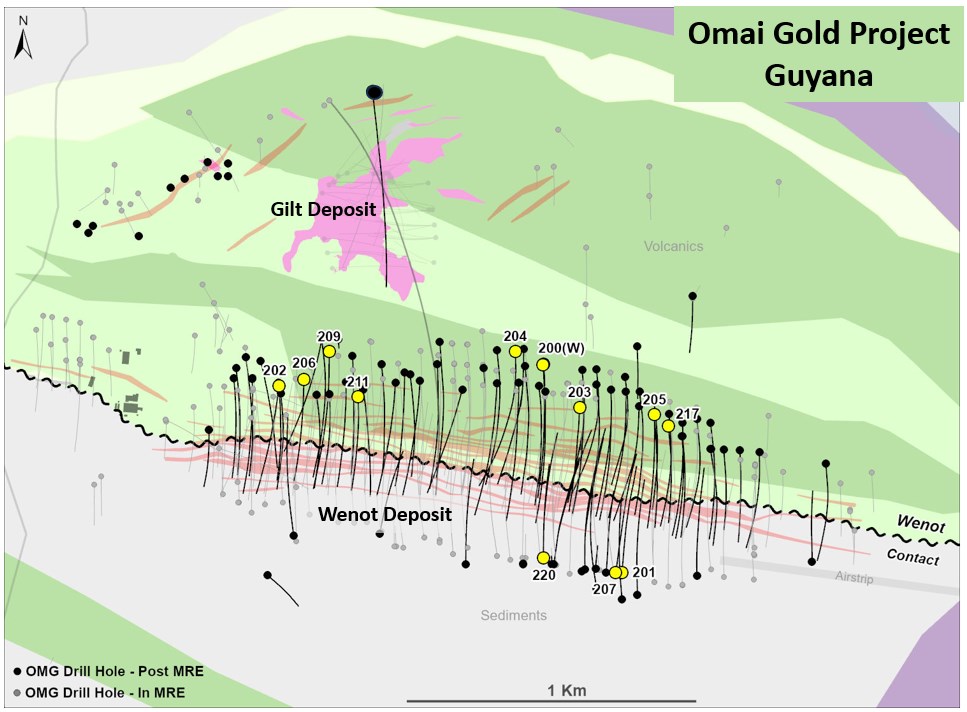
Figure 1. Drill Hole Location Map
To view an enhanced version of this graphic, please visit:
https://images.newsfilecorp.com/files/8712/323707_a4ec6e79e41b5ae8_001full.jpg
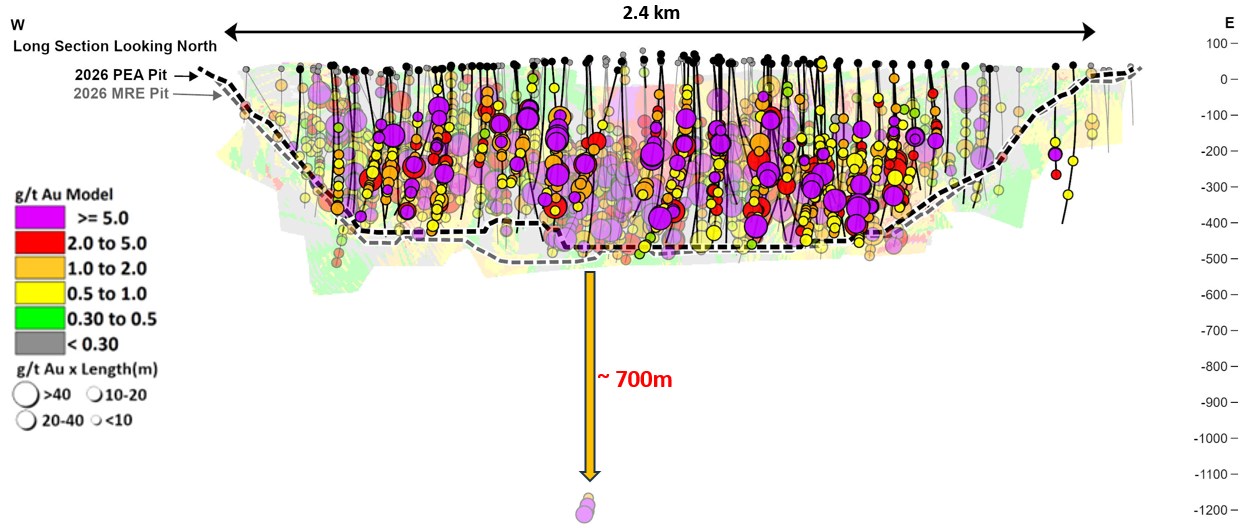
Figure 2. Wenot Longitudinal Section (looking north) Showing Distribution of Drill Composites. (Faded dots indicate results already included in the April 2026 MRE. Full colour dots are composites from 46 holes to date with results reported. Results for an additional 42 holes are pending.)
To view an enhanced version of this graphic, please visit:
https://images.newsfilecorp.com/files/8712/323707_a4ec6e79e41b5ae8_002full.jpg
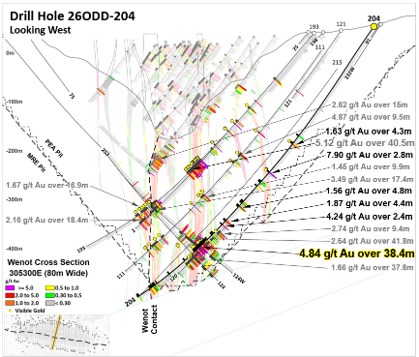
Figure 3. Cross-Section for DDH 26ODD-204 (Central Wenot)
To view an enhanced version of this graphic, please visit:
https://images.newsfilecorp.com/files/8712/323707_a4ec6e79e41b5ae8_003full.jpg
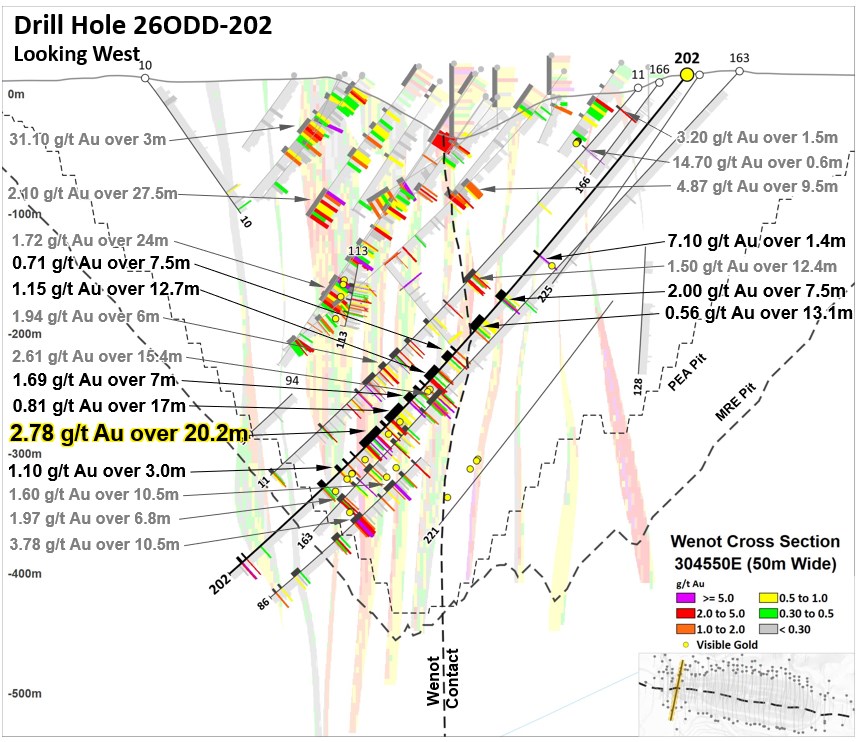
Figure 4. Cross-Section for DDH26ODD-202 (West Wenot)
To view an enhanced version of this graphic, please visit:
https://images.newsfilecorp.com/files/8712/323707_a4ec6e79e41b5ae8_004full.jpg
Table 2. Drill Hole Locations
| Hole Number | Azimuth | Inclination | Easting | Northing | Length |
| (degrees) | (degrees) | (m) | |||
| 26ODD-200W | 175 | -52 | 305395 | 601950 | 700.6 |
| 26ODD-201 | 6 | -50 | 305669 | 601223 | 606.7 |
| 26ODD-202 | 185 | -52 | 304472 | 601874 | 566.2 |
| 26ODD-203 | 184 | -53 | 305521 | 601800 | 574.9 |
| 26ODD-204 | 178 | -55 | 305297 | 601995 | 745.6 |
| 26ODD-205 | 180 | -49 | 305782 | 601774 | 559.8 |
| 26ODD-206 | 180 | -52 | 304559 | 601896 | 538.7 |
| 26ODD-207 | 8 | -45 | 305647 | 601224 | 574.5 |
| 26ODD-209 | 180 | -48 | 304648 | 601994 | 668.1 |
| 26ODD-211 | 180 | -45 | 304749 | 601836 | 426.5 |
| 26ODD-217 | 176 | -45 | 305831 | 601735 | 463.5 |
| 26ODD-220 | 0 | -46 | 305395 | 601274 | 487.8 |
Cautionary Note Regarding Forward-Looking Statements
This press release contains statements that constitute "forward-looking information" (collectively, "forward-looking statements") within the meaning of the applicable Canadian securities legislation. Forward-looking statements contained in this press release include, without limitation, statements regarding the results, conclusions, projections, assumptions and economic and operating parameters of the PEA for the Omai Gold Project, including projected LOM, throughput, capital and operating costs, metal recoveries, payable production, NPV, IRR, annual EBITDA, cash costs, AISC and payback period and sensitivities thereto; statements regarding metal price assumptions; statements related to projected costs and Capex; timing of filing of the technical report for the 2026 PEA; statements related to potential social and economic benefits to the local community and Guyana as a result of development of the Omai Gold Project; statements relating to the Omai Gold Project as a profitable project for the Company; statements related to the Company's plans for power, water and tailings at the Omai Gold Project; statements relating to exploration, drilling and mineralization on the Company's Omai Gold Project; the interpretation of the results and benefits of the drilling program; future drilling and the timing and expected benefits thereof; potential resource expansion; assay results; the interpretation of drilling and assay results, the extent of mineralization and the discovery of zones of high-grade gold mineralization; future exploration and the focus and timing of same; the merits of the Omai Gold Project; future press releases by the Company; and funding of the ongoing drilling program. Although the Company believes that such statements are reasonable, it can give no assurance that such expectations will prove to be correct. Forward-looking statements are statements that are not historical facts; they are generally, but not always, identified by the words "expects", "plans", "anticipates", "believes", "interpreted", "intends", "estimates", "projects", "aims", "suggests", "indicate", "often", "target", "future", "likely", "encouraging", "pending", "potential", "goal", "objective", "opportunity", "prospective", "possibly", "preliminary", and similar expressions, or that events or conditions "will", "would", "may", "can", "could" or "should" occur, or are those statements, which, by their nature, refer to future events. In making the forward-looking statements contained in this press release, the Company has made certain assumptions, including, without limitation, assumptions regarding the accuracy of the MRE underlying the 2026 PEA; the validity of the technical, economic and operating assumptions used in the 2026 PEA (including assumed metal prices, exchange rates, recoveries, Capex and operating costs, mining and processing methods, throughput, ramp-up profile, ownership of legal title, capacity to store tailings, mine life and tax and royalty regimes); the availability of financing on acceptable terms to fund further development; the timely receipt of required permits and regulatory approvals; the absence of material adverse changes in commodity prices, capital markets and the regulatory and political environment; and the continued availability of qualified personnel and key contractors.
The Company cautions that forward-looking statements are based on the beliefs, estimates and opinions of the Company's management on the date the statements are made, and they involve a number of risks and uncertainties. Consequently, there can be no assurances that such statements will prove to be accurate and actual results and future events could differ materially from those anticipated in such statements. Such factors include, but are not limited to: the inherently preliminary nature of a preliminary economic assessment, including its reliance on inferred mineral resources that are considered too speculative geologically to have economic considerations applied to them and that may not ultimately be upgraded to higher-confidence categories or to mineral reserves; the risk that mineral resources are not mineral reserves and do not have demonstrated economic viability; risks that the assumptions underlying the PEA, including capital and operating cost estimates, metal recoveries and metal prices, availability of water and power, prove to be inaccurate; sensitivity of project economics to changes in commodity prices, exchange rates, capital costs and operating costs; the risk that further studies (including pre-feasibility and feasibility studies) yield results that differ materially from the PEA, or that mineral reserves are not ultimately established; the Company's ability to obtain financing on acceptable terms or at all; delay or failure to obtain required permits, regulatory approvals or surface rights required to advance the Omai Gold Project; environmental, social, taxation, title, legal, political, market, infrastructure and other risks affecting the development of the Omai Gold Project; risks relating to exploration and development of mineral properties generally; and general business, economic, competitive, political and social uncertainties. Except to the extent required by applicable securities laws and the policies of the TSX Venture Exchange, the Company undertakes no obligation to update these forward-looking statements if management's beliefs, estimates or opinions, or other factors, should change. The reader is urged to refer to the Company's most recent Management's discussion and Analysis, publicly available through the Canadian Securities Administrators' System for Electronic Document Analysis and Retrieval (SEDAR+) at www.sedarplus.ca for a more complete discussion of such risk factors and their potential effects.
Cautionary Note Regarding Mineral Resource Estimates
Until mineral deposits are actually mined and processed, Mineral Resources must be considered as estimates only. Mineral Resource Estimates that are not Mineral Reserves have not demonstrated economic viability. The estimation of Mineral Resources is inherently uncertain, involves subjective judgement about many relevant factors and may be materially affected by, among other things, environmental, permitting, legal, title, taxation, socio-political, marketing, or other relevant risks, uncertainties, contingencies and other factors described in the Company's public disclosure available on SEDAR+ at www.sedarplus.ca. Inferred Mineral Resource in the MRE have a lower level of confidence than that applied to an Indicated Mineral Resource and must not be converted to a Mineral Reserve. It is reasonably expected that the majority of the Inferred Mineral Resource could be upgraded to an Indicated Mineral Resource with continued exploration. The accuracy of any Mineral Resource Estimates is a function of the quantity and quality of available data, and of the assumptions made and judgments used in engineering and geological interpretation, which may prove to be unreliable and depend, to a certain extent, upon the analysis of drilling results and statistical inferences that may ultimately prove to be inaccurate. Mineral Resource Estimates may have to be re-estimated based on, among other things: (i) fluctuations in mineral prices; (ii) results of drilling, and development; (iii) results of future test mining and other testing; (iv) metallurgical testing and other studies; (v) results of geological and structural modeling including block model design; (vi) proposed mining operations, including dilution; (vii) the evaluation of future mine plans subsequent to the date of any estimates; and (viii) the possible failure to receive required permits, licenses and other approvals. It cannot be assumed that all or any part of a "Inferred" or "Indicated" Mineral Resource Estimate will ever be upgraded to a higher category. The MRE disclosed in this news release were reported using Canadian Institute of Mining, Metallurgy and Petroleum Definition Standards for Mineral Resources and Mineral Reserves in accordance with National Instrument 43-101- Standards of Disclosure for Mineral Projects of the Canadian Securities Administrators.
1 The NI 43-101 Technical Report dated October 2, 2026 "NI 43-101 TECHNICAL REPORT ON THE PRELIMINARY ECONOMIC ASSESSMENT, OMAI GOLD PROJECT, GUYANA" prepared by SLR Consulting (Canada) Ltd. under the supervision of David M. Robson, P.Eng. is available on SEDAR+.
2 A PEA is preliminary in nature and includes inferred mineral resources that are considered too speculative geologically to have the economic considerations applied to them that would enable them to be categorized as mineral reserves, and there is no certainty that the PEA will be realized. Mineral resources ("Mineral Resources") that are not mineral reserves ("Mineral Reserves") do not have demonstrated economic viability.

To view the source version of this press release, please visit https://www.newsfilecorp.com/release/323707
FAQ
AI-generated questions and answers. How Rhea-AI works. Not financial advice.
What were Omai Gold's main Wenot drilling results?
The highlighted intersections were 4.84 g/t Au over 38.4m in hole 26ODD-204 and 12.57 g/t Au over 5.8m in hole 26ODD-207. Both were in central Wenot's Dike Corridor. Every one of the 12 reported holes encountered multiple gold zones.
When does Omai Gold plan to update its mineral resource estimate?
Omai plans an updated mineral resource estimate in Q1 2027. Current drilling is directed toward that update, with five of six active rigs focused on Wenot and assays pending for another 42 holes.
Do Omai Gold's Wenot drill intervals represent true mineralized widths?
The reported intervals have an estimated true width range of 70–90%. Wenot mineralization is generally hosted in networks of veins with surrounding altered rock. Reported grades are uncapped unless otherwise noted, meaning unusually high gold values have not been limited when calculating those grades.