
STOCK TITAN

PG&E Lowers Electric Prices in March, Fifth Electric Rate Drop Since Early 2024

Rhea-AI Impact
(Moderate)
Rhea-AI Sentiment
(Neutral)
Tags

Pacific Gas and Electric (PCG) lowered residential electric rates on March 1, 2026, marking the fifth cut since January 2024 and the third consecutive drop since September. Residential bundled electric rates are 13% lower than January 2024, saving typical customers about $25/month at 500 kWh.

March cuts: electric rates down 1.8% (CARE customers ~8.3%), typical bill down about $5.14. Natural gas rates rose 0.3%, adding roughly $0.24/month to typical gas bills.

Loading...
Loading translation...

Positive

  • Residential electric rates down 13% since January 2024
  • Typical residential bills $25/month lower at 500 kWh usage since Jan 2024
  • March 2026 electric reduction of 1.8% for bundled customers

Negative

  • New Base Services Charge ~$24/month for most customers changes bill structure

Key Figures

Bundled rate change: 13% lower Bill reduction: $25 per month March electric cut: 1.8% +5 more
8 metrics
Bundled rate change 13% lower Residential bundled electric rates vs January 2024
Bill reduction $25 per month Typical residential electric bill drop since January 2024 at 500 kWh
March electric cut 1.8% Residential electric rate decrease vs February 2026
CARE rate cut 8.3% March 2026 electric rate decrease for CARE customers
Bill drop typical $5.14 per month Typical residential electric bill decrease from March 1, 2026
Bill drop CARE $10.37 per month Typical CARE residential bill decrease from March 1, 2026
Base charge CARE $6 per month Base Services Charge for CARE customers
Gas rate change 0.3% Residential natural gas rate increase vs February 2026

Market Reality Check

Price: $19.00 Vol: Volume 25232564 vs 20-day...
normal vol
$19.00 Last Close
Volume Volume 25232564 vs 20-day average 21815466 ahead of this rate-cut update. normal
Technical Price 19 is trading above 200-day MA at 15.56, near the 19.085 52-week high.

Peers on Argus

PCG was up 0.64% with peers ED, WEC, DTE, ETR and PEG also positive between 0.16...

PCG was up 0.64% with peers ED, WEC, DTE, ETR and PEG also positive between 0.16% and 1.29%, suggesting a supportive utilities backdrop but no flagged momentum cluster.

Historical Context

5 past events · Latest: Feb 25 (Positive)
Pattern 5 events
Date Event Sentiment Move Catalyst
Feb 25 Customer tool launch Positive -0.1% Launched Clean Energy Calculator to model electrification costs and savings.
Feb 20 Dividend declaration Positive +1.4% Announced Q1 2026 common and preferred stock cash dividends.
Feb 13 Storm preparedness Positive +3.4% Mobilized crews and resources ahead of a multi-phase winter storm.
Feb 12 Earnings and guidance Positive +2.7% Reported 2025 EPS, cut non-fuel O&M, and tightened 2026 guidance.
Feb 09 Safety awareness Neutral -0.3% Warned about metallic balloon risks and urged safety precautions.
Pattern Detected

Recent PG&E headlines have mostly seen positive price reactions, with one small divergence on a customer-focused product launch.

Recent Company History

Over the last few weeks, PG&E reported solid 2025 results with tightened 2026 EPS guidance, announced new long‑dated subordinated notes, and highlighted rate reductions with wildfire mitigation progress. Operational updates included storm preparedness and customer tools like the Clean Energy Calculator. Most of these events, especially earnings and safety-related news, coincided with positive next-day moves, framing today’s further electric rate reductions as part of a broader affordability and reliability narrative since January 2024.

Market Pulse Summary

This announcement continues PG&E’s theme of improving affordability, with electric rates cut five ti...
Analysis

This announcement continues PG&E’s theme of improving affordability, with electric rates cut five times since January 2024 and new Base Services Charges reshaping bills under California Assembly Bill 205. The update complements recent earnings, capital plans, and reliability initiatives. Investors following this story may monitor future regulatory decisions, additional rate adjustments, and how evolving electric and gas pricing affects customer usage, grid investment needs, and overall financial performance.

Key Terms

california alternate rates for energy (care), california public utilities commission, kilowatt-hours, therms
4 terms
california alternate rates for energy (care) regulatory
"customers who receive the California Alternate Rates for Energy (CARE) income-eligible discount."
California Alternate Rates for Energy (CARE) is a state utility program that gives qualifying low-income households a reduced electricity and gas bill, like a steady discount applied at the meter. Investors care because the program lowers revenue per customer, shifts who pays for utility costs, and influences future rate-setting and regulatory risk; think of it as a long-term, government-mandated coupon that changes a utility’s expected cash flow and customer affordability profile.
california public utilities commission regulatory
"The California Public Utilities Commission directed the state's investor-owned utilities to implement the charge"
The California Public Utilities Commission (CPUC) is the state agency that sets rates, enforces safety and service standards, and approves major projects for investor-owned utilities like electric, gas and telecommunications companies in California. Its decisions are like a referee’s calls for utilities—shaping how much companies can charge, what investments they can make, and how costs are allocated—so commission rulings directly affect utility revenues, profits, and investment risk for shareholders.
kilowatt-hours technical
"assuming a consistent monthly usage of 500 kilowatt-hours."
A kilowatt-hour (kWh) is a unit of energy equal to one kilowatt (1,000 watts) of power used continuously for one hour; it’s the standard way utilities measure and bill electricity. Investors use kWh to compare how much electricity a plant generates, a device consumes, or a storage system can deliver, much like liters tell you how much fuel was used — it directly ties to revenue, costs and the economic value of energy assets.
therms technical
"A typical residential customer uses about 31 therms of energy monthly."
A therm is a standard unit of heat energy equal to 100,000 British thermal units (BTU), roughly 29.3 kilowatt-hours. It’s commonly used to measure natural gas volume and billing, so changes in price or consumption per therm directly affect utility revenues, fuel costs and profit margins; think of it like a “gallon” for gas energy that investors use to compare costs and earnings across companies.

AI-generated analysis. Not financial advice.

Company Expects Residential Customer Prices to be Lower Overall in 2026 than in 2025
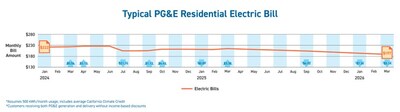
OAKLAND, Calif., March 2, 2026 /PRNewswire/ -- Pacific Gas and Electric Company (PG&E) lowered electric rates on March 1, 2026—the fifth time since January 2024. The decrease marks the third consecutive electric price cut since last September for residential customers who receive both electricity supply and delivery from PG&E.

Combined with previous decreases, residential bundled electric rates are 13% lower than in January 2024, reinforcing the company's commitment to manage energy costs for customers. Since that time, typical residential electric customer bills are about $25 less per month, assuming a consistent monthly usage of 500 kilowatt-hours.

Based on current information, the company expects typical residential electric rates to be lower overall in 2026 than in 2025. This is part of PG&E's ongoing effort to stabilize energy prices for customers.

"We are delivering on our promise to lower prices for our customers again, even as national prices are expected to rise. Our actions match our promises: we've reduced electric rates five times since January 2024 and remain committed to finding new ways to save and pass those savings on to our customers," said PG&E Corporation CEO Patti Poppe.

PG&E's electric prices have stabilized and are going down, even while the U.S. Energy Information Administration expects national electric prices to rise by nearly 10% between 2024 and 2026.

March Electric Rate Decrease

On March 1, 2026, PG&E reduced residential electric rates by 1.8% compared to February rates, for customers who get both electricity supply and delivery service from PG&E. Electric rates decreased about 8.3% for customers who receive the California Alternate Rates for Energy (CARE) income-eligible discount.

Typical residential electric bills are decreasing by about $5.14 per month. For CARE customers, bills are going down approximately $10.37 per month. Typical electric customers use about 500 kilowatt hours of electricity per month.

Electric rates are decreasing because the costs for completed safety and reliability work coming out of rates exceed the costs for new investments authorized by PG&E's regulators.

Restructured Electric Bill Debuts in March

The electric rate decrease also includes the new Base Services Charge. The California Public Utilities Commission directed the state's investor-owned utilities to implement the charge under California Assembly Bill 205.

The Base Services Charge lowers the price of electricity for all residential customers. It is not a new fee and does not increase the revenue that PG&E collects from customers. It makes bills clearer and more transparent, shifts costs away from low-income customers and makes it more affordable to transition to more clean-powered electric appliances in the home.

The new bill separates some costs of service from the price per unit (kilowatt hour) of electricity use, including approved infrastructure and maintenance costs for connecting customers' homes to the grid, energy efficiency and demand response programs, call center services and billing, all of which previously were included in electricity usage costs.

The Base Services Charge for customers enrolled in the California Alternative Rates for Energy (CARE) program is about $6 per month, while those in the Family Electric Rate Assistance (FERA) program and customers who live in Affordable Housing (Deed Restricted) pay approximately $12 monthly. For most customers, the Base Services Charge is about $24 per month.

The change aligns PG&E's billing structure with California's other large, regulated utilities and other utilities nationwide.

Each customer's usage varies so the lower price per unit of electricity used may or may not lead to a lower total bill.

Natural Gas Rate Change

On March 1, 2026, PG&E natural gas rates increased slightly by 0.3%, compared to February rates. The increase is due to the recovery of authorized costs for safety and emergency response work that was completed for customers.

Typical residential natural gas bills are increasing by about $0.24 per month. A typical residential customer uses about 31 therms of energy monthly. For a typical residential CARE customer using about 26 therms of energy monthly, bills will increase by about $0.16 per month.

The energy supply portion of natural gas bills changes monthly based on market prices. PG&E does not mark up energy supply costs.

About PG&E
Pacific Gas and Electric Company, a subsidiary of PG&E Corporation (NYSE: PCG), is a combined natural gas and electric utility serving more than sixteen million people across 70,000 square miles in Northern and Central California. For more information, visit pge.com and pge.com/news.

Cision View original content to download multimedia:https://www.prnewswire.com/news-releases/pge-lowers-electric-prices-in-march-fifth-electric-rate-drop-since-early-2024-302701359.html

SOURCE Pacific Gas and Electric Company

FAQ

How much did PG&E (PCG) cut electric rates on March 1, 2026?

PG&E cut residential electric rates by 1.8% on March 1, 2026. According to the company, CARE customers saw about an 8.3% reduction and typical bills fell roughly $5.14/month.

What does the 13% decline in PCG residential bundled rates mean for customers?

Residential bundled electric rates are 13% lower than in January 2024, which equates to about $25/month savings at 500 kWh usage. According to the company, this reflects cumulative rate cuts through March 2026.

How does the new Base Services Charge affect PG&E PCG customer bills?

The Base Services Charge separates fixed costs from per-kWh pricing and is about $24/month for most customers. According to the company, it is not new revenue and aims to make bills clearer and shift costs away from low-income customers.

Did PG&E (PCG) change natural gas rates in March 2026 and by how much?

PG&E raised natural gas rates by 0.3% on March 1, 2026, increasing a typical residential gas bill by about $0.24/month. According to the company, the change recovers authorized safety and emergency response costs.

Will PG&E (PCG) residential electric rates be lower in 2026 than 2025?

PG&E expects typical residential electric rates to be lower overall in 2026 than in 2025. According to the company, current information supports lower rates as part of efforts to stabilize energy prices for customers.
PG&E Us

NYSE:PCG

PCG Rankings

PCG Latest News

PCG Latest SEC Filings

PCG Stock Data

41.50B
2.66B
Utilities - Regulated Electric
Electric & Other Services Combined
Link
United States
OAKLAND
