
STOCK TITAN

PepsiCo Announces Industry-First AI and Digital Twin Collaboration with Siemens and NVIDIA

Rhea-AI Impact
(Low)
Rhea-AI Sentiment
(Neutral)
Tags
partnership AI

PepsiCo (NASDAQ: PEP) announced a multi-year, industry-first collaboration with Siemens and NVIDIA at CES 2026 to apply physics-based digital twins and AI across plant and supply chain operations.

Early U.S. pilots used Siemens Digital Twin Composer on NVIDIA Omniverse to simulate facilities, delivering a 20% increase in throughput, 10–15% CapEx reduction, near-100% design validation, and identifying up to 90% of potential issues before physical changes. PepsiCo said it will scale the digital-first planning approach globally to optimize facility layouts, capacity and flexibility.

Loading...
Loading translation...

Positive

  • Throughput +20% on initial deployment
  • CapEx -10–15% via virtual validation
  • Identify up to 90% of potential issues before physical changes
  • Near-100% design validation from digital twin testing
  • Multi-year collaboration with Siemens and NVIDIA

Negative

  • None.

News Market Reaction 1 Alert

-0.69% News Effect

On the day this news was published, PEP declined 0.69%, reflecting a mild negative market reaction.

Data tracked by StockTitan Argus on the day of publication.

Key Figures

Issue detection Up to 90% of potential issues Identified in digital twin simulations before physical modifications
Throughput gain 20% increase Throughput improvement on initial digital twin deployment
Capex reduction 10–15% reduction Capital expenditure savings from virtual design and validation
Organic revenue growth +2–4% Target range from preliminary 2026 financial outlook
Core EPS growth +5–7% Target core EPS increase from 2026 outlook
Margin expansion target ≥100 bps Planned core operating margin expansion over three years
Quarterly dividend $1.4225 per share Declared dividend payable January 6, 2026
Annual dividend $5.69 per share Annualized dividend after 2025 increase

Market Reality Check

$139.37 Last Close
Volume Volume 8,873,631 vs 20-day average 8,056,895 (relative volume 1.1x), indicating slightly elevated trading activity. normal
Technical Price at 139.92, trading below the 200-day MA of 141.79 and 12.63% under the 52-week high.

Peers on Argus

PEP was down 1.62% with mixed beverage peers: KO (-1.42%), KDP (-1.16%), MNST (-0.67%), CCEP (-0.38%), while COKE rose 0.28%, suggesting stock-specific factors alongside a mildly soft group.

Historical Context

Date Event Sentiment Move Catalyst
Dec 08 Strategic outlook Positive -0.7% Announced 2026 growth, margin, productivity and capital allocation priorities.
Nov 19 Dividend declaration Positive -0.7% Raised quarterly and annualized dividend with 53rd consecutive annual increase.
Nov 06 Brand partnership Neutral -0.9% Promotional Cheetos Flamin' Hot menu collaboration via Laredo Taco Company.
Nov 03 Sustainability initiative Positive -1.7% Launched regenerative agriculture pilot in Brazil’s Cerrado with partners.
Oct 27 Climate platform update Positive +0.7% Announced CRP 2.0 climate resilience tools expansion and new partners.
Pattern Detected

Recent PEP news, including dividend increases and strategic initiatives, often saw modest negative next-day moves despite generally positive fundamentals.

Recent Company History

Over the last few months, PEP highlighted shareholder-value initiatives and operational changes. On Dec 8, 2025, it outlined 2026 priorities, targeting organic revenue growth of +2–4%, core EPS growth of +5–7%, and at least 100 bps margin expansion, yet shares fell modestly. A $1.4225 quarterly dividend and 53rd annual increase also coincided with a small decline. Sustainability pilots in Brazil’s Cerrado and a Climate Resilience Platform update produced mixed price reactions. Against this backdrop, the CES 2026 AI and digital twin collaboration extends PepsiCo’s push to boost productivity and modernization.

Market Pulse Summary

This announcement details a multi-year collaboration with Siemens and NVIDIA to deploy AI-enabled, physics-accurate digital twins across PepsiCo’s plants and warehouses. Early pilots report a 20% increase in throughput, nearly 100% design validation, and 10–15% Capex reductions. In the context of prior goals for revenue growth and margin expansion, investors may watch how broadly these tools are rolled out, how reliably they deliver savings, and how they interact with ongoing productivity and restructuring programs.

Key Terms

digital twin technical
"transform plant and supply chain operations through advanced digital twin technology and AI"
A digital twin is a live virtual replica of a physical asset, process, or system that mirrors real-world behavior using data and models so users can test changes, predict problems, and measure performance without touching the real thing. For investors, digital twins matter because they can lower maintenance costs, speed product development, improve uptime and reliability, and make future cash flows and risks easier to forecast — like using a flight simulator to safely train and tune a real airplane.
ai agents technical
"leveraging physics-based digital twins and AI agents as co-designers to simulate"
AI agents are computer programs designed to perform tasks or make decisions automatically, often by learning from data and adapting to new information. They act like virtual assistants or robots that can handle complex activities without human intervention, which can help businesses and individuals save time and improve efficiency. For investors, AI agents matter because they can enhance decision-making and automate processes that influence markets and financial outcomes.
computer vision technical
"Leveraging Siemens' Digital Twin Composer, NVIDIA Omniverse and computer vision, PepsiCo can now recreate"
Computer vision is technology that gives machines the ability to 'see' and make sense of images or video, turning pixels into usable information like object counts, measurements, or activity patterns. For investors, it matters because it enables automation, cost reduction and new product features across industries—from quality checks on factory lines to retail analytics—so companies that adopt effective computer vision can boost efficiency, reduce labor needs and create competitive advantages.
industrial metaverse technical
"Siemens' new software solution builds Industrial Metaverse environments at scale"
A connected set of virtual environments and digital copies of physical equipment and facilities that let companies simulate, monitor and control real-world industrial operations using sensors, 3D models and augmented or virtual screens. Think of it as a flight simulator for factories and supply chains that lets managers test changes, train workers and spot problems without stopping production. Investors watch it because it can lower costs, speed rollouts, reduce risk and create new software and services revenue.
capital expenditure (Capex) financial
"driving faster design cycles, nearly 100 percent design validation and 10 to 15 percent reductions in capital expenditure (Capex)"
Capital expenditure (CapEx) is the money a company spends to buy, improve, or maintain long-term physical assets like buildings, machinery, vehicles, or computer systems—think of it as buying or renovating a house rather than paying monthly bills. For investors, CapEx matters because it uses cash today to enable future production or cost savings, affecting growth potential, ongoing cash flow, and the company’s ability to generate profits over time.
physics-based technical
"shifting to a digital-first planning strategy, leveraging physics-based digital twins"
Physics-based describes products, models or simulations built on established physical laws (for example motion, heat or fluid flow) rather than only on patterns in past data. For investors this matters because such approaches tend to be more explainable and testable—like using a blueprint instead of guessing from photos—which can reduce model risk, aid regulatory approval, and signal durable technical advantage, though they often require more development time and expertise.
photorealistic virtual scene technical
"physical real-time information from a managed, secure real-time photorealistic virtual scene accelerated by NVIDIA"
A photorealistic virtual scene is a computer-generated environment rendered to look like a real-world photograph, with lifelike lighting, textures and depth so viewers can’t easily tell it’s artificial. For investors, these scenes matter because they enable realistic product demos, immersive advertising, virtual real estate or training simulations that can drive new revenue streams, reduce physical costs, and change how customers experience a brand—similar to staging a showroom that never needs upkeep.
digital blueprint technical
"We are deploying the first digital blueprint that reimagines how the supply chain is designed"
A digital blueprint is a detailed, computer-based map or plan that shows how a company’s systems, products, processes or compliance steps fit together and will operate. For investors it matters because a clear blueprint reveals whether a business can scale, control costs, integrate new technology or meet regulatory requirements—much like an architect’s drawing that exposes construction problems and budget risks before work begins.

AI-generated analysis. Not financial advice.

Together, PepsiCo, Siemens, and NVIDIA will set a new standard for scalable, technically sound digital twin and AI in industrial operations.
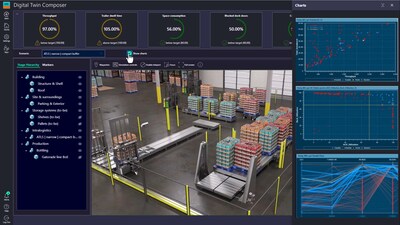
LAS VEGAS and PURCHASE, N.Y., Jan. 6, 2026 /PRNewswire/ -- At CES 2026, PepsiCo (NASDAQ: PEP) announced a multi-year, industry-first collaboration with Siemens and NVIDIA to transform plant and supply chain operations through advanced digital twin technology and AI. This collaboration marks a first-of-its-kind initiative for a global CPG company applying digital twins to reshape how plant and warehousing facilities are digitally simulated and tested, with early pilots already underway in the U.S.

With demand for production and distribution capacity rising, PepsiCo is using AI and new digital approaches to process simulation and facility design to retool and optimize its existing physical footprint. Traditional expansion methods are slow and costly, limiting flexibility and the scalability needed to meet growing consumer needs while driving innovation.

"The scale and complexity of PepsiCo's business, from farm to shelf, is massive—and we are embedding AI throughout our operations to better meet the increasing demands of our consumers and customers," said Ramon Laguarta, Chairman and CEO of PepsiCo. "Our work with Siemens and NVIDIA will help accelerate our continued journey of becoming a future-fit company, operating with agility and foresight."

PepsiCo is shifting to a digital-first planning strategy, leveraging physics-based digital twins and AI agents as co-designers to simulate, validate, and optimize facility layouts before any physical build. As part of these efforts, PepsiCo is using Siemens Digital Twin Composer, built on NVIDIA Omniverse libraries, to simulate upgrades to its facilities in the U.S. with plans to scale globally.

"Physical industries are entering the age of AI. For companies with real-world assets, digital twins are the foundation of their AI journey," said Jensen Huang, founder and CEO of NVIDIA. "Working with NVIDIA and Siemens, PepsiCo is re-architecting its operations—using physically accurate digital twins and AI to reinvent how it designs, optimizes, and runs its global operations."

"We are proud to partner with PepsiCo and NVIDIA to digitally transform their manufacturing facilities using physics-based digital twins and AI from design to engineering to operations. The Digital Twin Composer is a cornerstone in enabling PepsiCo to transform manufacturing and warehousing," said Roland Busch, CEO of Siemens AG. "Siemens is powering the industrial AI revolution – with an unmatched industrial AI technology stack, deep domain knowhow, and world-class partners. This collaboration sets a new standard for all industries. Customers can turn ideas into real-world impact with greater speed, quality, and efficiency."

Siemens' new software solution builds Industrial Metaverse environments at scale, empowering organizations to apply industrial AI, simulation and real-time physical data to make decisions virtually, at speed and at scale.

This new product enables industrial companies to combine 2D and 3D digital twin data from Siemens' comprehensive digital twin and physical real-time information from a managed, secure real-time photorealistic virtual scene accelerated by NVIDIA Omniverse libraries. With Digital Twin Composer, companies can rapidly build and maintain this global environment, containing all aspects of their product or production data (both virtual and physical) in a secure, managed, high-fidelity 3D experience throughout the lifecycle of the product, process or facility.

PepsiCo and Siemens are digitally transforming select U.S. manufacturing and warehouse facilities by converting them into high-fidelity 3D digital twins that simulate plant operations and the end-to-end supply chain to establish a performance baseline. Within weeks, teams optimized and validated new configurations to boost capacity and throughput, giving PepsiCo a unified, real-time view of operations with flexibility to integrate AI-driven capabilities over time.

Leveraging Siemens' Digital Twin Composer, NVIDIA Omniverse and computer vision, PepsiCo can now recreate every machine, conveyor, pallet route and operator path with physics-level accuracy, enabling AI agents to simulate, test, and refine system changes - identifying up to 90 percent of potential issues before any physical modifications occur. This approach has already delivered a 20 percent increase in throughput on initial deployment and is driving faster design cycles, nearly 100 percent design validation and 10 to 15 percent reductions in capital expenditure (Capex) by uncovering hidden capacity and validating investments in a virtual environment.

"We are deploying the first digital blueprint that reimagines how the supply chain is designed, built, and scaled, a first for the industry," says Athina Kanioura, CEO, Latin America, and Global Chief Strategy & Transformation Officer of PepsiCo. "With a unified, AI-powered digital foundation, PepsiCo is building toward a world where every plant and warehouse operates as part of a single, intelligent ecosystem. In this future, our facilities don't just respond to demand, they anticipate and then adapt to it."

Announcement at CES 2026

This partnership was formally announced during the opening keynote at CES 2026, highlighting PepsiCo's commitment to digital transformation and supply chain innovation. The collaboration brings together Siemens' Industrial AI expertise and comprehensive digital twin technology with NVIDIA's AI and visualization expertise to set a new standard for the industry.

About PepsiCo

PepsiCo products are enjoyed by consumers more than one billion times a day in more than 200 countries and territories around the world. PepsiCo generated nearly $92 billion in net revenue in 2024, driven by a complementary drinks and convenient foods portfolio that includes Lay's, Doritos, Cheetos, Gatorade, Pepsi-Cola, Mountain Dew, Quaker and SodaStream. PepsiCo's product portfolio includes a wide range of enjoyable foods and drinks, including many iconic brands that generate more than $1 billion each in estimated annual retail sales.

Guiding PepsiCo is our vision to Be the Global Leader in Drinks and Convenient Foods by Winning with pep+ (PepsiCo Positive). pep+ is our strategic end-to-end transformation that places sustainability at the center of our business strategy, seeking to drive growth and build a stronger, more resilient future for PepsiCo and the communities where we operate. For more information, visit www.pepsico.com, and follow on X (Twitter), Instagram, Facebook, and LinkedIn @PepsiCo.

Contact: pepsicomediarelations@pepsico.com

Cision View original content to download multimedia:https://www.prnewswire.com/news-releases/pepsico-announces-industry-first-ai-and-digital-twin-collaboration-with-siemens-and-nvidia-302653851.html

SOURCE PepsiCo, Inc.

FAQ

What did PepsiCo announce at CES 2026 about PEP operations?

PepsiCo announced a multi-year collaboration with Siemens and NVIDIA to deploy physics-based digital twins and AI to optimize plants and warehouses.

How much did PepsiCo's initial digital twin deployment improve throughput for PEP?

Initial U.S. pilots reported a 20% increase in throughput following simulation-driven changes.

What CapEx impact did PepsiCo report from the digital twin tests for PEP?

PepsiCo reported 10–15% reductions in CapEx by uncovering hidden capacity and validating investments virtually.

Which technologies are PepsiCo using in the collaboration for PEP?

PepsiCo is using Siemens Digital Twin Composer built on NVIDIA Omniverse, along with computer vision and AI agents.

When and where were PepsiCo's digital twin plans for PEP announced?

The collaboration was announced during the opening keynote at CES 2026 on January 6, 2026.
Pepsico Inc

NASDAQ:PEP

PEP Rankings

PEP Latest News

PEP Latest SEC Filings

PEP Stock Data

187.34B
1.36B
0.19%
79.01%
1.64%
Beverages - Non-Alcoholic
Beverages
Link
United States
PURCHASE
