
Planet Ships Three Additional Pelicans to Launch Site
Planet (NYSE: PL) shipped three Gen 1 Pelican satellites to Vandenberg Space Force Base on April 6, 2026, ahead of a CAS500/2 rideshare launch with SpaceX.




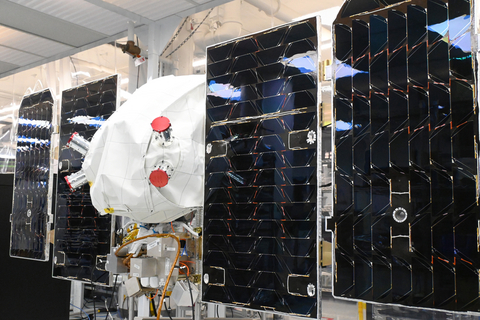
One of Planet's latest Pelican satellites, photographed at its headquarters in
“Kicking off our first Pelican launch of 2026 demonstrates the pace at which we’re scaling our most advanced constellation to date, with higher resolution, faster repeat rates, and lower latency,” said Will Marshall, Co-Founder and CEO of Planet. “By integrating the NVIDIA Jetson platform directly onboard, we are effectively adding a high-functioning AI ‘brain’ to our satellite ‘eyes’ – working to enable answers in minutes rather than hours. This is a move beyond mere imagery towards what we call Planetary Intelligence. By running AI at the edge, we’re striving to provide customers with near real-time answers about the planet, and move insights from the digital to the physical world.”
“The shipment and integration of these spacecraft reflects the incredible momentum of our production line,” said Brian Lewis, Mission Director for Pelican at Planet. “Our rapid manufacturing and design approach allows us to iterate and deploy at scale, providing the high-resolution intelligence customers need to make critical and time-sensitive decisions. This milestone reinforces our commitment to meeting the urgent operational demands of our partners at the pace of global change.”
These first generation (Gen 1) Pelicans are designed to capture 50 cm class resolution imagery across six multispectral bands, which are optimized for seamless cross-sensor analysis. After completing commissioning, they will join the existing Gen 1 Pelicans in supporting the ongoing delivery of Planet’s 50 cm class products. Each spacecraft on this launch features NVIDIA’s Jetson AI platform onboard to provide edge computing functions. By processing data on-orbit, Planet is working to reduce latency to deliver near-real-time situational awareness and rapid answers directly to customers. To meet the growing demand for high-resolution monitoring solutions, Planet plans to launch additional first- and second-generation Pelican satellites over the next year and beyond.
Looking ahead, Planet plans to begin launching its second generation (Gen 2) Pelican satellites later in 2026, which will be designed to achieve up to 30 cm-class resolution. With these advancements, Planet continues to push the boundaries of intra-day revisit rates and low latency tasking.
About Planet Labs PBC
Planet is a leading provider of global, daily satellite imagery and geospatial solutions. Planet is driven by a mission to image the world every day, and make change visible, accessible and actionable. Founded in 2010 by three NASA scientists, Planet designs, builds, and operates the largest Earth observation fleet of imaging satellites. Planet provides mission-critical data, advanced insights, and software solutions to customers comprising the world’s leading agriculture, forestry, intelligence, education and finance companies and government agencies, enabling users to simply and effectively derive unique value from satellite imagery. Planet is a public benefit corporation listed on the New York Stock Exchange as PL. To learn more visit www.planet.com and follow us on X, LinkedIn, or tune in to HBO’s ‘Wild Wild Space’.
Forward-looking Statements
Certain statements contained in this press release are “forward-looking statements” about Planet within the meaning of the securities laws, including statements about the expansion of the high resolution capacity of Planet’s fleet, the delivery of such capacity to Planet customers, and the Company’s ability to realize any of the potential benefits from product and satellite launches, either as designed, within the expected time frame, in a cost-effective manner, or at all. Such statements, which are not of historical fact, involve estimates, assumptions, judgments and uncertainties. There are a number of factors that could cause actual results or outcomes to differ materially from those addressed in the forward-looking statements, including risks related to the macroeconomic environment. Such factors are detailed in Planet’s filings with the Securities and Exchange Commission, including our most recent Annual Report on Form 10-K and Quarterly Reports on Form 10-Q. Planet does not undertake an obligation to update its forward-looking statements to reflect future events, except as required by applicable law.
View source version on businesswire.com: https://www.businesswire.com/news/home/20260406451373/en/
Planet Press
Emily Lewis Benz
press@planet.com
Planet Investor Relations
Cleo Palmer-Poroner
ir@planet.com
Source: Planet